
Move cash your business does not need this month out of checking and into US Treasury Bills, a money market fund, and an ultra-short income fund. Open with $50,000. The net yield updates daily and is shown by balance tier below.
Rho is a fintech company, not a bank or an FDIC-insured depository institution. Checking account and card services provided by Webster Bank, a division of Santander Bank, N.A. Member FDIC, and by Lead Bank, Member FDIC.
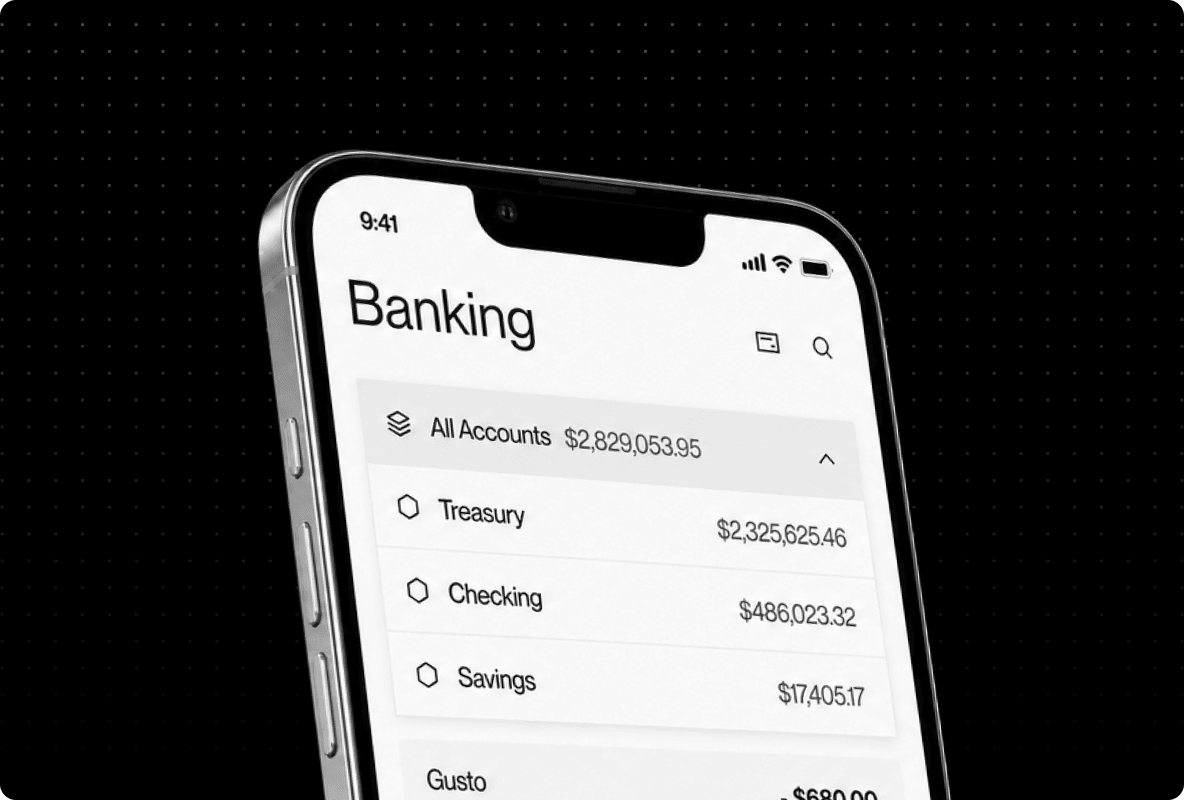
What you get with Rho Treasury
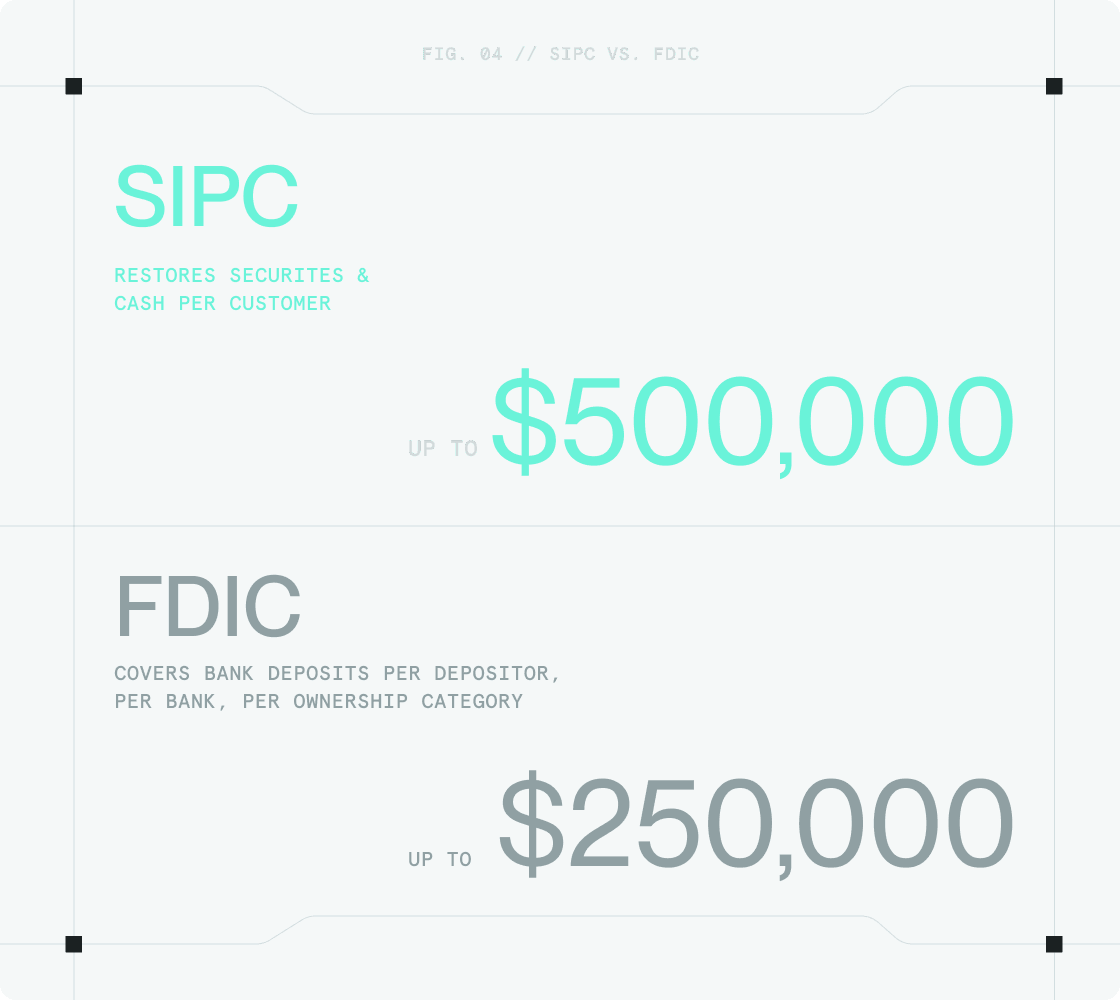
¹ Rho Treasury is a securities investment product, not a bank deposit, and is not FDIC-insured. Securities are protected by SIPC up to $500,000 per customer, including up to $250,000 for cash claims. SIPC protects against the failure of the broker dealer, not against market losses. Custodial services provided through Apex Clearing Corp. and Interactive Brokers LLC, registered broker dealers and members FINRA/SIPC.
- 01
Move cash from checking
Transfer excess operating cash into Treasury, or set a standing rule that moves it automatically.
- 02
Choose your allocation
Split across US Treasury Bills, a money market fund, and an ultra-short income fund. Adjust the mix any time.
- 03
Earn a variable net yield
Your blended yield updates daily and scales with balance size. See net yield by option and balance tier below.
- 04
Pull it back when you need it
Request a withdrawal at any time, or set a standing rule so checking tops itself up.
What Rho Treasury costs
- Access to US Treasury Bills, a money market fund, and an ultra-short income fund
- A live, tiered net yield that updates daily
- Standing transfer rules between checking and Treasury
- Allocations in 5% increments, rebalance any time
- QuickBooks, NetSuite, and Sage integrations for reconciliation
The fee is based on assets under management, billed monthly, and falls as the balance grows: 0.60% under $2M, 0.45% from $2M to $5M, 0.35% from $5M to $10M, 0.25% from $10M to $20M, 0.15% at $20M or more. The net yield shown on this page is already calculated after this fee.
What your cash actually earns
Yield headlines hide two things: fees and minimums. Find your balance below to see Rho’s fee at that tier and the net yield each option pays after it. See all Treasury rates, source dates, and definitions.
$20M+
0.15%
$10–20M
0.25%
$5–10M
0.35%
$2–5M
0.45%
$50K–$2M
0.60%
$20M+
0.15%
3.67%
3.87%
4.02% (3.97%)
$10–20M
0.25%
3.57%
3.77%
3.92% (3.87%)
$5–10M
0.35%
3.47%
3.67%
3.82% (3.77%)
$2–5M
0.45%
3.37%
3.57%
3.72% (3.67%)
$50K–$2M
0.60%
3.22%
3.42%
3.57% (3.52%)
13-week Treasury market yield as of 10/21/2026; Rho 7-day average YTM as of 10/17/2026; IJTXX yield as of 10/21/2026; MULSX yield as of 10/21/2026. Yields change daily. IJTXX uses a 7-day SEC yield; MULSX uses a 7-day current yield (subsidized). Net figures are net of Rho’s annual fee at the stated balance tier (0.60% for total deposits under $2M; 0.45% $2–5M; 0.35% $5–10M; 0.25% $10–20M; 0.15% at $20M+). Yields are variable and not guaranteed; past performance is not a guarantee of future results. Rho Treasury requires a $50,000 minimum investment. Net figures subtract Rho’s fee at each tier from the fund’s published yield (7-day SEC for IJTXX and 7-day current yield for MULSX) or from each of the two T-bill yields described below. Liquidity: T-Bill sales and mutual fund redemptions settle in 2 business days when submitted before the daily cutoff (5:00 PM ET for T-Bills, 4:00 PM ET for mutual funds), and 3 business days after. Proceeds from Treasury sell orders reach your checking within 2 business days. The first T-bill figure uses the latest daily 13-week coupon-equivalent (investment) yield published by the U.S. Department of the Treasury. The parenthetical figure uses the simple, unweighted mean of yield to maturity across all BUY T-bill trade orders that settled in the trailing seven-day window, supplied by Rho Treasury. Both sources are retrieved daily and both yields are annualized. The 13 weeks describe the market benchmark bill’s maturity; the seven days describe the Rho average’s trade sampling window. The market benchmark may differ from yields available on actual purchases. An em dash indicates an unavailable source. Displayed net yields subtract the applicable Rho annual fee. Rho Treasury invests in securities: SIPC-protected, not FDIC-insured, and subject to investment risk, including possible loss of principal. RBB Treasury LLC dba Rho Treasury is an SEC-registered investment adviser and subsidiary of Rho; registration with the SEC does not imply a certain level of skill or training.
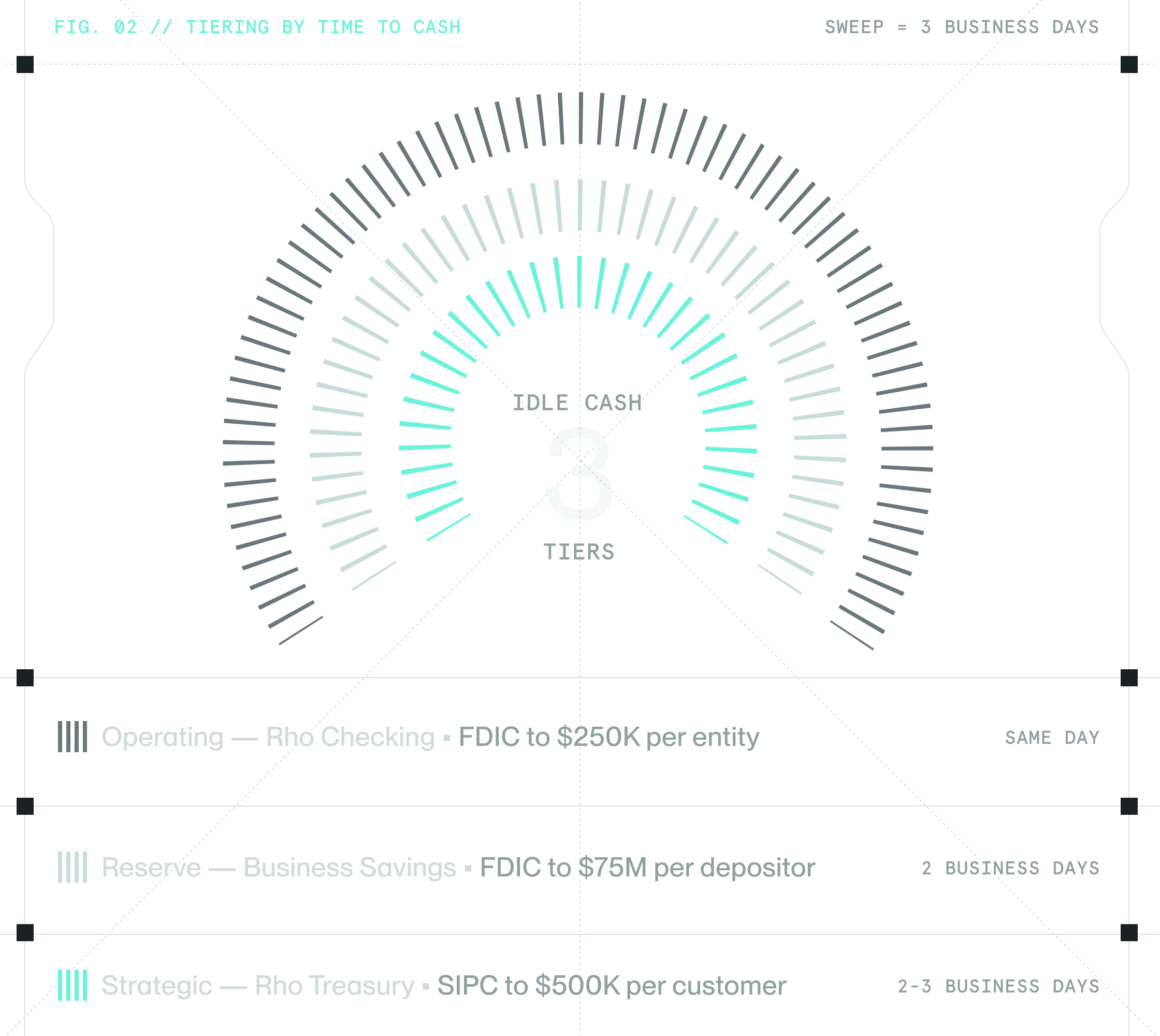
Access when you need it
Request a withdrawal any time; standing rules can move cash back to checking on a schedule.
Protected, not parked
Held with a qualified securities custodian, covered by SIPC up to $500,000 per customer, including $250,000 in cash.
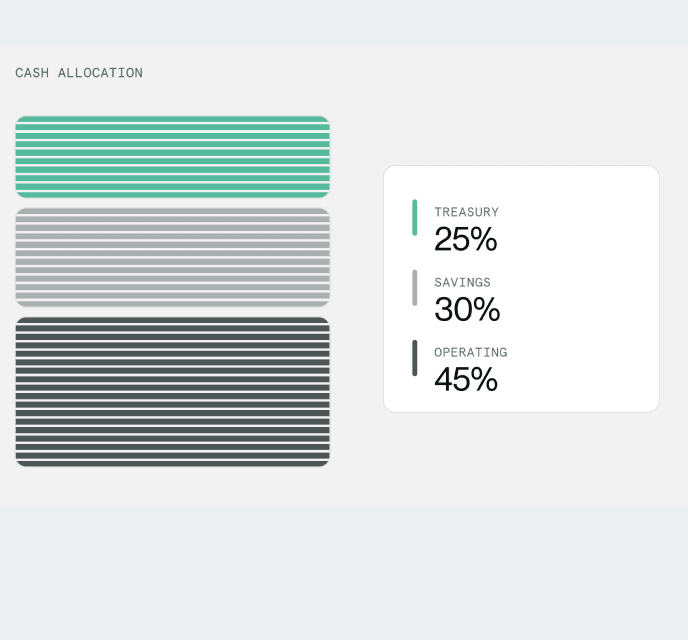
Bookkeeping on autopilot
Rho Treasury syncs with QuickBooks Online, NetSuite, Sage Intacct, Campfire, and Puzzle, and automatically reinvests your earnings.
Most companies split cash into two buckets. Operating cash covers payroll, rent, and vendors, and sits in checking earning nothing. Everything past that, sometimes called excess or idle cash, can go to work instead.
Here's where Rho Treasury comes in. It invests that second bucket in US Treasury Bills, a money market fund, and an ultra-short income fund, blended into one live rate that updates daily.
Set a standing rule and cash moves back to checking on a schedule (weekly is the fastest cadence Rho supports for that direction), so operating cash never runs dry while the rest keeps earning.
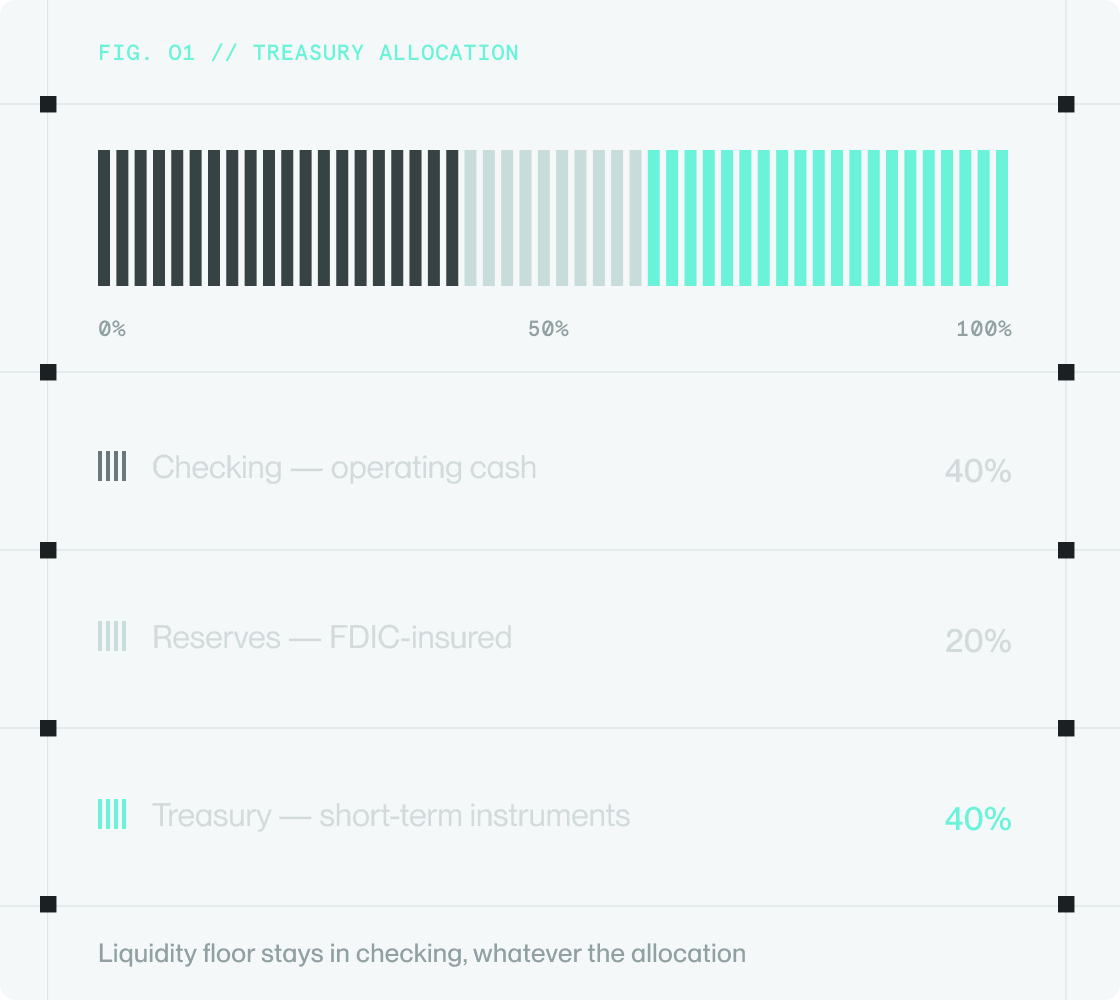
- Keep operating cash accessible for payroll and vendors
- Keep reserves protected in FDIC-insured accounts
- Put idle cash into short-term instruments that earn yield
- Formalize a treasury policy: instruments, limits, approvals, and liquidity floor
A lot of people search for a business money market account and land on personal-finance content built for individuals, not companies. The mechanism is similar (short-term, low-risk securities aiming for a better return than a savings account), but the account structure isn't.
Rho Treasury is built for business entities instead: statements built for your books, integrations that reconcile automatically, and allocations that scale from $50,000 into the tens of millions.
One more distinction worth knowing: it's not a bank account. Treasury investments are held through SIPC-member broker-dealers (Apex Clearing Corp. for accounts opened after July 2024, Interactive Brokers LLC before that), protected by SIPC up to $500,000 per customer, including up to $250,000 in cash, rather than FDIC-insured like a checking or savings deposit.
The trade-offs run both ways. A bank money market account is a deposit, so the balance doesn't fluctuate and you can usually access it the same day. Rho Treasury holds securities: the yield is variable and not guaranteed, and the principal can lose value. Investment income is also taxed differently from deposit interest, so check with your accountant on how each would land for your entity.
- A business money market account uses a similar mechanism to Rho Treasury, but not the same account structure
- Rho Treasury is built for business entities: statements, integrations, and allocations that scale from $50,000
- Treasury investments are SIPC-protected, not FDIC-insured, unlike a checking or savings deposit
- Trade-offs: a money market deposit doesn't fluctuate and is usually same-day; Rho Treasury yields vary and principal can lose value
Enterprise treasury management systems are built for companies running a dedicated treasury function across many bank accounts, entities, and currencies, with cash forecasting and compliance workflows layered on top. That's a real category, and it's not what most growing companies need.
Rho Treasury solves the narrower problem almost every company actually has: what happens to cash sitting idle in checking. No separate software to license, no treasury hire required, just an account you fund and a rate that updates on its own.
For teams evaluating enterprise treasury platforms, our guide to treasury management software breaks down that category in more depth.
- Enterprise TMS: built for a dedicated treasury function across many bank accounts, entities, and currencies
- Rho Treasury: solves the narrower problem of idle cash sitting in checking, no separate software or hire required
- See our guide to treasury management software for the enterprise category
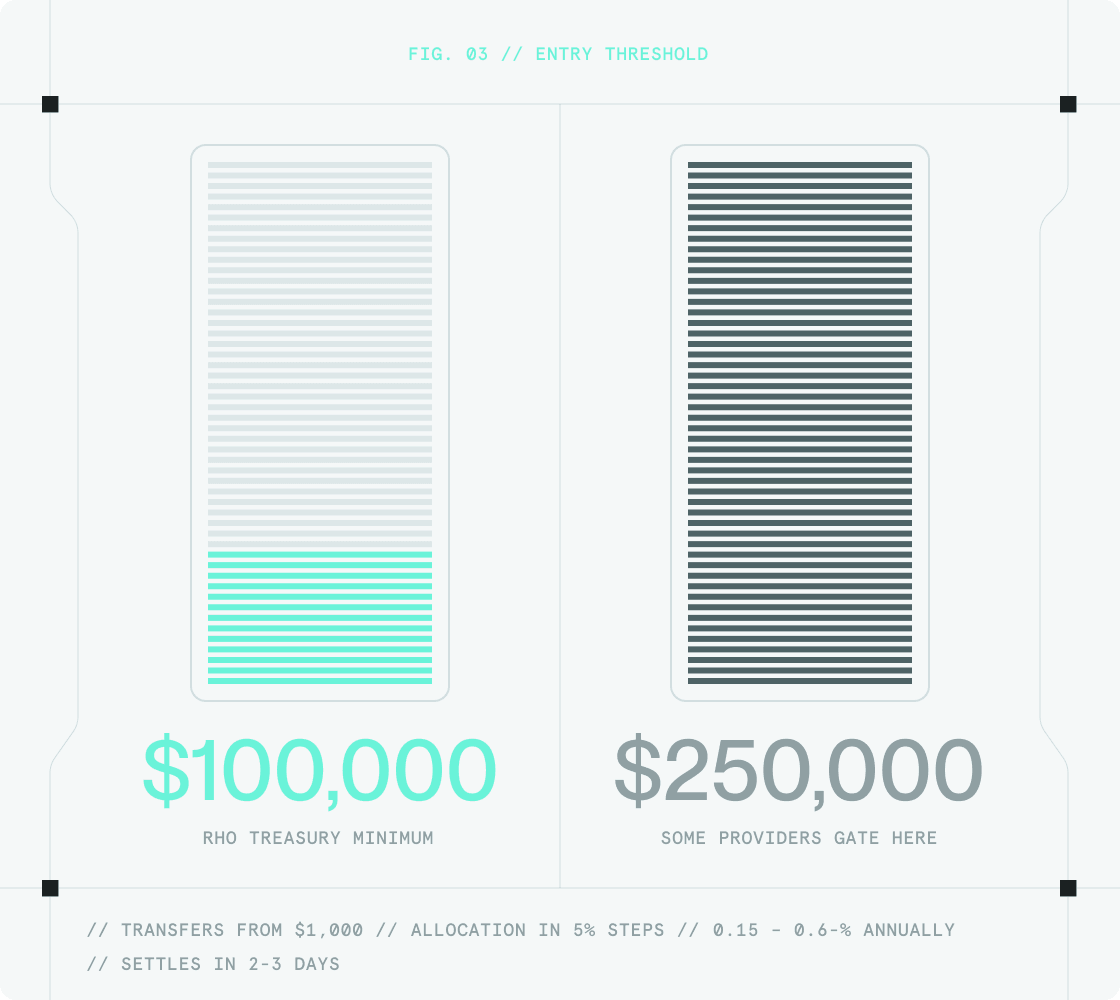
Rho Treasury starts to make sense once a company is holding more cash than the next few months of spend require, which for a lot of teams shows up right after a funding round or once revenue starts consistently outpacing burn.
Below the $50,000 minimum, the account doesn't apply yet, and that's fine. Above it, the fee schedule and the tiered yield both work in your favor as the balance grows.
If you're earlier than that, a corporate treasury function usually isn't the priority yet; checking and a savings account cover it.
- Rho Treasury starts to make sense once idle cash exceeds a few months of spend
- Below the $50,000 minimum, checking and a savings account cover it
- Above the minimum, the fee schedule and tiered yield both work in your favor as balance grows
| Rho | |
|---|---|
| Best for (stage) | Companies with idle cash from $50,000, from shortly after a raise through scale |
| Minimum to access yield | $50,000 |
| Published yield / return | Updates daily, scales with balance, see current rate above |
| Annual fee on invested balances | 0.15% to 0.60%, billed monthly |
| Investor protection | SIPC up to $500,000 per customer, including up to $250,000 cash¹ |
| Liquidity | Same day to 3 business days, by option |
| Rho | Mercury | Brex | Ramp | |
|---|---|---|---|---|
| Best for (stage) | Companies with idle cash from $50,000, from shortly after a raise through scale | Companies already holding $250,000 or more across Mercury accounts | Any balance; Brex sets no minimum | Companies starting around a $5,000 position |
| Minimum to access yield | $50,000 | $250,000 across all Mercury accounts | No minimum deposit | $5,000 initial investment |
| Published yield / return | Updates daily, scales with balance, see current rate above | Tiered by balance and fund | 3.57%–3.92% annualized compounded total Treasury return, by balance tier. Checked 10/19/2026. | Not published |
| Annual fee on invested balances | 0.15% to 0.60%, billed monthly | 0.15% to 0.60% of total monthly Treasury positions | None | Up to 0.15% advisory fee |
| Investor protection | SIPC up to $500,000 per customer, including up to $250,000 cash¹ | SIPC up to $500,000, with cash protection up to $250,000 | SIPC-protected; coverage cap not published | SIPC up to $500,000, including up to $250,000 cash |
| Liquidity | Same day to 3 business days, by option | Money market same day if initiated by 3pm ET; ultra-short 1 to 2 business days, up to 4 | Same-hour to daily | Same-day to about 2 business days, fund dependent |
Brex return checked 10/19/2026 at brex.com/product/cash-management-account/rates-fees; no separate rate-effective date stated. This estimate combines DGVXX income and Brex additional return, assumes unchanged rates and reinvestment for one year, and is not DGVXX’s 7-day yield. Other competitive facts retain their prior source dates: Mercury 10/05/2026; Brex and Ramp 09/06/2026. Rates and terms may change. ¹ Treasury investments are not FDIC-insured. They are held through SIPC-member broker-dealers and protected by SIPC up to $500,000 per customer, including up to $250,000 of cash. Investments are not deposits, are not bank-guaranteed, and may lose value.
See the rate you’d earn today, then move funds back to checking whenever you need them. Rho Treasury opens at $50,000.
Frequently asked questions
A business treasury account moves cash a company doesn't need for near-term operating expenses into interest-bearing instruments like Treasury Bills and money market funds, instead of leaving it idle in checking. With Rho Treasury, that cash is invested through RBB Treasury LLC, an SEC-registered investment adviser, starting at a $50,000 minimum.
No. Rho Treasury invests in securities, so it is not FDIC-insured. Investments are held through SIPC-member broker-dealers and protected by SIPC up to $500,000 per customer, including up to $250,000 in cash. SIPC protects against the failure of the broker-dealer, not against market losses. Rho Checking and the separate Rho Business Savings Account are FDIC-insured bank deposits and are different products.
Rho Treasury opens with a $50,000 minimum. From there, allocations split across US Treasury Bills, a money market fund, and an ultra-short income fund in 5% increments.
It depends on which option you sell. The JPMorgan money market fund (IJTXX) settles the same day when you sell before the daily cutoff. Treasury Bills and the other funds settle in two business days when submitted before the cutoff (5:00 PM ET for T-Bills, 4:00 PM ET for mutual funds) and three business days after it. You can also set a standing rule that moves cash back to Rho Checking on a schedule, so operating cash tops itself up without a manual withdrawal.
You choose the split yourself, in 5% increments. A common approach is to keep cash you may need on short notice in the money market fund, put cash you will not need for at least three months in US Treasury Bills (13-week instruments), and use the ultra-short income fund for the longest-horizon slice, since its share price can fluctuate. The allocation shown on this page is illustrative, not a recommendation, and you can rebalance any time.
Rho Treasury holds your investment through SIPC-member broker-dealers, protected by SIPC up to $500,000 per customer, including up to $250,000 in cash, which is a different protection than FDIC insurance on a bank deposit. Rho states plainly which one applies to each product: Treasury is SIPC-protected, Rho Checking is FDIC-insured through Webster Bank, a division of Santander Bank, N.A., and the separate Rho Business Savings Account carries its own FDIC coverage through a network of partner banks. FDIC deposit insurance coverage is available only to protect you against the failure of an FDIC-insured bank that holds your deposits and subject to FDIC limitations and requirements. It does not protect you against the failure of Rho or other third party.
Treasury management is how a company decides what happens to cash beyond its immediate operating needs: how much stays liquid, where the rest earns a return, and how quickly it can come back if plans change. For most growing companies that means splitting cash between checking for day-to-day spend and a treasury account like Rho Treasury for the excess.
Open a Rho Treasury account with a $50,000 minimum, choose an allocation across US Treasury Bills, a money market fund, and an ultra-short income fund in 5% increments, and set a standing transfer rule to move excess cash over from checking. Funds move back to checking whenever you need them; timing depends on the option you sell, typically 2 to 3 business days.
A personal cash management account, the kind built for individuals at brokerages like Fidelity or Schwab, isn't built for a business. Rho Treasury is: statements built for your books, integrations that reconcile automatically, and allocations that scale from a $50,000 minimum into the tens of millions. The underlying mechanism (short-term, low-risk securities aiming for a better return than cash sitting idle) is similar; the account structure, tax reporting, and minimums are not.
A business money market account invests company cash in a fund holding short-term, low-risk securities, aiming for a better return than a standard savings account while staying relatively liquid. Rho Treasury offers this as one allocation option alongside US Treasury Bills and an ultra-short income fund, with a rate that updates daily and scales with how much you hold, shown at sign-up.
Yes, and at Rho the two products aren't interchangeable. A separate Rho Business Savings Account holds cash for safety and easy access, with up to $75,000,000 in FDIC deposit insurance per entity through a network of partner banks. Rho Treasury is a different product, built for cash you're comfortable leaving invested a little longer, held through SIPC-protected accounts rather than FDIC-insured deposits. FDIC deposit insurance coverage is available only to protect you against the failure of an FDIC-insured bank that holds your deposits and subject to FDIC limitations and requirements. It does not protect you against the failure of Rho or other third party.
Yes. Money market funds are available to businesses as well as individuals, though the account structure, minimums, and tax reporting differ from a personal account. Rho Treasury is built specifically for business entities, with statements and integrations that reconcile into company books.
It depends on how much cash you're moving and how fast you need it back. Compare the minimum to open, the fee on invested balances, and how quickly funds settle when you withdraw. See how Rho, Mercury, Brex, and Ramp stack up on those three points, and on stage fit, in the comparison table above.
Enterprise treasury management systems typically handle cash forecasting, multi-entity reporting, and compliance for companies running a dedicated treasury team across many bank accounts and currencies. Rho Treasury solves a narrower, more common problem: what a growing company does with excess operating cash, without hiring a treasury team or standing up separate software.
Rho Treasury offers three options: US Treasury Bills, a money market fund, and an ultra-short income fund. You choose the split in 5% increments. The funds' share prices can fluctuate, so their value can rise or fall. Custody runs through Apex Clearing Corp., or Interactive Brokers LLC for accounts opened before July 2024, both SIPC-member broker-dealers.
Investment management and advisory services provided by RBB Treasury LLC dba Rho Treasury, an SEC-registered investment adviser and subsidiary of Rho. RBB Treasury LLC facilitates investments in securities: investments are not deposits and are not FDIC-insured. Investments are not bank guaranteed, and may lose value. Investment products involve risk, including the possible loss of the principal invested, and past performance does not guarantee future results. Registration with the SEC does not imply a certain level of skill or training. Treasury and custodial services provided through Apex Clearing Corp. ("Apex") and Interactive Brokers LLC ("Interactive"), registered broker dealers and members FINRA/SIPC. For additional information about investment management and advisory services provided by Rho Treasury, please refer to Rho Treasury’s ADV-2A Wrap Fee Brochure. This material presented is for informational purposes only and should not be construed as legal, tax, accounting or investment advice. Under no circumstances should any of this material be used for or considered as an offer to sell or a solicitation of any offer to buy an interest in any securities. Any analysis or discussion of financial planning matters, investments, sectors or the market generally are based on current information, including from public sources, that we consider reliable, but we do not represent that any research or the information provided is accurate or complete, and it should not be relied on as such. Our views and opinions are current at the time of publication and are subject to change. You should consult with your attorney or relevant professional advisor for advice particular to your personal or business situation. Rho Treasury is not insured by the FDIC. Rho Treasury are not deposits or other obligations of Webster Bank, a division of Santander Bank, N.A., Lead Bank, or American Deposit Management Co.’s partner banks, and are not guaranteed by Webster Bank, a division of Santander Bank, N.A., Lead Bank, or American Deposit Management Co.’s partner banks. Rho Treasury products are subject to investment risks, including possible loss of the principal invested. *This reflects the T-bill average yield to maturity supplied by Rho Treasury as of 10/17/2026, less an annual fee which ranges from 0.15% for deposits of $20M or more to 0.6% (the maximum annual fee) for deposits under $2M. Individual results may vary depending on the actual investment date and investment products selected. Past performance is not a guarantee of future performance results. The yield is variable and fluctuates without prior notice. The rate shown is net of fees. The amount of Treasury Bills available at a particular yield will depend upon the sellers’ offer size; any remaining cash balance after the purchase may not earn the same yield. Rho is a fintech company, not a bank or an FDIC-insured depository institution. Checking account and card services provided by Webster Bank, a division of Santander Bank, N.A. Member FDIC, and by Lead Bank, Member FDIC. Savings account services and up to $75M in FDIC deposit insurance per depositor provided by American Deposit Management Co. and its partner banks, subject to FDIC requirements. FDIC insurance coverage is only available to protect you against the failure of an FDIC-insured bank that holds your deposit; it does not protect you against the failure of Rho. Brex return checked 10/19/2026 at brex.com/product/cash-management-account/rates-fees; no separate rate-effective date stated. This estimate combines DGVXX income and Brex additional return, assumes unchanged rates and reinvestment for one year, and is not DGVXX’s 7-day yield. Other competitive facts retain their prior source dates: Mercury 10/05/2026; Brex and Ramp 09/06/2026. Rates and terms may change.