

Key takeaways:
Liquidation preference is the order in which investors and creditors get paid back in case of a liquidation, acquisition, or initial public offering (IPO).
The three types of liquidation preferences are standard, tiered, and pari passu structure, which pays out pro rata to all investors.
The term sheet of an investment agreement should clearly state the investor's liquidation preference position.
What is liquidation preference?
Liquidation preference is the order in which investors and creditors get paid back in case of a liquidation, acquisition, or initial public offering (IPO). A term sheet with a defined order of payout preferences is a requirement for any funding round.
Early-stage investors must weigh risk against reward. The business could underperform or fail, or it could exceed expectations. Receiving preferred or common shares does not fully mitigate the risk of losing their initial investment. If the company goes down, those shares could be worthless. Liquidation preferences can ensure they get at least something back.
How does liquidation preference work?
Liquidation preference provides downside protection to investors and creditors who need to get paid if the company is liquidated or sold. Creditors with liens, like mortgage holders, get the first bite. Major investors and venture capital firms with preferred stock are next in line. Employees and other common stockholders are usually last on the payout list.
Standard liquidation preferences also factor in seniority. If your firm does more than one fundraising round, the Series B investors get paid back before the Series A investors. Seed round investors get paid next. Other types of liquidation preferences may be tiered or use a pari passu structure that pays out pro rata to all investors, regardless of the fundraising round.
Standard terms
Standard liquidation terms dictate that preferred shareholders are paid based on their place in the liquidation stack. That payout is determined by multiplying the original issue price (OIP) by the number of shares the investor holds. If the payout is higher, investors may be able to convert their preferred shares to common shares using a conversion ratio.
The term sheet of an investment agreement should clearly state the investor's liquidation preference position. Venture capital firms insist on getting paid back first because they're normally the largest stakeholders. Employees receiving equity compensation are last in line. They'll get paid after the company has met their other financial obligations.
Non-standard terms
Small business owners aren't limited to one model for liquidation preferences. Preferred stock can be issued with a liquidation multiplier that guarantees the investor more than they'd get in a standard agreement. For instance, one million shares of preferred stock at $1 per share with a 2X multiplier would pay out $2 million in the event of a sale, provided the profit is there.
Another non-standard term to look for is cumulative dividends. Startups don't typically pay dividends regularly but can accumulate them, leading to a future payout. These can be added to an investor's liquidation preference. The issuer benefits because it increases the multiple on invested capital (MOIC) the shareholder uses to weigh future investments.
How does liquidation preference apply to venture capital?
A seed-stage venture capital investment can range from $1 to $3 million, Series A rounds are $3 to $10 million, and Series B round investments could be as high as $25 million.
Venture funding has become increasingly difficult to come by in recent years. VC firms generally seek a 20% annual return on their original investment (IRR). They're reluctant to get involved with startups unless a sale of the company is imminent. Later-stage companies may need to relinquish a bigger ownership stake in the shareholder's agreement to acquire private equity.
How does liquidation preference apply to startup companies?
Liquidation preference may seem obvious for startup companies, but entrepreneurs must evaluate several variables before accepting any investment amount. The first concern is dilution. Every share issued dilutes the ownership percentage of other investors. Common shareholders also have voting rights that may restrict executive control.
Another concern is targeting a specific liquidation event, aka an exit goal. That could come when the post-money valuation reaches a certain level. To do that, the cap table should favor the founders, and seniority levels should be clearly defined. You'll also need to ensure the bills will be paid, including payroll, and the remaining proceeds fully compensate your shareholders.
Liquidation preference and rights to know
Private companies don't have the luxury of selling common stock on an exchange to raise funds. That might come later. Raising money before then requires strategies to minimize downside risk and a liquidation preference seniority structure investors can live with. Here are some terms and rights you should understand when putting that together.
Original issue price
The original issue price is the stated value of preferred shares when issued to the investor, not the perceived value based on the company's valuation calculated by your finance team. This value is what the investor is paid at a liquidation event like an acquisition or sale.
Liquidation preference
The order in which creditors and inventors get paid during a liquidation event is called liquidation preference. Secured creditors, like mortgage and lien holders, typically get paid first, followed by preferred shareholders and then common shareholders.
Liquidation multiplier
A liquidation preference multiple guarantees the investor a multiplied value of the OIP in the event of liquidation. A 1x liquidation preference means the price stays the same. 2x liquidation preference multiple doubles the original issue price when the company pays out.
Cumulative and non-cumulative dividends
Startups don't typically pay dividends, but they may be available to investors after a liquidation or sale. Cumulative dividends are like compounded interest; they accumulate over time. Non-cumulative dividends are paid out when authorized by the board.
Conversion ratio
Some term sheets allow for the conversion of preferred stock to common stock. This is done using a conversion ratio that determines how many common shares to issue per preferred share. This is typically done only if the common share payout is higher.
Participation
Participation preferred stock is a special type of investment that allows shareholders to receive more than their liquidation payout. For instance, preferred shareholders can get a return on their investment and a pro-rata share of the proceeds common stockholders receive.
Capped Participation
Participation preferred stock can allow investors to double-dip and take huge profits from a business. Capped participation limits the total amount they can take. It's typically used as a check and balance when offering more lucrative terms to land bigger deals.
Preference stack
Your ordered list of liquidation preferences is called a 'preference stack.' You're unlikely to hear this term outside the boardroom, but your investors will understand the concept. Venture capitalists will use it frequently because they want to be on top of the stack, so familiarize yourself with the concept. There are three primary types of preference stacks:
Standard
Think of the standard liquidation preference stack as a basic structure you can build upon to create something more complex. The standard agreement is that secured creditors get paid first, followed by preferred stockholders, and finally, common stockholders. The preferred shareholders are paid in an order based on seniority.
Pari passu
This is a Latin term meaning 'equal footing.' Pari passu liquidation distributes proceeds equally to all investors. That won't typically work when venture capitalists are involved, but it's ideal when a company sells for less than the amounts invested. This model is also used in bankruptcy proceedings when leftover funds must be distributed to stakeholders.
Tiered
Tiered preference stacks segregate preferred shareholders into classes. Examples of that could be investors with participation rights and non-participating investors. The top tier gets paid first, then the next, and so on. Tiered structures work well with businesses several rounds into their fundraising process because deals get more complex as you go.
How liquidation preference impacts investor returns: participating vs. non-participating preferred
The participation right attached to preferred stock is the single most consequential variable in a liquidation preference clause. It decides whether an investor is paid once or twice out of the same exit.
Founders who treat participating and non-participating preferred as interchangeable routinely sign away meaningful upside. The difference can move millions of dollars across the cap table at the same exit price.
First, a definition that most guides skip.
Your liquidation preference is not the same number as the money you raised. It is the aggregate original issue price of the preferred stock, plus any accrued dividends the terms provide for.
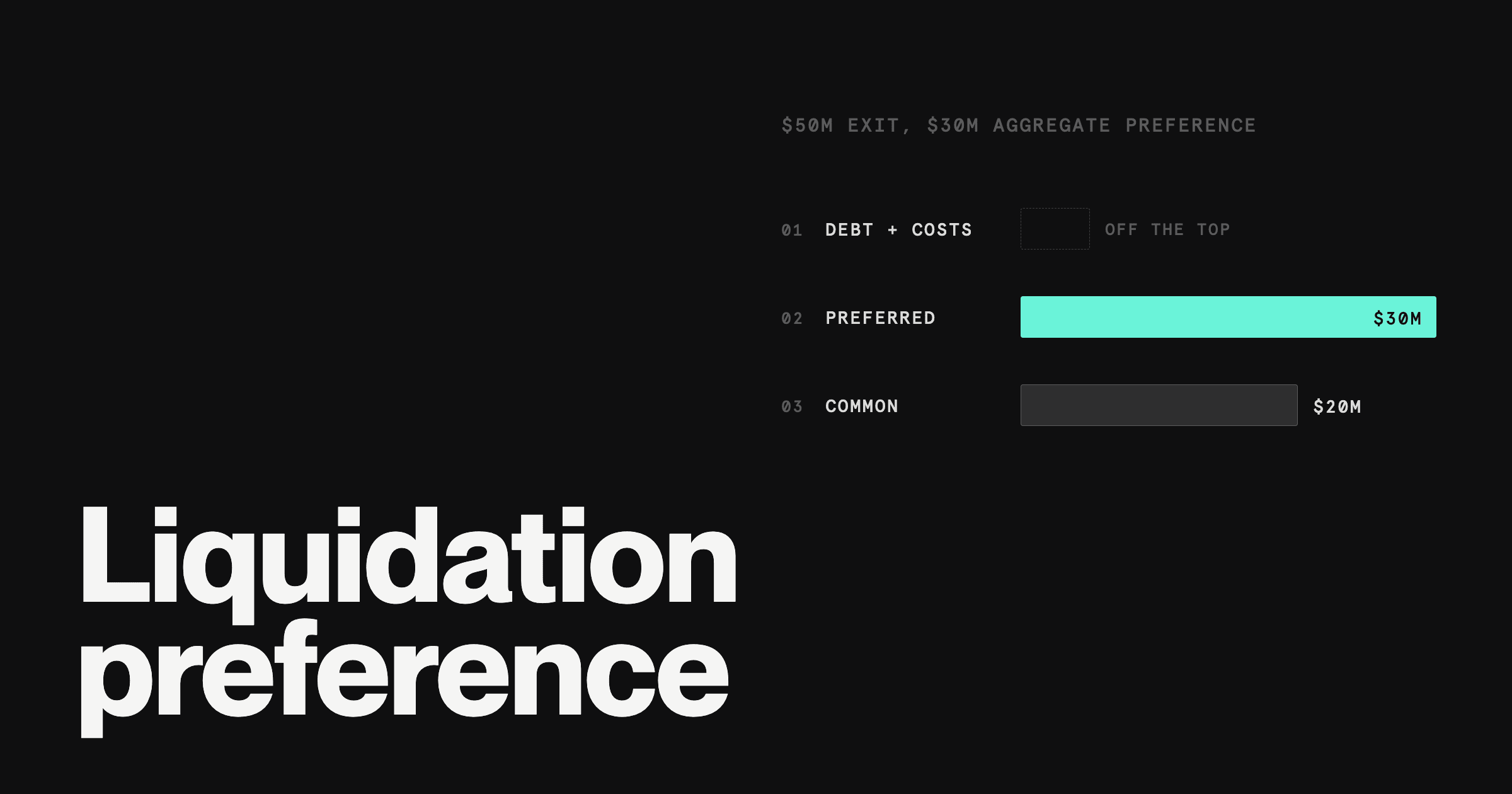
Venture debt, unconverted SAFEs, and convertible notes are not part of the preference. They sit somewhere else in the stack. Outstanding debt and transaction costs also come off the top before any preference is paid at all.
Participating preferred: the double-dip structure
With participating preferred, investors collect their liquidation preference first, then also share pro rata in whatever is left alongside common shareholders. They are paid twice from the same pool.
Work an example. A company exits for $50 million, and its preferred stack carries a $30 million aggregate liquidation preference.
Participating holders take the full $30 million before common sees a dollar. They then take their ownership percentage of the remaining $20 million on top of that.
Here is what that means for everyone else. Founders and employees holding common stock or options are splitting a residual that has already been cut down once, in an outcome that looks like a win on the press release.
Non-participating preferred: an either/or choice
Non-participating preferred forces a choice at exit. The investor either takes the liquidation preference, or converts to common and shares pro rata. Never both.
Rational investors take whichever is worth more. Below a certain exit price the preference wins. Above it, conversion wins, because their ownership percentage of a large number beats a fixed dollar floor.
That crossover is the whole point. At high exit valuations a non-participating preference stops protecting the downside and simply becomes ordinary equity, which is why founders prefer it.
Which structure favors whom, and when
Participating preferred favors investors most in low and moderate exits, where the preference is a large share of total proceeds. Non-participating favors founders and common holders at mid-size and large exits.
A 1x non-participating liquidation preference is widely described as the market standard in venture term sheets. Investors get their capital back first, and do not also share in what remains.
Understand the distinction before you sign. It is the difference between protecting your employee option pool and quietly gutting it, and it applies whether the eventual exit is $40 million or $400 million.
Liquidation preference example
A simple example of liquidation preference is a venture capitalist receiving $500, 000 in preferred stock and $500, 000 in common stock for investing $1 million into a startup. If the company sells for $2 million, the VC gets $1 million for their preferred stock and $500, 000 (50%) for their common stock. If it sells for $1 million, they get the $1 million.
The example above depends on the company not having any creditors to pay before it pays shareholders. If it does, creditors get paid first. If there are additional common shareholders, the proceeds are split based on ownership percentage. The company may also move them down the liquidation preference list if new investors are found in the next fundraising round.
How to negotiate liquidation preferences in a term sheet
Understanding the mechanics is half the job. The other half is knowing which levers actually move in a negotiation, and what you should trade to move them.
Most of the room lives in three variables: the multiple, the participation right, and seniority against other preferred classes. Everything else is detail.
Anchor to market-standard multiples
Market precedent is the cleanest anchor a founder has. A 1x non-participating preference is standard in most venture deals, so anything above it needs a reason.
Multiples of 1.5x or 2x are materially more investor-friendly and deserve real scrutiny. They show up most often in down rounds, bridge financings, and deals where the investor is pricing in risk they cannot negotiate away elsewhere.
But leverage is the real constraint.
Founders holding a single term sheet have far less of it, and often accept a higher multiple simply because there is no competing offer to point at. If that is your situation, spend your negotiating capital on eliminating participation before you try to argue the multiple down. Participation is usually worth more.
Cap participation, and understand the stack
If an investor insists on participating preferred, negotiate a cap. Caps typically land between 2x and 3x the original investment, and they are normally inclusive of the 1x preference rather than stacked on top of it.
Be precise about what a cap does. Nothing is forfeited and nobody is forced to do anything.
Once total participation proceeds reach the cap, participation simply stops accruing. Above that point converting to common becomes the better economic choice, and the investor takes it because it pays more, not because a clause compels them.
Seniority is the other half of the conversation.
A word of caution on terminology, because it is widely misused. The waterfall is the entire distribution mechanism that pays out proceeds in order, and every deal has one.
The real choice is between pari passu and a stacked structure. Under pari passu all preferred classes sit at the same priority and share pro rata if proceeds fall short. Under a stacked or senior structure, later rounds are paid before earlier ones.
Being junior is not the same as being wiped out. Earlier investors in a stacked structure still recover in full when proceeds remain after the senior classes are satisfied.
What compounds is the total. Each new round adds to the preference stack, and a cap table that looked founder-friendly at seed can be structurally punitive by Series B or C if nobody is tracking it.
Get your financial foundation right before the next raise
Favorable terms are easier to win when investors see clean financials and real-time spend visibility. Diligence questions get answered from a system of record instead of a reconstruction.
Rho's all-in-one banking platform puts banking, corporate cards, bill pay, and expense management in one place. The financial data investors ask for during diligence stays accurate and current, because it is not being stitched together from four tools at the moment you need it.
Wrap up
Liquidation preference is a key component of investment negotiations. Once creditor obligations are met, venture capitalists and major investors want to be paid as soon as possible after an acquisition or IPO, while common shareholders are paid last. That should be clearly stated in the term sheet. Any additions, like participation or cumulative dividends, should also be stated.
If you're looking to read other news, tips, and guides for finance teams, be sure to check out Rho's blog.
FAQs
An investor with a 2x liquidation preference multiplier receives twice the original issue price (OIP) they were given when their preferred stock was issued.
A liquidation preference is triggered when a company is liquidated by acquisition or initial public offering (IPO), but it can also be triggered by bankruptcy.
No. Liquidation preference is only for preferred stock, not common stock.
Dividends are approved by the board of directors. If they're part of the original term sheet, they're included in liquidation preference.
Secured creditors, such as mortgage and lien holders, are paid first when a company is liquidated. Unsecured creditors come next, followed by preferred shareholders.