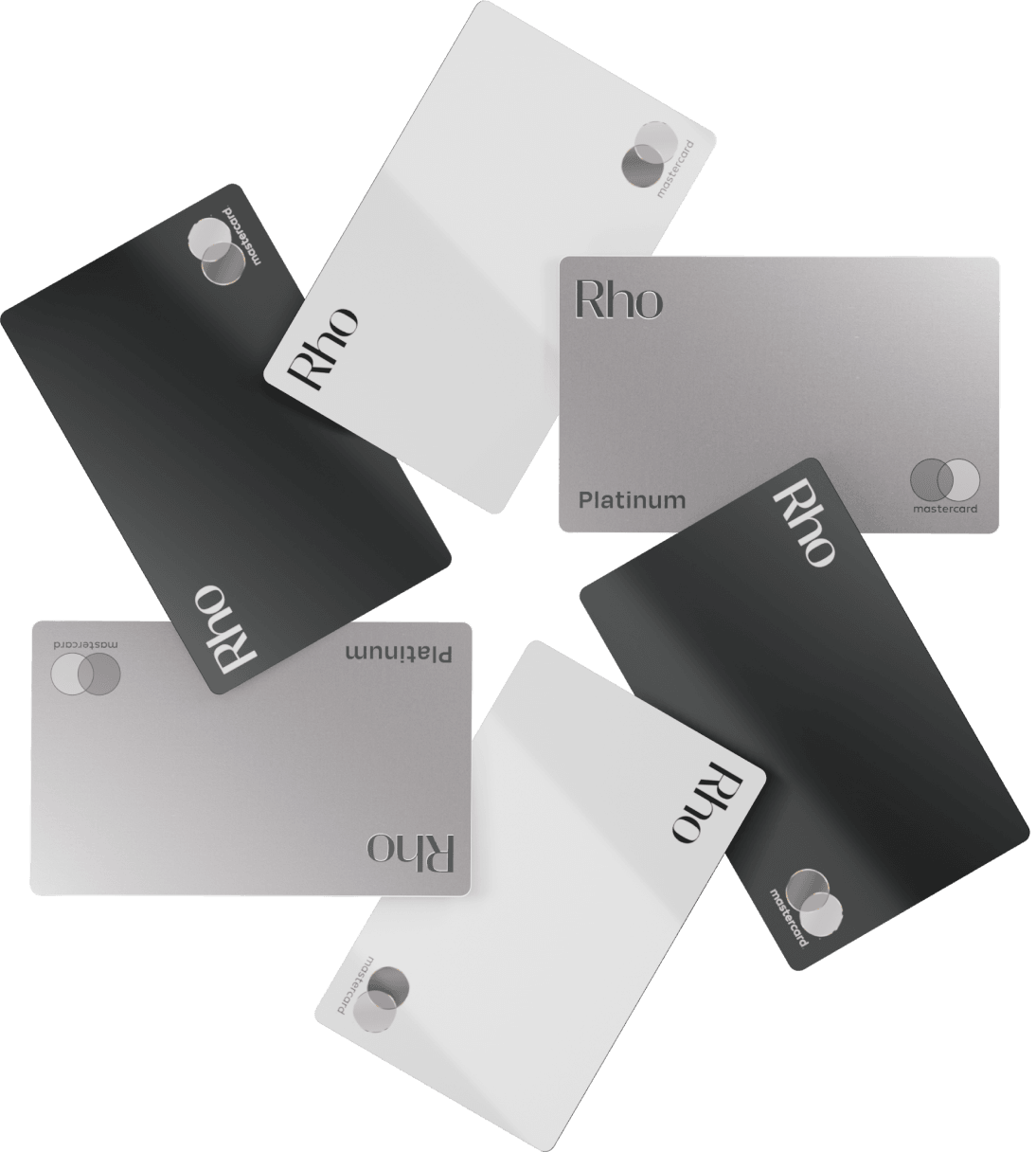
This guide compares seven high limit business credit cards, explains how issuers set limits, and shows how to work out the limit your business actually needs.
Key Takeaways
Limits of $50,000 or more are usually treated as high, and many charge and corporate cards have no preset limit or size it from your cash and revenue.
Corporate cards such as Rho, Ramp and Brex don't require a personal guarantee; most bank cards rely on your personal credit.
How often you repay changes the limit you need: daily repayment frees up your limit every day.
Rho Platinum members earn up to 2% cashback on the Rho Card with Daily Terms; terms apply.
The best high limit business credit cards in 2026 fall into two groups. Corporate cards such as Rho, Ramp and Brex set your limit from your company's cash, revenue or funding, and don't ask for a personal guarantee. Bank cards such as Capital One Spark Cash Plus, The Business Platinum Card from American Express and Chase Ink Business Premier lean on your credit profile and add rewards or travel perks. Capital on Tap advertises limits up to $50,000 for smaller businesses. The right pick depends on how much cash your business keeps on hand, how fast you can repay, and whether you want cash back or travel rewards.
Competitor details below were checked on each issuer's own website on November 16, 2026.
Which high limit business credit cards are worth comparing in 2026?
Card | Good fit for | How the limit is set | Annual or plan fee | Rewards |
|---|---|---|---|---|
Rho Corporate Card | Businesses that keep operating cash at Rho and want cards, banking and bill pay in one place | Daily Terms: set from your available checking balance and risk factors. Monthly Terms: personalized to your financial health | No subscription, per-user or platform fees | Up to 2% cashback with Rho Platinum on Daily Terms; terms apply |
Ramp | Corporations and LLCs with at least $25,000 in a US business bank account | Set from cash balance, cash flows and revenue | $0 per user (Basic); $15 per user per month (Plus) | Cash back; rate not published on Ramp's card page |
Brex | Venture-backed companies or businesses with more than $500,000 a year in revenue | Based on financial factors such as revenue or dollars raised | Plans from $0 per user; $12 per user per month for advanced features | Up to 7x points |
Capital One Spark Cash Plus | Owners with excellent credit who want flat cash back | No preset spending limit | $150, refunded every year you spend $150,000+ | Unlimited 2% cash back |
The Business Platinum Card from American Express | Frequent business travelers | No preset spending limit | $895 | 5X points on flights and prepaid hotels on AmexTravel.com |
Chase Ink Business Premier | Businesses with large single purchases | Pay in Full card with a Flex for Business balance | $195 | 2.5% on purchases of $5,000+, 2% on everything else |
Capital on Tap | Smaller businesses that want a revolving line | Credit limits up to $50,000 | $0 | 1.5% cash back |
1) Rho Corporate Card
The Rho Corporate Card comes in two versions. Every account starts on the Rho Card with Daily Terms, where the limit is set from your available checking balance and risk factors, so it moves as your balance moves. Charges are repaid automatically from your Rho checking account each day. Businesses that keep a cash balance of at least $25,000 can apply for the Rho Card with Monthly Terms, which has a 30-day billing cycle and a limit personalized to the business's financial health, subject to approval.
Rho does not require a personal guarantee and does not run a hard or soft check on your personal credit when you apply. Rho Platinum members earn up to 2% cashback on the Rho Card with Daily Terms on their first $1 million of eligible spend each calendar year (terms apply; some merchant categories and transactions outside the U.S. are excluded). The standard rate on Daily Terms is 1.25%. Cashback is paid into your Rho Rewards checking account.
There are no subscription, per-user or platform fees, and no foreign transaction fees. You can issue unlimited virtual and physical cards, lock any card instantly, set single-use cards, and limit a card to specific merchants or Mastercard merchant categories. Receipt capture, expense management and automated syncs to NetSuite, QuickBooks Online, Sage Intacct and Xero are included.
Good fit for: startups and growing businesses that want their card limit tied to the cash they hold, plus banking and bill pay on the same platform. Less suited to: businesses that want travel points or want to carry a balance over time. Open a Rho account to see your limit.
2) Ramp
Ramp is a corporate card for corporations, LLCs and limited partnerships; sole proprietors aren't eligible. To qualify, a business needs at least $25,000 in cash in a US business bank account and an EIN. Ramp doesn't require a personal guarantee and sets the business limit from cash balance, cash flows and revenue. The Basic plan is $0 per user, Plus is $15 per user per month, and both include unlimited physical and virtual cards.
Good fit for: US companies that want expense management software bundled with the card.
3) Brex
Brex doesn't require a personal guarantee and doesn't check or report to personal credit bureaus. It sets limits from financial factors such as revenue or dollars raised. Brex says it serves companies that have raised equity investment, earn more than $500,000 a year in revenue, or are referred tech startups on that path, and every applicant needs a US EIN, US incorporation, US operations and a US physical address. Cards earn up to 7x points.
Good fit for: venture-backed startups that want points and global card programs.
4) Capital One Spark Cash Plus
Spark Cash Plus is a charge card with no preset spending limit; your spending power adapts to your spending behavior, payment history and credit profile. It earns unlimited 2% cash back, plus 5% on hotels, vacation rentals and rental cars booked through Capital One Business Travel. The $150 annual fee is refunded every year you spend at least $150,000. It is designed to be paid in full, with an option to carry part of the balance with interest, and Capital One lists the credit level as Excellent.
Good fit for: established businesses with strong credit and high monthly spend.
5) The Business Platinum Card from American Express
The Business Platinum Card has no preset spending limit and a $895 annual fee. It earns 5X Membership Rewards points on flights and prepaid hotels booked on AmexTravel.com and includes access to the American Express Global Lounge Collection.
Good fit for: teams that travel often and will use the lounge access and travel credits enough to cover the fee.
6) Chase Ink Business Premier
Ink Business Premier earns 2.5% total cash back on every purchase of $5,000 or more and 2% on everything else, for a $195 annual fee. It is a Pay in Full card, but purchases first go to a Flex for Business balance that you can pay over time with interest, up to its limit.
Good fit for: businesses that make frequent large purchases, such as inventory or equipment.
7) Capital on Tap
Capital on Tap, issued by WebBank, offers credit limits up to $50,000, 1.5% cash back on every purchase, and no annual fee. Unlike the charge and corporate cards above, it is a revolving credit card, with interest rates from 16.99% APR. Capital on Tap says applying won't affect your personal credit score.
Good fit for: smaller businesses that want a revolving line and simple cash back.
What counts as a high limit business credit card?
There's no official threshold, but limits of $50,000 or more are usually treated as high. Cards express that spending power in three different ways:
A set credit limit. A revolving card such as Capital on Tap approves a fixed line and lets you carry a balance with interest.
No preset spending limit. Charge cards such as Spark Cash Plus and Business Platinum adjust what you can spend based on your spending, payment history and credit, and expect most of the balance paid each cycle.
A limit tied to your business finances. Corporate cards such as Rho, Ramp and Brex size the limit from your cash, revenue or funding instead of your personal credit score.
A high limit is only useful if it fits how you repay. A $100,000 limit on a card you repay monthly and a $30,000 limit on a card you repay daily can cover similar monthly spend.
How much credit limit does your business actually need?
Most guides tell you to chase the biggest number. A better approach is to size the limit to the most you will owe at any one time:
Monthly statement cards: you can owe up to a full month of spend before the statement closes, plus whatever you spend before the payment clears. A business spending $60,000 a month on a card with a 30-day cycle and a 25-day payment window can owe around $110,000 at its peak.
Daily repayment cards: charges are repaid every day, so you usually owe only a day or two of spend. The same $60,000 a month is about $2,000 a day.
Lumpy spend: add your largest single purchase, such as an annual software contract or an inventory order, on top of normal spend.
Headroom: keep balances well under the limit so a large ad bill or vendor invoice doesn't get declined.
If your peak balance is far above any limit you can get, look for a card with faster repayment before chasing a higher line.
How do issuers decide your credit limit?
Each issuer weighs different factors:
Personal credit and income: most bank-issued small business cards check the owner's credit and income.
Business cash and revenue: corporate cards look at bank balances, cash flow and revenue, often by connecting your bank and accounting accounts.
Funding: some corporate cards consider equity raised from investors.
Payment history: charge cards with no preset limit raise or lower spending power based on how you use and repay the card.
How do you get a $100,000 business credit card limit?
Most issuers don't publish a maximum, so a $100,000 limit comes from approval, not from the card you pick. To improve your odds:
Keep more of your operating cash with the card provider, or connect the bank accounts that hold it.
Have bank and accounting statements ready. Rho, for example, asks for bank and accounting statements for all active business accounts before providing credit.
Pay on time or in full every cycle. Charge cards and corporate cards raise spending power as payment history builds.
Choose a card that repays more often if you can't qualify for the limit you need on a monthly cycle.
At Rho, the Daily Terms limit is based on your available checking balance and risk factors, so it changes as your balance changes, and businesses with at least $25,000 in cash can apply for Monthly Terms with a personalized limit. Neither version requires a personal guarantee.
Can you raise your business credit card limit later?
Yes. Ask the issuer for a review once revenue or cash balances grow, keep utilization low, and pay on time. Cards tied to your cash balance, like the Rho Card with Daily Terms, change as your available balance changes.
Simple, powerful business banking.
Let Rho automate finance busywork so you can stay focused on serving your customers.
How different businesses use high limit cards effectively
Case studies highlight how diverse industries leverage high limit business credit cards while maintaining low-risk profiles. Each sector combines specific operational requirements with tailored card settings, demonstrating that customization is as crucial as the credit limit itself.
E-commerce and CPG: Dr. Squatch consolidated six-figure advertising budgets with our solution, tripled their credit limit, and reduced month-end closing time by 20 hours. High limit business credit cards provide e-commerce retailers with enhanced purchasing power while protecting cash flow and generating consistent cash-back rewards.
SaaS startups: Spark Advisors manages 178 active virtual cards, enabling engineers to charge AWS expenses with strict spending caps. They now operate 30% more efficiently than projected. Combining higher credit limits with card-specific controls helps rapidly growing companies build business credit without expanding headcount or risking excessive spending.
Agencies and Adtech: Anti Agency Group processes all Facebook and Google purchases through Rho, collects daily cash back, and saves 80 finance hours monthly. Marketing agencies benefit from fee-free, high limit cards that replace multiple personal credit cards and convert advertising expenditures into reliable 2% rewards programs that help offset client acquisition costs.
What are the pros and cons of high limit business credit cards?
Pros
Room for large purchase orders, ad spend spikes and annual contracts without a decline.
Smoother cash flow when vendors can be paid by card.
Spend controls such as per-card limits, merchant limits and single-use cards reduce fraud and out-of-policy spend.
Cons
Many high limit cards are charge cards that expect the balance paid in full each cycle.
Corporate cards often require meaningful cash balances or revenue to qualify.
Some cards add large annual fees or require a personal guarantee.
How do you manage a high limit card safely?
Turn on automatic repayment so balances clear on schedule.
Set card-level limits for each employee, vendor or campaign instead of sharing one card.
Use single-use virtual cards for one-off vendors and free trials.
Review spend weekly and write a simple corporate card policy so new cardholders know the rules.
Is a high limit business credit card right for your business?
If your monthly card spend is pushing against your current limit, a high limit card or a card with faster repayment can keep purchases flowing. Pick the card that matches how you qualify: your credit profile for bank cards, or your cash and revenue for corporate cards. If you keep operating cash at Rho, the Rho Corporate Card ties your limit to that balance, with no personal guarantee and no personal credit check. Open a Rho account or see how the Rho Corporate Card works.

Never outgrow your banking platform.
Built to handle your business at every stage, from inception to IPO. No switching costs, no starting over – just banking that expands with you.