

Let's say you operate an e-commerce startup selling prebiotic soda, and you have a record-breaking sales day thanks to a new Tik Tok promotion.
To support future growth, your business must safely store and diversify those funds for future inventory investment or marketing efforts. This is where business banking comes in.
What is business banking? Learn the answer to this question and more in our guide below.
What is business banking?
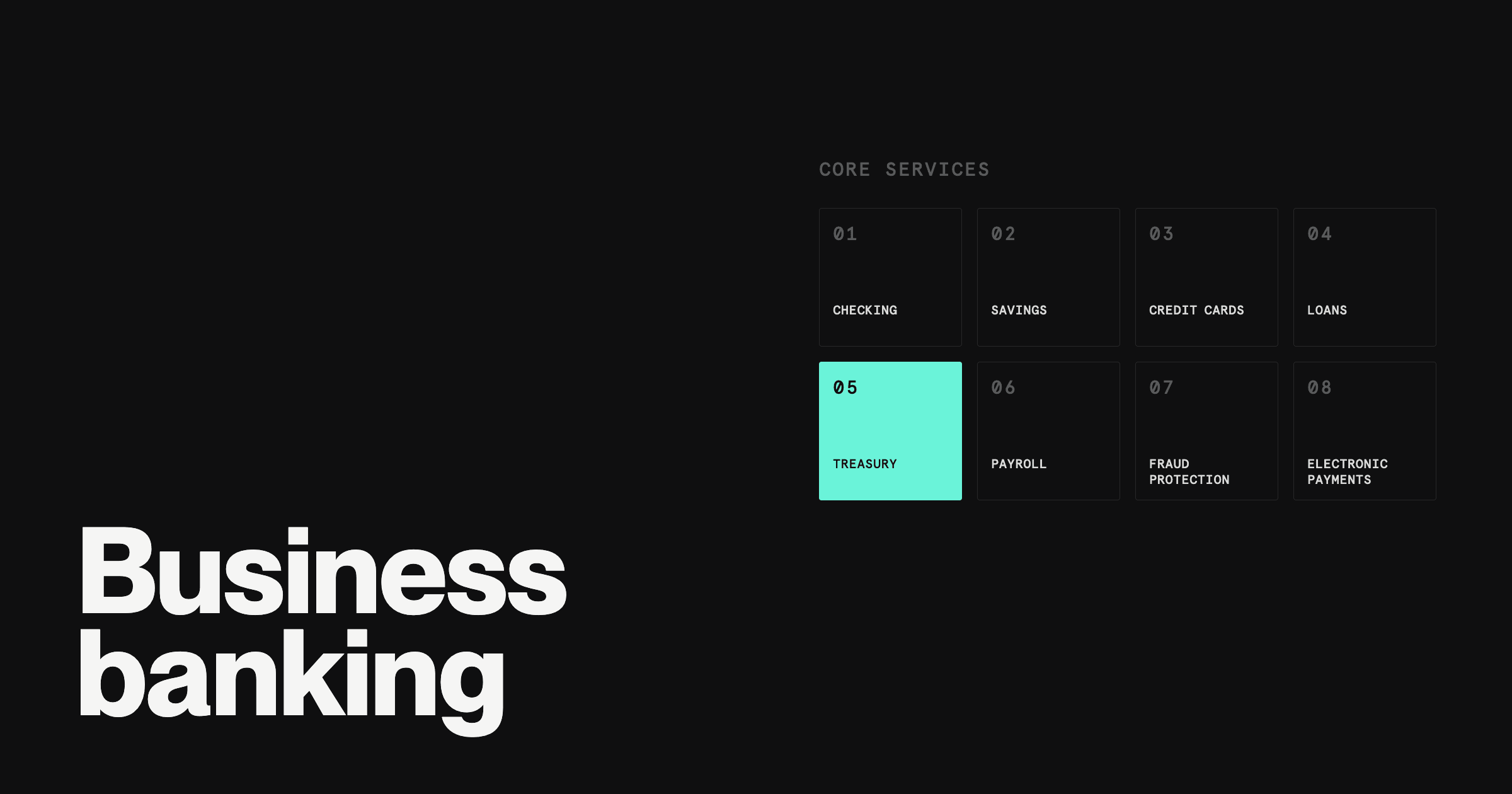
Business banking is the set of financial products and services that banks and fintech platforms provide to companies rather than individuals: business checking and savings accounts, corporate and business credit cards, loans and credit lines, wire and ACH payments, and treasury or cash management.
If you're reading this, you likely have a personal bank account you use to store funds, send money, and receive income, such as retail banking brands like Chase, Bank of America, Wells Fargo, or SoFi. Business banks provide the same core services, purpose-built for how companies operate.
Business banks differentiate themselves by market focus. Some, like Silicon Valley Bank (now a division of First Citizens Bank), serve startups, while others focus on large corporations.

How to open a business bank account
To open a business bank account you need four things: a registered business entity such as an LLC or corporation, an EIN, formation documents such as articles of incorporation, and beneficial ownership information for anyone who owns 25 percent or more of the company. Requirements vary by provider, and some fintech platforms can start onboarding before your EIN arrives.
Banks and fintech brands differ in their requirements. You can read more about opening a Rho account here.
But having a business entity isn't the only requirement. You will likely need to submit additional documentation for verification purposes. For example, to open a Rho Account, all applicants are required to provide business information and key documents, including:
Articles of incorporation
Company bylaws
EIN letter
Additional documents and information where applicable
Note: Rho cannot provide services to sole proprietorships or unincorporated businesses.
Some financial products may ask for more documentation for verification and underwriting purposes (for companies applying for Rho credit, our underwriting team will require additional information).
What happens next depends on the specific services your business is seeking.
Opening a bank account
The business may need to make an initial deposit to meet the bank's minimum balance limit.
Applying for a loan or line of credit.
The business may need to share its credit score, revenue, and detailed plans for how it intends to use the funds.
Every bank's process differs.
It's worth noting that the process and requirements for business banking differ from bank to bank. So you should research multiple options and talk to contacts in your network about what they like and don't like about their business banking partner.
The ideal business banking partner is one that provides responsive customer service, products and services that your company needs to operate and a modern UX that is seamless to use.
In addition to interest charged on loans and deposit float, many banks charge fees for specific services like ACH transactions, wire transfers, credit card interest, asset management, business consulting, and more. Make sure fees are reasonable when evaluating partners.
Did you know? Rho doesnt charge for ACH transactions or domestic wires. Learn why customers like Superfiliate moved from SVB to Rho for their banking and spend management needs.
Business banking vs. corporate banking
Commercial banking or corporate banking are similar to business banking with some differences.
Most notably, business banking is often associated with small to mid-sized companies, whereas commercial banking is commonly tailored to larger enterprises with more complex financial needs (e.g., international operations).
Common services offered by business banks
Every bank is different in terms of brand, cost structure, industry or company size, and range of services offered, but there are several common services many of them provide.
Business checking accounts
A business checking account is a fund account that stores a companys working capital.
These accounts are typically used by companies to deposit revenues, send and receive payments, and, in some cases, access cash from ATMs using a business checking debit card.
A business checking account is particularly useful for recurring payments, such as to suppliers or vendors, or for collecting payments from your payment service provider.
An important note is that most business checking accounts require the business to maintain a minimum balance and may charge fees in the event of an overdraft or for sending or receiving electronic transfers.
Rho does not!
Business savings accounts
A business savings account provides businesses with a secure place to store excess capital and earn a small amount of interest. Businesses may transfer capital to and from their business checking account to their savings account as needed.
Most banks allow businesses to access this money as often as needed, although some banks limit the amount of withdrawals in a statement cycle.
During periods of high interest rates, it isnt likely that businesses will store significant funds beyond their operating needs in a business savings account. They often use treasury management products to generate yield on excess cash reserves.
Business credit cards
A business credit card is a financial product usually in plastic, metal, or virtual form, which helps companies pay for business expenses using credit instead of working capital.
Businesses often use corporate credit cards to manage their working capital and earn bottom-line boosting cashback or points rewards on purchases like travel, digital ads, client entertainment, cloud computing, Saa S software subscriptions, and more. Did you know? Rho Corporate Cards offer up to 2% cashback for Rho Platinum members1 in addition to our platforms built-in expense management, AP automation, accounting integrations, business banking, and treasury products. Other benefits of corporate credit cards include:
Easy way to facilitate employee expenses and avoid the need for reimbursement management
Can help establish and improve the businesss creditworthiness, which in turn can provide the business with access to better financing opportunities.
Improves cash flow depending on the credit terms offered
Card policies and spend controls can help mitigate fraud
Support efficient accounting processes, including month-end close
Businesses typically link a business checking account and transfer funds over to pay off credit owed on purchases.
Business loans
Businesses often utilize banks to secure loans to facilitate business growth.
There are various types of loan products banks offer, such as term loans, real estate loans, equipment financing, lines of credit, SBA loans, invoice financing, and merchant cash advances, to name a few.
The specific terms of these loans, including the amount, interest rate (fixed or variable), and repayment schedule, are dictated by the needs and financial outlook of the business during the underwriting process.
A loan secured against a businesss assets will generally come with a lower interest rate, but the bank can seize the businesss assets in the event of default.
Defaulting a loan payment can also hurt a businesss creditworthiness, raise interest rates, and trigger legal proceedings against the business.
Note: Rho does not provide lender services, which is why many of our business clients work with a local or global bank brand for lending and Rho for our platforms automation, expense, treasury, and zero-fee ACHs and domestic wires capabilities.
FDIC insurance
Another benefit of business checking and savings accounts is that deposits are FDIC-insured up to $250k. This means account holders funds will be protected up to $250k if their financial institution fails.
In light of the 2023 collapse of Silicon Valley Bank, some banks now offer a networked banking solution, in which deposits of greater than $250k are spread out across several banks, ensuring additional Member FDIC coverage.
For example, Rho offers Treasury Management Accounts, which is built on a network of over 400 FDIC-insured banks, allowing you to access up to $75M in FDIC deposit insurance per entity.
This coverage saves you the hassle of opening multiple bank accounts to insure your funds.
Treasury or cash management
Some businesses utilize their bank's treasury services to manage cash more effectively.
Treasury management encompasses various financial processes, including sequencing income and expenditures, processing transactions, identifying financial risk, fraud prevention, and liquidity management.
Treasury management aims to ensure a businesss liquidity position is stable by monitoring its cash flow and accounts receivables.For example, a business might leverage a T-Bill ladder to hedge against changes in interest rates while earning yield, instead of putting all non-operational cash in a business checking account. Business banks often provide treasury services at a fixed cost, however many of these services are reserved for clients with significant revenues.
This is a big reason why Rho launched Rho Treasury, our treasury management service that invests your excess cash in short-dated government securities that are held in your business name. You don't have to be a cash management expert to generate significant yield thanks to our service.
Payroll management
Like treasury, payroll management is a service businesses sometimes outsource to their bank.
Many business banks offer software and services to help streamline the payroll process, including online paystubs, ACHdeposit processing, payroll tax management, and flagging unusual payments. This service is also typically offered at a fixed cost.
Did you know? Rho integrates with more than 50 different HR platform providers.
Fraud protection
Businesses are always at risk of fraud, so banks offer fraud protection services. With fraud protection, the bank will monitor a businesss checking account and report any unusual activity, such as suspicious checks or employee misuse of funds.
Most banks will offer some fraud protection services for free (e.g., check monitoring), but more comprehensive fraud protection can cost extra. Your best bet is to implement fraud protection best practices.
Electronic payments
Most business banks can facilitate wire transfers and automated clearing house (ACH) payments, two types of electronic money transfers commonly used by businesses to send and receive payment.
Many businesses use ACH transfers to set up recurring payments to suppliers and vendors, but the costs of wires and ACH transfers can vary by bank. Check out Rhos pricing to learn why companies use our platform.
Letter of credit
A business bank can provide a more niche service is a letter of credit or LC. Letters of credit are typically used in international trade to ensure that if a buyer cannot make payment, the issuer of the LC will step in and send payment to the exporter on behalf of the buyer.
A bank typically charges a fee for a letter of credit based on the total amount of credit theyre guaranteeing.
Note: Rho does not offer letters of credit, which is why many clients have a relationship with their local bank and use Rho.
Overdraft facility
Business banks typically offer clients overdraft facilities if a business doesn't have the cash to cover expenditures. Overdrafts are an alternative form of funding in which the bank covers the capital the business owes in return for interest on said cash.
An overdraft facility is typically a short-term loan and can be secured against the businesss assets. This type of financing is commonly utilized by seasonal businesses or businesses with fluctuating finance requirements.
Business banking platforms that integrate with QuickBooks, Xero, and NetSuite
Rho, a fintech platform partnered with Webster Bank, natively syncs transactions into QuickBooks Online, NetSuite, and Sage Intacct, and connects to Xero by bank feed. Most traditional banks offer no comparable accounting sync at all, and Mercury is the other major platform with equivalent native coverage across all three.
Platform | QuickBooks Online | Xero | NetSuite | Other | Sync type |
|---|---|---|---|---|---|
Rho | Yes | Yes | Yes | Sage Intacct, Campfire | Native integration (QBO, NetSuite, Sage Intacct, Campfire); bank feed (Xero) |
Mercury | Yes | Yes | Yes | Not published | Native push (NetSuite automations on paid plan) |
Axos Bank | Yes | Not published | Not published | Quicken (desktop) | Direct Connect / Web Connect (file-based) |
Chase | Not published | Not published | Not published | Not published | Not published |
Last verified: September 2026.
Figures above were confirmed on each provider's own site on September 16, 2026; cells marked “not published” mean the provider hasn't stated support publicly. See Rho's accounting integrations for the full list, including Sage Intacct and Campfire.
Before you choose a business banking platform for its accounting sync, confirm the sync direction: a native integration pushes categorized transactions and vendor detail into the ledger, while a bank feed only passes raw transaction lines for manual coding. Also check whether bill pay and card spend flow through the same connection and whether the sync is included at no added cost. Our comparison of the best business bank accounts and our online business bank account guide go deeper on providers built around this kind of automation.
What is the safest place to keep business cash above the FDIC limit?
FDIC insurance covers $250,000 per entity at a single institution, and that limit is per entity rather than per account, so opening a second checking account at the same bank does not extend it. Any business holding more than $250,000 in one place is carrying uninsured cash. The safest answer is not one very large bank. It is spreading the balance across many insured institutions, which a business savings account built on a deposit network does for you automatically.
Rho Savings works this way. Your balance is swept across a network of more than 400 FDIC- and NCUA-insured institutions (as of August 2026), with no single placement exceeding $250,000, for coverage of up to $75 million per entity. That is 300 times standard coverage without opening 300 accounts. The balance earns 1.00% APY, a variable rate, on an average monthly balance of $25,000 or more. Transfers back to checking settle within two business days, and the account allows six withdrawals per month, so it suits reserves rather than day-to-day operating cash.
For cash you will not need for several months, a treasury account is the other option, and it is a different trade. Rho Treasury invests idle balances in 13-week U.S. Treasury Bills and two short-duration, investment-grade mutual funds held in your business's name. Those are securities, not deposits: they are not FDIC-insured and they can lose value. Most companies use both, keeping operating cash in checking, reserves in savings, and longer-horizon cash in treasury.
What are the benefits of business banking?
If it wasnt already apparent, business banking provides many benefits to businesses. Lets delve into some of the specific benefits businesses enjoy:
Clear separation of funds
A business bank account makes it easy for business owners to separate their personal finances from their businesss finances, which is important because commingling funds can put your personal funds at risk and cause accounting issues down the road.
Separating personal and business finances is also good financial hygiene, providing a clearer picture of each entitys financial health.
Another reason why businesses use business bank accounts is to segment funds based on lines of business for clear accounting purposes.
For example, a CPG company may have separate bank accounts set up for their brick-and-mortar retail business, e-commerce business, and any international business.
Money movement
Working with a business bank makes it easier to move funds from one account to another and pay vendors and suppliers using wire or ACH transfers.
Tax prep
Having all of a businesss income and expenses flow through a dedicated business bank account streamlines tax preparation.
Many tax preparation software link directly with a business bank account to further simplify the process.
In the event of an audit, a business bank account leaves a clean audit trail, reducing the potential for issues with the IRS.
Financing
Working with a business bank gives the business direct access to financing to capitalize on opportunities and support growth ambitions.
Businesses in a healthy financial position can often select from various financing options to find one that fits their needs.
Cash management
A business bank account enables businesses to manage cash on hand, receivables, and payables more efficiently. A business bank account also leaves a paper trail of all activities to support expense tracking and tax prep.
Establish business credit
A business bank account in good standing can help a business establish credit, which can help it access better financing opportunities.
Protection
Business banks aim to be a trustworthy steward of their clients cash and will notify clients in the event of suspicious transactions or other activities that could be deemed fraudulent.
Access to business tools
Many business banks offer additional tools and services to clients that help them meet their needs, such as bookkeeping and invoicing software, payroll support, and advisory services.
Access to business rewards
Many business banks also offer rewards programs tailored to clients' specific needs, such as cost-saving promotions, cash back on business-related purchases, discounts on business products, and airline miles.
Professionalism
Lastly, a business bank account provides a business with a layer of professionalism.
Having a business bank account signifies to customers and vendors that the business wont be irresponsible with their money and that it has the foundation in place to properly manage cash.
If it wasnt already apparent, business banking provides many benefits to businesses. Lets delve into some of the specific benefits businesses enjoy:
What are the disadvantages of a business bank account?
While there are many benefits to business banking, there are also a few drawbacks business owners should be aware of:
Fees
This is the big one. Depending on the services a business utilizes, high fees and interest rates can be associated with business banking, leading to unforeseen costs.
Business owners must talk to their bank about the costs associated with any type of service to avoid being caught unawares. Learn why clients love Rhos pricing.
Customer support
Business banks are typically open Monday through Friday and have limited or no weekend availability.
While this lack of availability is mitigated somewhat by online business bank accounts, its still a consideration for business owners who need access to a local branch.
Like we've said before, you're in trouble if you have to tag the company's founder on social media just to get a response, or wait hours to connect with a service agent.
Minimum balance
Since most business banks fulfill loans using client deposits, they typically require their clients to maintain a minimum balance on their accounts. Failure to do so can result in overdraft fees.
Transaction limits
Some banks limit the number of monthly free client transactions, which can affect a businesss ability to manage its cash.
What is the difference between personal and business banking?
Surprisingly, we have received this question in various forms since launching Rho, so we wanted to provide some information.
Business banking serves corporate entities and tailors its services as such; personal banks serve the needs of you and me. As a result, they often market to end customers in very different ways.
Here are a handful of other ways that business and personal banking differ:
Best business banks and platforms for CFOs in 2026
1. Rho
Rho is the finance operating system businesses use to manage all their business banking, spend management, and treasury needs in one place without the annoying fees and lackluster customer service you get from legacy banks.
Organize your company's operating cash, earn yield on your reserve capital with Rho Prime Treasury, and enjoy fee-free Same-Day ACHs, domestic wires, and checks, all backed by 24/7 customer support.
Features
Commercial banking integrated with corporate cards, accounts payable, expense management, treasury, and the Rho mobile app, at no added cost.
Pros
Up to 2% cash back for Rho Platinum members, automated workflows, fee-free deposits, no minimum balance, no overdraft fees, 24/7 customer support, integrations with third-party accounting and HR software, and a sleek mobile app.
Cons
No physical locations, no ATM withdrawals.
Note: Many businesses avoid handling significant sums of cash for theft prevention purposes, but we typically see clients work with their local bank to cover their day-to-day cash withdrawals as needed.
Best for
If you run a high-performing startup or SMB that wants world-class banking and payments services built into a platform with a world-class user experience, Rho is worth checking out.
Rhos business checking account charges no fees for monthly maintenance, automated clearing house (ACH), domestic wires, and checks.
We also help you eliminate a bloated finance stack by integrating business banking, treasury, corporate cards, accounts payable (A/P) automation, and more in one unified platform. Plus, our the Rho app (available on i OSand Android devices) helps you manage all mobile banking needs with ease.
Note: To be eligible for Rho, your business must be incorporated in the United States. We do not offer services to sole proprietorships or unincorporated businesses.
Pricing
Check out our pricing page. Rho does not charge fees for ACH, domestic wires, or international SWIFT wires.
2. Axos Bank
Axos Bank is a full-service online bank that offers business banking products.
Features
Checking and savings accounts, CDs, merchant services, treasury, commercial loans.
Pros
No minimum deposit, fee-free transactions, ATM refunds.
Cons
Few third-party integrations beyond QuickBooks, $25 fee for insufficient funds.
Best for
SMBs who require ATM access.
Pricing
Axos Basic Business Checking is free, while Axos Interest Business Checking comes with a $10 monthly fee, which is waived if the account holder maintains a daily balance of at least $5k.
Best for
Axos is a bank, not a technology company. Businesses that want a name-brand bank but arent concerned about technology integrations and how it might impact processes like month-end close and expense management.
3. Chase Business Banking
Chase is a nationally recognized bank that offers business banking services for SMBs and enterprise customers.
Features
Checking and savings accounts, debit cards, 14k+ ATM network, commercial loans, lines of credit, business credit cards.
Pros
No minimum opening deposit, fee-free transactions, signup bonus, no overdraft fees on overdrafts of $50 or less (Overdraft Assist).
Cons
$15 monthly fee, out-of-network ATM fee, and monthly transaction limits. Chase clients are
Best for
Chase is a bank, not a technology company. Businesses that want a name-brand bank but arent concerned about technology integrations and how it might impact processes like month-end close and expense management.
Pricing
$15 per month.
4. Mercury
Mercury is a financial technology company providing basic banking products and services tailored to VC-backed startups.
Mercury is a great option for VC-backed startups who are looking for foundational banking services to get started.
Features
FDIC-insured checking and savings accounts, employee debit and credit cards with custom limits, global FX payments, and a Quickbooks integration.
Pros
No monthly or minimum deposit amounts, no overdraft fees, free domestic and international wire transfers, venture debt options, and Mercury Vault product offers up to $5M in FDIC insurance through partner banks and sweep networks.
Cons
Mercury does not publish a customer support phone line, with support handled primarily through email and in-app messaging, and reviews indicate customers struggle with customer support responsiveness.
Lacks multi-entity support depth and some finance capabilities companies may want to integrate with banking, such as fully integrated AP automation and mature expense management.
Companies may also prefer to invest directly in T-bill vs. the potential risks of investing in money market funds.
Best for
Startup businesses that are just getting started and want access to business banking services built into a technology platform with a good user experience.
As growth-stage startups scale, they may need additional capabilities like multi-entity support, AP automation, and other important financial operations features. In those scenarios, Rho can provide a great alternative option.
Pricing
Mercury offers a free core banking plan, with a 1% currency exchange fee and optional paid tiers (Mercury Plus and Mercury Pro) that add features for a monthly fee.
Wrap-up: All about business banking
We hope this guide has provided you with the necessary context to begin engaging with business banking. Partnering with the right bank for your business can help a business elevate its financial management, capitalize on new opportunities, and achieve scale.
Learn how Rhos fee-free platform for business banking and finance, business credit cards, and more compare with different startup solutions, including:
Legacy financial institutions: Chase Bank (Chase Business Complete Banking), US Bank, and Wells Fargo
Newer financial technology companies: Mercury, Ramp, Brex, Blue Vine, and Novo
Interested in opening a Rho account? Get in touch today.
FAQ: Business banking
Who can access a business bank account?
Anyone who is a signatory on the business bank account can access it and perform transactions.
For most businesses, this includes directors or officers of the company, a companys attorney or accountant, or another approved party who works in a finance-related role in the business for which access is needed.
Why would I be turned down for a business bank account?
A business bank can reject any business if it deems it too risky to work with.
This could be because the business has low creditworthiness, cant meet the initial deposit requirements, is engaged in a type of business that the bank is prohibited from engaging with (e.g., gambling, cannabis, etc.), or any number of other reasons.
What's the difference between an investment bank and a business bank?
Investment banks typically make money by selling securities, while business banks provide services to businesses.
However, many large businesses also use investment banks to assist with asset management, IPOs, mergers, and more.
Oftentimes, business banks and investment banks are one in the same.
This is due to 1999 legislation that repealed parts of the Glass-Steagall Act, which required investment and commercial banks to operate as separate business entities.
Matthew Speiser is a finance content writer who specializes on topics including startups, venture capital, corporate finance, and business banking. Competitive data was collected as of August 3, 2026 and is subject to change or update.
Rho is a fintech company, not a bank or an FDIC-insured depository institution. Checking account and card services provided by Webster Bank, a division of Santander Bank, N.A., member FDIC, and by Lead Bank, Member FDIC. Savings account services provided by American Deposit Management Co. and its partner banks. International and foreign currency payments services are provided by Wise US Inc. FDIC deposit insurance coverage is available only to protect you against the failure of an FDIC-insured bank that holds your deposits and subject to FDIC limitations and requirements. It does not protect you against the failure of Rho or other third party. Products and services offered through the Rho platform are subject to approval. The Rho Corporate Cards are issued by Lead Bank, Member FDIC, and by Webster Bank, a division of Santander Bank, N.A., member FDIC, as applicable, pursuant to a license from Mastercard, subject to approval. 1Up to 2% Cashback with Rho Platinum on up to $1M in eligible annual card spend; 1.5% standard; terms and conditions apply. See eligibility and complete Rho Cashback Rewards Program terms and conditions here.
FAQs
Anyone who is a signatory on the business bank account can access it and perform transactions. For most businesses, this includes directors or officers of the company, the company's attorney or accountant, or another approved party who works in a finance-related role and needs access.
A business bank can reject any business it deems too risky to work with. Common reasons include low creditworthiness, not meeting initial deposit requirements, or operating in an industry the bank is prohibited from serving (for example, gambling or cannabis).
Investment banks make money primarily by underwriting and selling securities and advising on deals like IPOs and mergers, while business banks provide day-to-day financial services to companies: deposit accounts, payments, cards, and credit. Since 1999 legislation repealed parts of the Glass-Steagall Act, many large institutions operate both under one roof.
Personal banking serves individuals; business banking serves legal entities like LLCs and corporations. Business accounts keep company funds separate from personal funds, support higher transaction volumes, and add company-specific tools such as multi-user access controls, accounts-payable workflows, payroll integrations, and treasury or cash management.
In most states an LLC is not legally required to have its own bank account, but it is strongly recommended. An LLC is a separate legal entity, and commingling personal and business funds can undermine its liability protection. To open one, banks typically ask for your EIN, articles of organization, and operating agreement.
Rho, a fintech platform, natively syncs corporate card, banking, and bill-pay transactions into QuickBooks Online, NetSuite, and Sage Intacct, and connects to Xero by bank feed. Coverage varies by provider: some push categorized data directly into the ledger, while others only pass raw transaction lines for manual coding. Confirm the sync type before choosing a platform.