
You have already done the research. You know you want a Delaware C Corporation. You have narrowed it to two names: Stripe Atlas and Clerky. There is also a third path worth knowing about before you pick.
This is a straight comparison. No filler. Just what each option does, what it costs, and which one fits your situation.
Quick Highlights
Stripe Atlas
$500 one-time fee
Incorporates in 1 to 2 business days
83(b) filed automatically for all founders
Stripe Treasury option available for banking, with the $500 fee credited back after a $5,000 deposit
$2,500 in Stripe credits plus $50,000 in partner discounts
Not a law firm. No attorney reviews your documents
No ongoing legal document support after incorporation
Clerky
$819 one-time fee (Lifetime Package)
Incorporates in 2 to 3 business days
Unlimited lifetime access to SAFEs, hiring docs, equity grants, and more
Advanced delay protection if Delaware rejects your filing
83(b) support with automated reminders
Not a law firm. No attorney reviews your documents
Pay Per Use option available for formation only
LegalZoom
$149 + state fees to start. Top tier $399
Registered agent costs $249 per year, sold separately
Forms any entity in any state, not just Delaware C Corps
Attorney consultations available on higher tiers
No automatic 83(b) filing, no SAFEs, no startup equity docs
Built for Main Street businesses, not venture-track startups
Rho (yes, that's us)
$400 one-time fee, credited back when you deposit $10,000 of new money into your Rho checking account and keep your daily average balance $10,000 above where it started for the 60 days after you incorporate
Attorney-reviewed Delaware C Corp filings
Business account opens in the same flow as incorporation, once your EIN is issued
Registered agent year one, automatic EIN filing, and 83(b) elections included
The short answer
Choose Atlas if you want the fastest, cheapest path to a Delaware C Corp and will handle legal documents elsewhere
Choose Clerky if you are raising capital and want all your legal documents in one place
Choose LegalZoom if you are not raising venture capital and want a home-state filing or attorney consultations
Choose Rho if you want incorporation, EIN, and business banking handled in one flow
File your 83(b) election. Atlas and Clerky support it; LegalZoom does not. You have 30 days. There are no extensions
Update, August 26, 2026: Clerky announced it is joining Stripe. Founder Darby Wong says the Clerky team will keep operating independently, with the same focus on high-growth startups and their attorneys. No pricing or product changes have been announced, so the comparison below still reflects two distinct products.
Stripe Atlas suits founders who don't need attorney-grade documents, Clerky suits founders about to raise a priced round, and a third path now skips the handoff between incorporating and opening a business account.
Pick Atlas if you want the cheapest, fastest Delaware filing and don't need attorney-grade documents. Pick Clerky if you're about to raise a priced round and want investor-ready paperwork from day one.
The third option, Rho, incorporates and opens your business account in the same flow, so the EIN that gates your first invoice, card, and payroll run doesn't sit in an inbox waiting on a second signup.
Rho is a fintech platform that partners with banks to offer this, not a law firm and not a bank itself. It earns a mention here because it answers a question Atlas and Clerky don't: what happens the day after you're incorporated.
Stripe Atlas vs Clerky vs Rho: Head-to-Head Comparison
Stripe Atlas | Clerky | Rho | |
|---|---|---|---|
Price | $500 one-time | $819 Lifetime Package, or $427 Pay Per Use (incorporation only) | $400, credited back after you deposit $10,000 of new money into your Rho checking account and keep your daily average balance $10,000 above your starting point for 60 days after incorporation |
What's included | Delaware incorporation, EIN, founder equity/share purchase docs, 83(b) election filing, document templates, first-year registered agent, $2,500 in Stripe credit | Delaware C-corp e-filing, expedited filing fees bundled, first-year registered agent, unlimited post-incorporation document generation (Lifetime tier), stock plan adoption | Delaware incorporation, EIN prepared and submitted for you, 83(b) election support, first-year registered agent, and a business account opened in the same flow |
Delaware C-corp support | Yes | Yes (also supports PBCs) | Yes |
LLC support | Yes | Not published | Coming soon |
EIN | Included | Not included in standard incorporation; a separate EIN application service is named specifically for non-US founders | Prepared and submitted for you as part of incorporation |
83(b) filing | Included | Pre-filled elections with automated reminders (support, not an automatic filing) | 83(b) election support |
Registered agent | Included year one, $100/yr after | Included year one; renewal price not published as a standalone figure | Included year one |
Turnaround | Within 2 business days | Typically 2-3 business days | About 24 hours for roughly 80% of filings (not guaranteed) |
Bank account included | Not bundled; Atlas offers a Stripe Treasury option separately | Not included; Clerky pre-fills applications to outside banks, no partner named | Included in the same flow as incorporation |
Ongoing annual costs | $100/yr registered agent renewal | Registered agent renewal implied in the year-one bundle value, not printed as a standalone figure | About $1,000/yr in platform access after incorporation, plus $100-250 per additional contract service; Delaware franchise tax applies separately |
Last verified: September 16, 2026. Stripe Atlas figures sourced from stripe.com/atlas. Clerky figures sourced from clerky.com/pricing and clerky.com/incorporation. All checked live as of the date above; anything not published on either company's own site is marked "not published" rather than estimated.
Ready to combine incorporation and banking? Get started with Rho.
What Stripe Atlas Does
Stripe launched Atlas in 2016. You pay $500 one time and get your company formed in Delaware.
Here is what you get for $500:
Delaware C Corp or LLC incorporation, processed in 1 to 2 business days
EIN registration. 1 to 2 business days if you have a US SSN. 15 to 25 business days if you do not
Founder equity issuance and stock purchase agreements
83(b) election filing. Atlas does this automatically for all founders
First year of registered agent service ($100 per year after that)
Legal documents built in collaboration with Cooley LLP
$2,500 in Stripe product credits plus $50,000 in partner discounts from AWS, Mercury, Xero, and others
Access to a Stripe Treasury account for banking, with your $500 fee credited back after a $5,000 deposit
Atlas is not a law firm. It does not review your specific situation. Once your documents are filed, Atlas is done.
What Clerky Does
Two startup attorneys built Clerky. The goal was to give founders attorney-quality documents without paying attorney prices.
The Company Lifetime Package costs $819 one time. A Pay Per Use option also exists if you only need the formation itself.
Here is what the Lifetime Package includes:
Delaware C Corp incorporation, processed in 2 to 3 business days
Post-incorporation setup including founder stock with vesting, bylaws, IP assignment, and board consents
Pre-filled 83(b) elections with automated reminders
Advanced delay protection if Delaware rejects your filing
Unlimited lifetime access to SAFEs, convertible notes, hiring paperwork, equity grants, and maintenance filings
First year of registered agent service ($125 per year after that)
Clerky also uses software-generated templates. No attorney reviews your specific company before filing. The difference from Atlas is what you get after you incorporate.
Pricing
Atlas charges you $500 once. Your only recurring cost is $100 per year for the registered agent after year one.
Clerky charges $819 for the Lifetime Package. You get unlimited access to all their standard post-formation documents. If you plan to raise a round and need SAFEs, hiring templates, and equity paperwork, the Lifetime Package pays for itself quickly. If you just want to incorporate and handle everything else elsewhere, you are paying $319 more than Atlas for documents you may never use.
Clerky also offers Pay Per Use at a lower upfront cost. You buy documents individually as you need them.
LegalZoom looks cheapest at $149, but the comparison shifts once you add what Atlas and Clerky bundle. The EIN, the first year of registered agent service, and startup-standard legal documents are all extras or absent. A typical first-year LegalZoom corporation runs $500 to $750 after state fees and the $249 registered agent, without any of the startup paperwork.
Document Quality
Atlas and Clerky both produce Delaware-standard startup formation documents. Both work with experienced startup attorneys to build their templates. For a standard setup with two founders, a typical equity split, and no unusual provisions, either service gives you legally sound documents.
The problem shows up when your situation is not standard. Neither Atlas nor Clerky can handle double trigger acceleration, super voting shares, or non-standard vesting. If you need any of those, you take the generated documents to an outside attorney and pay to revise them.
Plenty of incorporations involve questions that go beyond what a template can answer. Most incorporations are standard. But not all of them are.
LegalZoom's documents are general-purpose incorporation paperwork. They are fine for a standard corporation, but they do not include the founder stock purchase agreements, vesting schedules, or IP assignments that investors expect. If you form through LegalZoom and later raise, expect to pay an attorney to paper those pieces properly.
Processing Speed
Atlas processes your Delaware incorporation in 1 to 2 business days. That is the typical timeline, not a hard guarantee.
Clerky processes in 2 to 3 business days. Their Advanced Delay Protection monitors your filing and responds to any rejections from Delaware. Atlas does not offer this.
For most founders, the difference in processing time does not matter. If you have an investor waiting or a contract that needs a signed entity, Atlas gives you a slight speed advantage.
LegalZoom's standard processing depends on the state and can take weeks. Faster turnaround costs extra. If speed matters, Atlas and Clerky are both quicker by default.
EIN
Your EIN timeline depends on your situation.
Neither service can speed up the IRS.
One thing Atlas offers that Clerky does not: access to a Stripe Treasury account for banking, with the $500 fee credited back once you deposit $5,000. Clerky pre-fills applications to outside banks instead, without naming a partner bank of its own.
At LegalZoom, the EIN is a paid add-on on the basic tier or bundled into higher tiers. Timelines follow the same IRS rules as everyone else.
What Happens After You Incorporate
This is where Atlas and Clerky actually differ.
After Atlas, you have your documents and your Stripe account. You figure out the rest yourself. Need a SAFE for your first angel? You find a template, hire a lawyer, or use another platform.
After Clerky, those documents are already waiting for you. SAFEs, convertible notes, advisor agreements, offer letters, equity grants, and maintenance filings all live inside Clerky. The templates are attorney-designed. Founders who use Clerky through their seed round stay in it because the context carries forward.
If you will need legal documents in the next 12 to 18 months, the $319 premium Clerky charges over Atlas is worth it. If you will not, it is not.
After LegalZoom, you can subscribe to its legal plans for general business needs like contracts and leases. That is useful for a Main Street business. It is not a substitute for startup counsel or startup-standard fundraising documents.
Stripe Atlas: best for
Use Atlas if:
You want the lowest-cost path to a Delaware C Corp
You already use Stripe and want everything connected
You do not plan to need ongoing legal documents
You are comfortable finding future legal documents on your own
Clerky: best for
Use Clerky if:
You expect to raise a round in the next 12 to 18 months
You will need SAFEs, convertible notes, or hiring paperwork
You want all your legal documents in one place
Document quality matters more to you than upfront cost
Rho: best for
Rho is the right call if you want incorporation and your first business account handled without a second signup. Once your account is approved and your EIN is issued, you're ready to invoice, swipe a card, and run payroll, no second application to open banking somewhere else.
It is not the right call if you need the deepest legal document library available. That is still Clerky, and Clerky's document generation for priced rounds, SAFEs, and board consents goes further than what Rho is built to do.
It is also not yet the right call if you need an LLC. Rho's incorporation flow is Delaware C-corp only today, with LLC support coming soon.
Where Rho wins is speed to operating, not speed to filing. About 80% of filings complete within 24 hours.
The $400 fee is credited back once you deposit $10,000 of new money into your Rho checking account and hold a daily average balance $10,000 above your starting point for 60 days after you incorporate. See how the combined flow works on Rho's incorporation page.
Or something else: incorporate and open your business account together
Full disclosure: Rho is our product, so read this section with that in mind.
Here's the part Atlas and Clerky both leave you to solve on your own: incorporating doesn't make your company operational, your EIN does. Until it's issued and attached to an account, you can't bill a client, pay a vendor, or run payroll, or move money in or out of the business.
That's a real gap. Most founders incorporate with Atlas or Clerky, wait on the EIN, then start a second application somewhere else to open a bank account, upload the same formation documents again, and wait a second time before they can actually transact.
Two other names come up often under "something else," particularly for founders outside the US: Firstbase and doola. Both build specifically for the international case, with formation packages that start well under $100 (Firstbase's promotional $99 rate, doola's $297/year Starter plan, both plus state fees, as of 09/19/2026) and then sell ongoing compliance tooling most incorporation services don't bundle: registered agent coverage across states, mail handling, and bookkeeping or tax filing as paid add-ons. Neither pairs that with a business bank account in the same flow, which is still the gap Rho fills.
Here's what changes when that second wait disappears:
Rho is built for that moment. It's a fintech platform that partners with banks to offer checking and card accounts, not a bank itself and not a law firm.
It opens your account in the same flow as incorporation, so once your account is approved and your EIN is issued, you're ready to transact, without opening a second account somewhere else.
If you're set on the deepest legal document platform for a priced round, that's still Clerky.
If you want formation, an EIN, and the account your company will actually run on handled in one flow, with the fee credited back once you fund the account, that's the gap this option fills. See the table above for the exact terms.
Starting takes your business details and a founder ID, the same information any bank or incorporation service would ask for.
See how the EIN itself gets requested and tracked in our EIN lookup guide. Ready to see it end to end? Start incorporating with Rho.
Delaware C-corp or LLC?
Default to a Delaware C-corp if you're raising or plan to raise venture money. It's the structure investors, option pools, and SAFEs are built around, and it's what Atlas, Clerky, and Rho are all built to file.
An LLC can make sense if you're not raising institutional capital and want pass-through taxation, for example a bootstrapped services business or a holding company for a side project. It's a narrower case than founders often assume.
One thing to weigh before defaulting to a Delaware LLC specifically: Delaware has raised its LLC annual tax from $300 to $400 a year, on top of the state's separate corporate franchise tax structure for C-corps. Which tax year the higher rate first applies to is still unsettled, with some sources pointing to the 2025 tax year still billing at $300 through June 2026 and the $400 rate not invoiced until June 2027. Confirm your own current invoice amount with Delaware directly before you pick an entity type on tax grounds alone.
For a deeper look at why most venture-track startups default to a Delaware C-corp, see our Delaware C-corp guide. If you're weighing the incorporation market more broadly, our incorporation services comparison covers the rest of the field.
How to decide in five minutes
Raising VC soon, or already have a term sheet: go with Clerky. Investors and their counsel are used to Clerky's document format, and you'll want that document depth before a priced round.
Bootstrapping and want to move fast and cheap: Atlas or Rho both work. Atlas is the lower headline price if speed to filing is all you need. Rho is the better fit if you also want your business account live in the same flow: see how that works on Rho's incorporation page.
Non-US founder: check each platform's own EIN process directly. Clerky names a separate EIN service specifically for non-US founders rather than including it standard, and Rho's pre-EIN account access is not guaranteed to work the same way for founders without a US SSN.
Already have a startup lawyer: ask what document format they want to work from. If it's Clerky's, use Clerky. Otherwise, Atlas or Rho can handle the filing while your lawyer handles everything downstream of it.
What Founders on Reddit Say About Stripe Atlas vs. Clerky
Across threads in r/startups and r/ycombinator, founders who have been through this give consistent advice.
Both services work for standard setups. Clerky wins if you are raising capital.
A startup attorney in this r/startups thread said it directly:
"I'm a startup lawyer and often recommend Clerky unless you have a complicated setup. If you're worried about it, you could hire a lawyer to look over your shoulder as you complete Clerky/Atlas to provide guidance and explain anything that needs explaining."
For most founders, this choice is not high-stakes. A lawyer reviewing your documents after the fact costs less than people expect.
For a simple filing, either works. File your 83(b).
A commenter in this r/startups thread on incorporation services put it plainly:
"If you're looking to simply file, Clerky or Stripe Atlas. The other advice on formation, be mindful to file your 83b election."
The 83(b) comes up in every single thread. Both services support it. Neither one can make you actually do it. You have 30 days from stock issuance and there are no extensions.
Pick your structure first, then pick your service.
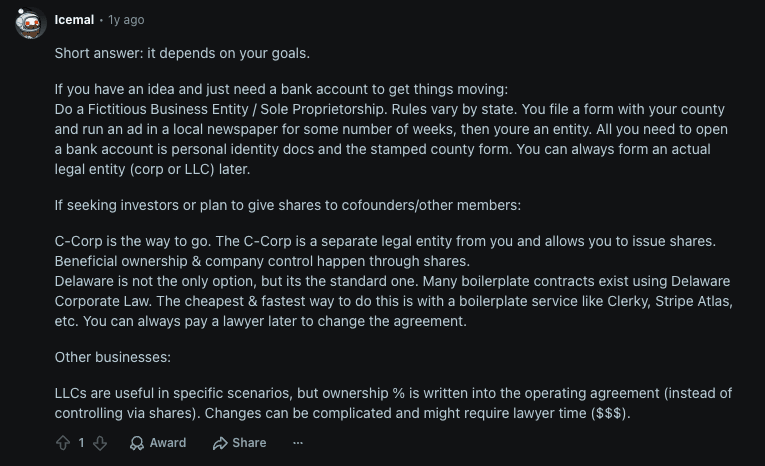
A top comment in this r/ycombinator thread laid it out clearly:
"Short answer: it depends on your goals. If seeking investors or plan to give shares to cofounders: C-Corp is the way to go. Delaware is not the only option, but it's the standard one. The cheapest and fastest way to do this is with a boilerplate service like Clerky, Stripe Atlas, etc. You can always pay a lawyer later to change the agreement."
The service is secondary. Getting the structure right is what matters.
What Reddit agrees on:
Both services work for standard Delaware C-Corp incorporations
Clerky is the better pick if you are raising capital and need ongoing legal documents
Atlas is faster and cheaper if you just need the company formed
The 83(b) election is the most commonly missed step. Treat it as mandatory
For anything non-standard, talk to a lawyer before you file
For a deeper look at either option on its own, read our full Stripe Atlas review and Clerky review.
Related incorporation guides
The full ranking: See our roundup of the best incorporation services for startups, scored on price, speed, and what comes after filing.
Atlas, reviewed: Read our full Stripe Atlas review for what the $500 covers and where it stops.
Clerky, reviewed: Read our full Clerky review for what the $819 lifetime package actually buys.
Beyond Stripe Atlas: Browse the best Stripe Atlas alternatives for providers with banking, bookkeeping, or lower fees built in.
Beyond Clerky: See the 7 best Clerky alternatives for options that bundle banking or charge a lower one-time fee.
Atlas vs Firstbase: Read the full Stripe Atlas vs Firstbase comparison.
Atlas vs doola: Read the full doola vs Stripe Atlas comparison.
Ready to incorporate? Rho Incorporation forms your Delaware C corp with attorney-reviewed filings, includes your first year of registered agent service, and gives you same-day access to Rho banking, corporate cards, and treasury once approved.
FAQs
No. Both services are self-serve. Neither one reviews your specific situation before filing. If your incorporation includes anything unusual, such as complex equity splits, existing IP, or non-standard vesting, talk to an attorney first.
Yes. Atlas documents are Delaware-standard and thousands of startups have used them. The limitation is not legal quality. It is customization. Standard documents work fine for standard situations.
Yes. Clerky's documents work for any Delaware C Corp regardless of where you incorporated. Form with Atlas and use Clerky for SAFEs or hiring paperwork later. That is a common pattern.
If you plan to raise venture capital, choose a Delaware C Corp. Most VC fund structures cannot legally invest in LLCs. C Corps issue preferred stock, support ISO stock options, and allow 83(b) elections. If you are bootstrapped and never plan to raise, an LLC is simpler. For everyone else, choose the C Corp.
Yes. Atlas is open to founders from more than 140 countries. Clerky is also available internationally but is primarily built for US-based startups.
LegalZoom works well for forming a corporation or LLC in any state, and its higher tiers include attorney consultations. It is not built for venture-track startups. There is no automatic 83(b) election filing, no founder stock with vesting, and no SAFEs or fundraising documents. If you plan to raise capital, Stripe Atlas or Clerky will get you closer to investor-ready.
Yes. Rho Incorporation files attorney-reviewed Delaware C Corp paperwork and opens your Rho banking account the same day you incorporate, before your EIN arrives. The $400 fee is credited back when you deposit $10,000 of new money into your Rho checking account and keep your daily average balance $10,000 above where it started for the 60 days after you incorporate. A registered agent for year one, EIN filing, and 83(b) elections are included.
As of August 26, 2026, Clerky operates independently within Stripe. Founder Darby Wong said the team will keep building for high-growth startups and their attorneys with the same team and focus, and no pricing or product changes have been announced. Clerky's Delaware C-corp formation and document library work the same way they did before the acquisition.
For a self-serve Delaware C corp with EIN, 83(b) filing, and first-year registered agent bundled at $500, yes, it is fair value. It is less worth it if you need hands-on support, a non-Delaware entity, or banking that opens with your company, since those are the areas where alternatives are stronger.
No. Clerky pre-fills your information to make applying to outside banks easier, but it doesn't include or bundle an account, and it doesn't name a specific bank partner on its own pricing pages. You'll still complete a separate application wherever you choose to bank.
Yes. Neither Atlas nor Clerky locks your banking to a specific provider long-term. Atlas offers a Stripe Treasury option at signup, and Clerky assists with applications elsewhere, but your formation documents work with any bank you choose once your EIN is issued.
Platform fees are a one-time cost ranging from $400 to $819 depending on the provider (Rho, Atlas, and Clerky's Pay Per Use and Lifetime tiers). Delaware's corporate franchise tax is separate and recurring: it's billed annually, starting at a $175 minimum under the Authorized Shares Method, on top of a separate state filing fee due at the time of incorporation.
Clerky is the closest alternative if you want deeper legal documents for fundraising. Rho is the closest alternative if you want incorporation and your business account opened in the same flow instead of as two separate signups. Both file the same Delaware C-corp paperwork Atlas does. See how the combined flow works on Rho's incorporation page.
The moment you have a term sheet from an actual investor, not just a SAFE. A priced round brings new board consents, updated cap table math, and investor-specific closing documents beyond what Atlas, Clerky, or Rho generate automatically. That's when most founders bring in a startup lawyer to paper the round.
Stripe Atlas states you'll be incorporated within two business days. Clerky states its typical turnaround for a filed certificate is two to three business days. Both timelines cover the state filing itself, not downstream steps like EIN issuance, which can take longer.
Not once you account for what's missing. LegalZoom's LLC tiers run $0 to $299 plus state fees, with EIN support only on Pro and Premium, and no published Delaware C-corp price. Atlas and Clerky bundle the EIN, registered agent, and startup documents a C-corp needs into one flat fee, so the sticker price alone isn't a fair comparison.