

Updated August 6, 2026 — registration steps, deadlines, and rates below were verified against official Washington agency sources in August 2026. Confirm current figures with the agencies before filing.
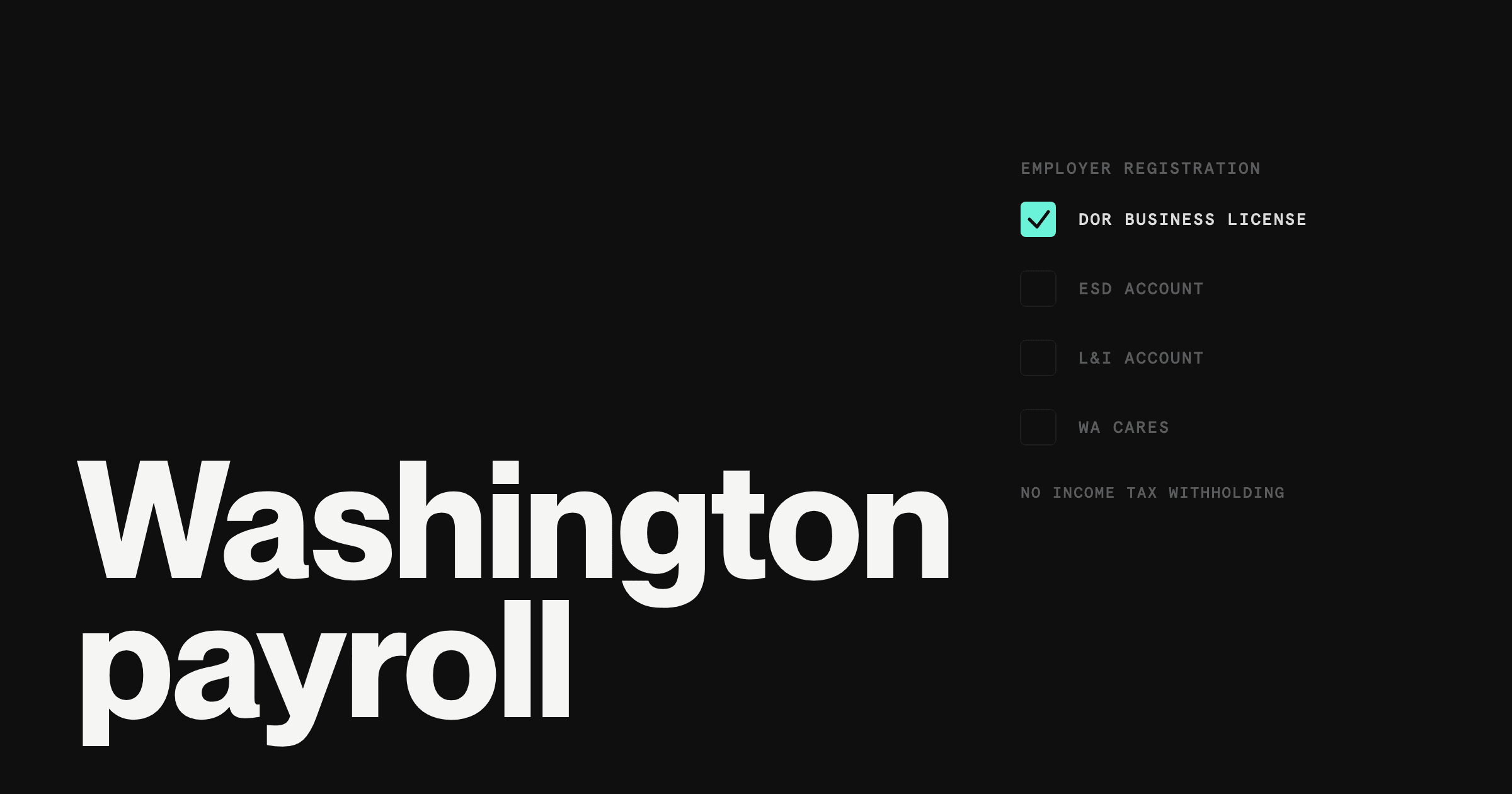
Washington has no broad-based tax on wage income, so there's no state income-tax withholding account to set up — but employer registration is heavier than most states.
One Business License Application filed with the Department of Revenue opens both your unemployment insurance account (ESD) and workers' compensation account (L&I).
You must register if you plan to hire employees within the next 90 days — before your first payroll run, not after.
As of August 2026, employers also collect and remit Paid Family & Medical Leave (1.13%) and WA Cares (0.58%) premiums through a combined quarterly report.
Everything runs on the same quarterly deadlines — April 30, July 31, October 31, January 31 — and reports are required even with zero payroll.
New hires must be reported to the Division of Child Support within 20 days.
Why payroll registration in Washington works differently
Most state payroll guides start with income tax withholding. In Washington, you can skip that chapter entirely: the state does not levy a broad-based tax on wage income, so there is no state withholding account to open for employee paychecks. Instead, Washington concentrates its employer obligations in four programs — unemployment insurance, workers' compensation, Paid Family and Medical Leave (PFML), and the WA Cares Fund — and it expects you to register early. The Department of Revenue (DOR) requires a business license if you plan to hire employees within the next 90 days, which puts registration on your checklist before the first offer letter is signed, not after. If you're also new to running payroll for the first time, start the paperwork now, because state processing takes real calendar time.
One application, four programs, three agencies
The unusual part of Washington's system is that you don't register with each agency separately. A single Business License Application filed with DOR is the front door to your employer accounts:
Unemployment insurance — issued by the Employment Security Department (ESD). This is an employer-paid tax on the first $78,200 of each employee's wages for 2026 (the wage base rises to $82,000 in 2027).
Workers' compensation — issued by the Department of Labor & Industries (L&I). Washington employers get coverage by opening an L&I account through the state business license, and premiums are charged per hour worked by risk classification rather than as a percentage of payroll.
Paid Family and Medical Leave — administered by ESD. As of August 2026, the premium is 1.13% of gross wages (excluding tips), up to the Social Security cap of $184,500. Employers with fewer than 50 employees are not required to pay the employer share of the premium (28.57% of the total), but they must still collect the employee share from paychecks or cover it themselves.
WA Cares Fund — the state long-term care program. The premium is 0.58% of gross wages and is fully employee-paid; the employer's job is to deduct it each pay period and remit it alongside Paid Leave premiums.
Step by step: registering through DOR
File the Business License Application online through My DOR. DOR's Business Licensing Wizard will tell you which endorsements and fees apply to your situation, since the application fee varies.
Indicate that you plan to hire employees. This answer is what triggers the creation of your unemployment insurance account at ESD and your workers' compensation account at L&I — there is no separate application for either.
Receive your Unified Business Identifier (UBI) number. Online applications take roughly 10 business days to process; mailed applications can take up to six weeks.
Wait for L&I contact. Your application is assigned to an account manager within about a week, who will confirm your risk classification. You'll then receive a rate notice, certificate of coverage, and required workplace posters by mail.
Set up SecureAccess Washington (SAW). This single login is the gateway to EAMS (ESD's quarterly filing system), your Paid Leave and WA Cares employer account, and the state's new-hire reporting service.
Once the accounts exist, most payroll software can calculate the premiums and file the ongoing reports — but no software can create the underlying state accounts for you.
What you'll file every quarter
Washington runs on a single quarterly rhythm: reports for each calendar quarter are due April 30, July 31, October 31, and January 31.
ESD tax and wage reports, filed through EAMS. You must file each quarter while your account is active, even with no employees and no payroll. As a new employer in 2026, your tax rate is 115% of the average rate for your industry (federal law sets a 1% minimum), and you move to experience rating after roughly two and a half to three years in business.
L&I workers' compensation reports, based on hours worked. A quarter with no workers still requires a report showing zero hours.
A combined [Paid Leave and WA Cares report](https://paidleave.wa.gov/reporting/) covering each employee's total hours (including paid time off) and wages (excluding tips), with premiums paid at filing. Note the enforcement change: beginning August 1, 2026, Paid Leave applies penalties to past-due reports and interest to overdue balances.
[New hire reporting](https://www.dshs.wa.gov/esa/division-child-support/new-hire-reporting) to the Division of Child Support within 20 days of hire or rehire, including the employee's name, address, Social Security number, date of birth, and hire date.
A note for remote and out-of-state employers
Washington's premium programs follow where the work is performed, not where the company is headquartered. An employee who lives in another state but works entirely in Washington is localized to Washington and subject to premiums; an employee who lives in Washington but works entirely out of state is not. A Delaware or California startup hiring its first remote employee in Seattle goes through the same Business License Application and opens the same four accounts as a hometown company.
FAQ
Does Washington withhold state income tax from employee paychecks?
No. Washington does not have a broad-based personal income tax on wages, so there is no state income-tax withholding to set up. The state funds itself primarily through sales tax, business and occupation (B&O) tax, and the employer programs described above.
How much unemployment tax will a brand-new startup pay?
As of 2026, new employers pay 115% of the average rate for all businesses in their industry, with a federal minimum of 1%, applied to the first $78,200 of each employee's annual wages. ESD recalculates rates every year and shifts you to an experience-based rate after about two and a half to three years.
Do I have to file quarterly reports before I run my first payroll?
Yes, once your accounts are active. ESD requires a tax and wage report every quarter even with no payroll, L&I requires a zero-hours report, and Paid Leave requires a quarterly filing even if you had no payroll. Filing the no-payroll versions takes minutes; skipping them triggers penalties.