
Every investment involves a tradeoff.
Taking additional credit or interest-rate risk can increase potential yield. But when it comes to operating cash–the money a business may need for payroll, vendors, taxes, or other near-term expenses–yield is only part of the equation.
Liquidity and the potential for changes in principal value matter too.
That’s why Rho Treasury is changing how we handle new allocations to the Vanguard Short-Term Investment-Grade Fund (VFSTX / VFSUX). Here’s what is changing, why we made the decision, and what it means if you already hold the fund.
What’s changing
Beginning Thursday, October 1, 2026, VFSTX or VFSUX will no longer be available for new Rho Treasury clients or for new allocations from clients who do not already hold the fund.
If you already hold VFSTX or VFSUX, your existing shares will remain invested unless you choose to sell them. We’ll contact you separately about how you want the portion of new cash currently designated for VFSTX or VFSUX to be invested going forward.
Nothing changes for clients who do not currently hold VFSTX or VFSUX.
VFSTX / VFSUX and T-Bills solve different problems
Both VFSTX / VFSUX and U.S. Treasury Bills are fixed-income investments, but their risk profiles are different.
Vanguard describes VFSTX / VFSUX as an actively managed short-term bond fund that invests primarily in investment-grade corporate bonds. As of August 31, 2026, Vanguard reported that the fund had an average duration of approximately 2.7 years.
T-Bills, by comparison, are short-term obligations of the U.S. government. The U.S. Treasury issues bills with maturities ranging from four to 52 weeks. Rho Treasury uses shorter-duration T-Bills, including 13-week T-Bills.
That distinction matters for operating cash.
Credit risk
VFSTX / VFSUX invests primarily in investment-grade corporate fixed-income securities. Those securities expose investors to credit risk: if the financial condition or perceived creditworthiness of an issuer deteriorates, the value of its bonds may decline.
That additional credit exposure can also contribute to higher potential yields.
T-Bills do not carry corporate credit risk. They are direct obligations of the U.S. government and are backed by its full faith and credit.
That does not mean T-Bills are risk-free. Their market value can change before maturity, and an investor who sells a T-Bill before maturity may receive more or less than the price paid.
Interest-rate risk
Interest rates and bond prices generally move in opposite directions: when market interest rates rise, the value of existing fixed-income securities generally falls, and vice versa.
Duration is one way of measuring a bond or bond fund’s sensitivity to changes in interest rates.
Vanguard reported an average duration of approximately 2.7 years for VFSTX or VFSUX as of August 31, 2026. Because the 13-week T-Bills used in Rho Treasury have a substantially shorter maturity, they generally have less price sensitivity to changes in market interest rates.
For operating cash that may be needed on relatively short notice, we believe that difference is meaningful.
What happens at maturity
There is another important difference between owning a bond fund and owning an individual T-Bill.
VFSTX or VFSUX does not have a maturity date at which an investor is entitled to receive a predetermined face value. Its shares are bought and sold at the fund’s net asset value, or NAV, which fluctuates.
A T-Bill has a stated maturity date. Treasury explains that bills are sold at par or at a discount and that, at maturity, Treasury pays the bill’s face value.
If a T-Bill is sold before maturity, however, its market value can fluctuate and the investor may realize a gain or loss.
The tradeoff: potentially less yield for less credit and duration risk
There’s no free lunch in fixed income.
Corporate bonds generally offer additional yield in exchange for taking additional risks, including corporate credit risk. Moving new allocations from VFSUX to short-term T-Bills may therefore mean accepting a lower yield than VFSUX may offer at a particular point in time.
VFSTX or VFSUX remains a short-term, investment-grade bond fund designed by Vanguard to seek current income while maintaining limited price volatility. It may be appropriate for investors willing and able to accept additional credit risk, interest-rate risk, and fluctuations in NAV in pursuit of additional income.
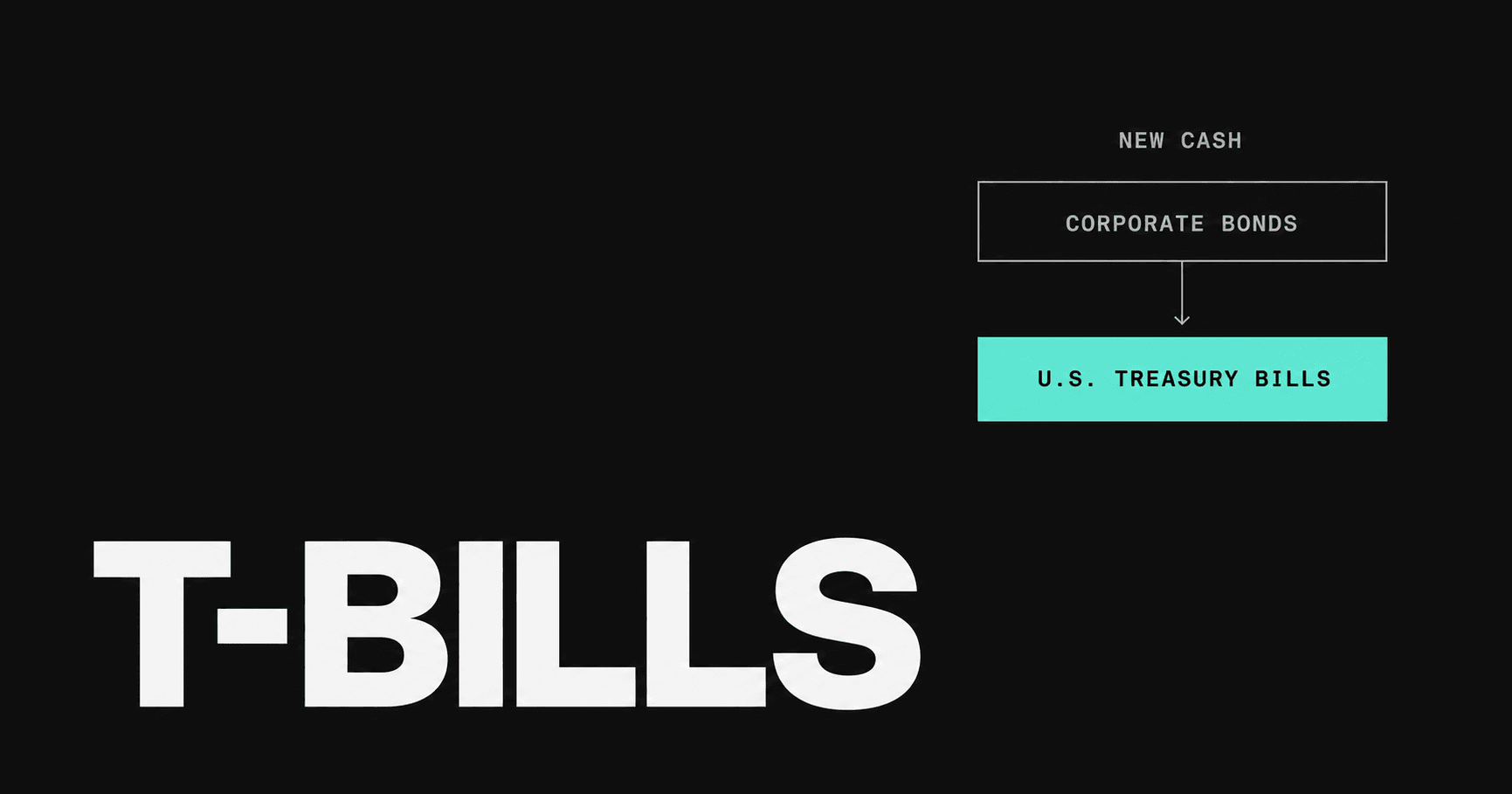
Our decision is narrower: for operating cash with near-term liquidity needs, Rho believes short-duration U.S. Treasury securities provide a more appropriate balance of principal stability, liquidity, and yield within the Rho Treasury program.
That does not mean T-Bills will outperform VFSTX or VFSUX. In some market environments, VFSTX or VFSUX may produce higher income or better total returns. The appropriate investment depends on factors including an investor’s objectives, liquidity needs, time horizon, and tolerance for changes in principal value.
What this means if you already hold Vanguard
If your Rho Treasury account currently holds VFSTX or VFSUX, your existing investment will remain in place unless you choose to sell it.
You’ll receive an email from us with two options:
Opt in: The portion of new cash currently allocated to VFSTX or VFSUX will instead be invested in T-Bills. Your existing Vanguard shares will remain invested.
Opt out: We will continue to invest the applicable portion of new cash in VFSTX or VFSUX according to your existing allocation.
You’ll need to make your election by Friday, October 9, 2026. If you don’t respond by the deadline, we will apply the change to future allocations.
Your existing VFSTX or VFSUX shares will not be sold as part of this change unless you separately instruct us to sell them.
For more information, see Managing your Rho Treasury account.
The bottom line
For operating cash, we believe the investment question is about more than maximizing yield.
It’s about matching the investment to the job the cash needs to do.
For money a business may need in the near term, Rho believes shorter-duration U.S. Treasury securities offer an appropriate balance of liquidity, principal stability, and yield while reducing the corporate credit and duration exposure associated with VFSTX or VFSUX.
That comes with a tradeoff: T-Bills may provide less income than VFSTX or VFSUX, and VFSTX or VFSUX may outperform T-Bills in certain market environments.
For operating cash, we believe that is a tradeoff worth making.
Questions? Talk to a Rho Treasury advisor or contact Rho Client Service.
Important information
This material is provided for general informational and educational purposes. It does not take into account the investment objectives, financial circumstances, liquidity needs, or other circumstances of any particular client and should not be construed as legal, tax, or accounting advice.
All investments involve risk, including possible loss of principal. Fixed-income securities are subject to risks including interest-rate, market, credit, and liquidity risk. Mutual fund values fluctuate, and investors may receive more or less than their original investment when shares are sold.
U.S. Treasury securities are backed by the full faith and credit of the U.S. government as to the timely payment of principal and interest when held to maturity. Treasury securities sold before maturity are subject to market risk and may be sold for more or less than their purchase price.
Rho Treasury investments are not deposits or other obligations of Webster Bank, a division of Santander Bank, N.A., or American Deposit Management Co.’s partner banks; are not guaranteed by those institutions; and are not FDIC insured. Investment products involve risk, including the possible loss of principal.
Investment management and advisory services are provided by RBB Treasury LLC dba Rho Treasury, an SEC-registered investment adviser and subsidiary of Rho. Registration with the SEC does not imply a certain level of skill or training.
Treasury and custodial services are provided through Apex Clearing Corporation and, where applicable, Interactive Brokers LLC, registered broker-dealers and members FINRA/SIPC. SIPC protection does not protect against losses from a decline in the market value of securities.
For additional information regarding Rho Treasury’s investment management and advisory services, including applicable risks, fees, and conflicts of interest, please refer to Rho Treasury’s Form ADV Part 2A brochure and applicable account documentation.
Rho is a fintech company, not a bank or an FDIC-insured depository institution. Checking account and card services are provided by Webster Bank, a division of Santander Bank, N.A., Member FDIC. Savings account services are provided by American Deposit Management Co. and its partner banks. International and foreign currency payment services are provided by Wise US Inc.
FDIC deposit insurance is available only for eligible deposits held at an FDIC-insured bank, subject to applicable FDIC limits, requirements, and conditions. FDIC insurance does not protect investment products or protect against the failure of Rho or other non-bank third parties.
Third-party links are provided for informational purposes only. Rho does not control or endorse third-party websites or content and makes no representation regarding the accuracy or completeness of information provided by third parties. Third-party information is subject to change.
Sources
Vanguard — Vanguard Short-Term Investment-Grade Fund (VFSUX): Fund objectives, portfolio characteristics, duration, holdings, and investment risks.
U.S. Department of the Treasury / TreasuryDirect — Treasury Bills: Information regarding T-Bill maturities, issuance, pricing, and payment at maturity.
U.S. Securities and Exchange Commission — Investor Bulletin: Fixed Income Investments: General information regarding interest-rate, credit, and other risks associated with fixed-income investments.