
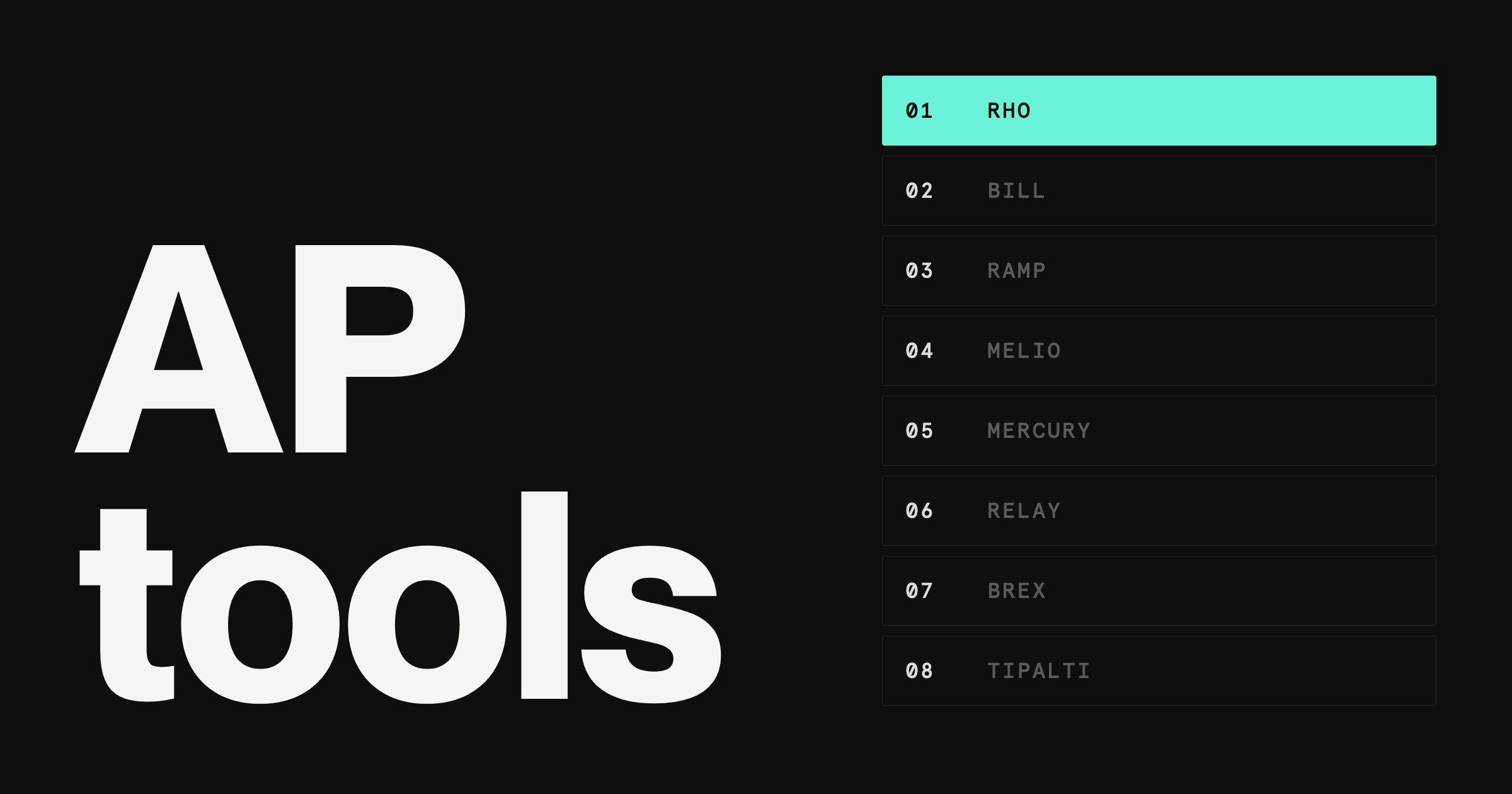

Eight AP automation tools compared on fees, payment types, approval workflows, and accounting sync.
Highlights
Best if you bank with Rho: Rho Bill Pay (free with the account, no ACH fees, approvals built in)
Best dedicated AP platform: BILL (from $49 per user per month plus per-payment fees)
Best free plan with spend management attached: Ramp ($0 plan includes bill pay)
Best for a handful of monthly bills: Melio (5 free ACH transfers per month on the free plan)
Best for Mercury customers: Mercury (free unlimited bill pay inside the account)
Best for Relay checking customers: Relay (bill management on the $0 plan, automation on paid tiers)
Best for card-first startups: Brex (bill pay included in the $0 Essentials plan)
Best for global payouts at scale: Tipalti (from $99 per month plus transaction pricing)
Paying vendors should be the boring part of running a startup. In practice it is a pile of emailed invoices, a Slack thread asking who approved what, and a spreadsheet nobody trusts. This comparison covers the eight AP automation tools startups actually shortlist, what each one costs, and where each one genuinely wins.
Head-to-Head Comparison
Platform | Free tier | Payment types | Approval workflows | Accounting integrations | Best for |
|---|---|---|---|---|---|
Rho | Yes, included with every Rho account | ACH with zero fees, wires including international, single-use vendor cards | Amount-based approval guardrails, included | Auto-sync with QuickBooks and ERP systems | Startups that want AP inside their banking |
BILL | No, from $49/user/mo | ACH $0.59, checks from $1.99, intl USD wire $19.99 | Yes, multi-user approval workflows | QuickBooks, Xero, and others | Finance teams standardized on dedicated AP software |
Ramp | Yes, $0 plan includes bill pay | ACH, card, check, wire | Yes, tied to spend controls | QuickBooks, NetSuite, and others | Card-first teams that want spend management plus AP |
Melio | Yes, 5 free ACH transfers/mo | ACH $0.50 after free allotment, checks $1.50, cards 2.9% | Yes, varies by plan | QuickBooks, Xero | Very small businesses with a handful of monthly bills |
Mercury | Yes, unlimited free bill pay | ACH, domestic and international wire, check | Multi-layered approval rules, free | QuickBooks, Xero; NetSuite on paid plans | Startups that bank with Mercury |
Relay | Yes, bill management on $0 Starter | ACH and wires, fees vary by plan; 10 free same-day ACH/mo on Scale | Multi-step bill approval rules on all plans | QuickBooks, Xero | Small businesses on Relay checking |
Brex | Yes, $0 Essentials includes bill pay | Pay bills from the Brex business account | Yes, with automatic invoice entry | QuickBooks, NetSuite, and others | Venture-backed startups already on Brex cards |
Tipalti | No, from $99/mo plus transaction pricing | Global payment methods across many currencies | Yes, enterprise-grade controls | NetSuite and major ERPs | Global payouts at scale |
Prices verified August 2026 from each provider's published pricing. Transaction fees are set by each provider and can change.
How We Evaluated
We scored each tool on five things that matter to a startup paying its first few hundred bills, not to an enterprise AP department.
Fee structure. The subscription plus the per-payment fees that quietly stack on top of it.
Payment speed. How fast money actually reaches the vendor, and what expedited rails cost.
Approval workflows. Whether you can enforce who signs off before money moves, without a paid upgrade.
Accounting integration depth. Whether bills and payments sync to your books automatically or become month-end cleanup.
Startup fit. Setup time, learning curve, and whether the tool makes sense before you have a finance team.
One honest note up front. If you run global payouts across many entities and currencies, a dedicated platform like Tipalti will serve you better than any banking-native tool. If you pay mostly US vendors and want AP handled without another subscription, read on.
Rho
Rho Bill Pay is built into the Rho platform, so accounts payable runs from the same place your money lives. There is no separate subscription, and vendor payments by ACH carry zero fees.
Here's how it works. You forward invoices to a dedicated AP inbox, and Rho uses OCR to convert each file into a draft bill. Amount-based approval guardrails route every bill to the right approver before payment, and bill and payment details auto-sync with your accounting software so there is less to clean up at month end.
Because payment and banking happen on one platform, there is no settlement lag between an AP tool and a bank account, and no second system to reconcile against. Rho also supports international bills, single-use vendor cards, and scheduled payments to capture early-pay discounts. AP pairs with Rho expense management on the spend side, so payables and card spend sit in one place.
Pros
Free with the Rho account, no per-user AP subscription
Zero fees on ACH vendor payments
AP inbox with OCR turns emailed invoices into draft bills
Amount-based approval guardrails included
Payments settle from the same platform, so reconciliation is not a separate job
Cons
Requires a Rho account, it is not a standalone AP tool
Not built for enterprise procurement or mass global payouts
Verdict: If you bank with Rho, this is the shortest path from invoice to paid vendor, with zero ACH fees and no extra software. See the full feature set at rho.co/product/bill-pay.
BILL
BILL is the default name in standalone AP software, and the pricing reflects it. Essentials is $49 per user per month, Team is $65, and Corporate is $89, with payment fees on top: $0.59 per ACH, $1.99 per mailed check, and $19.99 per international USD wire.
What you get for that is a mature AP system: invoice capture, multi-user approval workflows, and integrations with QuickBooks, Xero, and other accounting platforms. Accountants know it, and many bookkeeping firms run client AP through it.
But do the math for a small team. Three users on Essentials is $147 per month before a single payment fee, for a tool that does not hold your deposits.
Pros
Mature, widely adopted AP feature set
Strong accountant and bookkeeper ecosystem
Works with any bank account
Cons
Per-user subscription plus per-payment fees
$0.59 per ACH adds up at volume
A separate system to reconcile against your bank
Verdict: The safe pick for finance teams that want dedicated AP software and will use enough of it to justify the stack of fees.
Ramp
Ramp bundles bill pay into its free spend management platform. The $0 plan lets you pay bills by ACH, card, check, and wire, and Plus is $15 per user per month for deeper automation.
The draw is the package. If your team already runs on Ramp cards, bills land in the same place as card spend, with approvals tied to the same controls and sync to QuickBooks, NetSuite, and others.
The catch is that Ramp is not where your operating cash lives. Payments still draw from an external bank account, so funding timing and reconciliation involve a second system.
Pros
Bill pay included in the free plan
ACH, card, check, and wire from one tool
Approvals share rails with card spend controls
Cons
Not a bank account, payments fund from elsewhere
Deeper automation sits behind the $15 per user Plus plan
Verdict: The strongest pick if card-led spend management is the priority and AP comes second.
Melio
Melio is the lightest-weight tool on this list. The free Go plan includes 5 free ACH transfers per month, with paid plans at $25, $55, and $80 per month raising the free-transfer allotment.
Beyond the allotment, fees per transaction: $0.50 per ACH, $1.50 per check, and 2.9% to pay by card. The card option is the interesting one, letting you put bills on a credit card even when the vendor only takes bank transfers.
For a business paying five bills a month, Melio is effectively free. Past that, the per-payment meter runs.
Pros
Free plan covers light AP volume
Pay by card even when vendors want a bank transfer
Simple to set up, QuickBooks and Xero sync
Cons
Per-payment fees kick in past the monthly allotment
Expedited payments and wires carry premium fees
Light on controls for growing teams
Verdict: Right for very small businesses with a handful of bills, outgrown quickly once volume or controls matter.
Mercury
Mercury includes bill pay free with its business accounts: unlimited bills, AI-assisted data extraction, duplicate invoice detection, and multi-layered approval rules with sign-off from Slack or the mobile app.
It is the closest analog to Rho's approach, and the free tier is genuinely capable. Payments go out by ACH, domestic and international wire, or check, and W-9 collection plus 1099 filing assistance are built in.
The edges show in accounting depth. NetSuite integration and advanced accounting automations sit on paid plans starting at $35 per month, so teams past QuickBooks pay to close the loop.
Pros
Free unlimited bill pay with approval rules included
ACH, wires, and checks from the account itself
W-9 collection and 1099 assistance built in
Cons
NetSuite and advanced accounting automations require paid plans
Requires banking with Mercury
Verdict: A strong free option for Mercury customers, with accounting depth metered behind paid tiers.
Relay
Relay is a small-business banking platform with AP features layered onto its checking accounts. The $0 Starter plan includes bill creation, intake, and management plus multi-step bill approval rules, Grow is $30 per month with batch vendor payments and savings on payment fees, and Scale is $90 per month with bill payment automation and 10 free same-day ACH transfers monthly.
Relay's core audience is small businesses running envelope-style budgeting across multiple checking accounts, often on the Profit First method. AP is part of the package rather than the headline.
For startups specifically, the fit is narrower. The platform is built around small-business cash management, and the AP automation that matters at volume sits on the $90 per month Scale plan.
Pros
Multi-step bill approvals included on the free plan
Strong multi-account budgeting workflow
Deep QuickBooks and Xero integration
Cons
Bill payment automation requires the $90/mo Scale plan
Same-day ACH allotments are capped by plan
Built for small-business cash management more than startup finance stacks
Verdict: A sensible choice for small businesses already on Relay checking, less compelling as a startup AP platform.
Brex
Brex includes bill pay in its $0 Essentials plan, with automatic invoice entry and payments from the Brex business account. Premium is $12 per user per month for more advanced workflows.
Like Ramp, the pitch is consolidation: cards, expense management, and AP in one system, with accounting sync to QuickBooks, NetSuite, and others. For venture-backed startups already on Brex cards, adding bills is low friction.
The consideration is the same as with any card-first platform: AP is a feature inside a spend management product, and the deeper your payables complexity, the more you feel the edges.
Pros
Bill pay included at $0 with automatic invoice entry
One system for cards, expenses, and bills
Cons
Advanced workflows sit on the $12 per user Premium plan
AP is a feature of the card platform, not the focus
Verdict: Worth it for teams already committed to Brex cards, not a reason to switch on its own.
Tipalti
Tipalti is the enterprise option. AP plans start at $99 per month with transaction pricing layered on top, and the platform is built for mass payouts across many countries, currencies, and legal entities.
The feature set reflects that: self-service supplier portals, tax form collection, multi-entity workflows, and integrations with NetSuite and major ERPs. If you pay thousands of global suppliers or creators, this is the category leader.
For a typical startup paying US vendors, it is more platform than the problem requires, at a price built for companies with an AP department.
Pros
Best-in-class global payout coverage
Supplier portal and tax compliance built in
Multi-entity support for complex structures
Cons
From $99 per month plus transaction pricing
Implementation effort suited to established finance teams
Verdict: The pick when global payout scale is the actual problem, overkill before that.
Which One Should You Pick?
Here's the honest decision tree.
Bank with Rho? Use Rho Bill Pay. It is free, ACH payments carry no fees, and approvals and accounting sync are included. Bank with Mercury or Relay? Their built-in bill pay covers the basics well.
Running a card-first stack? Ramp and Brex both fold AP into their free plans. Need dedicated AP software your accounting firm already knows? BILL. Paying five bills a month? Melio. Paying thousands of global suppliers? Tipalti.
Whatever you pick, add up the real cost: subscription, per-payment fees, and the hours spent reconciling an AP tool against a separate bank account. For a deeper look at the broader market, including enterprise platforms, see our guide to the best Bill Pay software, and if you are choosing where to bank in the first place, start with the best banks for startups.
FAQs
Most startups feel the pain around 10 to 20 bills per month. At that volume, manual data entry, chasing approvals over Slack, and marking payments in a spreadsheet start costing real hours, and a missed due date can strain a vendor relationship.
A good rule: automate when someone on the team spends more than an hour a week processing bills, or when more than one person needs to approve payments. Tools like Rho include AP automation free with the business account, so there is little reason to wait for a dedicated finance hire.
Standalone AP tools typically charge a subscription plus per-payment fees. As of August 2026, BILL starts at $49 per user per month plus $0.59 per ACH payment, Melio's free plan includes 5 free ACH transfers per month with $0.50 per transfer after that, and Tipalti starts at $99 per month plus transaction pricing.
Banking platforms flip that model. Rho, Mercury, Ramp, and Brex all include bill pay with the account at no subscription cost, and Rho charges no fees on ACH vendor payments. For most startups, the real comparison is not tool versus tool, it is standalone subscription versus the bill pay already built into your business banking.
ACH is the cheaper, slower rail: payments settle in one to three business days and cost little or nothing, which makes it the default for routine vendor bills. Wires settle the same day and are harder to reverse, so they are used for urgent, large, or international payments, and most providers charge meaningfully more for them.
The fee spread matters at volume. A startup paying 50 bills a month at $0.50 to $0.59 per ACH on a standalone tool pays real money for the same rail that platforms like Rho include with no ACH fees.
An approval workflow routes each bill to the right approver before any money moves. Rules are usually based on amount, vendor, or department: for example, bills under $1,000 auto-approve, bills over $10,000 require the CEO, and everything else goes to the budget owner.
In practice the tool captures the invoice, applies the rule, notifies the approver, and releases payment once approvals are complete, leaving an audit trail the whole way. Rho Bill Pay includes amount-based approval guardrails with the account, so startups can enforce controls without buying separate AP software.
Usually not at startup scale. Built-in bill pay from platforms like Rho covers the core AP loop: invoice capture, approval routing, scheduled payments, and accounting sync, without a second subscription or another tool to reconcile against.
Standalone AP software earns its cost in specific cases: mass global payouts across many currencies and entities (Tipalti's specialty), complex procurement flows, or a finance team standardized on a tool like BILL. If none of those apply, start with what your banking platform includes and add software only when a concrete gap shows up.