

Search for the best state to form an LLC and you will find a wall of articles pushing Delaware, Wyoming, or Nevada. Most of them are written by companies that get paid when you form an out-of-state LLC.
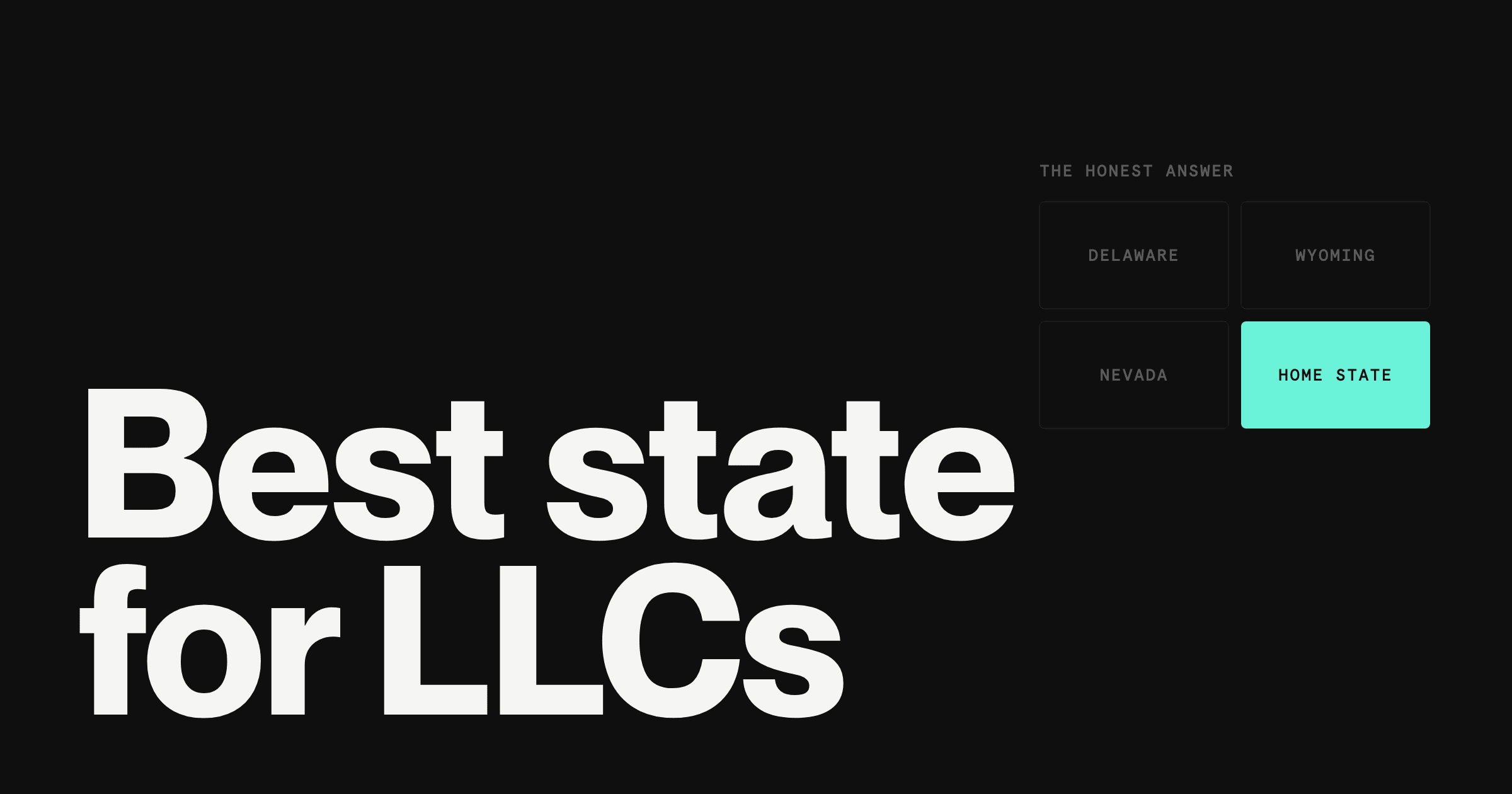
Here is the answer those articles bury: for roughly 95% of business owners, the best state to form your LLC is the state where you live and operate. Forming anywhere else usually means paying two states every year for the privilege of extra paperwork. Delaware, Wyoming, and Nevada each make sense in specific situations, and we will cover exactly what those are. But the default answer is home.
If you live and operate in one state, form your LLC there. An out-of-state LLC still has to register as a foreign LLC in your home state, so you pay both states' fees, maintain two registered agents, and file twice the paperwork.
Delaware makes sense if you are raising institutional capital or expect complex multi-member ownership. Its business courts and case law are unmatched, but its LLC franchise tax is now $400 per year.
Wyoming is the low-cost, high-privacy option: $100 to form and a $60 minimum annual report, with no state income tax and no public member names.
Nevada markets itself on privacy and no income tax, but at $425 to form and $350 per year it is hard to justify over Wyoming.
Non-US residents are the big exception to the home-state rule, since they have no home state. Delaware and Wyoming are the standard choices.
Why your home state usually wins
An LLC does not free you from the rules of the state where you actually do business. States regulate and tax activity that happens inside their borders, regardless of where your entity is registered.
Say you live in California and form a Wyoming LLC to avoid California costs. The moment that LLC does business in California, which includes you running it from your living room, California requires it to register as a foreign LLC and pay the state's $800 minimum annual franchise tax anyway. Now you are paying Wyoming's fees and California's, plus two registered agents, and you have gained nothing. Skipping the registration is not a loophole either: it exposes you to penalties and can prevent your LLC from enforcing contracts in your home state's courts.
The same logic applies in every state. Out-of-state formation does not reduce your home state income taxes, does not exempt you from local licenses, and does not hide you from your own state's tax authority. What it reliably does is double your annual compliance cost.
So the honest framework is simple: form at home unless you fall into one of the exceptions below.
Delaware vs Wyoming vs Nevada vs your home state
Delaware | Wyoming | Nevada | Your home state | |
|---|---|---|---|---|
Filing fee | $110 | $100 | $425 total ($75 articles + $150 initial list + $200 business license) | Varies, roughly $35 to $500 |
Annual cost | $400 franchise tax | $60 minimum annual report | $350 ($150 annual list + $200 license renewal) | Varies, $0 to $800+ |
State income tax on LLC income | None on income earned outside Delaware | None | None | Your normal state rates |
Privacy | Members not listed on formation filing | Strong; no member or manager names required | Members or managers listed on public annual list | Most states list members or organizers |
Courts and case law | Court of Chancery, deepest business case law in the US | Standard state courts, business-friendly statutes | Business court program, far less precedent than Delaware | Varies |
Best for | Startups raising capital, complex ownership | Low-cost holding companies, privacy, non-residents | Rarely the best answer at current prices | Almost everyone else |
Delaware's annual tax deserves a note: it was $300 for years, but HB 400 raised it to $400 beginning with the 2026 tax year, so older comparisons understate the gap between Delaware and Wyoming.
When Delaware makes sense
Delaware earns its reputation for one audience in particular: companies with outside investors. Its Court of Chancery decides business disputes quickly with expert judges and no juries, its LLC statute gives members almost total freedom of contract, and decades of case law make outcomes predictable. Investors, lawyers, and lenders all know Delaware paperwork on sight.
If that is you, our step-by-step Delaware LLC formation guide covers the whole process. One caveat before you start: founders planning to raise venture capital usually should not be forming an LLC at all. VCs invest in Delaware C corporations, and starting as an LLC means a costly conversion later.
When Wyoming makes sense
Wyoming invented the LLC in 1977 and remains the cheapest serious option: $100 to form, a $60 minimum annual report, no state income tax, and no corporate presence requirements. Its biggest differentiator is privacy. Wyoming does not require member or manager names on public filings, which is why it is the default for anonymous holding companies and asset-protection structures.
Wyoming is a strong choice for holding companies, real estate entities, online businesses with no fixed operating state, and non-US founders who do not need Delaware's legal machinery. For a detailed head-to-head, see Delaware vs Wyoming LLC.
When Nevada makes sense
Nevada built a business-friendly brand on no state income tax and strong charging-order protection, but the math has stopped working. Between the articles of organization, the initial list of managers, and the mandatory state business license, forming a Nevada LLC costs $425, and the annual list plus license renewal run $350 every year after. Member or manager names also appear on the public annual list, so the privacy pitch is weaker than Wyoming's.
Unless you actually live or operate in Nevada, Wyoming delivers the same core benefits at a fraction of the price.
The exceptions to the home-state rule
You are raising institutional capital. Investors expect Delaware. If venture capital is the plan, talk to your counsel about a Delaware C corp rather than an LLC.
You are a non-US resident. With no home state, you get to pick, and Delaware and Wyoming are the standard answers. Our guide to Delaware LLCs for non-US residents covers EINs, taxes, and banking.
You need anonymity. Wyoming, or a layered structure designed by an attorney, keeps your name off public filings.
You have no fixed operating state. Fully remote businesses with no office or employees anywhere specific have a genuine choice, and usually pick Wyoming on cost or Delaware on legal infrastructure.
Real estate investors. Common practice is to form the LLC in the state where the property sits, since that state's registration is unavoidable anyway.
Whatever state you pick, separate your finances
The state you choose matters less than what you do after formation. Keep business and personal money separate from day one, because commingled funds are the most common way owners lose the liability protection an LLC exists to provide. How your LLC's profits are taxed also follows you, not your formation state; our LLC tax rates guide explains how pass-through taxation works.
Once your LLC is approved and you have an EIN, Rho gives it a real financial stack: business checking, corporate cards with up to 2% cashback on the Platinum tier, treasury, expense management, and invoicing, with an application that takes under 10 minutes. Compare options in our roundup of the best online business bank accounts. And if your plans point to a Delaware C corp instead, Rho Incorporation offers attorney-reviewed Delaware C corp formation today, with LLC support coming soon.
FAQs
For most people, the state where you live and run the business. Forming elsewhere forces you to register as a foreign LLC at home anyway, doubling your fees and paperwork. Delaware is best for companies raising outside capital, and Wyoming is best for low costs and privacy or for owners with no US home state.
Among the popular formation states, Wyoming is the cheapest to both form and maintain: $100 to file and a $60 minimum annual report. A handful of states have lower one-time filing fees, but Wyoming's combination of low ongoing costs, no state income tax, and strong privacy is why it wins on price overall. Remember that the cheapest state on paper is not cheap if you must also register at home.
Yes, but less than the marketing suggests. Your formation state controls filing fees, annual fees, privacy, and which courts interpret your operating agreement. It does not change your federal taxes, and it does not exempt you from taxes and registration in the state where you actually operate.
If you mean total cost of ownership, it is usually your home state, because you avoid paying two states at once. If you have no home state or no fixed operations, Wyoming's $100 formation fee and $60 minimum annual report make it the cheapest credible option.
Delaware is the most sophisticated, with a dedicated business court and the deepest LLC case law, which is why investor-backed companies choose it. Wyoming is the most friendly on cost and privacy. Nevada courts a similar reputation but charges $425 to form and $350 per year, so it rarely wins on the merits anymore.
The big ones: forming out of state without realizing you must also register at home, mixing personal and business funds, skipping the operating agreement, missing annual report or franchise tax deadlines, and forming an LLC when your fundraising plans actually call for a C corporation. Each is cheap to avoid up front and expensive to fix later.
Delaware is the right choice if you are raising institutional capital or need complex multi-member ownership structures, thanks to its Court of Chancery and deep body of business case law. Note that founders planning to raise venture capital typically need a Delaware C corporation, not an LLC, to avoid a costly conversion later.
Nevada charges $425 to form an LLC and $350 per year in ongoing fees, and member or manager names still appear on the public annual list. Wyoming delivers the same core benefits of no state income tax and business-friendly statutes at a fraction of the price.
You will be required to register as a foreign LLC in your home state and pay both states' fees, maintain two registered agents, and meet reporting requirements in both jurisdictions. Skipping the foreign registration is not a loophole and can expose you to penalties while preventing your LLC from enforcing contracts in your home state's courts.
Yes. Non-US residents have no home state, so they can choose freely, and Delaware and Wyoming are the standard options. Delaware suits those who need strong legal infrastructure, while Wyoming is the default for cost and privacy.