
Your bank statement shows a $35 charge you don't recognize. You call support, and it turns out you dipped below a minimum balance you didn't know existed, for four days, three weeks ago. Nobody warned you. That's not a glitch. It's how a lot of business bank accounts are built.
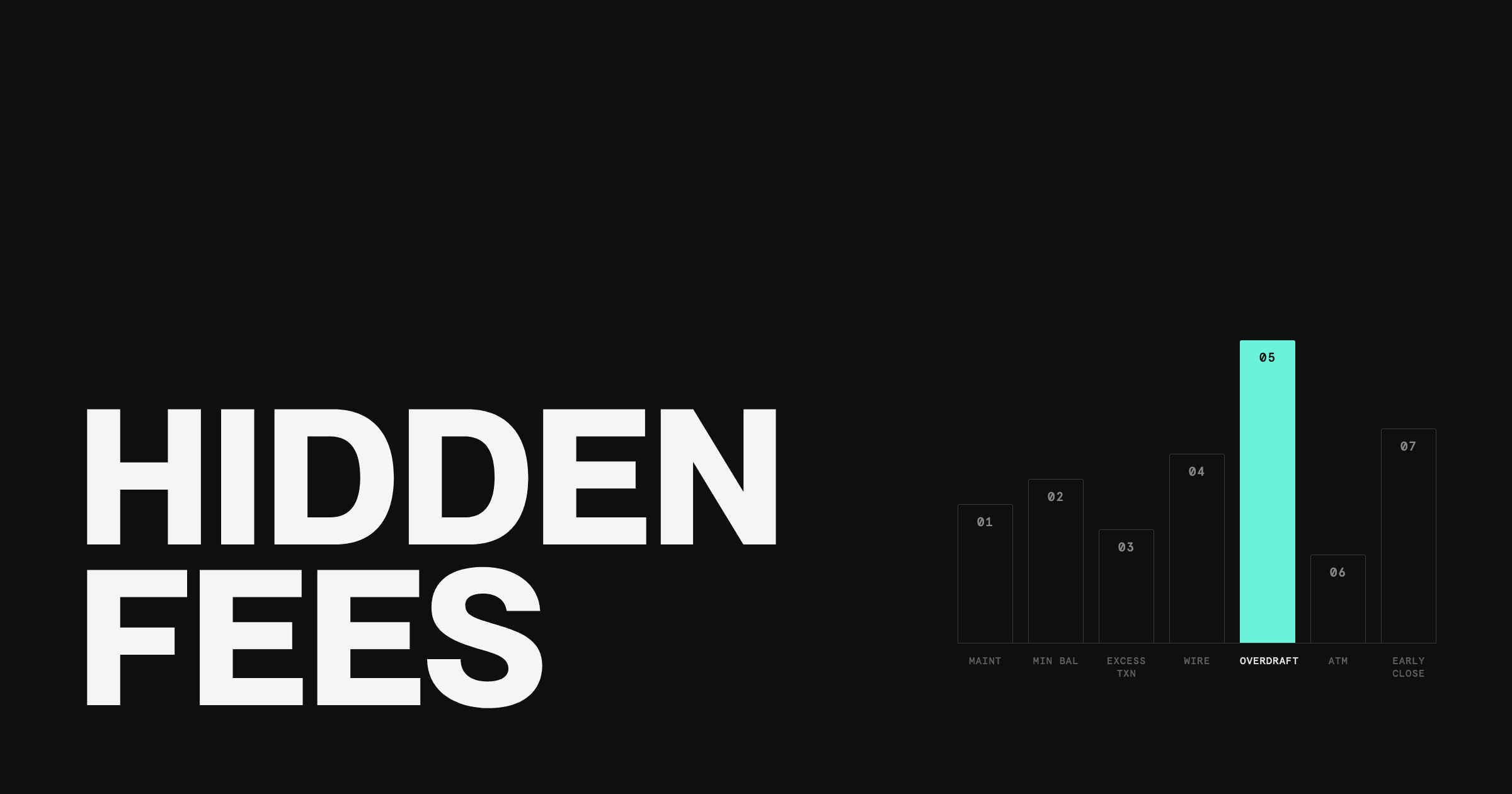
Business bank account fees fall into a fairly short list of categories: monthly maintenance, minimum balance, per-transaction, wire and ACH, overdraft, cash deposit, out-of-network ATM, early closure, and paper statement or stop payment. Some banks charge all nine. Some charge none.
The rest of this piece walks through each one: what triggers it, what it typically costs, and how to avoid it. Figures below come from published fee data at six providers, Sunwest Bank, Lili, Brex, Bank of America, Wells Fargo, and Slash, as of September 2026.
Why banks charge these fees in the first place
A business checking account costs the bank money to run: compliance, fraud monitoring, wire infrastructure, ATM networks, cash handling.
Traditional banks tend to recover that cost through a long list of small, itemized fees. Fintech-model providers tend to recover it a different way, usually by not offering certain services, like cash deposits or branch banking, rather than charging for the ones they do offer.
Neither model is inherently better. But if you don't know which model your provider uses, you'll be surprised by the bill.
Large traditional banks like Bank of America publish detailed fee schedules covering many of these same categories individually. Check your own bank's schedule for the equivalents.
Here's what to check for.
Monthly maintenance fees
A monthly maintenance fee is a flat charge just for keeping the account open, independent of how you use it.
Wells Fargo's three business checking tiers illustrate the range well:
Initiate Business Checking: $15/month
Navigate Business Checking: $25/month
Optimize Business Checking: $75/month
The two lower tiers are waivable under different conditions (see the minimum balance section below); Optimize's fee is offset through an earnings-allowance calculation instead. Lili's tiers run from $0 to $20/month for its Core tier up to $100 or more for its highest tier.
How to avoid it:
Hold the required minimum balance for your tier.
Choose a provider that doesn't charge a monthly fee at all. Rho, for comparison, charges $0 monthly and per-user fees across banking, corporate cards, and expense management.
Minimum balance fees
A minimum balance fee, distinct from the maintenance fee above, kicks in when your account balance drops below a set threshold, even if only briefly.
Wells Fargo waives its $15 Initiate tier with a $2,000 minimum daily balance or a $5,000 average combined balance across linked accounts. Its $25 Navigate tier needs $10,000 daily or $15,000 combined. Miss the threshold on any given day and the fee applies for that cycle, whether or not you noticed.
How to avoid it:
Know your provider's exact threshold, in dollars.
Confirm whether it's measured daily or as an average balance.
Or use an account that doesn't carry a minimum-balance requirement at all.
Per-transaction and excess transaction fees
Some accounts include a set number of free transactions per month, then charge per transaction after that.
Sunwest's educational fee guide cites a typical range of $0.25 to $0.75 per transaction once you exceed your plan's free tier. Lili's guide cites $0.50 per transaction under the same structure. If your business runs high transaction volume, a low free-tier cap turns into a real monthly cost fast.
How to avoid it:
Count your actual monthly transaction volume before choosing a plan.
Confirm whether the tier you're picking has a transaction cap at all.
Wire and ACH fees
Wire fees vary more than almost any other category on this list, both by provider and by domestic versus international routing.
Here's how it breaks down across four providers:
Sunwest: $15 to $50, depending on wire type
Lili: its guide cites $25 to $40 outgoing domestic, $0 to $15 incoming domestic; $25 to $50 outgoing international, $15 to $25 incoming international
Slash: Free plan charges $6 domestic / $25 international; the $25/month Pro plan drops the domestic fee to $0 but keeps the $25 international charge
Brex: $0 across the board, domestic and international, both directions, plus ACH and checks
Here's the catch with any "$0 wire fee" claim, Rho's included: the fee your bank charges is only one leg of the trip. Brex's own fee page notes that "your recipient's financial institution may charge a fee upon receipt of the wire," and on international wires, correspondent and intermediary banks outside either party's control can add their own charges.
Even a domestic wire that gets returned or fails can see roughly $20 to $45 deducted by the receiving bank, a charge neither bank in the transaction actually levies itself.
How to avoid it:
Ask separately about domestic versus international.
Ask separately about incoming versus outgoing.
Remember that a "$0 wires" claim often covers only one of those four combinations, not all of them.
Overdraft fees
An overdraft fee applies when a transaction takes your balance below zero and the bank covers it anyway.
Sunwest cites $25 to $35 per occurrence. Lili's guide cites $10 to $35. Multiply either range by a bad week of timing mismatches between receivables and payables, and it adds up faster than most business owners expect.
How to avoid it:
Set low-balance alerts a few days ahead of major payments.
Or choose a provider that doesn't charge overdraft fees at all.
Cash deposit fees
If your business handles physical cash, some providers charge a fee once you exceed a monthly deposit cap, calculated as a percentage of the amount over that cap. The exact caps and rates vary widely by bank and aren't standardized enough to quote a single range here.
This is also a category where the more important question isn't the fee, it's availability. Fintech-model banking providers are frequently not built to accept cash deposits at all, so if your business runs cash-heavy, confirm this upfront rather than assuming a "no fee" account covers it.
How to avoid it:
Ask directly what your monthly free cash-deposit allowance is.
Ask what happens above that allowance, and get the rate in writing.
Confirm the provider accepts cash deposits at all before you open the account.
Out-of-network ATM fees
Withdraw cash from an ATM outside your bank's network, and you can get charged twice: once by the ATM owner, once by your own bank.
Sunwest quotes $2 to $5 per out-of-network withdrawal from its own side of that charge.
How to avoid it:
Check your provider's in-network ATM footprint before you need cash on the road.
Use a provider with a large surcharge-free network.
Early account closure fees
Close a business account within the first few months of opening it, and some banks charge a fee for the early exit. The trigger window and amount vary bank to bank and aren't published consistently enough across our six-provider set to quote a typical figure here.
How to avoid it:
Read the fee schedule before you open the account.
Check the early-closure clause specifically if there's any chance you'll switch providers within the first year.
Stop payment and paper statement fees
Cancel a check or ACH payment after you've already issued it, and that's a stop payment fee. Lili's guide cites $30 to $35 per request.
A separate, smaller fee shows up for paper statements or copies of old statements instead of online records. The amount varies enough by provider that it's not worth quoting a single range here.
How to avoid it:
Catch payment mistakes before you issue them; canceling after the fact almost always costs more than the error would have.
Switch to digital statements by default to avoid the paper-statement fee.
The fee taxonomy, at a glance
Fee type | Typical range (where published) | Who charges it | How to avoid it |
|---|---|---|---|
Monthly maintenance | $0 to $75+/mo (Wells Fargo tiers: $15, $25, $75; Lili up to $100+) | Most traditional banks; some fintech providers waive it | Meet the minimum balance, or use a $0-fee provider |
Minimum balance | Tied to maintenance tier ($2,000 to $15,000 threshold, Wells Fargo) | Tiered checking products | Track your balance daily, or use an account with no minimum |
Per-transaction / excess | $0.25 to $0.75/transaction (Sunwest); $0.50 (Lili) | Capped-transaction accounts | Confirm your plan's free-transaction cap against real usage |
Wire transfers | $0 (Brex) to $50 (Sunwest, international); Slash $6 to $25 | Most providers, varies by direction/type | Ask domestic vs. international, incoming vs. outgoing, separately |
Overdrafts | $10 to $35 (Lili, Sunwest) | Accounts without overdraft protection | Balance alerts, or a $0-overdraft provider |
Out-of-network ATM | $2 to $5 (Sunwest) | Accounts with a small ATM network | Use in-network ATMs |
Stop payment | $30 to $35 (Lili) | Most accounts | Cancel payments before they're issued |
Fee ranges above reflect providers' own published or self-reported figures. Last verified: September 2026.
Cash deposit and early-closure fees aren't included above; rates vary too widely by provider to quote a typical range (see those sections for what to ask instead).
Rho's approach
Stack Rho against the taxonomy above and three categories fall away entirely: no monthly fee, no minimum-balance trap, and no charge on domestic ACH, wire, or check fees, including domestic wire recalls. Checking balances carry the standard $250,000 in FDIC coverage per entity.
That doesn't erase every fee category. International wires can still carry a $15 SWIFT fee (mandatory with no opt-out on some wire types) and a foreign currency conversion fee of approximately 1% (the exact rate is set per business), comparable to Lili's own 1% to 3% foreign-transaction range, plus a $30 recall fee on international wires. But it removes the fees that hit small businesses most often.
If you're evaluating providers against this list, ask each one directly which of these nine categories they charge for, and get the exact figure in writing rather than relying on a marketing page.
Or skip the exercise: see Rho's full fee schedule to compare. Rho charges $0 across the monthly, minimum-balance, and domestic wire fees above.
FAQs
The exact count depends on who's counting, but the ones that show up on almost every business account's fee schedule are monthly maintenance, minimum balance, per-transaction or excess-transaction, wire and ACH, overdraft, out-of-network ATM, and stop payment fees. Cash deposit and early-closure fees show up less consistently, but they're worth checking for too.
No. Fee-free business accounts exist, and several fintech providers, Brex and Rho among them, publish $0 on some or all of the categories above. The tradeoff is usually reduced access to services traditional banks offer, like cash deposits or branch banking, not a hidden catch on the fees themselves.
It's a charge that applies when your account balance drops below a bank-set threshold, even briefly, distinct from the flat monthly maintenance fee. Wells Fargo's tiers, for example, require anywhere from $2,000 to $15,000 in daily or average balance depending on which checking product you hold.
Most surprise fees trace back to one of two things: a minimum balance requirement you didn't know applied, or a transaction type (a wire, an excess transaction, an overdraft) that falls outside your plan's free allowance. Pull your account's specific fee schedule, not just the marketing page, to see exactly what triggered it.
Often, yes. Many banks will waive a monthly maintenance or overdraft fee once, especially for an account in otherwise good standing, if you call and ask. It's not guaranteed and depends on the bank's policy and your account history, but it costs nothing to ask before you pay it.
Generally yes. Bank fees tied to operating a business account are typically deductible as ordinary business expenses, usually filed under a bank fees or service charges category. Confirm the specific treatment with your accountant, since deductibility rules vary by fee type and structure.
Two related terms come up in the same searches, even though neither is actually a fee, starting with this one. It refers to the Bank Secrecy Act requirement that banks file a Currency Transaction Report for cash transactions over $10,000, part of federal anti-money-laundering rules, not a charge to the account holder.
Also not a fee. It's a Bank Secrecy Act recordkeeping requirement: banks must retain records on funds transfers of $3,000 or more. Like the $10,000 rule, it's a compliance obligation on the bank, not something deducted from your balance.