
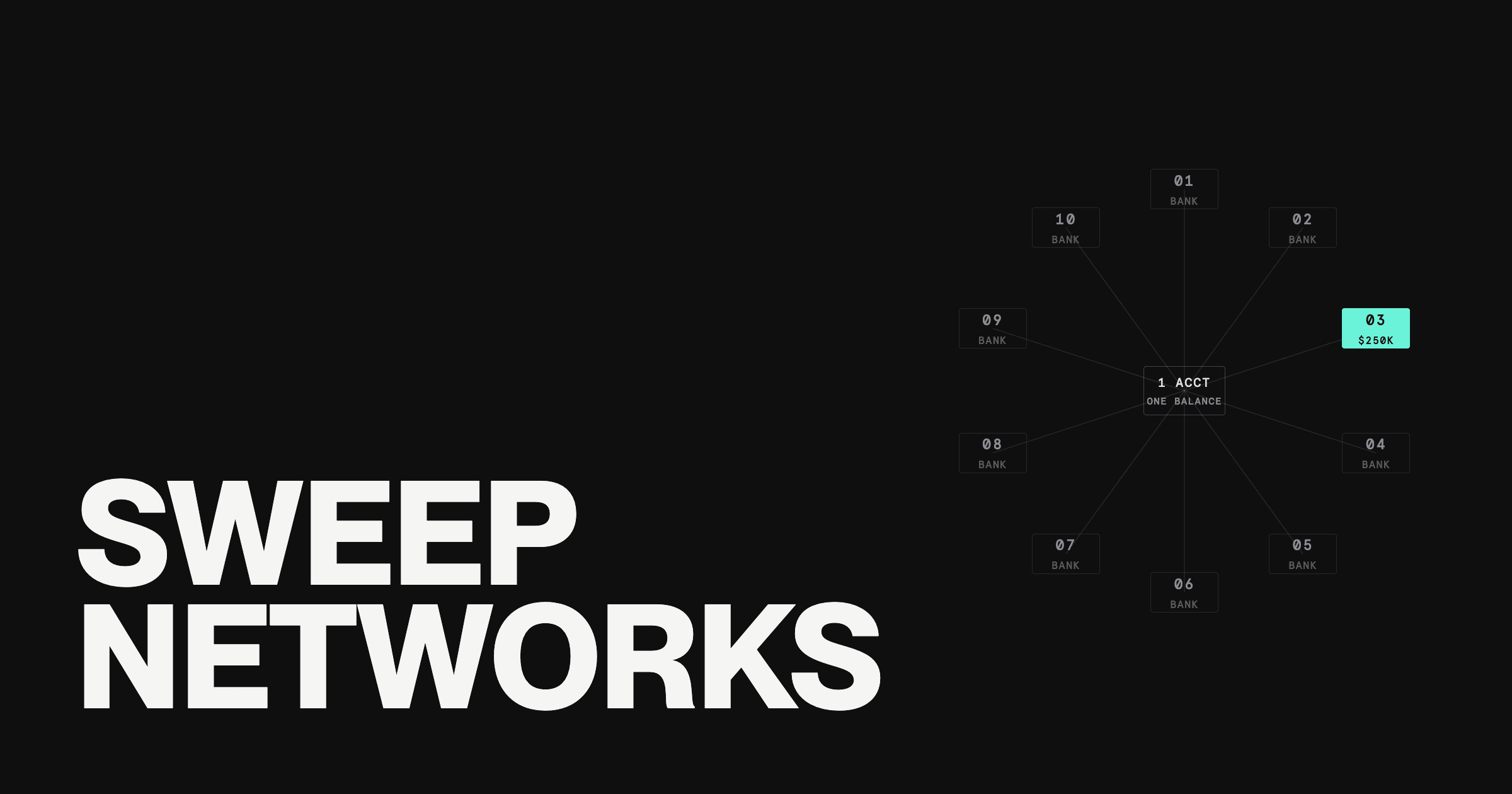
How do sweep networks work?
A single FDIC-insured bank covers $250,000 per depositor. Anything above that is uninsured if the bank fails.
A sweep network gets around this by splitting one deposit across many separate banks, so the same depositor holds less than $250,000 at any single institution. Yes, sweep accounts are FDIC insured: the coverage comes from each participating bank's own FDIC insurance, not from a separate policy the network sells.
Here's the mechanism, step by step:
A program administrator maintains relationships with a network of partner banks and credit unions, sometimes hundreds of them.
When a business deposits cash into the program, the administrator allocates that balance across the network in pieces sized to stay under each bank's insurance ceiling.
The business still sees one balance in one account.
Behind that balance, the cash actually rests in dozens or hundreds of separate FDIC- or NCUA-insured institutions, each holding a piece under its own $250,000 ceiling.
A worked example: a $2,000,000 deposit needs at least 8 banks to stay under $250,000 at each one ($2,000,000 ÷ $250,000 = 8). A network of hundreds of partner banks has far more room than that single deposit needs, which is why coverage capacity for a sweep network scales into the tens or hundreds of millions rather than capping out at a handful of banks.
What are CDARS and ICS?
CDARS (Certificate of Deposit Account Registry Service) and ICS (Insured Cash Sweep, sometimes called IntraFi Cash Service) are the two established multi-bank deposit programs most sweep networks are built on.
This isn't a new idea. It's the same basic structure behind ICS and CDARS-style programs, an older mechanism this space builds on, now packaged into a modern business account instead of requiring the business to open and manage each bank relationship itself. American Deposit Management Co., the administrator behind Rho's own savings program, describes its version as a network of “more than 400 banking partners” that “deposits are distributed across.” ADM holds those deposits as agent for its clients, the structural mechanism that lets FDIC coverage pass through to each underlying depositor rather than pooling as a single insured entity.
The $250,000-per-depositor, per-bank rule that makes any of this necessary is federal law, not a bank's own policy. For the full mechanics of how that limit works, including joint accounts and trust accounts, see how FDIC insurance coverage works.
How coverage ceilings compare across providers
Two things set the ceiling on how much coverage a given sweep network can offer: how many banks sit in the network, and how much of the deposit needs to land at each one. That's why coverage claims vary so much between providers, as of 2026-09-27:
Mercury: according to Mercury's own site, up to 20 banks and roughly $5 million in coverage.
Bluevine: Bluevine's own explainer cites industry-wide ranges of $3 million to $5 million for typical networks and $50 million or more for larger ones, without stating its own product's specific ceiling.
Slash: according to Slash's own site, “hundreds of millions” in coverage through a network of roughly 800 banks.
Brex: no dedicated sweep-network explainer at all; its business-banking content sits in a general resource hub rather than a page naming a network size or coverage figure.
Different network, different ceiling, same underlying math. Rho's own network runs the same math further: more than 400 partner banks and credit unions, with coverage capacity up to $75,000,000, designed so no single bank in the network typically holds more than $250,000, subject to the program's terms, covered in detail below.
What's the safest place for business cash above the FDIC limit?
There are three safe places for business cash above the FDIC limit: a sweep network, Treasury bills or money market funds, and multiple separate bank relationships, each protected differently.
A sweep network spreads the deposit across many banks, each within its own FDIC or NCUA limit, while the business still sees one balance in one account.
Treasury bills and money market funds are SIPC-protected up to $500,000, including $250,000 in cash, a different kind of protection that covers custodial failure, not market loss, and works differently from FDIC pass-through insurance.
Multiple separate bank relationships are the manual version of the same idea a sweep network automates, opened and tracked one by one.
Is it a good idea to keep more than $250,000 in one bank? Not if one of the three paths above is available: each gets the excess balance out from under a single bank's uninsured exposure without giving up access to the cash.
How Rho's coverage network puts this into practice
Here's what that looks like inside the Rho Business Savings Account.
FDIC insurance covers up to $250,000 per depositor, per insured bank. The Rho Business Savings Account's partner-bank network works with that rule rather than against it:
You deposit funds into the Rho Business Savings Account ($25,000 minimum). Transfers in come from your Rho checking account.
The program, administered by American Deposit Management Co. (ADM), allocates your funds across the network institutions in increments below the $250,000 per-bank FDIC limit. The underlying structure is an administered money market deposit account: your funds sit in deposit accounts at the network institutions, deployed and managed on your behalf.
You see one account and one balance in your Rho dashboard. Allocation, rebalancing, and record-keeping are handled for you.
A 400-plus bank network. One account. One balance. Up to $75,000,000 in coverage capacity, designed so no single bank in the network typically holds more than $250,000, subject to the program's terms, and you never have to open a single one of those bank relationships yourself. That's what the Rho Business Savings Account is built to do. Open a Rho Business Savings Account →

Never outgrow your banking platform.
Built to handle your business at every stage, from inception to IPO. No switching costs, no starting over – just banking that expands with you.
Rho is a fintech company, not a bank. Checking and card services provided by Webster Bank, a division of Santander Bank, N.A., member FDIC; savings account services provided by American Deposit Management Co. and its partner banks.