
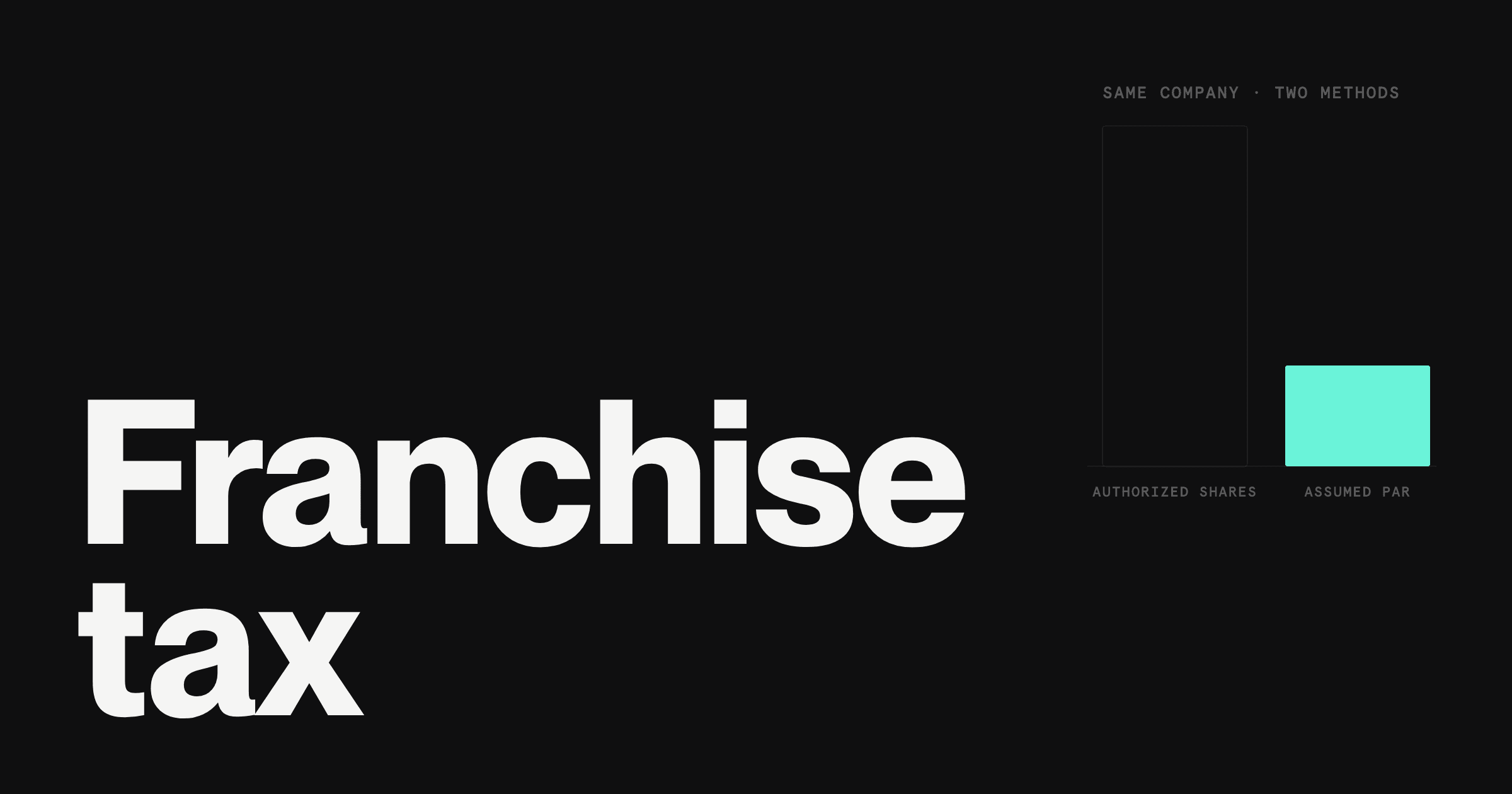

Every February, founders open a letter from Delaware demanding tens of thousands of dollars in franchise tax and briefly consider whether the company was a mistake. That number is almost always wrong — not a scam, not an error, just Delaware calculating with the only information it has. Here is why it happens and how to get to the real figure.
Quick Highlights
The scary notice is not your bill. Delaware defaults to the Authorized Shares Method because it is the only one the state can calculate without your input.
A typical seed-stage startup sees $85,215 on the notice and actually owes $850 after recalculating under the Assumed Par Value Capital Method.
You need two numbers: total gross assets from Form 1120 Schedule L, and total issued shares.
The realistic floor is $450 a year — the $400 minimum tax plus the $50 annual report fee.
March 1, every year. Late means a $200 penalty plus 1.5% interest per month. Quarterly estimated payments kick in once your tax hits $5,000.
Why your bill looks insane
Delaware calculates franchise tax two completely different ways, and you are allowed to pay whichever produces the lower number.
New to the state site? Our Delaware Division of Corporations guide walks through the portal, filings, and fees.
The notice Delaware sends you uses the Authorized Shares Method. Not because it is correct, but because it is the only one the state can compute on its own. Delaware knows how many shares you authorized, because that is in your certificate of incorporation. It does not know your gross assets or how many shares you actually issued, because you have not told it yet.
So the notice is a placeholder built from the one input the state already has, and for a company with millions of authorized shares that input produces an enormous number.
The Assumed Par Value Capital Method uses your actual balance sheet. For virtually every early-stage startup it produces a dramatically smaller bill. You just have to report the numbers that make it available.
The two methods
Authorized Shares Method
Authorized shares | Tax |
|---|---|
5,000 or fewer | $175 |
5,001 to 10,000 | $250 |
Each additional 10,000 shares or portion thereof | Add $85 |
Delaware's own example: a corporation with 10,005 authorized shares pays $250 plus $85, or $335.
The trouble is obvious once you apply it to a standard startup. Ten million authorized shares means 999 additional blocks of 10,000, which is $84,915 on top of the $250 base.
Assumed Par Value Capital Method
This one needs two numbers from you: total gross assets as reported on your federal Form 1120 Schedule L, and total issued shares including treasury shares.
The steps:
Divide total gross assets by total issued shares, carried to six decimal places. That is your assumed par value.
Multiply the assumed par value by the number of authorized shares whose stated par value is below the assumed par value.
Multiply any authorized shares whose stated par value is above the assumed par value by their own stated par values.
Add steps 2 and 3. That is your assumed par value capital.
Divide by $1,000,000, rounding up to the next full million, and multiply by $400.
The minimum under this method is $400.
The worked example that matters
Take a typical seed-stage company: 10,000,000 authorized shares at $0.0001 par, 8,000,000 shares issued, and $1,000,000 in gross assets after a pre-seed round.
What the notice says
```
Shares above the 10,000 threshold: 10,000,000 - 10,000 = 9,990,000
Blocks of 10,000 (or part): 9,990,000 / 10,000 = 999
Additional tax: 999 x $85 = $84,915
Base: $250
FRANCHISE TAX $85,165
Annual report fee $50
TOTAL $85,215
```
What you actually owe
```
Assumed par value = $1,000,000 / 8,000,000 = $0.125000
Stated par ($0.0001) is below assumed par ($0.125000),
so apply assumed par to all authorized shares:
10,000,000 x $0.125000 = $1,250,000
No class with stated par above assumed par: $0
Assumed par value capital = $1,250,000
Exceeds $1,000,000, round up to $2,000,000
$2,000,000 / $1,000,000 = 2
2 x $400 = $800
$800 is above the $400 minimum, so the tax is $800
Annual report fee $50
TOTAL $850
```
$85,215 versus $850. Same company, same year, same filing deadline. The only difference is which method you report under.
What you will actually pay at each stage
Once you understand the mechanism, the pattern becomes clear: your franchise tax tracks your balance sheet, not your share count.
Pre-revenue, before raising
$50,000 in gross assets, 8,000,000 shares issued:
```
Assumed par = $50,000 / 8,000,000 = $0.006250
10,000,000 x $0.006250 = $62,500
$62,500 / $1,000,000 = 0.0625, x $400 = $25
Below the $400 minimum, so tax = $400
Plus annual report $50
TOTAL $450
```
$450 is the realistic floor for a newly formed Delaware startup.
After a Series A
$10,000,000 in gross assets, 9,000,000 shares issued:
```
Assumed par = $10,000,000 / 9,000,000 = $1.111111
10,000,000 x $1.111111 = $11,111,110
Round up to $12,000,000, / $1,000,000 = 12
12 x $400 = $4,800
Plus annual report $50
TOTAL $4,850
```
Raising money raises your franchise tax. That is the system working as designed, and it is worth budgeting for in the year after a round closes.
Deadlines, penalties, and estimated payments
Item | Detail |
|---|---|
Corporation deadline | March 1 each year, for both the tax and the annual report |
Annual report fee | $50 for non-exempt domestic corporations, $25 exempt, $125 foreign |
LLC, LP, and general partnership | Flat $300, due June 1, no annual report required |
Late penalty | $200 |
Interest | 1.5% per month on tax and penalty |
Minimum tax | $175 authorized shares method, $400 assumed par value method |
Maximum tax | $200,000 |
If your franchise tax comes to $5,000 or more, Delaware requires quarterly estimated payments: 40% by June 1, 20% by September 1, 20% by December 1, and the remainder with your annual report by March 1. That threshold catches companies from about Series A onward, so it is worth knowing before it surprises you.
Notes on the extremes
The $200,000 maximum has one exception. A corporation that is listed on a national securities exchange and meets substantial revenue and asset tests is classified as a Large Corporate Filer and pays $250,000. Being publicly listed is a requirement, so this will never apply to a private startup.
How to actually file
Go to Delaware's Division of Corporations online filing system.
Enter your total gross assets from Form 1120 Schedule L and your total issued shares.
The system recalculates under the assumed par value method and shows you the lower figure.
Pay the tax plus the $50 annual report fee.
That is it. The entire $84,000 swing in the example above comes down to filling in two fields rather than paying the number printed on the notice.
Delaware publishes its own franchise tax calculator, and it is worth running your specific numbers through it before you file. The examples here follow Delaware's published brackets and formula, but your share classes and asset figures are yours.
Common mistakes
Paying the notice as invoiced. The most expensive unforced error in Delaware compliance.
Using authorized shares instead of issued shares in step 1 of the assumed par value calculation. It has to be issued.
Using net assets instead of gross assets. Delaware wants total gross assets from Schedule L, before liabilities.
Forgetting the annual report fee. The $50 is separate from the tax.
Missing March 1. $200 plus 1.5% monthly interest, compounding until you pay.
Assuming you are exempt because you had no revenue. Every Delaware corporation owes at least the minimum, revenue or not.
Missing the estimated payment schedule once your tax crosses $5,000.
The structural fix
If you are forming a company now rather than paying a bill, the decision that keeps this number small forever is your par value. A low par value like $0.0001 means the assumed par value calculation is always driven by your actual assets rather than an arbitrary floor.
Set par value at $1.00 with 10,000,000 authorized shares and you have guaranteed yourself at least $4,000 of franchise tax every year, even at zero assets, because the calculation floors at your stated par value.
For the full setup, including the filing fee mechanics that push in the same direction, see our Delaware C corp guide. If you have not incorporated yet, start with how to incorporate a startup.
One way to get the structure right without thinking about it: Rho incorporates your Delaware C corporation using the standard startup share structure, for free, with the $400 fee credited back once you deposit $10,000 of new money into your Rho checking account and keep your daily average balance $10,000 above where it started for the 60 days after you incorporate. Every document is reviewed by a licensed attorney, your EIN application is filed for you, and about 80% of filings complete within 24 hours. Delaware C corporations are supported today, with LLC support coming soon.
FAQs
Because Delaware defaults to the calculation method that produces the largest number. The state bills you under the Authorized Shares Method, which is the only method it can compute without your input — it knows how many shares you authorized but not your gross assets or issued shares.
You are entitled to pay under the Assumed Par Value Capital Method instead, which uses your actual balance sheet. For a typical startup with 10,000,000 authorized shares, 8,000,000 issued, and $1,000,000 in gross assets, the default notice reads $85,215 while the amount actually owed is $850.
To recalculate, report your total gross assets from Form 1120 Schedule L and your total issued shares in Delaware's online filing system, which then applies the lower figure. The minimum under this method is $400, plus a $50 annual report fee, and everything is due by March 1.
The Authorized Shares Method uses only your authorized share count, which Delaware already has from your certificate of incorporation. The Assumed Par Value Capital Method uses your actual gross assets and issued shares, and for most early-stage startups it produces a dramatically lower bill.
You need two numbers: total gross assets from your federal Form 1120 Schedule L, and total issued shares including treasury shares. You enter both into Delaware's online filing system, which then calculates the lower figure for you.
The realistic floor is $450 per year, which is the $400 minimum tax under the Assumed Par Value Capital Method plus the $50 annual report fee.
Corporations must file and pay by March 1 each year. LLCs, LPs, and general partnerships pay a flat $300 fee due June 1 instead.
A late filing triggers a $200 penalty plus 1.5% interest per month on the tax and penalty until you pay.
Yes. Every Delaware corporation owes at least the minimum tax regardless of whether it generated revenue, turned a profit, or opened a bank account.
The most expensive mistake is paying the notice as invoiced rather than recalculating under the Assumed Par Value Capital Method. Other common errors include using authorized shares instead of issued shares in the calculation, using net assets instead of gross assets, and forgetting the separate $50 annual report fee.
Yes, because the Assumed Par Value Capital Method is based on your gross assets, raising money increases your balance sheet and therefore your franchise tax. A company with $10,000,000 in gross assets after a Series A would owe $4,850, compared to $450 before raising.
Delaware requires quarterly estimated payments once your tax hits $5,000: 40% by June 1, 20% by September 1, 20% by December 1, and the remainder with your annual report by March 1.