

If you're searching for a Ramp alternative, you're really asking one of two questions. Either you're picking your financial stack for the first time and trying not to land somewhere you'll have to rebuild from in eighteen months. Or you're already on Ramp and starting to feel friction — a Plus paywall, a slow support response, a finance hire who wants banking and spend in one place, or simply too many features for what your company actually needs right now.
Both questions have the same underlying answer: the right starting point is the one that scales. Most articles on this topic stop at feature comparisons. The questions that often matter more to a founder are which institution holds your company's cash, and what is the architecture of the platform you operate on top of it?
Rho is now available directly through Stripe Atlas and Clerky, the two leading incorporation platforms for venture-backed startups. The platform a founder opens at incorporation is the same one used at Series B. No switching, no re-platforming, no migration tax.
Here are the ten strongest Ramp alternatives in 2026, what each is actually built for, and how to choose based on where you are.
Rho — Best overall for venture-backed startups that want banking and spend management in one platform, set up once and trusted as you grow
Brex — Best for global, multi-entity scale and integrated travel
Mercury — Banking-first product for founders who want a checking account today
Airbase by Paylocity — Best for mid-market finance teams (100–5,000 employees) with sophisticated procurement workflows
Navan — Best for travel-heavy teams
Rippling — Best if you're already on Rippling for HR
BILL — Best for accountant-led finance teams with AP-first needs
Expensify — Best for solo founders and very small teams
SAP Concur — Best for large enterprises on SAP infrastructure
Capital One / American Express — Worth naming because founders sometimes default to a familiar bank or a card brand they trust personally
Why founders are looking past Ramp in 2026
The institutional question
Ramp now offers a Business Account through First Internet Bank of Indiana (Member FDIC), accessed via Increase's API infrastructure. It works. It's insured. For most use cases it gets the job done. Ramp's "unlimited free same-day ACH and international wires" applies to bill payments — that's the qualifier on ramp.com/business-banking (as of 08/02/2026). And while Ramp Checking deposits are FDIC-insured through First Internet Bank of Indiana ($5.6 billion in total assets as of 06/30/2026, with API rails by Increase), the higher-yield Investment Account is, in Ramp's own words, "not insured by the FDIC, not a deposit product, and may lose value."
The institutional question is whether that's the bank your venture-backed company should be growing into. First Internet Bank is roughly a $5.6 billion internet-only bank in Indianapolis. Webster Bank, a division of Santander Bank, N.A. — Rho's banking partner — was founded in 1935 and is now part of Santander's $327 billion-asset U.S. banking organization (per Santander, at close 8/20/2026). Both are FDIC-insured and both work. But if you're a founder thinking about where your company's cash will live for the next decade, the difference is worth understanding.
Architecture matters when you're picking a foundation
Ramp is a spend management platform that extended into banking, treasury, and cash management. Rho is a banking platform with spend management built on top. Both architectures produce a similar feature list today, but the underlying choice shapes what gets prioritized over time. If banking is the foundation, the banking experience tends to be the cleanest part of the product. If banking is a recent extension, the spend management features tend to be the cleanest part.
This isn't a knock on Ramp — it's a factual difference. Founders who care about the institution holding their cash and the architecture of the platform they operate on top of should pick accordingly.
Ramp can feel like a lot for founders without a finance team
Ramp's product has expanded rapidly. The platform now spans cards, expense management, bill pay, procurement, travel, a Business Account, an Investment Account, a Managed Investment Account, several AI agents, and a tier-based pricing structure with Starter, Core, Plus, and Enterprise plans. For a CFO at a 200-person company, that breadth is a feature. For a founder running their first company without a finance team, it can be a lot to navigate when the immediate need is a card, a bank account, and a way to pay vendors.
Rho's product surface is narrower by design — banking, cards, bill pay, invoicing, expenses, treasury — and adds depth as a company grows into it. Recent additions reflect that philosophy: Vendor Cards put a dedicated, named card behind every subscription so the AUTH ABC*PLATFORM mystery line goes away, and the Rho Gmail Connector captures every receipt automatically the moment it hits your inbox. Both reduce the operator workload rather than expanding the surface area to learn.
Advanced features still sit behind Ramp Plus
Ramp's free tier is real and generous. But multi-entity support, advanced procurement controls, deeper ERP integrations, and custom workflows require Ramp Plus at $15 per user per month, with Enterprise pricing custom. For a 30-person company with two entities and a finance hire who wants real ERP automation, the headline price and the actual cost diverge meaningfully. The list price also isn't the whole price. Ramp Plus is $15 per user per month plus a "platform fee based on team size" whose amount Ramp doesn't publish, and procurement is a paid add-on on top of Plus (ramp.com/pricing, as of 08/02/2026). Workday and Oracle Fusion integrations require the custom-priced Enterprise tier.
Rho includes multi-entity support, ERP integrations, and the full automation surface area at $0.
Support is the hidden cost
A card freeze before a wire deadline can be a real moment for a founder operating without a finance team.
Rho's average customer support response time is under a minute via in-app messaging, with a real person on the other end, included from day one regardless of plan. Ramp's premium support is reserved for paid tiers (verified 08/02/2026).
Ramp alternatives compared:
Platform | Best for | Key features | Starting costs |
|---|---|---|---|
Rho | Venture-backed startups that want banking + spend management in one platform | Checking, cards, vendor cards, treasury, bill pay, invoicing, expenses, accounting | $0/month |
Brex | Global, multi-entity scale | Cards, travel, multi-entity, AI automation | $0/user/month |
Mercury | Founders who only want a clean bank account today | Checking, savings, treasury, IO Mastercard | $0/month |
Airbase by Paylocity | Mid-market AP automation and procurement (100–5,000 employees) | Pre-approvals, multi-entity, ERP integrations, HR + finance unified | Quote-based |
Navan | T&E-heavy teams | Travel booking, expense management, policy enforcement | Free up to 5 users |
Rippling | Teams already on Rippling for HR/payroll | HR-integrated cards, expense, role-based limits | Custom pricing |
BILL | Accountant-led teams, AP/AR automation | Invoice management, payments, accounting integrations | $0 (Spend & Expense) |
Expensify | Solo founders and very small teams | Expense tracking, receipt scanning, reimbursements | Free / $5/user/month |
SAP Concur | Large enterprises on SAP infrastructure | T&E, ERP integrations, global compliance | Custom pricing |
Capital One / Amex | Big-bank or card-rewards instinct | Business banking, corporate cards, basic expense tools | Varies |
1) Rho — Best Overall
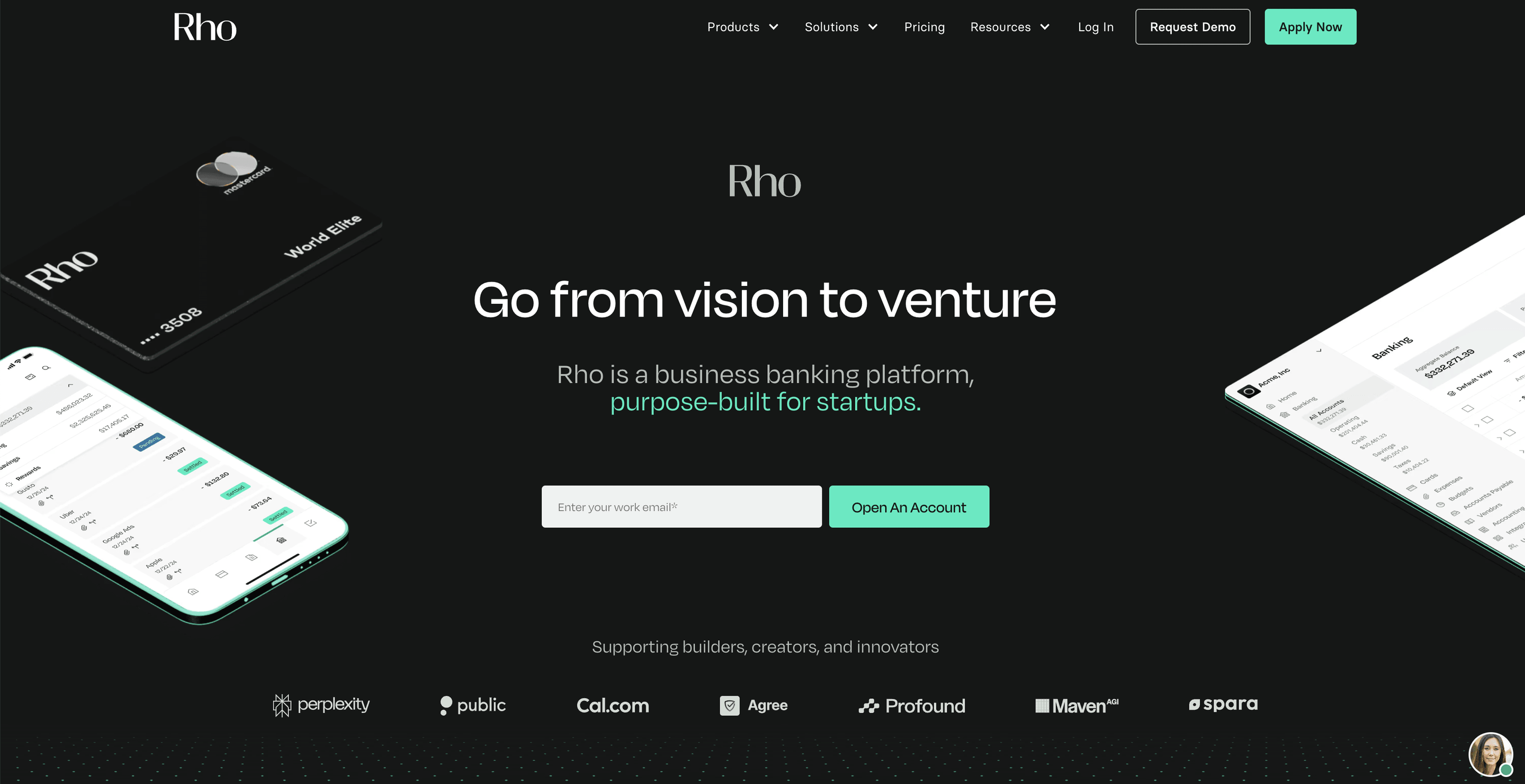 Rho is the modern banking platform built for startups. Banking, corporate cards, treasury, bill pay, invoicing, and expense management in one place — set up once and trusted as you grow.
The institutional foundation is Webster Bank, a division of Santander Bank, N.A., a commercial bank founded in 1935, part of Santander's $327 billion-asset U.S. banking organization (per Santander, at close 8/20/2026). That's a different category of institution than the partner banks behind most fintech-led banking products, and it matters when an investor, board member, or finance hire eventually asks where the company's cash sits.
Rho is now available at incorporation through both Stripe Atlas and Clerky. Founders incorporating with Stripe Atlas can open a Rho account before their EIN arrives, issue cards, and configure their finance stack while company formation is still in progress. Clerky users can pre-fill a Rho application with one click from their incorporation paperwork. Qualifying C corps that deposit $20K within 60 to 90 days receive a sign-on bonus.
The customer roster is the proof. Perplexity runs treasury on Rho. Dr. Squatch and Rhode Skin both scaled successfully on the platform — Dr. Squatch is the case study for what a Rho customer looks like at exit. Rho serves over 8,000 customers moving more than $4 billion every month, with over a dozen publicly traded companies running their finances on it.
How Rho compares to Ramp
1. The institution holding your money. Webster Bank, a division of Santander Bank, N.A. provides Rho's banking directly — founded 1935, part of Santander's $327 billion-asset U.S. banking organization (per Santander, at close 8/20/2026). For a venture-backed company growing into a real business, that institutional foundation is a different kind of starting point.
2. Architecture, not feature parity. Ramp added banking to a spend management platform. Rho built spend management on a banking platform. The features look similar today; the foundations took different paths to get there. If banking is the most important thing your financial stack does, banking being the foundation matters.
3. Support included from day one. Rho's average customer support response time is under a minute via native messaging, with a real person on the other end, no premium tier required. Ramp reserves its highest-touch support for paid plans.
4. The full platform at $0. Multi-entity, ERP integrations, advanced approvals, AP automation, treasury, expense management — all included at no per-user cost on Rho. Ramp gates several of these behind Ramp Plus at $15/user/month.
Rho key features
Business Checking — Provided by Webster Bank, a division of Santander Bank, N.A. with no monthly fees, no minimums, $0 same-day ACH, $0 domestic wires
Up to $75M FDIC insurance on Rho savings — Through American Deposit Management Co.'s 400+ bank sweep network; checking is FDIC-insured to $250K at Webster Bank, a division of Santander Bank, N.A.
Corporate Cards — Up to 2% Cashback with Rho Platinum (terms apply)*; standard rate up to 1.25%, plus dedicated Vendor Cards for every subscription with daily, weekly, or monthly limits and the ability to pause or kill any card from your phone in seconds
Bill Pay — Pay hundreds of vendors in minutes with zero platform fees
Invoicing — Send invoices and get paid from where you bank, with payments flowing directly into your Rho checking account
Expense Management — Connect Gmail once and Rho captures every receipt automatically, matched to the right transaction. No chasing, no manual reports.
Rho Treasury — Multi-asset portfolios across T-Bills, Morgan Stanley (MULSX), and Vanguard (VFSTX) funds, with selectable allocation modes (Capital preservation, Balanced income, Optimized yield, or Custom) and automatic reinvestment
Rho Mobile — Manage team cards and vendor cards, approve spend, capture receipts, and check status from your phone
Accounting Integrations — Direct sync with QuickBooks Online, NetSuite, Sage Intacct, and more
Available at incorporation — One-click setup through Stripe Atlas and Clerky
Rho Partner Portal — Built specifically for fractional CFOs and accounting partners
24/7 support — Live human support from day one with average response times under a minute via in-app chat
Rho pricing
$0 monthly plans
$0 per-user fees
$0 same-day ACH
$0 domestic wires
$0 support
$0 platform fees on bill pay
$0 access to AP, Expense, and Accounting Automation
The only fee: 1% on foreign currency transfers.
What customers say
"Better spend management, better customer service, easy migration, higher treasury, better incentives. Much less admin time spent on spend tracking, easier card management than we had with the other guys."
— Skyler Ji, Co-founder, Spark
"The company implementation of Rho was easy and took less than 2 hours. We sync with QuickBooks Online seamlessly, which has saved the finance department 60 hours per month."
— Verified Rho customer, G2
For more detail, see Rho vs. Ramp.
Where Rho isn't the right fit
If your primary need is global card issuance in 20+ currencies for a multi-entity team, Brex is purpose-built for that. If your finance team's biggest pain is procurement governance with PO matching across hundreds of vendors, Airbase is the specialized tool. Rho is built for the founder picking their financial foundation and the company growing into a serious operation. For finance teams whose main constraint is enterprise-grade procurement complexity, the right tool is usually one of the above.
See it for yourself — get a demo in 20 minutes →
2) Brex
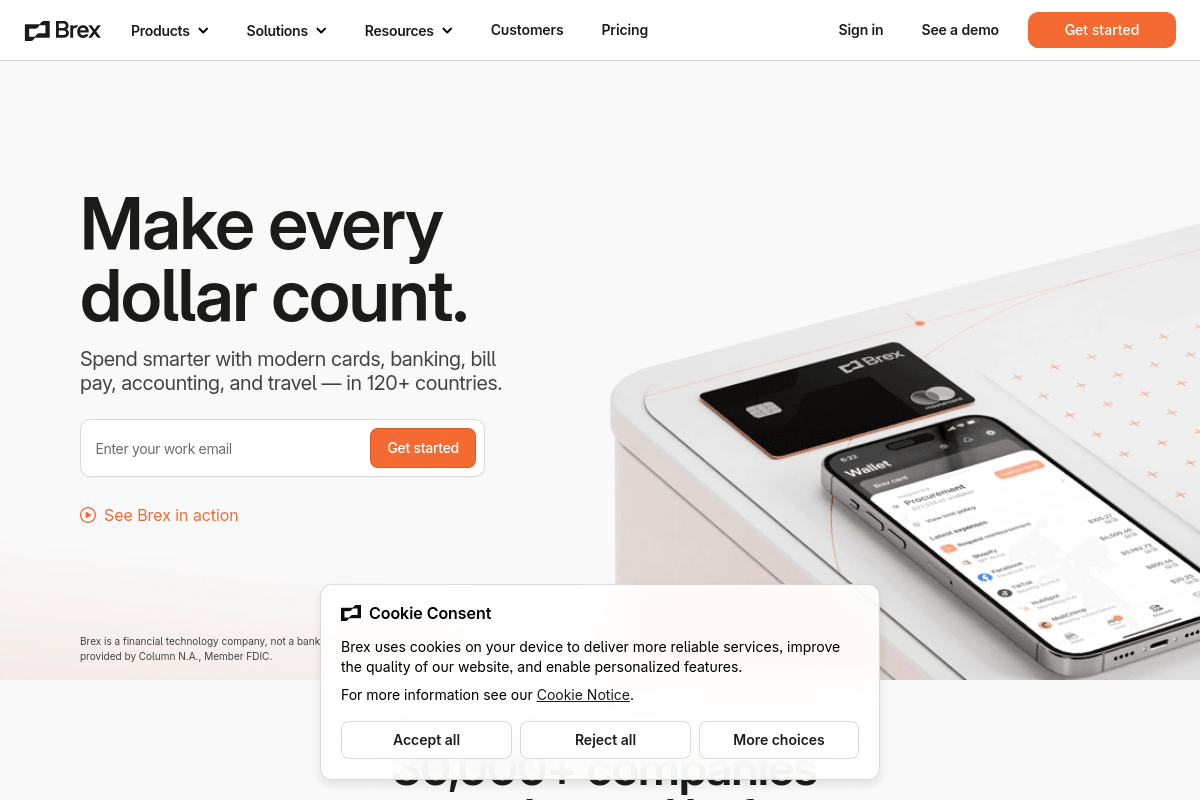 Brex is the strongest Ramp alternative if your needs are global. Multi-entity card issuance, integrated travel booking, AI-driven expense automation, and operations in 50+ countries make it the right tool for companies operating across borders at scale. Brex serves over 25,000 companies as of 2026.
Brex key features
Corporate Cards — Global acceptance with AI-powered policy controls
Expense Management — Auto-generated receipts, pre-populated memos, AI categorization
Travel Management — In-app booking with policy enforcement and 24/7 travel support
Bill Pay — AI-driven invoice capture, coding, and approval workflows
Banking and Treasury — Up to $6M FDIC insurance on Vault; money market fund yield of 4.01%–4.36% (as displayed by Brex, 07/31/2026; variable). Fund holdings are SIPC-protected securities, not FDIC-insured
AI assistant integrations — Brex in ChatGPT and Brex in Claude for natural-language queries on card and expense data
Brex pricing
Essentials: $0/user/month — global cards, AI-powered rules, accounting integrations
Premium: $12/user/month — customizable expense policies, advanced approvals, multi-entity
Enterprise: Custom pricing
Honest assessment
Capital One completed its $5.15 billion acquisition of Brex on April 7, 2026. Capital One holds $475.8 billion in deposits and $669 billion in total assets as of December 31, 2025, and is the largest US card issuer following its acquisition of Discover. That's a relevant institutional fact for founders who originally chose Brex as the modern alternative to big-bank infrastructure — Brex is now part of the largest US card issuer.
For global multi-entity companies, the platform itself remains the strongest in this list, and Brex's AI-native investment and ChatGPT/Claude integrations are real product differentiation. For early-stage US-based startups that don't need cross-border card issuance, the feature surface is more than the moment requires.
3) Mercury
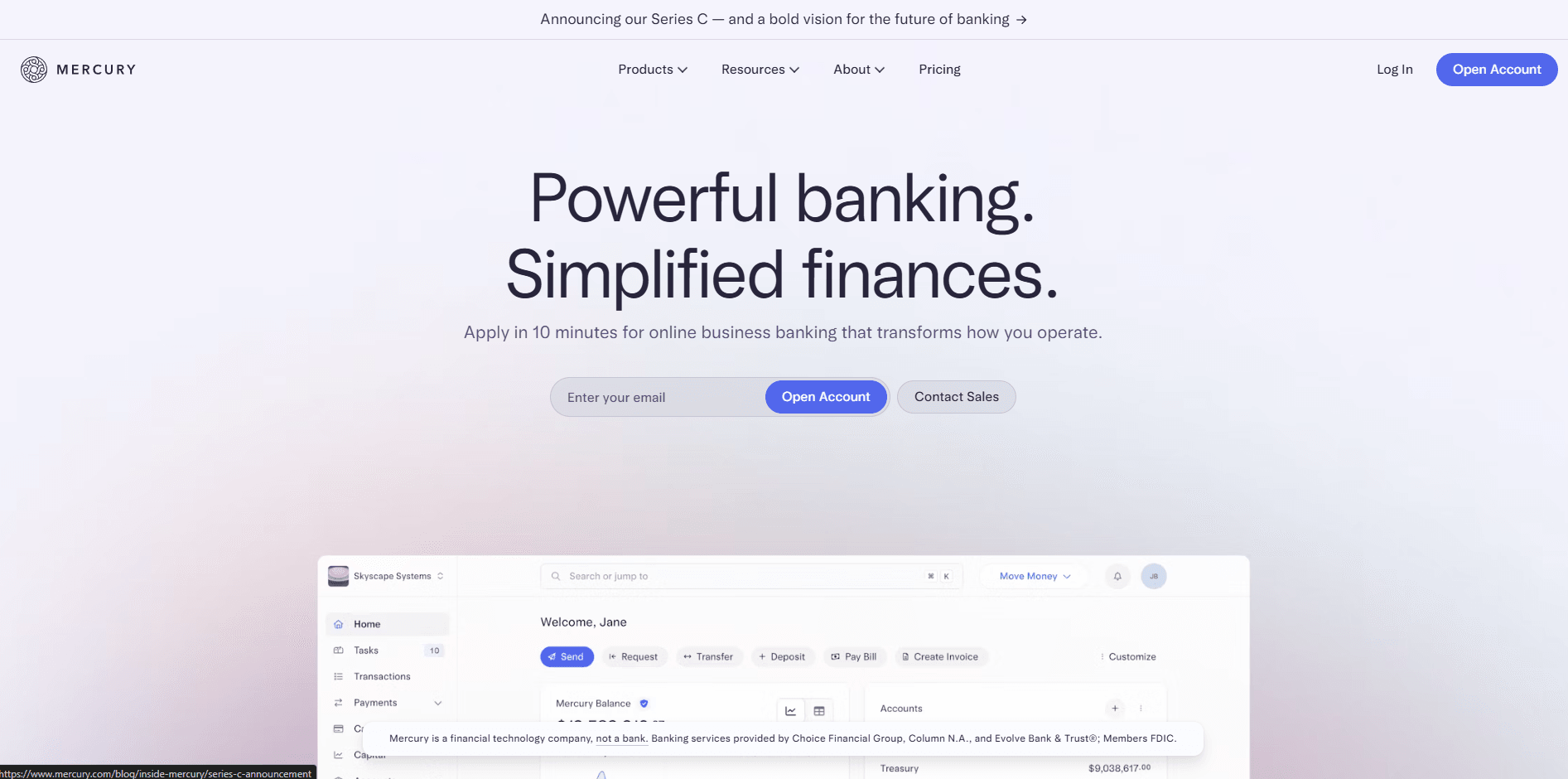 Mercury is a banking-first product with a clean UI and fast onboarding. It serves more than 200,000 companies as of 2026 and is the answer many founders default to when they only need a bank account.
Mercury key features
Business Checking and Savings — FDIC-insured up to $5M via partner banks' sweep networks, no minimum balance
Mercury Treasury — Competitive yield on idle cash via money market funds
Mercury IO Mastercard — Charge card with unlimited 1.5% cashback ($50K minimum balance in a Mercury account required to qualify; 3% foreign transaction fee)
Wire and ACH Transfers — $0 domestic wires and ACH
Accounting Integrations — QuickBooks, Xero, NetSuite
Mercury pricing
Core banking is free. Mercury Plus is $35/month. Mercury Pro is $350/month for larger or higher-touch accounts.
Honest assessment
Mercury is a genuinely good banking product, and a notable shift is in progress. On April 27, 2026, Mercury received conditional approval from the OCC to establish Mercury Bank, N.A., a national bank to be headquartered in Utah and led by Jon Auxier. Mercury still needs FDIC and Federal Reserve approvals before launch (likely late 2026). If those clear, Mercury moves from a fintech routing through partner banks to a fintech with its own national bank charter — a real institutional shift worth tracking.
The gap is what comes around the bank account. Mercury is a banking product with limited spend management, no native expense workflow, and an IO Card that requires a $50K balance to qualify. Many founders who start on Mercury end up adding Ramp for cards, something else for bill pay, and something else for expense management as the company grows. That's the patchwork problem Rho was built to prevent. Rho gives a founder banking, cards, treasury, bill pay, and expense management on day one — backed by Webster Bank, a division of Santander Bank, N.A.'s institutional foundation — with the same clean onboarding experience and no $50K threshold to use the card.
4) Airbase (now part of Paylocity)
 Airbase is a procure-to-pay platform built for mid-market finance teams (100–5,000 employees) with sophisticated AP and procurement workflows. Now branded "Airbase by Paylocity" and integrated with Paylocity's HCM platform under the "Paylocity for Finance" umbrella, Airbase pairs spend management with payroll and HR data on one system.
Airbase key features
AI-Powered AP Automation — Touchless invoice processing with OCR
Guided Procurement — No-code approval routing for purchase requests
Corporate Cards — Virtual and physical with pre-approvals and ERP integration
ERP Integrations — NetSuite, Sage Intacct, QuickBooks, Microsoft Dynamics, Oracle
Unified HR + Finance data — Payroll and non-payroll spend through one Paylocity-backed view
Audit Trail — Compliance-ready documentation for every transaction
Airbase pricing
Custom pricing across Standard, Premium, and Enterprise tiers, with the Paylocity bundle increasingly the path to purchase.
Honest assessment
Airbase wins on procurement governance. It's not the system you'd open before you have a procurement problem to govern. For a 100+ person company with a finance team that needs PO matching, multi-step approval routing, and audit-grade procurement workflows — especially one already on Paylocity for HR — Airbase is purpose-built for that constraint. For an early-stage startup, the platform's depth outpaces the use case.
5) Navan
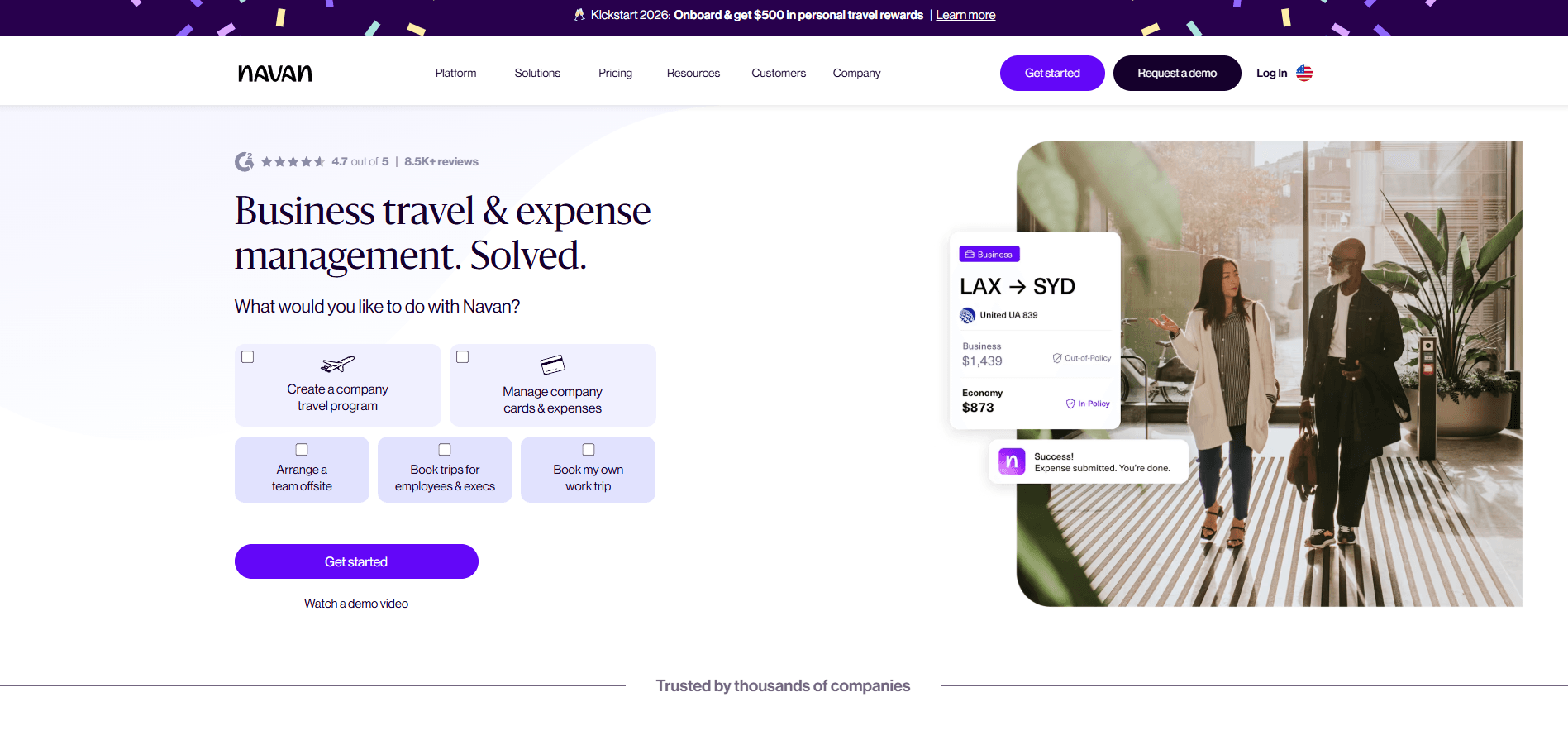 Navan (formerly TripActions) is a travel and expense management platform for companies where business travel is a core spend category. The strongest Ramp alternative if your dominant pain is T&E compliance and traveler experience. Navan went public on Nasdaq in October 2025 (ticker: NAVN), with most of its revenue (about 92% per its Q3 FY2026 filings) coming from travel commissions and card interchange rather than expense management subscriptions.
Navan key features
Integrated Travel Booking — Flights, hotels, rental cars with policy enforcement built in
Corporate Cards — Physical and virtual cards tied to travel and expense policies, plus Navan Connect for bring-your-own-card setups
Expense Management — Real-time tracking with automated receipt capture
Employee Reimbursements — Out-of-pocket expense workflows globally
AP Automation — Invoice processing with ERP sync
Navan pricing
Expense management is free for the first 5 monthly active users, then $15/user/month for companies up to 300 employees. Travel booking is free (commission-funded by suppliers) for companies under 300 employees. Enterprise (300+) requires a demo for a custom quote.
Honest assessment
Navan solves a specific problem extraordinarily well: managing a distributed team's travel without losing control of policy. For companies where travel is the dominant variable cost, it's the right tool, and being publicly traded adds a level of financial transparency that some buyers value. For companies where the bigger problem is banking, treasury, or vendor payments, Navan doesn't reach those layers of the stack.
6) Rippling
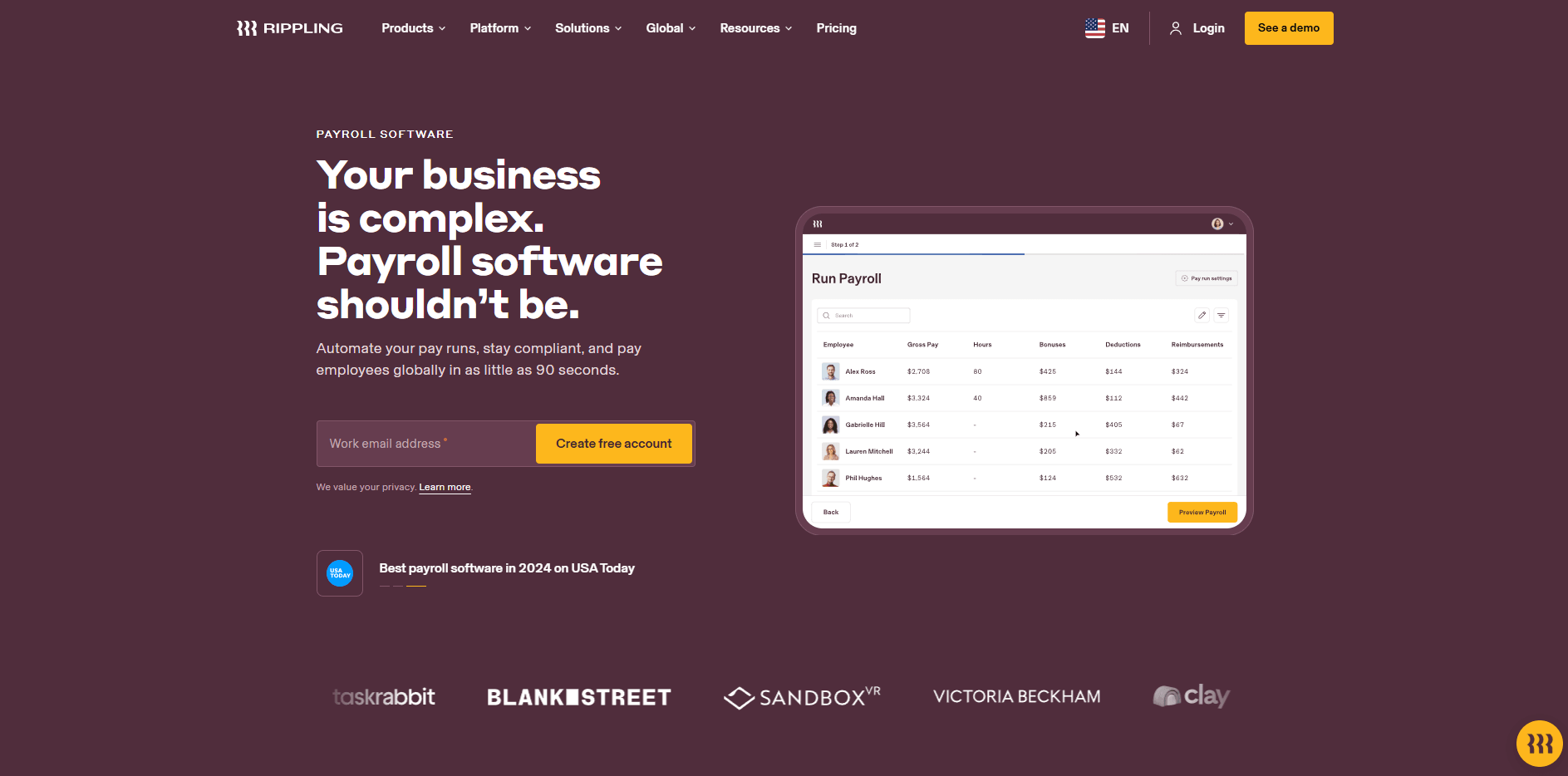 Rippling is the spend management option for teams already running their HR and payroll on Rippling. Cards, expense management, and approvals integrated with employee roles and HR data, with a global footprint covering 200+ countries and reimbursements in 100+ countries across 37+ currencies.
Rippling key features
Corporate Card with 1.75% cashback — Higher than Rho's standard 1.25% rate (Rho Platinum members earn up to 2% Cashback, terms apply) and Ramp's variable 0%-1.5%, tied to employee roles and HR data
Automatic Categorization — Mobile receipt upload and expense approval workflows
Role-Based Permissions — Spending limits and approvals synced with HR records
Global reimbursements — 100+ countries, 37+ currencies
Unified HR + IT + Finance — One login for people, devices, and expenses
Accounting Integrations — QuickBooks, NetSuite, Xero
Rippling pricing
Rippling Spend subscriptions start at $11 per employee per month, with the Corporate Card module adding $8 per employee per month. Companies with fewer than 25 employees can use the Rippling Corporate Card without a Spend subscription. Total cost depends on employee count and selected modules.
Honest assessment
Rippling extended into finance from a strong HR core, and the spend product is now real, mature, and competitive on cashback. For a team that's already deep in Rippling, the convenience of one login — plus 1.75% cashback that beats most card programs in this list — is genuine. The question is whether your financial foundation should be an extension of your HR system. For most venture-backed startups, banking and spend management are foundational decisions that warrant their own purpose-built platform; HR features are something different.
7) BILL (formerly Bill.com)
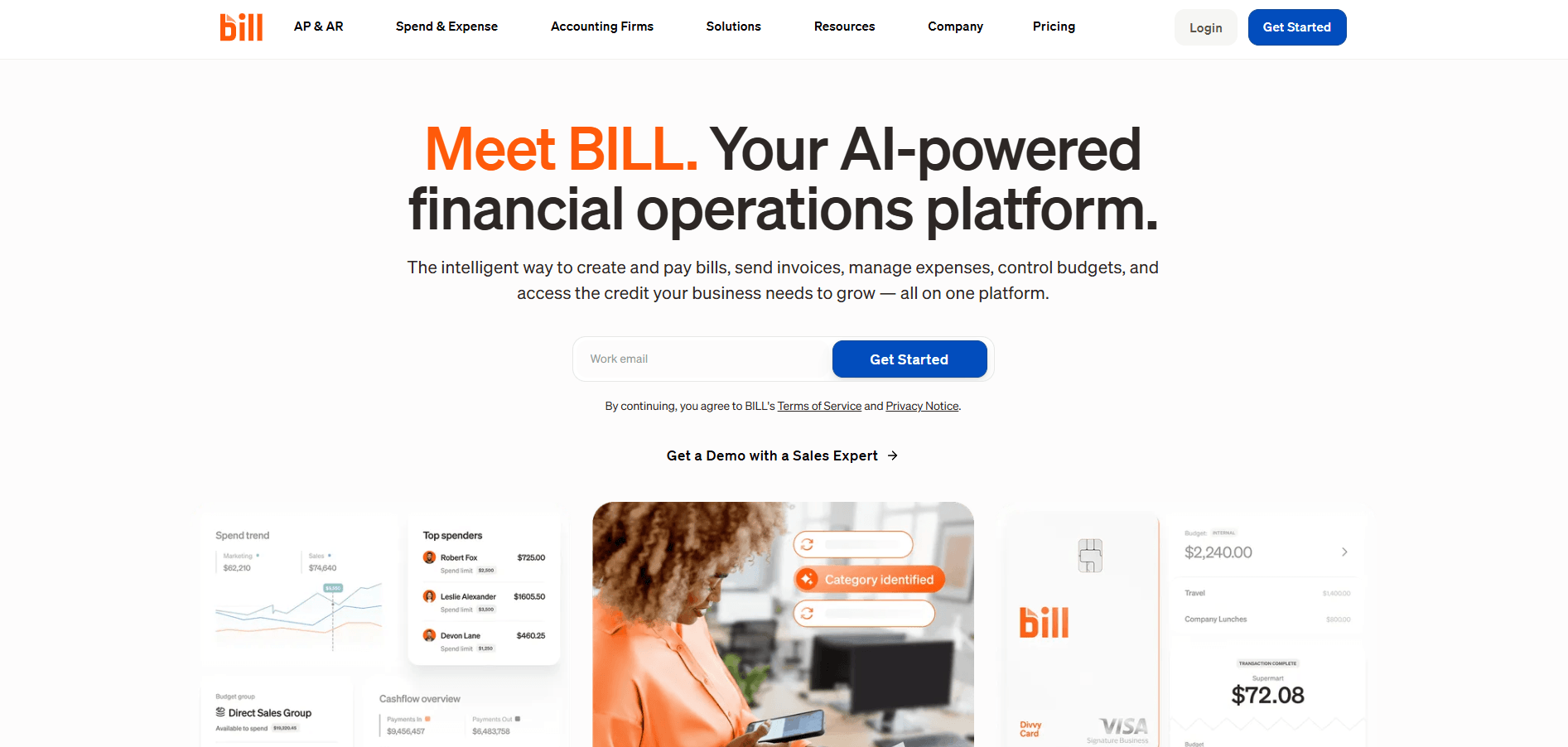 BILL is the AP automation platform with deep roots in the accountant community. Now expanded into spend management through BILL Spend & Expense (formerly Divvy), the spend product BILL acquired in 2021.
BILL key features
Accounts Payable Automation — Invoice ingestion, approval workflows, payment processing
Accounts Receivable — Invoicing and payment collection
BILL Spend & Expense — Free spend management software, paired with the BILL Divvy Card (the card is required for the platform's full functionality)
BILL Divvy Card rewards — Tiered up to 7x at restaurants and 5x at hotels with weekly payments; 1x base on most categories
Accounting Integrations — Deep QuickBooks, Xero, NetSuite, Sage Intacct integrations
International Payments — 130+ countries
BILL pricing
BILL Spend & Expense software is free, but full functionality requires using the BILL Divvy Card. BILL's core AP/AR platform is $49 to $89 per user per month depending on plan. Enterprise pricing is custom.
Honest assessment
BILL is the right tool when AP is the bottleneck and your finance team grew up on it. The accountant community has used BILL for years and trusts it deeply — that institutional familiarity is real value, and the Divvy Card's tiered rewards can outperform flat 1.5% cashback for companies whose spend skews toward restaurants, hotels, and recurring software subscriptions.
It's not the right starting point for a founder who hasn't hired a controller yet. BILL is AP-first by architecture, the spend product is tied to using BILL's card (so existing card programs and banking relationships need to move), and a separate banking relationship is still required.
8) Expensify
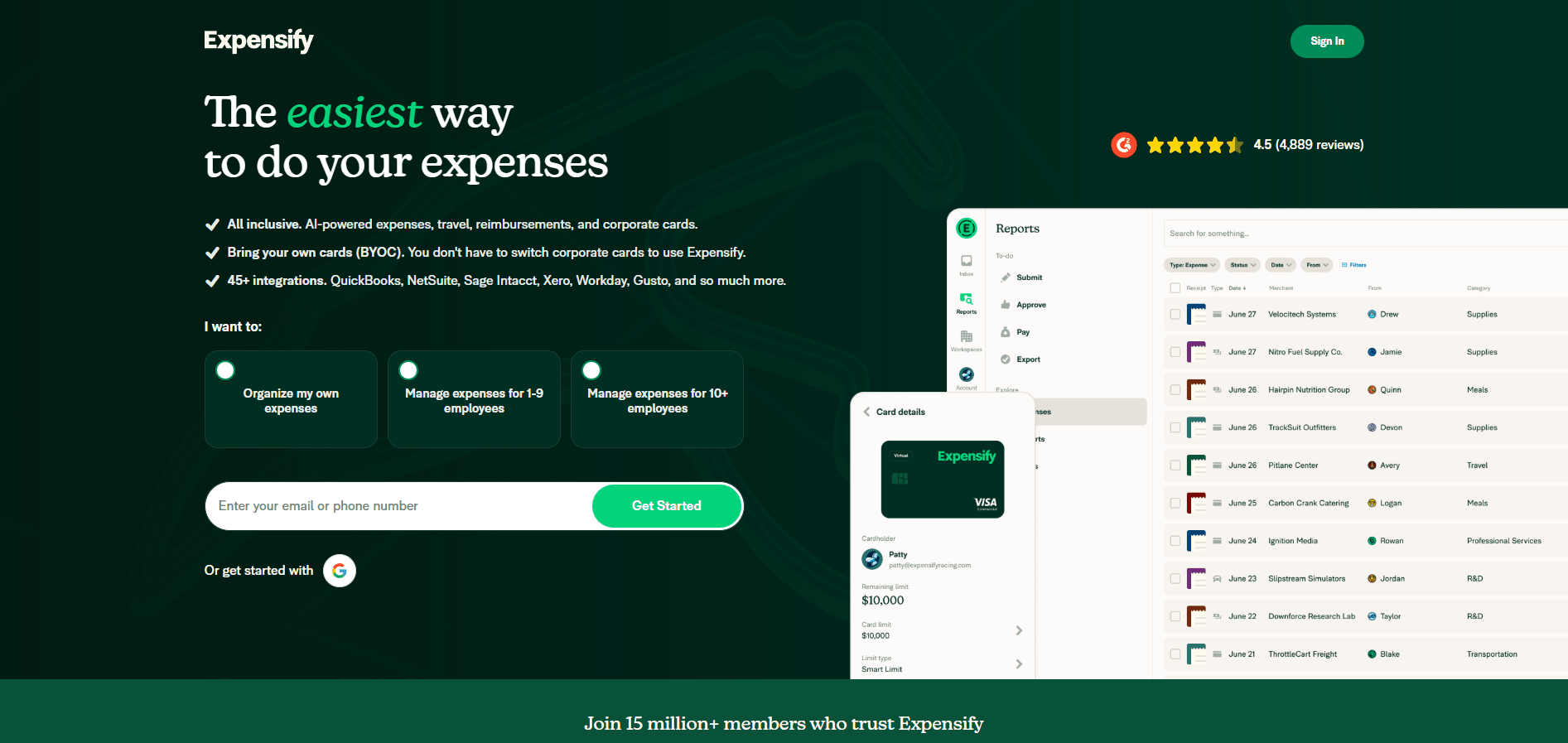 Expensify is the long-running expense tracking and reimbursement tool for individuals, sole proprietors, and very small teams. Strong receipt scanning, simple workflows, recognizable brand. A real differentiator: Expensify is card-agnostic ("Bring Your Own Card") and works with any existing corporate card program (Amex, Chase, Citi, Capital One, etc.) in addition to its own optional Expensify Visa Commercial Card.
Expensify key features
SmartScan Receipt Capture — OCR receipt scanning via mobile app
Bring Your Own Card — Connect any existing corporate card; no requirement to switch card programs
Expense Reports — Automated creation and approval routing
Expensify Card — Optional Visa Commercial Card with 1% cashback (2% if your company spends $250K+/month on it; US purchases on US cards)
Reimbursements — Direct deposit reimbursements for out-of-pocket expenses
Accounting Integrations — QuickBooks, Xero, NetSuite, Sage
Expensify pricing
Free plan available. Collect plan is $5/active user/month. Control plan is $9/active user/month (annual commitment with Expensify Card usage; $18/user/month annual without the card; $36/user/month month-to-month).
Honest assessment
Expensify earns a place on this list because it shows up on so many shortlists and because its card-agnostic posture is genuinely differentiated — a real fit for a team that wants expense automation without giving up an existing card program and rewards relationship. There's no banking, no treasury, and no AP workflow in the way a finance team typically means it. For a solo founder tracking expenses, a two-person team submitting reimbursements, or a small company committed to keeping its existing corporate card, Expensify is fine. For anyone planning to consolidate banking and spend management onto one foundation, it's not built for that job.
9) SAP Concur
 SAP Concur is the enterprise legacy player in travel and expense management. Acquired by SAP in 2014, with deep roots in large organizations on SAP infrastructure.
SAP Concur key features
Travel Booking — Integrated booking with policy enforcement
Invoice Automation — AP workflow automation with ERP sync
ERP Integrations — Native SAP integration plus Oracle, NetSuite, others
Global Compliance — Multi-currency, VAT, per diems, global tax
Role-Based Approvals — Configurable approval chains and analytics
SAP Concur pricing
Custom only. Implementation costs are substantial.
Honest assessment
Concur is right for Fortune 500 companies with dedicated travel teams and SAP infrastructure. Its presence on this list is for founders who encounter it because they came from a large company. For an early-stage startup, the implementation timeline and feature depth are calibrated for a different kind of organization.
10) Capital One and American Express
 These two represent founder instincts that deserve honest treatment, not feature-by-feature comparison.
Capital One
Capital One is investing aggressively in business banking and completed its acquisition of Brex on April 7, 2026. Capital One holds $475.8 billion in deposits and $669 billion in total assets and is now the largest US card issuer. The platform a founder gets through Capital One today is a growing collection of capabilities on top of a large banking core. The relevant question for a founder isn't whether the features exist — it's whether the institution and the support model are calibrated for a 12-person venture-backed company moving fast.
American Express
Amex is the prestige default — the card founders often default to because they had it personally. The rewards are real and the brand is unmatched. But Amex doesn't solve the banking + spend management integration problem. You'll still need a bank, and you'll still need a spend management tool. For founders who specifically want a recognizable card with strong rewards, Amex makes sense as a piece of the stack — not as the foundation.
Rho vs. Ramp: The head-to-head:
Rho | Ramp | |
|---|---|---|
Banking partner | Webster Bank, a division of Santander Bank, N.A. — founded 1935, part of Santander's $327B-asset U.S. banking organization (per Santander, 8/20/2026) | First Internet Bank of Indiana — $5.68B in assets (FDIC call report, 03/31/2026); API rails by Increase |
Direct integrated banking | Banking-first foundation | Banking added to spend platform |
FDIC coverage | Checking: $250K at Webster Bank, a division of Santander Bank, N.A.. Savings: up to $75M via American Deposit Management Co.'s 400+ bank network. Treasury: SIPC-protected securities, not FDIC (as of 08/02/2026) | “Up to tens of millions” per Ramp, via IntraFi sweep — exact cap unpublished. Ramp's higher-yield Investment Account is not FDIC-insured and may lose value (ramp.com, 08/02/2026) |
Treasury / yield | Up to 4.81% as of 09/23/2026 (variable) — $50,000 minimum, one-fifth of Mercury Treasury's $250,000 (rho.co/product/treasury, verified 08/02/2026) | Rate displayed dynamically on ramp.com (variable); highest-yield option is the non-FDIC-insured Investment Account |
Corporate cards | Up to 2% Cashback with Rho Platinum (terms apply)*; standard rate up to 1.25% — published rates and terms (as of 08/02/2026) | 0%-1.5% cashback, variable — rate is set per business and not disclosed until after you apply (range confirmed by Ramp to NerdWallet, 06/15/2026) |
Bill pay | $0 platform fees | $0 when paid from Ramp Business Account |
Multi-entity support | ✅ Included | ⚠️ Ramp Plus or Enterprise required |
Advanced procurement controls | ✅ Included | ⚠️ Paid add-on — even on Plus and Enterprise (ramp.com/pricing, 08/02/2026) |
Deeper ERP integrations | ✅ QuickBooks Online, NetSuite, Sage Intacct, Microsoft Dynamics 365, Xero, Puzzle — included, no paid tier | ⚠️ Free tier: QuickBooks Online + Xero only. NetSuite/Sage Intacct need Plus; Workday and Oracle Fusion need Enterprise (as of 08/02/2026) |
Per-user fees for advanced features | $0 — no per-user, subscription, or platform fees on any tier (as of 08/02/2026) | $15/user/mo for Ramp Plus plus an undisclosed platform fee based on team size (as of 08/02/2026; 20% off with annual billing) |
24/7 live human support | ✅ Real human by phone, in-app chat, or SMS — 24/7, every tier | ⚠️ Premium support reserved for paid tiers (verified 08/02/2026) |
The short version: Ramp is a strong spend management platform that has extended into banking. Rho is a banking platform with spend management built on top, backed by a major commercial bank. If you're choosing the foundation your company will grow on, the architecture and the institution are part of the decision.
How to choose
The question isn't which tool has the best feature list. It's which foundation you'll never have to rebuild.
If you're picking your financial stack for the first time — pre-seed, just incorporated, just got into a batch — Rho is the answer that scales. Banking, cards, vendor cards, treasury, bill pay, invoicing, and expenses live in one platform built on Webster Bank, a division of Santander Bank, N.A.'s institutional foundation, and Rho is now available directly through Stripe Atlas and Clerky for founders who want their first account to also be their last one. Mercury is also a strong choice if you want only a clean bank account with nothing layered on yet — just know you'll be adding tools the moment you need cards with spend controls, bill pay automation, or accounting integration.
If you're already on Ramp and feeling friction — the Plus paywall, support that's slower than you'd like, two systems to reconcile, or simply more product than you need right now — Rho is built for the consolidation. Customers who've made the switch describe the migration as fast and the platform as a comfortable fit for how founders run a company. See the Rho vs. Ramp comparison for the head-to-head detail.
If your company is scaling globally with multi-entity complexity, Brex is the specialized tool.
If you're 100+ employees with a finance team and procurement governance is the constraint, Airbase by Paylocity is purpose-built for that.
If travel is your dominant spend category, Navan. If you're already on Rippling for HR, Rippling Spend works for basic needs. If your finance team is accountant-led and AP is the priority, BILL is worth evaluating.
For solo founders and very small teams: Expensify for simple expense tracking, Mercury for clean banking. Both will be revisited as you scale.
Evaluate total cost, not headline price. Most platforms in this category have free entry points. The real cost is in per-user fees on advanced features, FX charges on international transactions, and support tier upgrades.
Check support quality before committing. A failed wire or a card freeze can be a real moment, especially for a founder without a finance team. The difference between a sub-minute response and a longer wait can matter.
Frequently Asked Questions
What is the best Ramp alternative for startups?
Rho is the best overall Ramp alternative for venture-backed startups. It combines banking — provided by Webster Bank, a division of Santander Bank, N.A. — with corporate cards, vendor cards, treasury, bill pay, invoicing, and expense management in a single platform with $0 monthly fees and no per-user charges. Rho is also available at incorporation through Stripe Atlas and Clerky. Onboarding is fast, cashback is up to 1.5%, the Gmail Connector captures every receipt automatically, and 24/7 live human support averages under a minute via in-app chat.
Where does Rho hold my money?
Rho's checking and card services are provided by Webster Bank, a division of Santander Bank, N.A., Member FDIC — a commercial bank founded in 1935, part of Santander's $327 billion-asset U.S. banking organization (per Santander, at close 8/20/2026) and headquartered in Stamford, Connecticut. Savings services are provided by American Deposit Management Co. and its 400+ bank network, with up to $75M in FDIC insurance on Rho savings. Rho Treasury invests in SIPC-protected securities, which are not FDIC-insured.
Is Rho FDIC-insured?
Yes, for deposit products. Rho checking accounts are FDIC-insured up to $250K through Webster Bank, a division of Santander Bank, N.A., Member FDIC, and Rho savings are FDIC-insured up to $75M through American Deposit Management Co.'s 400+ bank sweep network. Rho Treasury is SIPC-protected securities, not FDIC-insured. Rho is a fintech company, not a bank — banking services are provided by FDIC-insured partners.
Does Ramp have a business banking product?
Yes. Ramp Business Account is provided by First Internet Bank of Indiana, Member FDIC, accessed through Increase's API infrastructure. It includes free same-day ACH and free wires when paid from the Ramp Business Account, plus access to Ramp's Investment Account for excess cash. The institutional difference relative to Rho is the bank: First Internet Bank of Indiana is a roughly $5.7 billion internet-only bank (FDIC call report, 3/31/2026); Webster Bank, a division of Santander Bank, N.A. is part of Santander's $327 billion-asset U.S. banking organization (per Santander, at close 8/20/2026).
Is Ramp free?
Ramp has a real free tier — cards, expense management, bill pay, travel booking, and QuickBooks Online/Xero sync at $0 per user (as of 08/02/2026). It stops being free when you need multi-entity support, deeper ERP integrations (NetSuite, Sage Intacct), or procurement: Ramp Plus is $15/user/month plus an undisclosed platform fee based on team size, and procurement is a paid add-on even on Plus. Rho includes AP automation, expense management, and accounting automation with no platform fee on all accounts.
What's the difference between Rho and Ramp?
Rho is a banking platform with spend management built on top, with checking and card services provided directly by Webster Bank, a division of Santander Bank, N.A. Ramp is a spend management platform that extended into banking, treasury, and AP, with banking provided by First Internet Bank of Indiana via Increase's API layer. Rho includes multi-entity support, advanced approvals, and ERP integrations at $0; Ramp gates these features behind Ramp Plus at $15/user/month. Rho's customer support averages under a minute via in-app messaging; Ramp's premium support is reserved for paid tiers.
How hard is it to switch from Ramp to Rho?
Switching can be a smooth migration, and a Rho team member is there to help guide the process. Cards reissue, vendors update payment instructions, and the Rho team supports the operational transition. Customers like Skyler Ji of Spark have described the switch as easy and the platform as the right next foundation, not another stop on the way.
What's the difference between Rho and Mercury?
Mercury is a clean, fast banking product — great for getting started. Rho includes everything Mercury does plus corporate cards with up to 1.5% cashback, dedicated vendor cards for every subscription, bill pay, invoicing, expense management with the Gmail Connector, multi-asset treasury portfolios, and accounting integrations, all in one connected platform. Most founders who start on Mercury end up adding tools every time the company grows. Rho was built to prevent that, and is now available directly through Stripe Atlas and Clerky for founders who want to start on the right foundation from day one.
Does Rho integrate with QuickBooks?
Yes. Rho integrates directly with QuickBooks Online, NetSuite, Sage Intacct, and other leading ERPs. Transactions, receipts, and expense data sync automatically.
What companies use Rho?
Rho serves over 8,000 customers moving more than $4 billion every month, including Perplexity, Dr. Squatch, and Rhode Skin, as well as over a dozen publicly traded companies and hundreds of venture-backed startups.
Ready to see it yourself?
Rho is built for founders who want a financial foundation they can set up once and trust as they grow — backed by Webster Bank, a division of Santander Bank, N.A., with banking, cards, vendor cards, treasury, bill pay, invoicing, and expense management in one place. Available directly through Stripe Atlas and Clerky, so the platform a founder opens at incorporation is the same one their controller uses at Series B.
Request a free demo → | Open an account →
Rho is a fintech company, not an FDIC-insured depository institution. Checking account and card services provided by Webster Bank, a division of Santander Bank, N.A., Member FDIC. Savings account services provided by American Deposit Management Co. and its partner banks. *2% Cashback on the Rho Card with Daily Terms for Rho Platinum members, up to $1M in eligible spend per year; standard Daily Terms rate 1.25%; Monthly Terms: 1.75% (Platinum) / 1% (standard); requires paying the full statement balance on time. Rho Platinum qualification: payroll run from Rho, business revenue deposited via Rho Checking, 50%+ of company assets at Rho, and an open Rho Corporate Card. Terms and conditions apply. Treasury yield is variable and subject to change without notice; past performance does not guarantee future results. Investment products involve risk, including possible loss of principal. Webster Bank, a division of Santander Bank, N.A. assets per FDIC call-report data, 3/31/2026. Ramp Business Account is provided by First Internet Bank of Indiana, Member FDIC. Ramp Treasury and Ramp Investment Account features and fees are sourced from Ramp's published documentation. All competitor pricing, fees, and features are sourced from each company's public-facing website as of August 2, 2026 and are subject to change.