
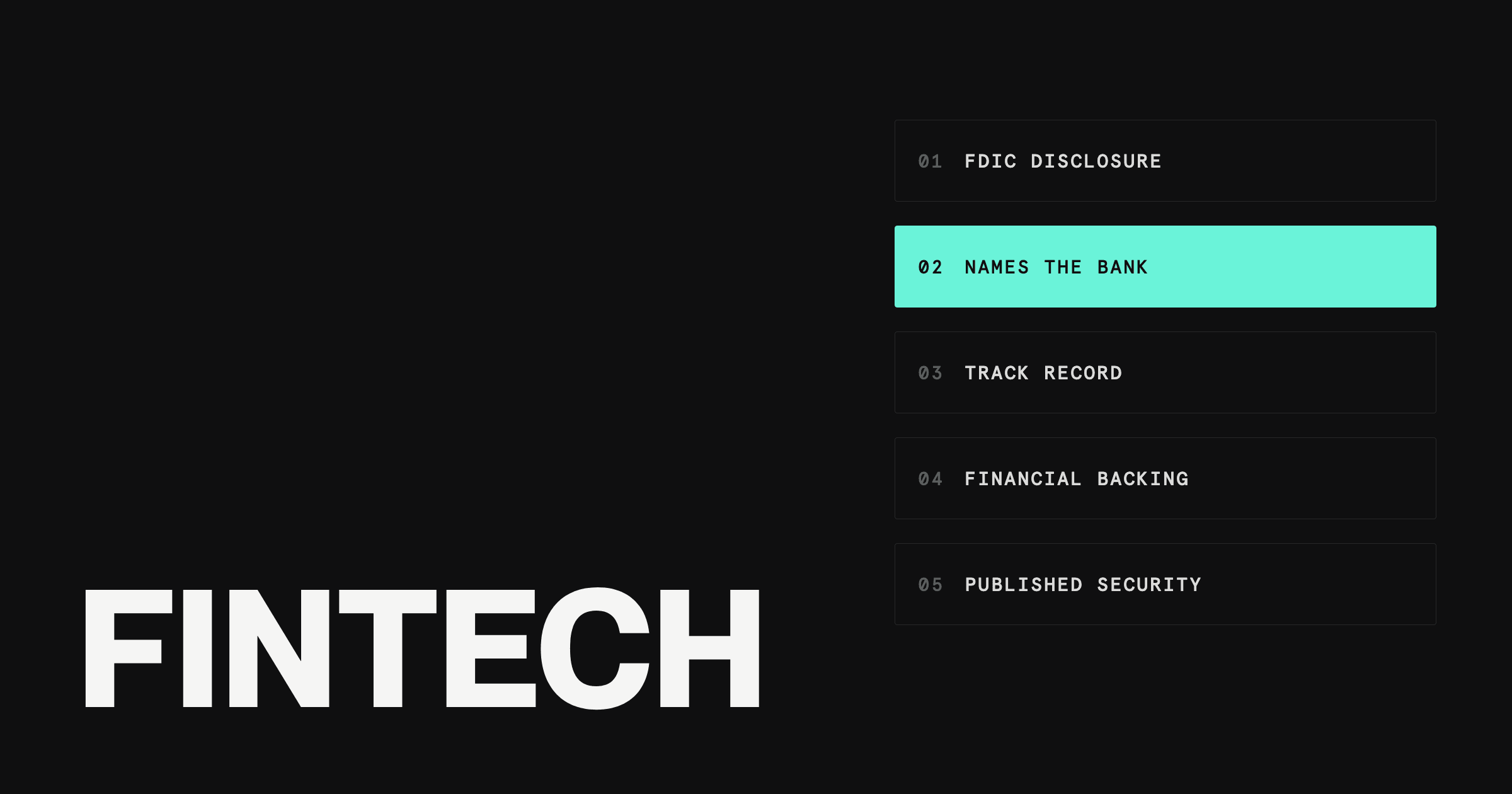
What "fintech" actually means for business banking, how the partner-bank model works, and what to check before you trust one with your company's money.
A fintech bank isn't a bank. It's a technology company that builds the app, the cards, and the workflows you use every day, then partners with a chartered, FDIC-insured bank to actually hold your deposits and move your money.
That distinction isn't a technicality. It determines who's regulated and where your FDIC coverage actually comes from.
Here's what that means in practice, and how to tell a transparent fintech from one that's hoping you won't ask too many questions.
"Fintech" doesn't mean what the marketing implies
"Fintech" is shorthand for "financial technology," and in casual use it covers almost anything: budgeting apps, payment processors, crypto wallets. In business banking specifically, it has a narrower and more useful meaning.
A fintech banking platform is not a chartered bank. It does not hold a banking license, and it is not directly insured by the FDIC in its own name.
Instead, it partners with one or more chartered banks that do hold those things, and builds its product on top of that partnership.
Here's the split in plain terms.
The technology company handles what you interact with: the app, the debit cards, the approval workflows, the customer support.
The chartered bank underneath holds the actual deposits, connects to the Federal Reserve's payment rails, and carries the FDIC insurance. Neither half works without the other, but only one of them is legally a bank.
That's the partner bank model. It's how nearly every fintech in business banking operates today, including the three names you're probably already comparing.
How the partner bank model actually works
FDIC insurance doesn't attach to the fintech. It attaches to the chartered bank holding your money, and it passes through to you as the account holder, as long as the fintech's disclosures and account structure actually support that pass-through.
Here's what the three most-searched names in this category disclose today, checked live on September 29, 2026:
Bluevine describes itself as "a financial technology company, not a bank." Deposits are FDIC-insured through Coastal Community Bank and its program banks, with coverage up to $3,000,000 per depositor.
Mercury describes itself as "a fintech company, not an FDIC-insured bank." Banking services run through Choice Financial Group and Column N.A., with a sweep network spreading deposits across up to 20 partner banks for coverage up to $5,000,000.
Relay describes itself as "a financial technology company" that is "not an FDIC-insured bank." Banking services are provided by Thread Bank, and the disclosure runs sitewide in Relay's footer.
Three different structures. One shared requirement: name the bank.
What to check before you trust one with your money
Trust here isn't a vibe. It's a handful of things you can actually go check yourself before you open an account.
Is the FDIC pass-through disclosure written in plain language, or buried? A trustworthy platform states it clearly, usually right in the footer or on a dedicated security page, not three clicks deep in a terms-of-service PDF.
Does it name the specific chartered bank? "FDIC insured" without naming who actually holds the deposits isn't a disclosure, it's a claim you can't verify.
How long has it operated? A longer track record gives you more history to evaluate. A newer platform isn't automatically untrustworthy, it just has less of a record to point to, so weigh the other checks more heavily.
Who backs it financially? Companies confident in their backing tend to name their investors or institutional partners. Vagueness here is itself information.
Does it publish its security practices, or just assert them? Certifications like SOC 2, a documented penetration-testing program, and a real bug bounty are checkable. A generic "bank-level security" claim is not.
The Rho example later in this piece sticks to the checks a single account page can actually back with a live, confirmed fact: the named partner bank and the disclosed coverage math.
Tenure and financial backing are worth checking too, they just aren't something one account page settles on its own.
The line between disclosure and assertion is easiest to see in security claims.
Mercury publishes a SOC 2 Type II compliance claim on its security page, along with pen-testing and bug-bounty program details.
Bluevine lists account-level controls like two-factor authentication, real-time fraud alerts, and instant card lock on its equivalent page, but doesn't publish a certification claim there.
Neither approach makes one platform unsafe and the other safe. But one gives you more you can independently verify, which is the actual point of this whole exercise.
What separates a legitimate platform from a risky one
Put the checklist together and the pattern is pretty clear.
Signs of a transparent fintech:
Names its partner bank specifically
States its FDIC coverage in a real dollar figure
Keeps that language consistent across its site instead of shifting the wording depending on which page you land on
Signs worth a second look:
Vague "FDIC insured" language with no bank named
Disclosures that only surface if you go looking
Marketing copy that blurs the line and implies the fintech itself is the bank
Fintech status also isn't necessarily permanent.
A handful of companies that started as fintechs eventually become chartered banks in their own right.
What this looks like done well
Rho is one example of a platform structured this way. It's not the only one that does this correctly, and it isn't included here to claim it's "the most trusted," just to show the checklist applied to a real account.
The Rho banking platform names its partner bank specifically: checking and card services are provided by Webster Bank, a division of Santander Bank, N.A.
FDIC pass-through coverage works out to $250,000 per entity, not per account. If your business holds several checking accounts under one entity, they share that single $250,000 limit rather than each getting their own.
That structure and the disclosure language behind it are published, not just implied in marketing copy.
None of that makes any one platform "the most trusted" in the category. It's what the criteria above look like when a platform is willing to be specific about them.
If you want to see the checklist applied to a live account, here's how Rho's banking platform is structured.
FAQs
A chartered bank holds a banking license, is directly regulated as a depository institution, and carries FDIC insurance in its own name. A fintech doesn't hold that license. It partners with a chartered bank to offer banking services, and FDIC coverage passes through that partner rather than attaching to the fintech itself.
A few companies have made the jump from fintech to chartered bank rather than staying partnered with one, but that's the exception, not the rule. Most fintech banking platforms, including Bluevine, Mercury, Relay, and Rho, still operate on the partner-bank model.
Bluevine, Mercury, Relay, and the Rho banking platform are all examples of the model: technology companies that partner with chartered banks rather than holding a banking license themselves.