
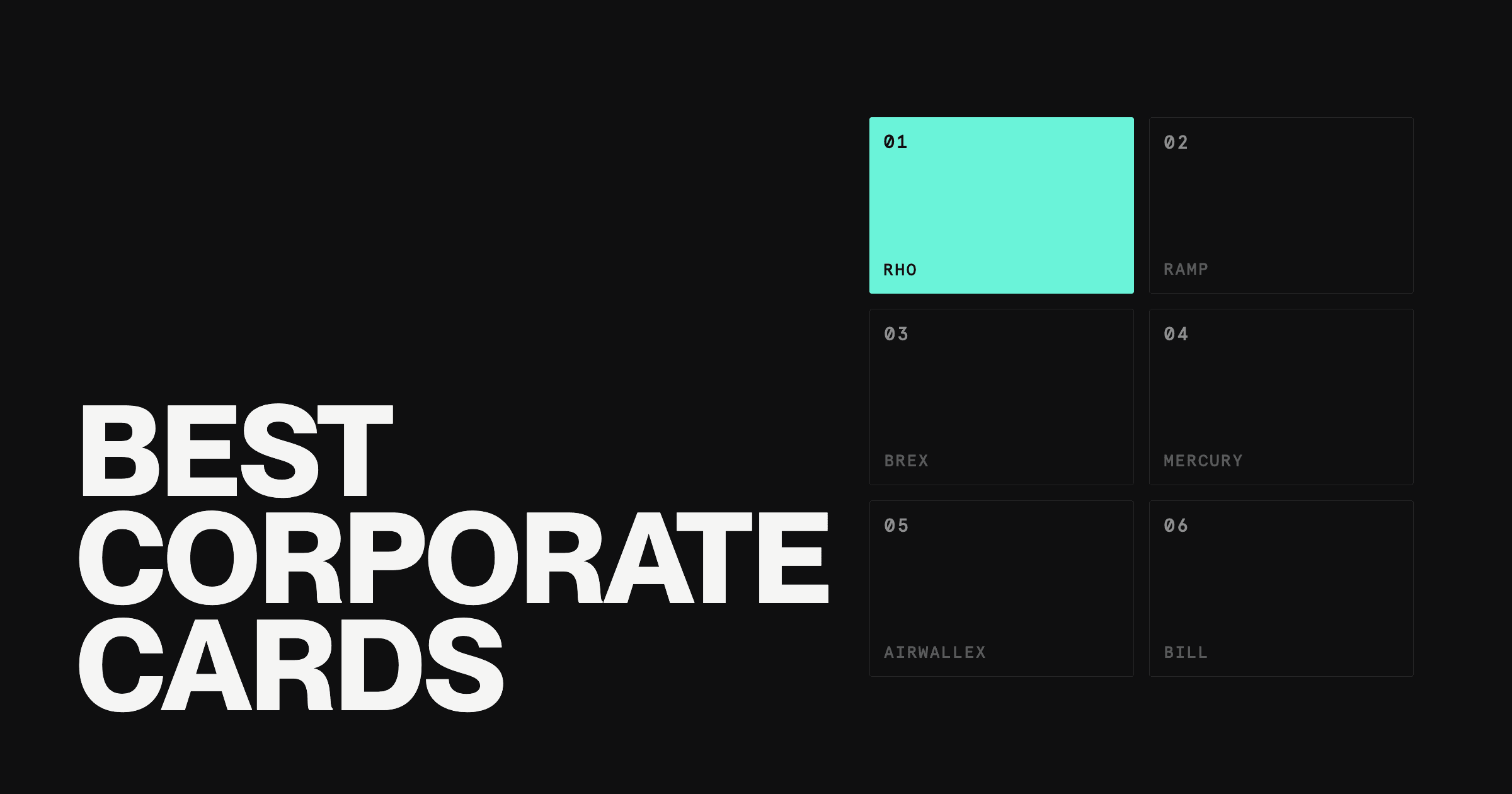

Startups comparing corporate cards in 2026 are choosing between six issuers that all skip the personal guarantee and personal credit check a traditional business credit card requires.
The short answer: Rho's corporate card offers the highest potential cashback of the group, up to 2% with Rho Platinum (terms apply), with no annual fee and no personal guarantee. You unlock the top rate by routing your payroll and revenue through Rho and holding the majority of your company's assets there.
Here's how the rest compare: Mercury publishes the simplest flat rate, an unconditional 1.5% with no strings attached. Airwallex advertises 2% with no cap, but its own linked promotional terms describe a narrower benefit (up to 1.5%, with spend minimums; see the Airwallex verdict below). Brex rewards specific spend categories instead of a flat rate, and Ramp and BILL don't publish a rate at all.
Ramp, Brex, Mercury, Airwallex, BILL Spend & Expense, and Rho all skip the personal guarantee and the personal credit check that legacy small-business credit cards require.
All six issuers support instant virtual cards; Rho and several others also support vendor-locked cards, so a single subscription or contractor payment can't be used anywhere else.
Rho requires a US-incorporated business with an EIN; eligibility requirements vary by issuer, from Brex's revenue or funding thresholds to Ramp's and BILL's unpublished criteria (see the comparison table below).
Cashback terms range from Ramp's and BILL's unpublished rates to Mercury's flat 1.5% and Rho's up to 2% Platinum rate (terms apply). Rho's standard rate trails Mercury's flat rate unless a startup qualifies for Platinum, which caps eligible cashback at $1M per calendar year.
Competitor figures throughout are pulled from each vendor's own site on October 4, 2026, with “not published” used wherever a vendor hasn't disclosed a number.
This comparison covers corporate charge cards only, not revolving business credit cards: no personal guarantee, no revolving balance.
Want revolving business credit cards from banks like Amex, Chase, or Capital One instead? See the 17 best startup business credit cards. Still deciding what to look for? See how to choose a corporate card.
Comparison table
Card | Best for | Cashback / rewards | Annual fee | Personal guarantee | Key requirement |
|---|---|---|---|---|---|
Startups that want cashback tied to where they already bank | Daily Terms: 1.25% standard / up to 2% Platinum (terms apply). Monthly Terms: 1% standard / up to 1.75% Platinum (terms apply). $1M annual cap, terms apply. | $0 | Not required | US-incorporated with an EIN. Monthly Terms requires $25,000 held at Rho, or $75,000 combined with linked external accounts. | |
Ramp | Startups that want spend controls and automation without a published rewards rate | Not published | Not stated | Not required | Not published |
Brex | Startups with venture funding or higher revenue that want tiered rewards on specific spend categories | Tiered multipliers: up to 7x on rideshare, 4x on Brex prepaid travel, 3x on restaurants, 2x on software, 1x on everything else. Not a flat cashback rate. | Not stated on the card product page | Not required | $50,000 minimum cash balance if venture-funded, or $500,000+ in annual revenue for daily payments ($400,000+ monthly for mid-market terms). |
Mercury | Startups already banking with Mercury that want one flat rate | Unlimited 1.5% cashback on all spending, flat | $0 | Not required | Daily repayment by default; switch to 30-day terms once your balance reaches $15,000. |
Airwallex | Startups with international spend who want a simple promotional rate | Advertised as 2% cashback with no cap, but Airwallex's own linked promotional terms describe a narrower benefit: up to 1.5% on qualifying US-merchant USD transactions of $25+, requiring a $2,000 minimum monthly card spend, running through at least December 31, 2026 (promotional, see terms). | $0 | Not required | No minimum balance stated |
BILL Spend & Expense | Startups that want budgeting and expense tools bundled with the card | Not disclosed as a percentage; the product page describes rewards qualitatively only | $0 per user | Not published | Credit lines from $1,000 to $5M, subject to approval |
Rates and fees verified directly from each company's own site as of October 4, 2026. Subject to change; confirm current terms before applying.
Here's the reasoning and the trade-offs behind each number.
Card-by-card verdicts
Rho
Ideal for: Startups that want their corporate card cashback tied to the rest of their banking relationship, and that are comfortable keeping a meaningful balance at Rho to qualify for the higher rate.
Our take: Rho's standard rate (1.25% on Daily Terms, 1% on Monthly Terms, terms apply) is lower than Mercury's flat 1.5% if you don't qualify for Platinum. Platinum gets you up to 2% on Daily Terms or up to 1.75% on Monthly Terms (terms apply), but it requires routing payroll and revenue through Rho and holding the majority of your company's assets there. That's a real concentration decision, not a free upgrade.
The $1M annual cap on eligible spend and the 12-month redemption window (after which unredeemed cashback is forfeited, terms apply) are both worth knowing before you plan around the rate.
Pros:
No personal guarantee, no personal credit check
$0 annual, subscription, or per-card fees
Physical, virtual, and vendor cards on the Mastercard World Elite Business network
Cashback rate scales up (not down) the more of your banking you consolidate at Rho
Cons:
Platinum's top rate requires routing payroll and revenue through Rho and keeping most company assets there
Monthly Terms requires a $25,000 balance at Rho ($75,000 combined with linked accounts), subject to underwriting
Cashback is capped at $1M in eligible spend per calendar year and unredeemed cashback expires after 12 months
Standard (non-Platinum) rate is lower than Mercury's flat 1.5%
Rho is the only one of these six cards that ties its cashback to a broader banking relationship instead of a single-purpose rewards program. Moving your payroll, revenue, and banking to Rho is the tradeoff for a rate and a relationship that scale together, instead of adding a separate rewards card on top of a bank account held elsewhere.
See Rho's corporate card for current rates, full eligibility terms, and how to apply.
Ramp
Ideal for: Startups that want strong default spend controls and expense automation and are willing to apply without knowing the cashback rate in advance.
Our take: Ramp doesn't publish a cashback percentage or range on its card page or pricing page as of this writing. That's not unusual for Ramp specifically, but it means you can't comparison-shop the rate the way you can with Rho, Mercury, or Airwallex before you apply.
Pros:
No personal guarantee or personal credit check required
Strong reputation for built-in spend controls and automation (qualitative, not a figure we can cite)
Cons:
Cashback rate is not published anywhere on Ramp's own site
Minimum balance or revenue requirement to qualify is not published
Annual fee is not stated on the card or pricing pages
Brex
Ideal for: Venture-funded startups or higher-revenue companies that spend heavily in categories Brex rewards at a multiplier, like rideshare, travel, and software.
Our take: Brex's rewards aren't a flat rate. You earn more in a handful of categories (up to 7x on rideshare) and fall back to 1x on everything else, so your effective rate depends heavily on your spend mix.
Pros:
No personal guarantee required
Multiplier rewards can beat a flat rate if your spend concentrates in the rewarded categories
Mastercard network, accepted in 210+ countries
Cons:
Falls back to 1x on most general spend outside the bonus categories
Requires a $50,000 minimum cash balance (if funded) or $500,000+ in annual revenue to qualify for daily payment terms
Annual fee status is not stated on the current card product page
Mercury
Ideal for: Startups that already bank with Mercury and want a simple, flat cashback rate with no tiers to track.
Our take: 1.5% flat, unlimited, and unconditional is the simplest rate of the six: no spend minimums, no merchant restrictions, no promotional end date. It beats Rho's and Brex's standard rates, and once you account for Airwallex's real spend minimums, it's the most straightforward flat rate on this list even though it isn't the highest headline number.
Pros:
Flat 1.5% cashback on all spending, no categories or tiers
No annual fee
No personal guarantee
Cons:
Starts on daily repayment terms; 30-day terms require a $15,000 balance
Rate is fixed, so there's no path to a higher tier the way Rho or Brex offer
Airwallex
Ideal for: Startups with meaningful US-merchant spend who want a simple promotional rate and no FX fees, and who can read past the headline number to the terms behind it.
Our take: Airwallex advertises “2% cashback on every purchase, with no cap” on its cards page, but the promotional terms linked from that same page describe a materially different benefit: up to 1.5% on USD transactions of $25 or more at US merchants only, and only if you spend at least $2,000 on the card that month. The promotion is scheduled to run through December 31, 2026, and Airwallex can extend, shorten, or end it early.
The lack of foreign transaction fees is still a genuine advantage for companies paying vendors or contractors abroad, and there's no minimum balance requirement to get the card itself.
Pros:
Up to 1.5% cashback on qualifying US-merchant transactions (promotional, see terms; scheduled through at least December 31, 2026)
No monthly fee, no setup fee, no minimum balance requirement to hold the card
No foreign transaction fees, conversions at the interbank rate
Cons:
The advertised “2%, no cap” headline doesn't match the linked promotional terms, which cap the real rate at up to 1.5% and require a $2,000 monthly minimum spend
Company cards are virtual-only; only employee cards come in physical form
Visa network, not Mastercard, which matters only if your vendors have a network preference
BILL Spend & Expense
Ideal for: Startups that want budgeting and expense-management software bundled with the card itself, rather than a high cashback rate.
Our take: BILL doesn't publish a cashback percentage, just a qualitative “earn rewards” statement, so this isn't the card to pick for the rate. The wide credit-line range ($1,000 to $5M) suggests it serves a broad range of company sizes, but approval and the actual line you get are individual.
Pros:
No per-user subscription fee
Wide credit-line range to grow into
Budgeting tools built into the same product
Cons:
No published cashback rate or range
Personal guarantee requirement isn't stated either way on the product page
Card network isn't disclosed on the product page
How corporate cards work
Corporate charge card vs. business credit card
A corporate charge card is issued based on your company's financials, not your personal credit. You don't sign a personal guarantee, and the issuer doesn't pull your personal credit report. A traditional business credit card from a bank almost always requires both, which is why those cards show up under your personal credit history and a missed payment can follow you personally.
Corporate cards from Ramp, Brex, Mercury, Airwallex, BILL, and Rho are not revolving credit either. The balance is expected to be paid off on a set schedule (daily or monthly, depending on the issuer and your terms), not carried.
Virtual cards are instant; some lock to one vendor
Ramp, Brex, Mercury, Airwallex, BILL, and Rho all issue virtual cards instantly, so you can set up a new recurring payment or a one-off vendor charge without waiting on plastic. Several, including Rho, also support vendor-specific cards, meaning you can issue a card locked to a single vendor or spend category so a subscription or a contractor payment can't be used anywhere else.
Spend limits live at the card level, not in a policy document
Ramp, Brex, Mercury, Airwallex, BILL, and Rho each let an admin set limits by employee, department, or card type, and most let you freeze or cancel a card instantly if an employee leaves or a card number is compromised. This is the main practical advantage corporate cards have over handing out a shared company credit card: the limits live at the card level, not just in a policy document.
Accounting sync is standard; how deep it goes varies by issuer
Corporate cards generally sync transactions to your accounting software automatically, cutting down on the manual receipt-matching that comes with a traditional card program.
How deep that sync goes (categorization, receipt capture, close-the-books automation) varies by vendor, and it's worth testing against your own accounting workflow before you commit.
Methodology
Every Rho cashback, fee, and eligibility figure comes directly from rho.co/product/corporate-cards, read on October 4, 2026.
Here's how that sourcing worked in practice: every competitor figure is sourced directly from that company's own website, its card product page, pricing page, or published support documentation, also read on October 4, 2026, with the specific URL and date cited in our internal fact-check record.
None of the figures for Ramp, Brex, Mercury, Airwallex, or BILL Spend & Expense come from a third-party review site, forum, or comparison article. Where a vendor hasn't published a number, this comparison says “not published” rather than estimating it.
This comparison is published by Rho, a company that issues a corporate card. Every figure above is traceable to a primary source and a date, so you can verify any of it yourself rather than take our word for it.
For a broader walkthrough of what to look for before comparing specific issuers, see how to choose a corporate card.
How to apply
Ramp, Brex, Mercury, Airwallex, BILL, and Rho each have their own application flow on the issuer's own site.
For Rho specifically, you'll need a US-incorporated business with an EIN. Monthly Terms eligibility depends on holding $25,000 at Rho, or $75,000 combined with linked external accounts, subject to underwriting. Businesses that don't meet the Monthly Terms balance apply on Daily Terms instead.
Start an application for Rho's corporate card to move forward, or to talk with a Rho expert about which terms your business qualifies for first.
If your business doesn't fit the corporate-charge-card model, you want a revolving balance, you're not ready to meet a corporate card's financial requirements, or you'd rather compare a wider set of options, see the 17 best startup business credit cards for a broader roundup that includes traditional bank cards.
Next step
See current rates and apply if Rho's corporate card fits what you need. Not ready for a corporate-charge card yet? See the 17 best startup business credit cards for a broader roundup that includes traditional bank cards.
FAQs
A corporate card is issued based on your company's financials and doesn't require a personal guarantee or a personal credit check. A business credit card almost always requires both, which means it shows up on your personal credit history. Corporate cards are also typically charge cards, meaning the balance is paid off on a schedule rather than carried as revolving debt.
It depends on the issuer. Brex states a minimum cash balance of $50,000 for funded companies or $500,000+ in annual revenue for daily payment terms. Rho's Monthly Terms require $25,000 held at Rho or $75,000 combined with linked external accounts, subject to underwriting. Ramp, Mercury, Airwallex, and BILL don't publish a specific revenue or funding threshold on their own sites as of this writing.
Yes. Ramp, Brex, Mercury, Airwallex, BILL Spend & Expense, and Rho each issue their card to a registered business entity, not an individual. Rho specifically requires that your business be incorporated in the US with an EIN.
No. None of Ramp, Brex, Mercury, Airwallex, BILL Spend & Expense, or Rho requires a personal guarantee or a personal credit check, so approval and usage don't appear on your personal credit history the way a personal-guarantee business card would.
A virtual corporate card is a card number issued digitally, without a physical card, that you can use immediately for online purchases, SaaS subscriptions, or a specific vendor. Ramp, Brex, Mercury, Airwallex, BILL, and Rho all issue virtual cards instantly alongside physical ones.
An admin sets limits per employee, department, or card, and can freeze or cancel individual cards without affecting anyone else's. This is handled inside the issuer's own platform rather than through a shared card and a written policy.
No. Cashback rates at Ramp, Brex, Mercury, Airwallex, BILL Spend & Expense, and Rho are all subject to each issuer's current terms and can change. Rho's rate specifically (up to 2% Platinum or 1.25% standard on Daily Terms, up to 1.75% Platinum or 1% standard on Monthly Terms, terms apply) depends on meeting ongoing qualification requirements, payroll, revenue, and asset concentration at Rho for Platinum, not a one-time application.
12 months from when it's earned (terms apply). After that, unredeemed cashback is forfeited.