

If you're trying to find the single best business bank account, the honest answer is that it depends on what you're optimizing for. A sole proprietor who wants a free account open by lunch needs a different platform than a 40-person company sweeping $2 million in idle cash every month.
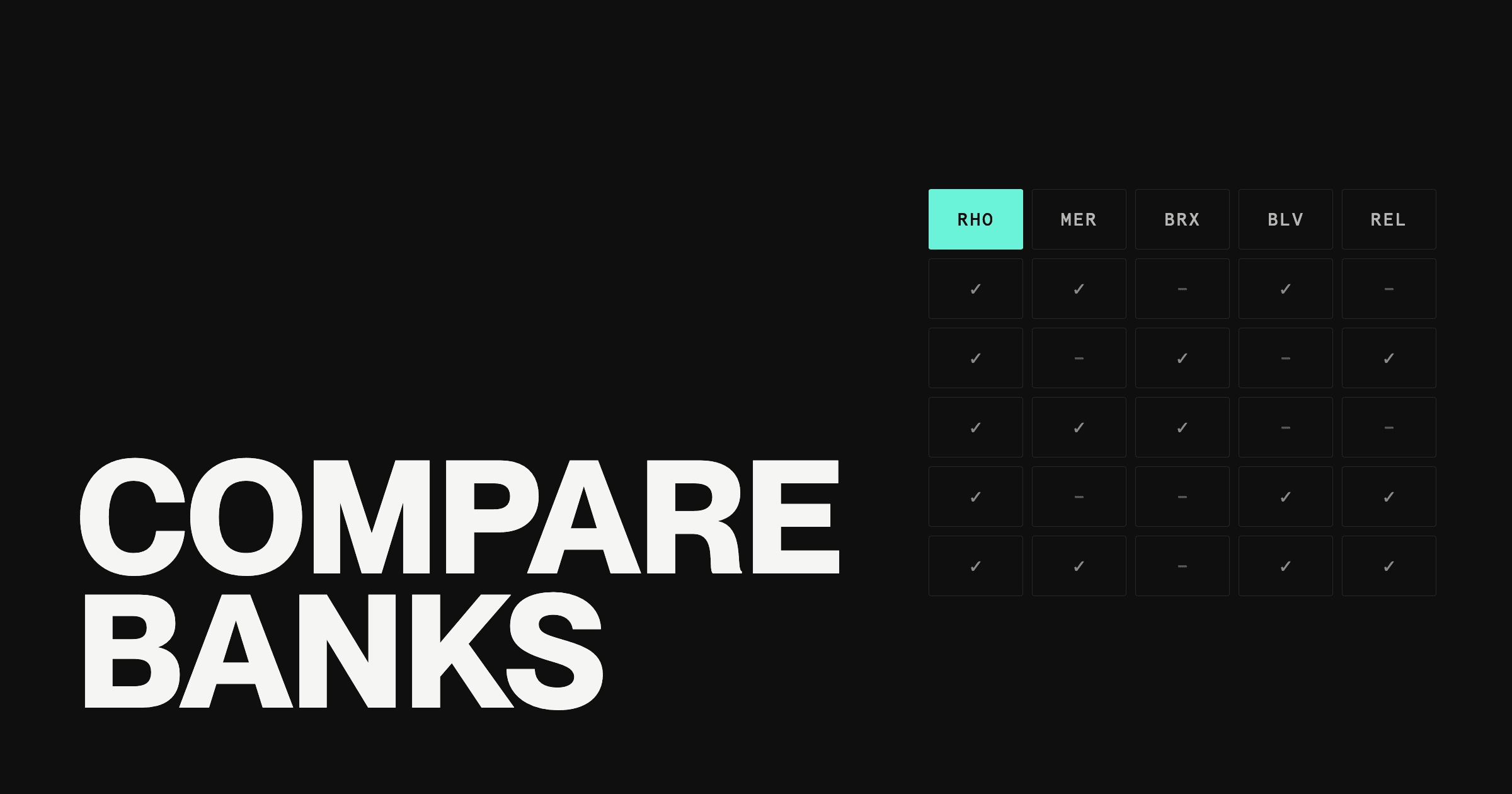
So instead of one more ranked list, here's a direct comparison: the same six questions, asked of all 11 platforms, with the sourced answer for each.
This covers the platforms people actually put side by side when they search for the best business checking account: Bluevine, Brex, Found, Grasshopper, Lili, Mercury, Novo, Ramp, Relay, Rho, and Wise. That's a wider set than most existing comparisons.
Airwallex, for instance, publishes its own comparison page but only covers 8 providers, leaving out Ramp, Novo, Lili, Wise, and Grasshopper entirely.
One disclosure up front: we build one of the accounts on this list. Rho's row gets the same sourcing standard as every other row below: every figure pulled directly from each platform's own published pages and dated, not just Rho's.
Jump to: the comparison table · how to read FDIC vs. SIPC · each platform in detail · FAQs
The 11-platform comparison matrix
All figures below were pulled directly from each platform's own website on October 3, 2026, and every rate carries the date it was published, since account yields move. Where a platform didn't publish a figure (a sub-account cap, an opening-time claim, a specific FDIC ceiling), the cell says so instead of guessing.
Bluevine | Brex | Found | Grasshopper | Lili | Mercury | Novo | Ramp | Relay | Rho | Wise | |
Monthly fee | $0 Standard; $30/mo Plus (waivable); $95/mo Premier (waivable) | $0 Essentials; $12/user/mo Premium; Enterprise custom | $0 Free; $35/mo Plus; $80/mo Pro | $0, no monthly fee | $0 Core; Pro/Smart/Premium fees not itemized on the homepage | $0 Free; $29.90/mo Plus (annual) or $35/mo monthly; $299/mo Pro (annual) or $350/mo monthly | $0, no-fee checking | $0, no minimum balance or maintenance fee stated | $0 Starter; $30/mo Grow; $120/mo Scale (list price) | $0, no monthly, per-user, or minimum-balance fees | No account/monthly fee stated; wires from $1.13 to send, $6.11 to receive |
Account & sub-accounts | Checking with built-in sub-accounts; no published maximum | Cash Management Account with sub-accounts; no published maximum | Checking built for freelancers/sole props with tax set-asides; no sub-account cap published | Checking account; no sub-account cap published | Checking with "Pockets" budgeting feature; paid tiers add features | Checking, Treasury, and sub-accounts; no published maximum | Checking plus "Reserves," which are in-account budgeting buckets, not full sub-accounts | Checking integrated with Ramp's card and spend platform; no sub-account cap published | 20 checking accounts on Starter and Grow, 50 on Scale, the only platform here with a published number | Checking plus a separate Savings account; sub-accounts available, no published maximum | Multi-currency balances, structurally different from sub-accounts |
APY / yield | Up to 3.00% (Premier); 1.75% (Plus); 1.3% (Standard, requires a monthly activity goal) (verified live 10/03/2026, no source date published) | No checking APY. Vault/Treasury (DGVXX) rate renders client-side with no static figure on a direct pull; rate varies, check brex.com directly | Found Plus 1.50% up to $20,000; Found Pro 2.50% uncapped, effective 07/01/2026 | Checking up to 1.35% (tiered 1.00%–1.35%–1.00%) as of 11/03/2025; Money Market up to 3.00% as of 01/05/2026 | Pockets savings feature, not checking: up to 4.00%, but only on the $500,000–$1,000,000 balance band; 2.25% applies $0–$500,000, 0% above $1M, as of 01/13/2026 | No checking APY. Treasury sweep up to 3.96%, tiered 3.11%–3.96% by balance ($250K–$50M+), as of 09/25/2026 | No APY product published (verified live 10/03/2026); Reserves aren't interest-bearing | Checking 2.00% APY, accurate as of 10/03/2026. Investment Account yield varies and has moved on its own stated as-of date before; check ramp.com for the current figure | No checking APY on Starter/Grow; Savings 1.19% (Starter), 1.87% (Grow), 3.21% (Scale), as of 09/17/2026 | Savings 1.00% APY (verified live 10/03/2026, no source date published), variable, requires $25,000 average monthly balance to earn interest. Treasury yield varies; current rate at rho.co/treasury | Rate varies, opt-in feature, business-account eligibility not confirmed on the current page |
FDIC coverage | Up to $3,000,000 per depositor via Coastal Community Bank, Member FDIC, plus partner banks | Up to $6,000,000 via sweep across 20+ program banks; base bank Column N.A., $250,000 | $250,000 per depositor, per ownership category, via Lead Bank, Member FDIC | $250,000 standard per bank, plus enhanced sweep coverage up to $125,000,000 via ICS | Up to $3,000,000 via sweep network; base partner Sunrise Banks, N.A. | Up to $5,000,000 via sweep across up to 20 partner banks; base banks Choice Financial Group and Column N.A. | $250,000 via partner bank Middlesex Federal Savings, Member FDIC; no sweep network found | First Internet Bank of Indiana, Member FDIC; "tens of millions" via IntraFi ICS, no specific ceiling published | Up to $3,000,000 via Thread Bank sweep, $250,000 per institution | $250,000 per entity on checking (Webster Bank, a division of Santander Bank, N.A.); up to $75,000,000 in sweep capacity on Savings (capacity, not a guarantee) | Not FDIC-insured; Wise is a Money Service Business. Pass-through FDIC up to $250,000 on interest-earning funds via program banks |
SIPC-protected investment product | None found; checking and savings run through an FDIC bank only | Vault/Treasury (DGVXX) is a brokerage product, not FDIC-insured; specific SIPC coverage figure not published | None found; FDIC only | None found; FDIC only | None found; FDIC only | Treasury is a brokerage sweep product, not FDIC-insured; specific SIPC coverage figure not published | None; FDIC only | Investment Account is a brokerage product via Moment Advisors and Apex Clearing; SIPC applies, but check ramp.com's own disclosure for the exact figure | None found; FDIC only | Rho Treasury (separate product, $50,000 minimum) is SIPC-protected up to $500,000, including $250,000 for cash, via Apex Clearing Corp and Interactive Brokers LLC. Not FDIC-insured | None; not a bank, no investment product |
Time to open | "Submit in just a few minutes" (Bluevine's own user-testing-based claim) | No specific claim published | "Sign up in as little as 5 minutes," no credit check, no minimum balance | "In minutes" (qualitative) | No specific claim published | "Apply online in 10 minutes" | "In just a few clicks," no specific minute claim | "Less than a minute" for existing Ramp customers adding Checking; not a new-customer onboarding claim | "Open and fund your first account in minutes," no branch visit required | Less than 10 minutes | No specific claim published |
So before the deep dives: no single platform wins every row. Grasshopper's $125M sweep ceiling dwarfs everyone else's, with Rho's Business Savings Account's $75M the next-highest in the table, but Grasshopper is also the only one still showing rate tiers from late 2025. Relay is the only platform with a hard sub-account number. Ramp's checking APY is the highest dated, verifiable figure in the whole table.
How to read "FDIC" vs "SIPC" in that table
These aren't interchangeable, and the difference actually matters for where your cash sits. FDIC insurance covers deposits at a bank, up to $250,000 per depositor per bank, and it only pays out if the bank itself fails.
It doesn't protect you if the fintech on top of that bank fails. SIPC insurance is different: it covers brokerage accounts, up to $500,000 including $250,000 in cash, against the failure of the brokerage, not against investment losses.
That distinction shows up directly in this table. A platform's checking account is almost always FDIC-insured through a partner bank.
A platform's "Treasury" or "Investment Account" product, when it has one, is usually a brokerage product covered by SIPC instead, and it isn't FDIC-insured even though it sits next to an FDIC-insured checking account on the same dashboard. If a page doesn't say which one applies, that's worth asking before you move money.
Each platform in detail
Here's what each of those rows actually looks like once you zoom in on a single platform.
Bluevine
Bluevine's three-tier structure (Standard, Plus, Premier) lets a business trade a $30–$95 monthly fee for a higher APY, up to 3.00% on Premier (verified live 10/03/2026, no source date published), both waivable with certain requirements. Its FDIC coverage, up to $3,000,000 through Coastal Community Bank, sits in the middle of this group.
Best for: a business that wants its checking balance to earn something without opening a separate savings product.
Watch for: Bluevine's own page still doesn't publish an as-of date on its APY figures. Verified live 10/03/2026, so confirm the current rate directly before you plan around it.
Brex
Brex's Essentials tier is free, and its Vault sweep goes to $6,000,000 across 20+ program banks, among the higher FDIC ceilings here. Its Treasury yield (ticker DGVXX) renders dynamically on Brex's own site and didn't resolve to a static number on a direct pull today.
Best for: a company already in Brex's card ecosystem that wants banking on the same platform.
Watch for: no published account-opening-time claim and no fixed Treasury rate to compare against competitors.
Found
Found is built for freelancers and sole proprietors specifically, and explicitly serves them, along with LLCs, S-corps, and C-corps. That's a real structural difference from most of this list: Rho, for one, requires an incorporated business.
Best for: a sole proprietor or freelancer who doesn't have, and doesn't want to form, an LLC.
Watch for: Found's uncapped 2.50% APY is on its $80/mo Pro tier, not the free tier.
Grasshopper
Grasshopper's sweep coverage, up to $125,000,000 via its ICS network, is the largest FDIC ceiling in this comparison by a wide margin. Its APY tiers, however, are the oldest dated figures here: checking as of November 2025, money market as of January 2026.
Best for: a business holding a large cash balance that wants that balance spread across many FDIC-insured banks.
Watch for: the rates above are nearly a year old on the checking side; confirm current tiers at grasshopper.bank before relying on them.
Lili
Lili advertises "up to 4.00% APY" on its Pockets savings feature, not on checking, and that headline rate only applies to the slice of a balance between $500,000 and $1,000,000. Balances under $500,000 earn 2.25%, and anything over $1,000,000 earns 0%.
Best for: a very specific balance range ($500K-$1M); outside that band, the advertised rate doesn't apply to your money.
Watch for: Lili's paid-tier fees (Pro, Smart, Premium) aren't itemized on its homepage, so check the fee schedule directly.
Mercury
Mercury's free tier has no monthly fee, and its Treasury sweep tops out around 3.96% at higher balances, though the $250,000 minimum to access Treasury is five times Rho's $50,000 minimum for the equivalent product. Its FDIC sweep, up to $5,000,000, runs across as many as 20 partner banks.
Best for: a venture-backed company that wants a higher-balance Treasury sweep and is comfortable with the $250K entry point.
Watch for: no checking APY; the yield only applies once you've moved money into Treasury.
Novo
Novo's checking is fee-free, but it has no interest-bearing savings or Treasury product; its "Reserves" feature is a budgeting tool, not a yield (re-verified via novo.co's features and help documentation as of 10/03/2026). Its FDIC coverage, $250,000 through Middlesex Federal Savings, is the base case with no sweep network layered on top.
Best for: a very early-stage business that wants simple, free checking and isn't optimizing for yield.
Watch for: no interest on idle cash, and FDIC coverage caps out at the standard $250,000.
Ramp
Ramp's checking APY, 2.00% as of October 3, 2026, is the highest dated and currently stable figure in this table. Its separate Investment Account can yield more, but that rate has moved before on the same stated as-of date, so treat any specific percentage there as a snapshot, not a stable number.
Best for: a company already using Ramp for cards and spend management that wants checking on the same login.
Watch for: the Investment Account is a brokerage product (SIPC, not FDIC); confirm the current disclosure before moving a meaningful balance into it.
Relay
Relay is the only platform in this comparison with a published sub-account limit: 20 on its Starter and Grow plans, 50 on Scale. Its Savings APY scales from 1.19% to 3.21% by tier, each dated as of mid-September 2026.
Best for: a business that wants to split cash across many named sub-accounts (payroll, taxes, rent) without a workaround.
Watch for: Scale's $120/mo list price is shown with a limited-time discounted price on Relay's own pricing page; budget for the list price.
Rho
Rho's checking, savings, and treasury platform charges $0 for monthly, per-user, and minimum-balance fees, with $250,000 in FDIC coverage per entity through Webster Bank, a division of Santander Bank, N.A., Member FDIC.
Its Savings account carries up to $75,000,000 in sweep capacity, the second-highest ceiling in this comparison behind Grasshopper's $125,000,000, though that figure is capacity, not a contractual guarantee.
Best for: an incorporated business that wants no account fees, a Treasury minimum a fraction of Mercury's ($50,000 versus $250,000), and 24/7 human support by phone, chat, or SMS, with dedicated account management for growth-stage and qualifying clients.
Watch for: no account for sole proprietors (a business needs to be incorporated in the US, with either a US operating address or an owner holding a valid US SSN) · Rho Treasury is a separate, SIPC-protected product with a $50,000 minimum, not FDIC-insured.
Wise
Wise isn't a bank. It's a Money Service Business registered with FinCEN, which means its FDIC coverage is pass-through only, up to $250,000 on interest-earning funds through a partner bank.
Its account structure is multi-currency balances rather than the checking-plus-sub-accounts model most of this list uses.
Best for: a business that moves money internationally in multiple currencies more often than it needs US-dollar banking features.
Watch for: rate varies, opt-in feature, business-account eligibility not confirmed on the current page.
New to Rho?
Rho is built for incorporated businesses that want checking, savings, and treasury on one platform, with no monthly fees and an application that takes less than 10 minutes.
FAQs
There isn't one universal answer; it depends on what the business needs most.
A business that wants the highest FDIC coverage ceiling on idle cash looks at Grasshopper or Rho's Business Savings Account. One that wants a hard sub-account limit it can plan around looks at Relay. A sole proprietor without an LLC has a shorter list, since several platforms on this page, including Rho, require incorporation.
A business that wants to move idle cash into a higher-yield Treasury sweep without tying up $250,000 to get started looks at Rho, whose $50,000 Treasury minimum is a fraction of Mercury's entry point for the equivalent product.
Any platform on this list serves an LLC, since incorporation requirements (where they exist, like Rho's) are built around having a formal business entity, not a specific entity type.
The better question is which FDIC ceiling, fee structure, and sub-account setup fits the LLC's cash balance and operating complexity, which the table above is built to answer directly.
On speed, Found and Rho both publish sub-10-minute claims; several others describe opening as "a few minutes" without a specific number. On cost, nine of the 11 platforms here charge $0 for a base account (see "Which bank gives a free business account?" below for the full list).
Nine of the 11 platforms compared here have a genuinely free base tier with no monthly fee: Bluevine (Standard), Brex (Essentials), Found (free tier), Grasshopper, Mercury (free tier), Novo, Ramp, Relay (Starter), and Rho.
Lili and Wise don't publish a flat monthly account fee either, though Lili's paid tiers add features for a cost, and Wise charges per-transaction wire fees instead of a monthly fee.
Not inherently, as long as the fintech partners with an FDIC-insured bank and is transparent about which one. None of the 11 platforms compared here, including Rho, is itself a bank; each routes deposits to a chartered bank partner, which is exactly what the FDIC coverage row in the table above is built to show.
The real risk isn't the fintech wrapper. It's not knowing whether a given balance sits behind FDIC coverage, SIPC coverage, or neither, which is why that distinction gets its own section above rather than a footnote.
It varies widely, and most platforms on this list don't publish specifics beyond "live chat" or "email support" in their help docs.
Rho is the exception: it publishes 24/7 human support by phone, chat, or SMS, with dedicated account management added for growth-stage and qualifying clients. For the rest of this list, treat "support" as an open question to confirm directly before you switch.
This refers to a federal reporting requirement, not a bank-specific policy: businesses generally must report cash transactions over $10,000 to the IRS using Form 8300. Banks also file Currency Transaction Reports for cash transactions over $10,000. Neither rule blocks the transaction; it triggers a reporting obligation.
Yes. Most business bank accounts, including every one covered here, accept an EIN in place of a Social Security number for account opening, alongside your formation documents.