
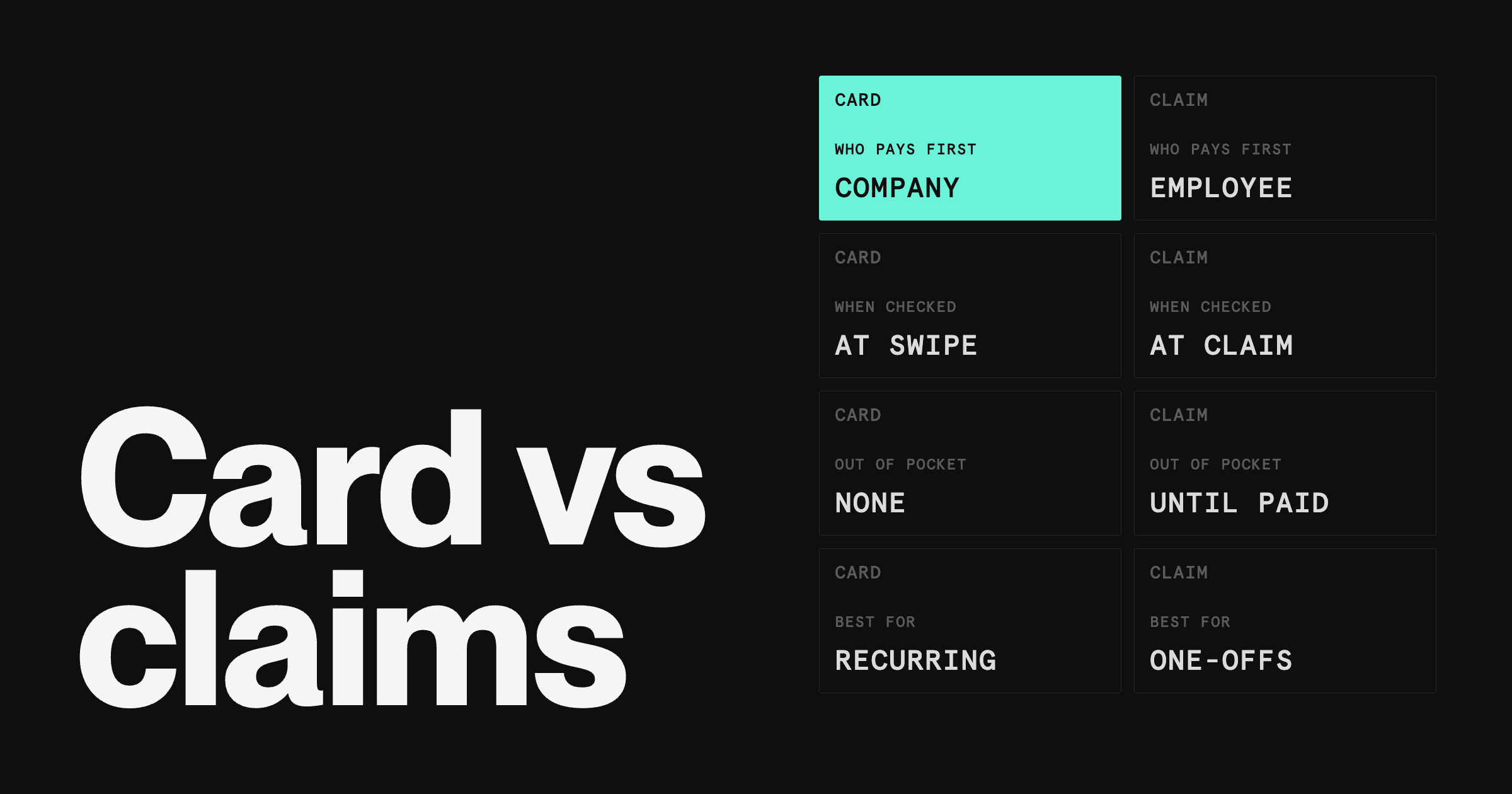
Corporate cards let the company pay first; reimbursements let the employee pay first. Everything else in the comparison follows from that difference.
Cards suit recurring, predictable spend; reimbursements suit one-offs and mileage. Most companies run both and pick one as the default.
Reimbursements follow IRS accountable plan rules. IRS Publication 463 sets three tests: a business connection, adequate accounting, and return of any excess.
Corporate cards let the company pay first. Employee reimbursements let the employee pay first. Everything else in this comparison, from cash flow to approval rules to how clean your books are at month end, follows from that one difference.
This comparison covers how each works, where each wins, and how to choose.
Looking for specific card picks? See the best corporate cards.
What's the difference between corporate cards and employee reimbursements?
With a corporate card the company pays first; with an employee reimbursement the employee pays first, and the company pays them back after approving the claim.
Use corporate cards for recurring and predictable spend: software, ads, travel, vendor payments, team purchases. Use reimbursements for the exceptions: a one-off cab ride, a purchase where a card was not accepted, a mileage claim.
Most companies end up running both. The question is which one is the default. For a growing startup, the default that holds up best is the card, because the company controls the spend before it happens rather than reviewing it after.
See the side-by-side table below.
What is an employee expense card? How corporate cards work
A company issues cards, physical or virtual, to employees or teams. Depending on the card program, each card can carry rules set by the company: how much can be spent, and which approvals or receipts are required.
The company pays the card bill, not the employee. Nobody fronts cash, and nobody waits to be paid back.
The employee swipes or enters the card number, and the transaction posts to the company's account. With the right setup, receipts get attached, the transaction gets coded to a category, and it flows into the accounting system.
What that means in practice:
Spend can be capped up front. Depending on the card program, limits can be set before the card is issued.
Off-policy spend can be caught earlier. With the right setup, the company does not have to wait for an expense report to find out.
Employees keep their own money. Personal cards and personal cash stay out of company spend.
How expense reimbursement works
An employee pays for a business expense with a personal card or cash. They then submit the receipt, usually with a short note on the purpose of the expense. A manager approves it, and the company pays the employee back.
This is the older model, and it still has a place. It needs no cards, no limits, and no setup beyond a policy and a way to pay people.
The tradeoff sits in the timing. The company learns about the spend after it happens, and the employee carries the cost until payback arrives.
Mileage has its own rules: see our mileage reimbursement guide.
Corporate cards vs. employee reimbursements, side by side
Corporate cards | Employee reimbursements | |
|---|---|---|
Who pays first | The company | The employee |
Cash-flow impact | The company pays the card bill; timing depends on the card's repayment terms. The employee is never out of pocket. | The employee is out of pocket until paid back |
When off-policy spend is flagged | Often when the card is used, depending on the card program | When the expense is submitted |
Spending limits | Typically set before the card is issued, depending on the card program | Set by policy, checked at approval |
Approval | Rules can be set up before the card is used | Manager approval after the purchase |
Receipts | Typically matched to the transaction, depending on the setup | Attached by the employee to the request |
Misuse and fraud risk | Can be limited by controls set before use, depending on the card program | Receipts checked by hand after the fact |
Admin effort | Typically one card feed rather than separate claims | A stack of separate claims, each entered and approved |
Accounting | Transactions can be coded and synced to the books, depending on the integration | Entered per claim, then paid out |
Cash back | Many card programs pay cash back on spend | A reimbursed personal-card purchase earns whatever the employee's own card pays |
Best for | Recurring, predictable, higher-volume spend | One-offs, mileage, places that do not take cards |
The pattern: cards move control earlier, reimbursements move it later. Neither is wrong. They suit different kinds of spend.
Control, timing, and accountable plan tax rules
Three differences matter most once a company is past a handful of people.
Control. On a card, limits and approval rules can apply when the card is used. With reimbursements, the first time anyone checks is the claim. A $3,000 purchase on a personal card that should have been $300 gets noticed after it is paid, not before.
Timing. Cards shift cash timing to the company. Reimbursements shift it to the employee, who may wait days or weeks. That wait is a real cost to the people you are asking to front money, and it grows with the size of the expense.
Tax. The IRS separates reimbursements made under an accountable plan from everything else. According to IRS Publication 463, an accountable plan requires a business connection for the expense, adequate accounting by the employee within a reasonable period, and return of any excess within a reasonable period.
The IRS lists safe harbors of an advance within 30 days, accounting within 60 days, and returning excess within 120 days, as of October 2026. Reimbursements that fail the rules are treated as wages and reported in box 1 of the employee's W-2. For what happens when expenses are never reimbursed, see unreimbursed employee expenses.
A card does not remove the need for a policy. It does give the policy something to enforce while the purchase is still happening.
Which is right for you
Here is how that plays out by company type. Start with how your company actually spends.
You have a small team and spend is mostly one-offs. Reimbursements can be enough. If five people spend a few hundred dollars a month between them, a policy and a quick approval cover it.
You have recurring software, ads, or vendor spend. Use cards. These are the purchases you can predict, cap, and code ahead of time, and a card keeps them off personal credit.
You have a team that travels or buys regularly. Use cards for the trips and purchases, reimbursements for the stragglers. A virtual card with a limit set first can handle much of what used to become a claim. See virtual corporate cards.
You are scaling, hiring, or raising. Cards, as the default. Control that depends on someone reviewing every claim does not scale with headcount. Control that is set before the card is issued can.
Your finance team spends days chasing receipts. Move volume to cards. With the right setup, rules set on the card shift the chase from "after the fact" to "at the purchase."
A simple rule of thumb: once more than a few people spend company money each month, make the card the default.
When employee reimbursement still makes sense (and the reimbursement policy to pair with it)
Start with a written policy so reimbursement stays the exception and stays easy to approve. Our expense reimbursement policy template covers the basics.
Cards do not cover everything.
A merchant that does not take cards. Some vendors, markets, and events take cash or a personal card only.
Mileage. There is no card swipe for driving your own car. Mileage is a reimbursement by nature, usually at the IRS standard rate or a rate the business sets.
A true emergency. An employee on a trip whose company card fails should not stand at a counter. Let them pay and claim it back.
Occasional spend by people who do not need a card. A contractor or part-time employee who spends twice a year may not justify issuing anything.
How the big platforms handle both
Here is what four of the best-known ones publish as of October 2026.
Reimbursements | Published pricing | |
|---|---|---|
Ramp | Employees request reimbursement on web or mobile by photo and memo. Reimbursements can be included in any fund, so they follow preset limits. Ramp says employees "can be paid in two days or less in their local currency." | Free at $0 per user per month; Plus at $15 per user per month plus a platform fee based on team size; Enterprise is custom |
Brex | Included in Essentials, Premium, and Enterprise | Essentials at $0 per user per month; Premium at $12 per user per month; Enterprise is custom |
SAP Concur | Publishes its own guide to this exact comparison; argues for using both models | Base from $7 per report; Plus from $11 per report; Premium is custom |
Expensify | Reimbursement details not covered in this snapshot | Collect at $5 per member per month; Control at $18 per included member per month on an annual subscription ($9 with the Expensify Card, subject to conditions) |
Ramp and Brex list reimbursements alongside cards in their published plans, and SAP Concur argues that the two models complement each other, per their own published pages.
Where Rho fits
There are no per-user fees on Rho expense management.
Team and vendor cards can be created and managed with card controls from the Rho mobile app.
Coded transactions sync to NetSuite, QuickBooks Online, Sage Intacct, and Puzzle.
Monthly Terms is a separate application, subject to underwriting.
Rho Card terms and eligibility, as of October 2026:
Rho Card with Daily Terms | Rho Card with Monthly Terms | |
|---|---|---|
How you get it | Default | By application, subject to underwriting |
Repayment | Daily | 30-day billing cycle plus 1-day repayment |
Cashback on card spend | Up to 1.25% (terms apply) | Up to 1% (terms apply) |
Cashback with Rho Platinum | Up to 2% with Rho Platinum (terms apply), on up to $1M in eligible annual card spend | Up to 1.75% with Rho Platinum (terms apply), on up to $1M in eligible annual card spend |
Requirement | Available to eligible US-incorporated businesses | $25,000 held at Rho |
Rho serves US-incorporated businesses only.
Domestic ACH and wire transfers cost $0.
Ready to set one up? See Rho corporate cards.
Keep reading
FAQs
With a corporate card, the company pays first: the employee spends within any limits the company set, and the company pays the bill. With a reimbursement, the employee pays first with their own money and the company pays them back after approving the claim. Cards control spend before it happens. Reimbursements review it afterward.
For recurring, predictable spend, usually yes, because limits and approval rules can apply before the purchase and employees do not front cash. Reimbursements still fit one-offs, mileage, and places that do not take cards. Most companies use cards as the default and reimbursement as the exception.
An employee reimbursement is a payment from a company to an employee for a business expense the employee paid personally. The employee submits a receipt and a note, a manager approves it, and the company pays the employee back. Whether it is taxable depends on whether the plan meets the IRS accountable plan rules in Publication 463.
An accountable plan is a reimbursement arrangement that meets three IRS rules: the expense has a business connection, the employee adequately accounts for it within a reasonable period, and any excess is returned within a reasonable period. Reimbursements under a nonaccountable plan are reported as wages in box 1 of the W-2. Source: IRS Publication 463, irs.gov, as of October 2026.
An employee expense card is a company-issued card that employees use for business purchases instead of their own money. The company sets limits and rules where the card program supports them, and the company pays the bill. It can be physical or virtual, and some companies issue single-use cards for individual vendor payments.
Set the controls before anyone spends, so finance does not have to find out from an expense report weeks later. Rho team and vendor cards can be created and managed with card controls from the Rho mobile app.
No. Spend on the Rho Card can earn Cashback for the company (terms apply). A purchase an employee reimbursed from a personal card earns whatever that employee's own card pays, if anything. Rho Card Cashback rates are in the table above.
Yes, and most do. Cards handle the recurring and predictable spend, while reimbursements cover mileage, merchants that do not take cards, and emergencies. A written expense policy keeps the two from overlapping or contradicting each other.
A corporate card is issued to and paid by the company, with limits and rules the company can set. A personal card used for work puts the cost and the credit exposure on the employee until they are reimbursed, and the company only sees the spend when the claim comes in.
US-incorporated businesses. The Rho Card with Daily Terms is the default. The Rho Card with Monthly Terms is available by application, with a 30-day billing cycle and 1-day repayment, subject to underwriting and $25,000 held at Rho.