
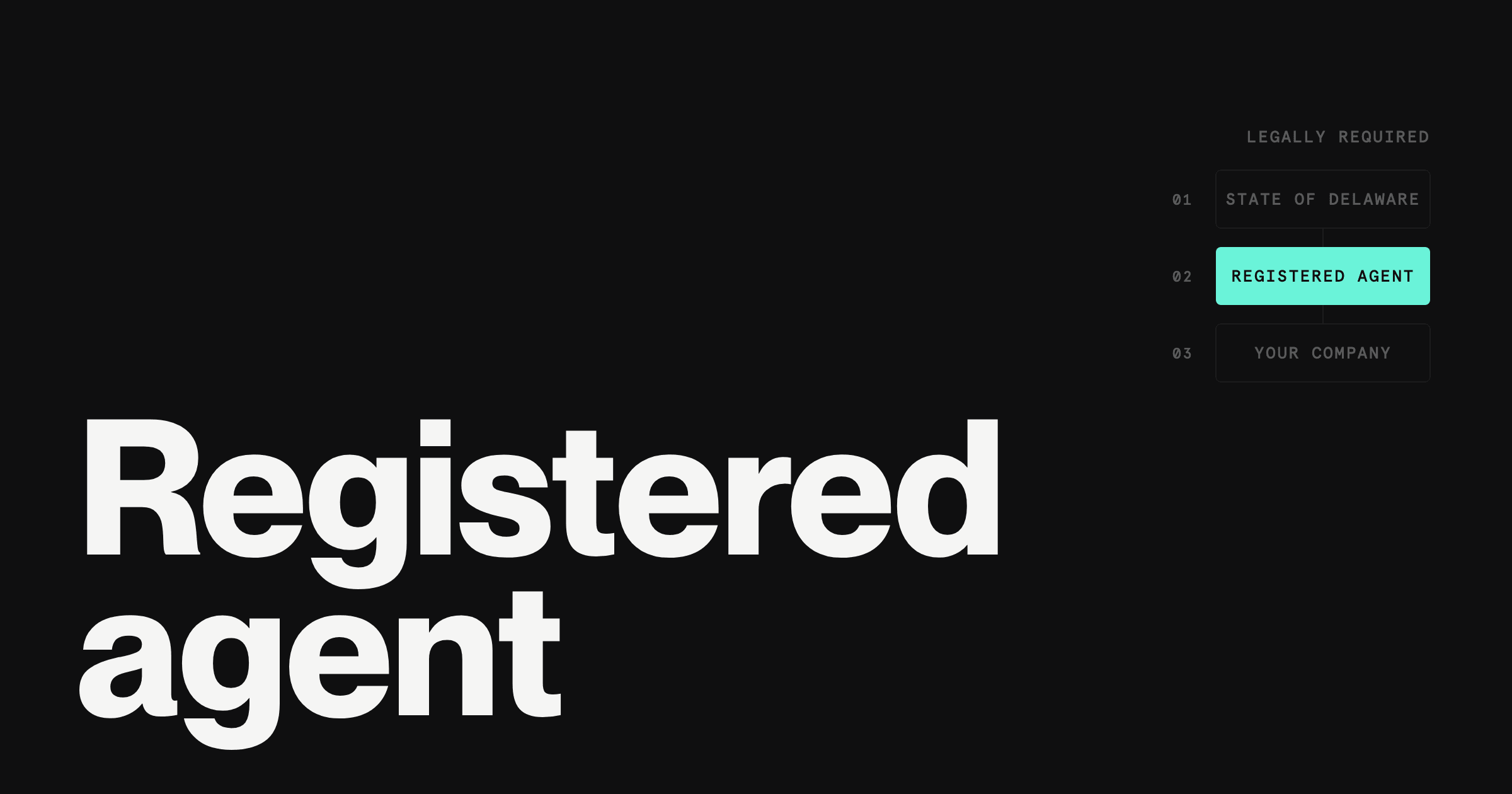

Every company formed in Delaware, from a solo founder's new C corp to a Fortune 500 parent, is required by law to have a registered agent in the state. It is one of the few truly non-negotiable pieces of Delaware compliance, and one of the easiest to get wrong if you do not understand what the role actually involves. This guide covers what a Delaware registered agent does, who can serve as one, what it costs in 2026, and what happens if you go without.
Delaware law requires every corporation, LLC, and partnership registered in the state to continuously maintain a registered agent with a physical Delaware street address.
The agent's job is to receive service of process (lawsuit papers) and official state mail, and to get them to you fast.
You can only act as your own agent if your business has a physical presence in Delaware, which rules out most startups incorporated there from other states.
Commercial registered agent services typically cost $50 to $300 per year. Verified 2026 prices: Harvard Business Services $50, Northwest Registered Agent $125, LegalZoom $249.
Losing your agent, or never appointing one, costs your company its good standing and can ultimately void its charter.
What is a registered agent?
A registered agent is the person or company officially designated to receive legal and government documents on behalf of your business. That includes service of process (the papers that notify you when your company is being sued), tax notices, franchise tax reminders from the state, and other official correspondence from the Delaware Division of Corporations.
The agent's name and Delaware address go on your certificate of incorporation or formation and become part of the public record. Anyone who needs to serve your company legally knows exactly where to deliver the papers. That is the whole point: Delaware lets companies from anywhere in the world form under its law, and in exchange it requires a reliable in-state address where each of those companies can always be reached.
What Delaware law requires
Delaware requires every entity formed or registered in the state to have and continuously maintain a registered agent. For corporations the requirement comes from Section 132 of the Delaware General Corporation Law; the LLC Act has a parallel rule for LLCs. The requirement applies from the day you file until the day the entity is formally dissolved. There is no exemption for small companies, inactive companies, or companies with no revenue.
The agent must have a physical street address in Delaware. A P.O. box does not qualify, and neither does a virtual mailbox. The agent must be available at that address during normal business hours to accept deliveries, because a process server has to be able to hand documents to a real person.
If you formed your startup in Delaware but operate from California, New York, or anywhere else, you will also register as a foreign entity in your home state, and that state will require a registered agent there too. Most commercial agents cover all 50 states.
Who can serve as a Delaware registered agent?
Delaware law allows three options:
The entity itself, but only if it has a physical place of business in Delaware. A Wilmington-based company with a real office can list itself as its own agent.
An individual Delaware resident, such as a founder, employee, or other person who lives in the state and agrees to be available at a Delaware address during business hours.
A commercial registered agent, a company in the business of serving as agent for many entities. This is what the overwhelming majority of startups use.
Here is the practical reality: most startups incorporate in Delaware without any physical presence there. If your team works from San Francisco or remotely, you cannot be your own Delaware agent, full stop. And even founders who could technically qualify usually should not. Being your own agent means your name and address on the public record, the risk of missing a lawsuit delivery while you are traveling or heads-down, and the awkward possibility of being served in front of employees or customers.
How much does a Delaware registered agent cost?
Commercial registered agent service in Delaware typically runs $50 to $300 per year. Prices verified from providers' official sites in August 2026:
Provider | Annual price |
|---|---|
Harvard Business Services | $50 |
Northwest Registered Agent | $125 |
LegalZoom | $249 |
The service at every price point is fundamentally the same legal function: a Delaware address, acceptance of service of process, and forwarding documents to you. Higher prices sometimes bundle extras like compliance calendars, mail scanning, or annual report reminders. National corporate-services firms that cater to large enterprises (CSC, CT Corporation) charge more, often around $300 or above, for multi-state programs that startups rarely need.
One line item to watch: many formation packages include the first year of registered agent service free, then auto-renew at the provider's standard rate. Note the renewal price, not just year one. Rho Incorporation includes the registered agent for the first year with every Delaware C corp it forms.
How to choose a registered agent
For most startups the decision comes down to a few practical checks:
Speed of forwarding. The agent's core job is getting a lawsuit into your hands quickly. Look for same-day electronic forwarding of service of process.
Renewal price and billing practices. A cheap first year matters less than what years two through ten cost.
Compliance reminders. A good agent nudges you before the Delaware franchise tax deadline of March 1 for corporations (June 1 for LLCs).
Coverage in other states. If you will foreign-qualify where you operate, one provider covering both states simplifies life.
Stability. Your agent is a matter of public record and legal reliance. Pick a firm that will still exist in five years.
How to change your registered agent
Switching agents is a routine filing, not a restructuring:
Sign up with the new agent and confirm they consent to the appointment.
File a Certificate of Change of Agent with the Delaware Division of Corporations. The state filing fee is $50 for both corporations and LLCs, and many commercial agents prepare and submit the filing for you.
Confirm the change is on record, then cancel the old service so you are not billed for another year.
There is no downtime if the filing is handled correctly. The new agent takes over the moment the certificate is accepted.
What happens if you don't have a registered agent?
Going without an agent is not a paperwork technicality. The consequences stack up quickly:
Loss of good standing. The state will not issue a certificate of good standing for an entity without a valid agent, and that certificate is exactly what banks, investors, and acquirers ask for during diligence.
Default judgments. If a process server cannot reach your agent, a lawsuit can proceed without you ever knowing about it, and you can lose by default.
Charter forfeiture. If your agent resigns and you fail to appoint a replacement within 30 days, or you accumulate unresolved compliance failures, Delaware can declare your corporation's charter void or cancel your LLC's certificate of formation. Reviving a voided entity means extra filings, back taxes, and penalties.
Agents most commonly resign for non-payment. If you let a $50 to $300 invoice lapse, you can end up spending far more restoring a Delaware C corp to good standing in the middle of a fundraise, which is precisely when you cannot afford the delay.
The registered agent as part of your formation stack
If you have not incorporated yet, the simplest path is to have the agent handled at formation. Rho Incorporation files an attorney-reviewed Delaware C corporation with the registered agent included for the first year, your SS-4 (EIN application) prepared and submitted for you, and 83(b) election support. It costs $400, credited back when you deposit $10,000 of new money into your Rho checking account and keep your daily average balance $10,000 above where it started for the 60 days after you incorporate, and approval comes with same-day access to Rho business banking, corporate cards, and treasury. Rho Incorporation currently supports Delaware C corps; if you are forming a Delaware LLC, you will appoint an agent through your formation service or directly, and Rho can still handle your LLC's banking.
FAQs
No. The agent must be either the entity itself with a physical place of business in Delaware, an individual Delaware resident, or a company authorized to do business in Delaware, and in every case the agent needs a physical street address in the state where someone is available during business hours. A friend in another state or a P.O. box does not qualify.
Typical commercial services run $50 to $300 per year. As of August 2026, Harvard Business Services charges $50 per year, Northwest Registered Agent charges $125, and LegalZoom charges $249. Formation packages, including Rho Incorporation for Delaware C corps, often include the first year.
For almost every startup, yes. The service costs less than an hour of legal time per year, keeps your home address off the public record, ensures lawsuits and state notices actually reach you, and satisfies a legal requirement you cannot skip. The main exception is a company with genuine Delaware offices that prefers to receive service itself.
Only if you or your business has a physical Delaware street address where you are reliably available during business hours. Since most founders incorporate in Delaware while living elsewhere, most cannot. Even eligible founders usually choose a commercial agent for privacy and reliability.
Your LLC falls out of good standing with Delaware, you will be unable to get the good standing certificate lenders and partners ask for, and lawsuits can proceed against you without notice. If the gap continues, the state can cancel your certificate of formation, and you will owe back franchise taxes and penalties to revive the company.
The agent must be either the entity itself with a physical place of business in Delaware, an individual Delaware resident, or a company authorized to do business in the state. In every case, the agent needs a physical street address in Delaware where someone is available during normal business hours.
No. Delaware law requires a physical street address in the state, and a P.O. box or virtual mailbox does not meet that requirement.