
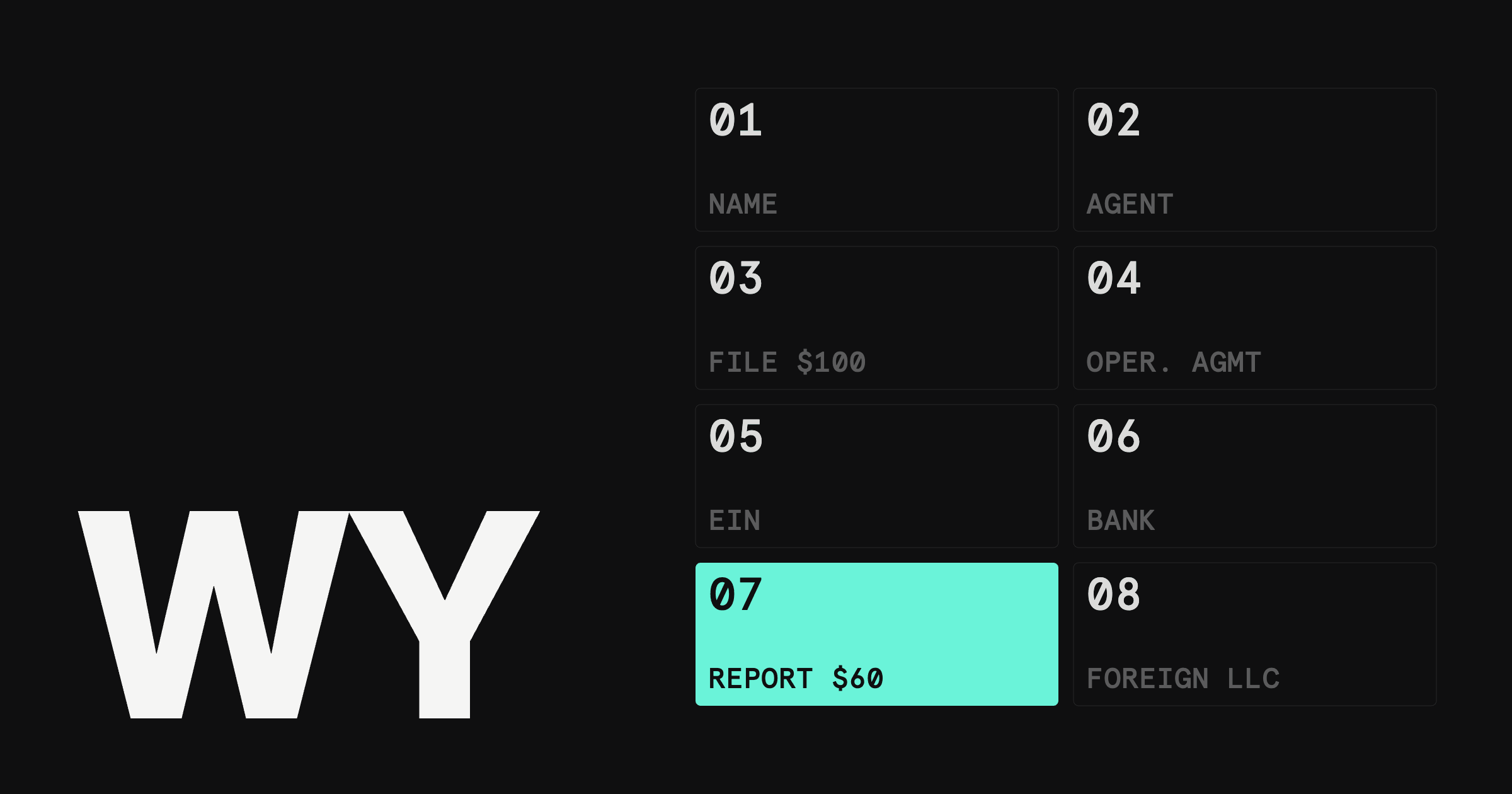

Starting a Wyoming LLC comes down to eight concrete steps, and none of them require you to set foot in Wyoming. The filing fee is $100. There's no state income tax on the LLC or its owners. And the annual report that keeps it in good standing carries a license tax of $60 minimum, according to the Wyoming Secretary of State.
This guide walks through all eight steps, what it costs, the mistakes that trip people up, and when Wyoming is (and isn't) the right call. If you're comparing states, we've also written up the same process in California and how Delaware's process compares.
Filing fee: $100 for the Articles of Organization, filed with the Wyoming Secretary of State (fee schedule effective July 1, 2026).
No state income tax: Wyoming has no individual or corporate income tax, so LLC profits that pass through to you aren't taxed at the state level.
A registered agent is mandatory: every Wyoming LLC needs a registered agent with a physical Wyoming street address, and most people forming one don't live in the state.
Privacy, with real limits: the Articles of Organization don't ask for member or manager names, but that's not the same as anonymity, and it doesn't override federal rules.
Annual report: due the first day of your formation anniversary month each year, with a license tax of $60 or $0.0002 per dollar of Wyoming-located assets, whichever is greater.
Who this is actually for: non-resident owners, holding companies, real estate investors, and people who want a low-cost, low-maintenance entity. If you're building a startup that plans to raise venture capital, read the note on C corps below before you file anything in Wyoming.
How do you start an LLC in Wyoming?
You start a Wyoming LLC by appointing a Wyoming registered agent and filing Articles of Organization with the Wyoming Secretary of State for $100, online at wyobiz.wyo.gov or by mail. After that, the LLC files an annual report each year with a license tax of $60 or $0.0002 per dollar of Wyoming-located assets, whichever is greater, according to the Wyoming Secretary of State fee schedule effective July 1, 2026 (figures as of October 17, 2026).
If you would rather have the formation handled for you, Rho Incorporation forms LLCs for $349 all in, state filing fee included. When you incorporate a Delaware C-corp with Rho for $400, your Rho business account application opens in the same flow, subject to approval.
Best for: founders forming a Delaware C-corp who want their company formed and a business account opened in the same flow, subject to approval. We assess formation options on price, what's included, and whether a business account can open in the same flow as formation.
What a Wyoming LLC actually is, and why founders choose it
An LLC, or limited liability company, is a legal structure that separates your personal assets from your business's debts and liabilities. If the business gets sued or can't pay its bills, your house and personal bank account are generally off the table, as long as you've kept the LLC's finances separate from your own.
Wyoming was the first state to create the LLC as a legal entity, and that head start plus a deliberately low-maintenance structure is why the entity type keeps showing up for a specific set of owners:
Real estate investors, who use Wyoming LLCs to hold individual properties.
Online businesses without a fixed physical presence, since the ongoing cost is low.
Non-U.S. residents, since Wyoming doesn't require citizenship or U.S. residency to form or own one.
Holding companies and asset-protection structures, where privacy and low fees matter more than day-to-day operations.
What Wyoming isn't built for: attracting venture capital. If you're raising a priced round or planning to take on institutional investors, they will usually expect a Delaware C corp, not a Wyoming LLC, for reasons we'll get into below. Wyoming's advantages are real, but they're advantages for a specific kind of owner, not a universal upgrade over every other state.
LLC vs. C corp vs. S corp vs. sole proprietorship
Before you file anything, it's worth confirming an LLC is actually the right structure. Here's how the four common options stack up in Wyoming.
LLC | C corporation | S corporation | Sole proprietorship | |
|---|---|---|---|---|
Created by filing | Yes, Articles of Organization | Yes, Articles of Incorporation | No, it's a tax election on an LLC or corporation | No filing required |
Wyoming filing fee | $100 | $100 | No state fee for the election (IRS Form 2553) | None |
Owners | Members, unlimited | Shareholders, unlimited | Up to 100 shareholders, U.S. persons only | One owner |
Personal liability protection | Yes | Yes | Yes (inherited from the underlying LLC or corp) | No |
Default taxation | Pass-through to owners | Corporate tax, then dividends taxed again | Pass-through, but wages subject to payroll tax | Pass-through, reported on your personal return |
Can raise venture capital | Rarely, many VCs won't invest directly in an LLC | Yes, this is the standard startup vehicle | No | No |
Best fit | Holding companies, real estate, non-resident owners, small operating businesses | Startups planning to raise institutional capital | Profitable small businesses trying to reduce self-employment tax | Freelancers and single-owner side businesses testing an idea |
If venture fundraising is anywhere on your roadmap, the C corp column above is the one that matters. A Wyoming LLC is a fine vehicle for a lot of things. Attracting a priced VC round usually isn't one of them.
What you need before you start
Before you file the Articles of Organization, have these ready:
A business name that's distinguishable from every other entity on file with the Wyoming Secretary of State, and that includes "LLC," "L.L.C.," "Limited Liability Company," or another designator the statute allows.
A registered agent with a physical Wyoming street address who is available during normal business hours. The agent signs a Consent to Appointment that's filed with your articles.
An organizer to sign the Articles of Organization. This can be you, an attorney, or your registered agent service.
A mailing address and principal office address for the LLC, which can be outside Wyoming, plus an email address for state notices.
A plan for an operating agreement. Wyoming doesn't require you to file one, but you should have one drafted before you open a bank account.
A payment method for the $100 filing fee. Visa or Mastercard works for online filings; mail filings take a check or money order.
The 8 steps to start a Wyoming LLC
1. Search your LLC name
Run a search on the Wyoming Secretary of State's business database (wyobiz.wyo.gov) to confirm your desired name isn't already taken by another registered entity. Wyoming requires names to be distinguishable on the record, which is a lower bar than a full trademark search but still worth doing carefully.
2. Appoint a Wyoming registered agent
This is the step that catches the most people off guard, because most people forming a Wyoming LLC don't live in Wyoming. Every Wyoming LLC is required to maintain a registered agent with a physical street address in the state, who is available during regular business hours to accept legal and state documents on the LLC's behalf.
If you don't live in Wyoming, or don't want your home address on file anywhere, you'll hire a commercial registered agent service, and each provider sets its own annual fee. This is a normal, expected part of forming a Wyoming LLC, not a workaround. Your registered agent signs a Consent to Appointment that gets filed alongside your Articles of Organization.
3. File the Articles of Organization
This is the document that legally creates your LLC. You'll file it with the Wyoming Secretary of State, either online through wyobiz.wyo.gov or by mail. It asks for your LLC's name, its registered agent's name and physical address, the LLC's mailing and principal office addresses, and the organizer's signature.
Filing option | Fee | Turnaround |
|---|---|---|
Standard filing | $100 | Mailed documents are reviewed in the order received, within 15 business days |
Expedited, next business day | $700 | Next business day |
Expedited, same business day | $1,400 | Same business day |
Fees are from the Wyoming Secretary of State Business Division fee schedule effective July 1, 2026, and the Secretary of State says expedited review is available for most documents, with some exclusions. Most people never need the expedited tiers. They exist for situations like a closing deadline or a time-sensitive contract that requires a formed entity by a specific date.
4. Adopt an operating agreement
Wyoming doesn't legally require an LLC to have an operating agreement, but skipping it is one of the more common mistakes people make (more on that below). An operating agreement spells out ownership percentages, how profits and losses are divided, how decisions get made, and what happens if a member wants to leave or the LLC needs to be dissolved.
It's an internal document. You don't file it with the state, but banks, courts, and the IRS will all expect one to exist if a dispute or an audit ever comes up. A single-member LLC still benefits from one, mostly because it reinforces that the LLC is a separate legal entity from you personally, which matters if your liability protection is ever challenged.
5. Get an EIN from the IRS
An Employer Identification Number is your LLC's federal tax ID, and you'll need one to open a business bank account, hire employees, or file taxes as an entity. Apply directly through the IRS website. It's free, and if you have a Social Security Number or Individual Taxpayer Identification Number, you can apply online.
Be careful here: a number of third-party sites charge a fee to "help" you get an EIN. You don't need to pay anyone for this step. It's a free application directly with the IRS.
6. Open a business bank account
Once you have your Articles of Organization, EIN, and operating agreement, you can open a business bank account in the LLC's name. This is the step that actually makes your liability protection real in practice.
Keep running business expenses through your personal account, and a court can decide you never actually treated the LLC as separate from yourself. Your personal assets lose the protection the LLC was supposed to provide.
Most banks will ask for your Articles of Organization, EIN confirmation letter, and operating agreement to open the account. If your LLC doesn't have a physical presence in Wyoming, which is common, look for a provider that supports remote account opening rather than one that requires an in-person branch visit. On the Rho banking platform: banking, invoicing, cards, and bill pay, all live the moment your account is approved.
7. File the annual report and pay the annual license tax
Wyoming requires every LLC to file an annual report and pay a license tax, due each year on the first day of the anniversary month of your LLC's formation. The tax is $60 or two-tenths of one mill on the dollar ($0.0002) of your LLC's assets located and employed in Wyoming, whichever is greater. The Secretary of State notes that an entity with $300,000 or less in Wyoming assets pays $60.
If the annual report isn't filed within 60 days of the due date, the state administratively dissolves the LLC. Reinstatement after a dissolution for unpaid tax costs $100, and reinstatement after a dissolution for having no registered agent costs $350, both more expensive than filing the report on time.
8. Register as a foreign LLC if you also operate in other states
If you form your LLC in Wyoming but actually live, work, or have a physical business presence in another state, you likely need to register as a "foreign LLC" in that state too. This means paying that state's foreign-entity registration fee and, in most cases, its own state income tax on the income your business earns there, on top of everything you've already paid Wyoming.
This is the step that quietly erases a lot of the savings people expect from forming in Wyoming. We cover it in more detail below, because it's one of the most common reasons a Wyoming LLC ends up costing more than expected.
What a Wyoming LLC costs
Item | Cost |
|---|---|
State filing fee (Articles of Organization) | $100 |
Annual report license tax | $60 or $0.0002 per dollar of Wyoming-located assets, whichever is greater |
Optional: expedited filing | $700 (next business day) or $1,400 (same business day) |
Registered agent | Annual fee set by each provider, not by the State of Wyoming |
EIN from the IRS | Free |
Reinstatement, if dissolved | $100 (unpaid tax) or $350 (no registered agent) |
State fees are from the Wyoming Secretary of State Business Division fee schedule effective July 1, 2026, as of October 17, 2026.
Here's the tradeoff many people miss: Wyoming's own fees are low. The registered agent requirement and any foreign-state registration you might also need are where more of the cost shows up, and those costs don't appear on Wyoming's fee schedule at all.
Common mistakes to avoid when forming a Wyoming LLC
Using a drop box as your registered agent office. Wyoming requires a physical street address in the state for your registered agent. A P.O. box is only acceptable in addition to a physical address.
Skipping the operating agreement because Wyoming doesn't require one. Banks, courts, and the IRS all expect one to exist. Not having one weakens your liability protection exactly when you need it most.
Assuming "no state income tax" means no taxes at all. You still owe federal income tax, and if you live and work in another state, that state can usually still tax the income your LLC generates there.
Forgetting the annual report deadline. If the report isn't filed within 60 days of the due date, the LLC is administratively dissolved, and reinstatement costs more than the report itself.
Treating Wyoming's privacy as full anonymity. The Articles of Organization don't list members, but that doesn't erase your paper trail elsewhere (bank accounts, contracts, and tax filings all still identify you).
Not registering as a foreign LLC where you actually operate. If you live or do business in another state, that state likely still wants its own registration and its own taxes, regardless of where your LLC was formed.
Forming a Wyoming LLC for a startup that plans to raise venture capital. Institutional investors usually expect a Delaware C corp. A Wyoming LLC will likely need to be converted before a priced round can close, which costs time and legal fees you could have avoided by starting with the right structure.
Two more Wyoming considerations that trip founders up
Foreign LLC registration, if you operate anywhere else. This is worth repeating because it's one of the most common surprises. A Wyoming LLC is a Wyoming entity.
If you live in Texas and run your business from Texas, Wyoming's low fees and no-income-tax pitch don't exempt you from Texas's rules. You'll likely still need to register your Wyoming LLC as a foreign entity there, pay that state's fees, and follow that state's tax rules on income earned there.
Wyoming's benefits apply most cleanly to owners who genuinely have no other state's nexus to worry about, or who are using the LLC to hold assets (like real estate or IP) rather than to run an active, physically located business.
Wyoming helps most when the business isn't tied to another state. Wyoming's zero-income-tax and privacy reputation are real, and they're a genuine advantage for non-resident owners, holding companies, and asset protection structures.
If you're a founder running an active business from your home state, most of what makes your business taxable and regulated is where you actually live and work, not where you filed your paperwork. Forming in Wyoming doesn't relocate your tax residency or your legal obligations. It adds a Wyoming layer on top of whatever obligations you already have.
After the paperwork: run it like a company
Forming the LLC is the easy part. Keeping the liability protection you formed it for means treating it like a real, separate business from day one: a dedicated bank account, no mixing of personal and business expenses, your operating agreement actually followed rather than just filed away, and your annual report filed on time every year.
One clarification on privacy: Wyoming keeping member names off the Articles of Organization is not the same as a federal exemption from disclosure.
Under FinCEN's Beneficial Ownership Information rules, U.S.-formed entities (including Wyoming LLCs) and their owners are currently exempt from BOI reporting, following an interim final rule that took effect in March 2025 and narrowed the requirement to foreign-formed entities registering to do business in the U.S.
That's good news if you were bracing for another filing, but it's worth confirming your entity's status directly if federal reporting rules change again.
If your actual goal is building a startup that raises venture capital, the Delaware C corp remains the market-standard structure for that path, for reasons we cover in what a C corp actually is and how to incorporate a startup. Wyoming's advantages are real, but they're built for a different kind of owner.
Where Rho fits
Rho Incorporation forms both entity types. An LLC is $349 all in, with the state filing fee included. A Delaware C-corp is $400, with every formation document reviewed by a licensed attorney, your EIN application filed for you, 83(b) election support, and registered agent service covered for the first year. If a Delaware C corp is the right structure for what you're building, that's worth knowing before you file anywhere.
When you incorporate a Delaware C-corp with Rho, your Rho business account application opens in the same flow, subject to approval; Rho requires at least one US-based owner or officer, a US operating address, and a business in a non-excluded industry. For a wider view, compare incorporation services across states and structures.
Keep reading
FAQs
The Wyoming Secretary of State charges $100 to file Articles of Organization. Each year after that, the LLC files an annual report with a license tax of $60 or $0.0002 per dollar of Wyoming-located assets, whichever is greater (fee schedule effective July 1, 2026). You also need a Wyoming registered agent, whose fee is set by each provider.
If you want the filing handled for you, Rho Incorporation forms LLCs for $349 all in, with the state filing fee included.
The main recurring cost is the annual report and license tax, a $60 minimum, plus whatever you're paying your registered agent service annually. For most small LLCs without significant Wyoming-based assets, that's the full ongoing state cost.
Wyoming has a thin body of business case law, so complex disputes are less predictable than in Delaware, and investors give Wyoming entities no special credibility. If you operate in another state you must still register and pay there, erasing most of the savings. Banking can also take extra steps, since some banks want proof of why you formed out of state.
Yes. Wyoming doesn't require members, managers, or organizers to live in the state, or even in the U.S. This is one of the main reasons Wyoming LLCs are popular with non-resident and international owners. You do need a Wyoming-based registered agent, which is almost always a commercial service if you're not local.
It depends on why you're forming one. For holding companies, real estate investors, and non-resident owners, Wyoming's low fees, no state income tax, and privacy reputation make it a strong option. For a startup planning to raise venture capital, Delaware C corp is the more standard choice. For someone running an active business from their home state, forming in Wyoming instead of your home state often just adds a layer of extra registration without much benefit.
No. Wyoming has no individual or corporate state income tax. That said, you still owe federal income tax on your LLC's profits, and if you live or operate in a state that does have income tax, that state can generally still tax the income your business earns there.
Yes, a registered agent is mandatory, and yes, you can be your own registered agent if you have a physical street address in Wyoming and are regularly available there during business hours. Most people forming a Wyoming LLC don't meet that bar, which is why commercial registered agent services exist.
Wyoming doesn't require members' or managers' names on the public Articles of Organization, only the organizer's name (who can be your registered agent or attorney rather than you). That keeps your name off that specific public document. It doesn't make the LLC anonymous in every sense: your name will still appear on bank records, contracts, tax filings, and any state where you register as a foreign LLC.
Yes, once you have your Articles of Organization, EIN, and operating agreement. If you don't have a physical presence in Wyoming, which is common, look for a bank that supports opening an account remotely rather than one that requires a branch visit.
Yes. The filing itself is straightforward enough that most people file it directly with the Wyoming Secretary of State without an attorney. Where a lawyer earns their fee is usually the operating agreement, especially with multiple members, or if your situation involves more complex tax or liability questions.
No. Both file with the Wyoming Secretary of State for the same $100 fee, but they're different structures with different tax treatment and different owner requirements. An LLC has members and passes profits through to their personal returns by default; a C corp has shareholders, pays corporate tax, and is the structure institutional investors expect.
Generally, no. Venture investors usually expect a Delaware C corp, and a startup that forms as a Wyoming LLC often has to convert before a priced round can close, which adds legal cost and time. If fundraising is the goal, start with a Delaware C corp: Rho Incorporation forms Delaware C-corps for $400, with every formation document reviewed by a licensed attorney.