

A C corporation is the default corporate structure in the United States, and it is the structure behind nearly every venture-backed startup you can name. If you have ever wondered why investors keep asking whether you are "a Delaware C corp," this guide explains what a C corp actually is, how it works, how it is taxed, and when it is the right choice.
A C corporation is a legal entity that exists separately from its owners. It can own property, sign contracts, sue and be sued, and survive changes in ownership.
"C corp" refers to how the entity is taxed: under subchapter C of the Internal Revenue Code, the corporation pays a flat 21% federal tax on its own profits.
C corps can issue stock to an unlimited number of shareholders, including funds and foreign investors, which is why venture capital firms require them.
The main tradeoff is double taxation. Profits are taxed at the corporate level, then again when distributed to shareholders as dividends.
Qualified Small Business Stock (QSBS) can let founders and early investors exclude millions of dollars in federal capital gains when they sell C corp shares.
What is a C corporation?
A C corporation is a corporation taxed under subchapter C of the Internal Revenue Code. When you file a certificate of incorporation with a state, you create a corporation. Unless you then elect S corporation status with the IRS, your corporation is a C corp by default. There is no separate "C corp filing." The C simply describes the tax treatment every corporation starts with.
Legally, a C corp is a separate person from its founders. It earns its own income, pays its own taxes, holds its own assets, and carries its own liabilities. If the company is sued or cannot pay its debts, shareholders generally stand to lose only what they invested. That separation, called limited liability, is one of the core reasons corporations exist.
The other defining trait is permanence. A C corp has perpetual existence, meaning it continues even if founders leave, sell their shares, or pass away. Ownership transfers by moving stock, not by rewriting the company itself.
How a C corp works
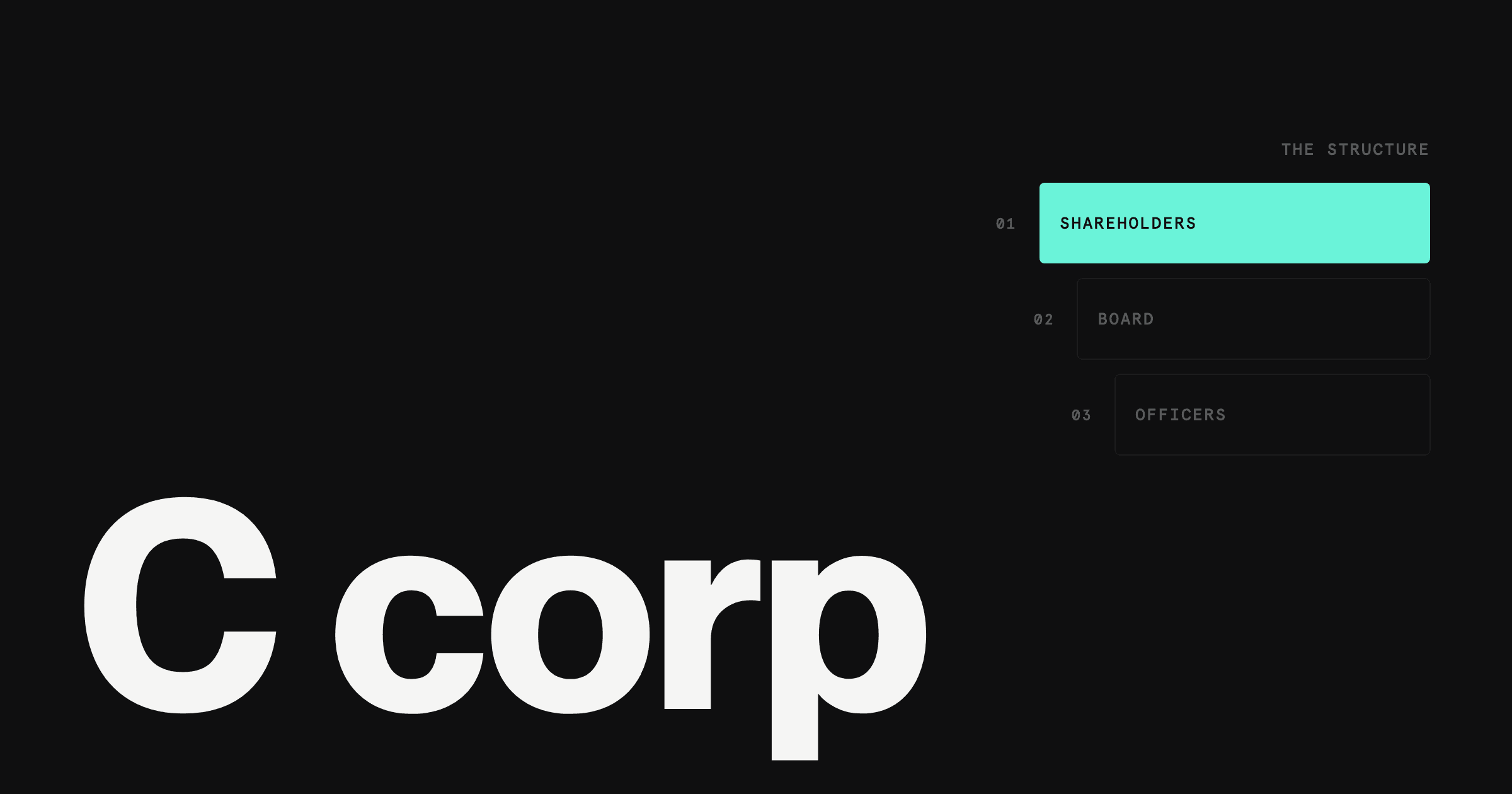
Every C corporation has three layers of control, even a one-person startup where the same human fills every seat.
Shareholders own the company through stock. They vote on major decisions such as electing directors, approving mergers, and amending the charter. In an early-stage startup, the shareholders are usually the founders plus any investors.
The board of directors sets strategy and oversees management. The board approves stock issuances, option grants, fundraising rounds, and executive hiring. Startups typically start with a one to three person board of founders, then add investor directors as they raise.
Officers run the business day to day. The CEO, CFO, secretary, and other officers are appointed by the board and carry the authority to sign contracts and execute decisions.
Ownership is divided into shares of stock. Startups usually authorize 10,000,000 shares of common stock at incorporation, issue a portion to founders, and reserve a pool for employee options. Because stock is standardized and transferable, a C corp can take on new owners without restructuring, which is exactly what happens in a priced funding round.
How C corps are taxed
C corps pay federal income tax on their profits at a flat 21% rate, plus any state corporate income tax. The corporation files its own return, Form 1120, and pays tax as its own entity.
The second layer arrives when profits leave the company. If the corporation distributes earnings to shareholders as dividends, shareholders pay tax on those dividends personally, typically at qualified dividend rates of 0%, 15%, or 20%, plus a possible 3.8% net investment income tax. The same dollar of profit gets taxed twice, once at the corporate level and once at the shareholder level. Our guide to C corp double taxation walks through the math and the legitimate ways companies reduce it.
In practice, most startups never feel double taxation in their early years. They reinvest every dollar into growth rather than paying dividends, and companies that are not profitable owe little or no corporate income tax in the first place. Losses can also be carried forward to offset future profits.
Advantages of a C corporation
Venture capital compatibility. Nearly all institutional investors require a C corp, usually a Delaware one, before they will invest. Venture funds often cannot hold pass-through entities like LLCs without creating tax problems for their own limited partners, and the standardized documents that make fundraising fast (SAFEs, priced equity rounds, board consents) are all written for corporations.
Unlimited, flexible ownership. A C corp can have any number of shareholders, and those shareholders can be individuals, funds, other companies, or non-US persons. It can also issue multiple classes of stock, such as common for founders and employees and preferred for investors. S corps, by contrast, are capped at 100 shareholders, allow one class of stock, and exclude most entities and all foreign owners.
Stock options and equity compensation. C corps are built for employee equity. Option pools, restricted stock, and early exercise with an 83(b) election are all standard, well-understood tools in the corporate form.
QSBS. Stock in a qualifying C corporation can be Qualified Small Business Stock under Section 1202. Founders and early investors who hold QSBS long enough can exclude a substantial portion, and in many cases all, of their federal capital gains when they sell, an exclusion that can be worth millions of dollars. The rules have specific requirements, so see our guide to QSBS eligibility for the details.
Credibility and permanence. Banks, enterprise customers, and acquirers all know exactly what a C corp is and how it works.
Disadvantages of a C corporation
Double taxation on distributed profits, which matters most for businesses that plan to pay out earnings rather than reinvest or sell.
More formality. C corps must maintain bylaws, hold board and shareholder meetings, keep minutes, and track stock issuances on a cap table.
Ongoing costs. Expect annual state franchise taxes and report filings, plus a separate corporate tax return.
Losses stay inside the company. Unlike an LLC's pass-through losses, C corp losses cannot flow to founders' personal returns.
For a profitable small business with no plans to raise venture capital or sell to employees and investors, these tradeoffs often point toward an LLC or S corp instead. For a startup aiming at outside investment, they are usually a fair price for access to capital.
C corp vs S corp vs LLC at a glance
C corp | S corp | LLC | |
|---|---|---|---|
Taxation | Entity pays 21% federal; dividends taxed again | Pass-through | Pass-through by default |
Owners | Unlimited, any type | Max 100, US individuals (mostly) | Unlimited, any type |
Stock classes | Multiple (common, preferred) | One class only | Flexible membership units |
VC funding | Standard | Rarely workable | Usually requires conversion |
QSBS | Yes, if qualified | No | No |
This is the short version. If you are actively deciding between structures, our full comparisons of C corp vs S corp and S corp vs LLC cover taxes, ownership rules, and conversion paths in depth.
How to form a C corp
Forming a C corporation comes down to a few concrete steps: choose a state (most startups pick Delaware for its predictable corporate law and specialized Court of Chancery), file a certificate of incorporation, appoint a registered agent, adopt bylaws, issue founder stock, and get an EIN from the IRS. Our guide to forming a Delaware C corp covers each step and the state fees involved.
If you would rather not manage the paperwork across a state agency, the IRS, and a stack of legal templates, Rho Incorporation handles it in one flow. You get an attorney-reviewed Delaware C corp filing, a registered agent included for the first year, your SS-4 (EIN application) prepared and submitted for you, and support for 83(b) elections. It costs $400, credited back when you deposit $10,000 of new money into your Rho checking account and keep your daily average balance $10,000 above where it started for the 60 days after you incorporate, and once approved you get same-day access to Rho's banking platform: business checking, corporate cards, treasury, expense management, and invoicing. If your situation is non-standard, for example complex IP assignments or existing foreign entities, it is worth having a startup attorney review your setup.
FAQs
The most cited disadvantage is double taxation: the corporation pays 21% federal tax on profits, and shareholders pay tax again on any dividends. C corps also require more formality than LLCs, including a board, bylaws, meeting minutes, and annual state filings.
It depends on your goals. If you plan to raise venture capital, grant stock options, or pursue QSBS treatment, a C corp is almost always the right answer. If you are running a profitable business you own and operate yourself, an LLC's pass-through taxation and lighter formalities often win. Our S corp vs LLC guide covers the pass-through side of that decision.
By default, neither. A single-member LLC is taxed as a sole proprietorship and a multi-member LLC as a partnership. An LLC only becomes an S corp or C corp for tax purposes if it files an election with the IRS (Form 2553 for S corp status, Form 8832 for C corp status). Check your formation and IRS paperwork, or ask your accountant.
Because the law treats the corporation and its shareholders as separate taxpayers. The corporation pays tax on its profits, and shareholders pay tax on dividends they receive from those profits. The second tax only applies when earnings are actually distributed, which is why growth companies that reinvest profits rarely feel it. See our C corp double taxation guide for strategies.
Yes. A C corporation can own some or all of an LLC, and this parent-subsidiary structure is common for holding separate product lines, real estate, or liability-heavy operations. A wholly owned LLC is disregarded for federal tax purposes by default, so its results simply roll up into the corporation's return. Structure decisions like this are worth confirming with a tax advisor.
Double taxation means the corporation pays a flat 21% federal tax on its profits, and shareholders then pay personal income tax on any dividends distributed from those same profits. Most early-stage startups rarely feel this because they reinvest earnings into growth rather than paying dividends.
Nearly all institutional investors require a C corp, typically a Delaware one, because venture funds often cannot hold pass-through entities without creating tax problems for their own limited partners. C corps also support multiple classes of stock, unlimited shareholders of any type, and standard fundraising documents like SAFEs and priced equity rounds.
Qualified Small Business Stock (QSBS) is a tax benefit available only to shareholders of qualifying C corporations under Section 1202. Founders and early investors who hold QSBS long enough may be able to exclude a substantial portion of their federal capital gains when they sell, potentially worth millions of dollars.
Yes, a C corp continues to exist even if founders leave, sell their shares, or pass away. Ownership transfers by moving stock, so the company itself does not need to be restructured when ownership changes.