

The Qualified Small Business Stock exclusion under Section 1202 is the single largest tax benefit available to startup founders and early employees. Meet the requirements and you can exclude millions of dollars of gain from federal tax when you sell your shares. Miss one requirement, sometimes by a single decision made at formation, and the benefit evaporates.
The rules also just changed. The One Big Beautiful Bill Act, signed July 4, 2025, made QSBS meaningfully more generous for newly issued stock. This guide covers the full eligibility checklist as it stands in 2026, what changed, and how your entity choice and 83(b) timing interact with all of it.
One note up front: this is general information, not tax or legal advice. QSBS positions worth millions deserve a conversation with a qualified tax advisor.
QSBS requires original-issuance stock in a domestic C corporation that passed the gross asset test and runs a qualified active business.
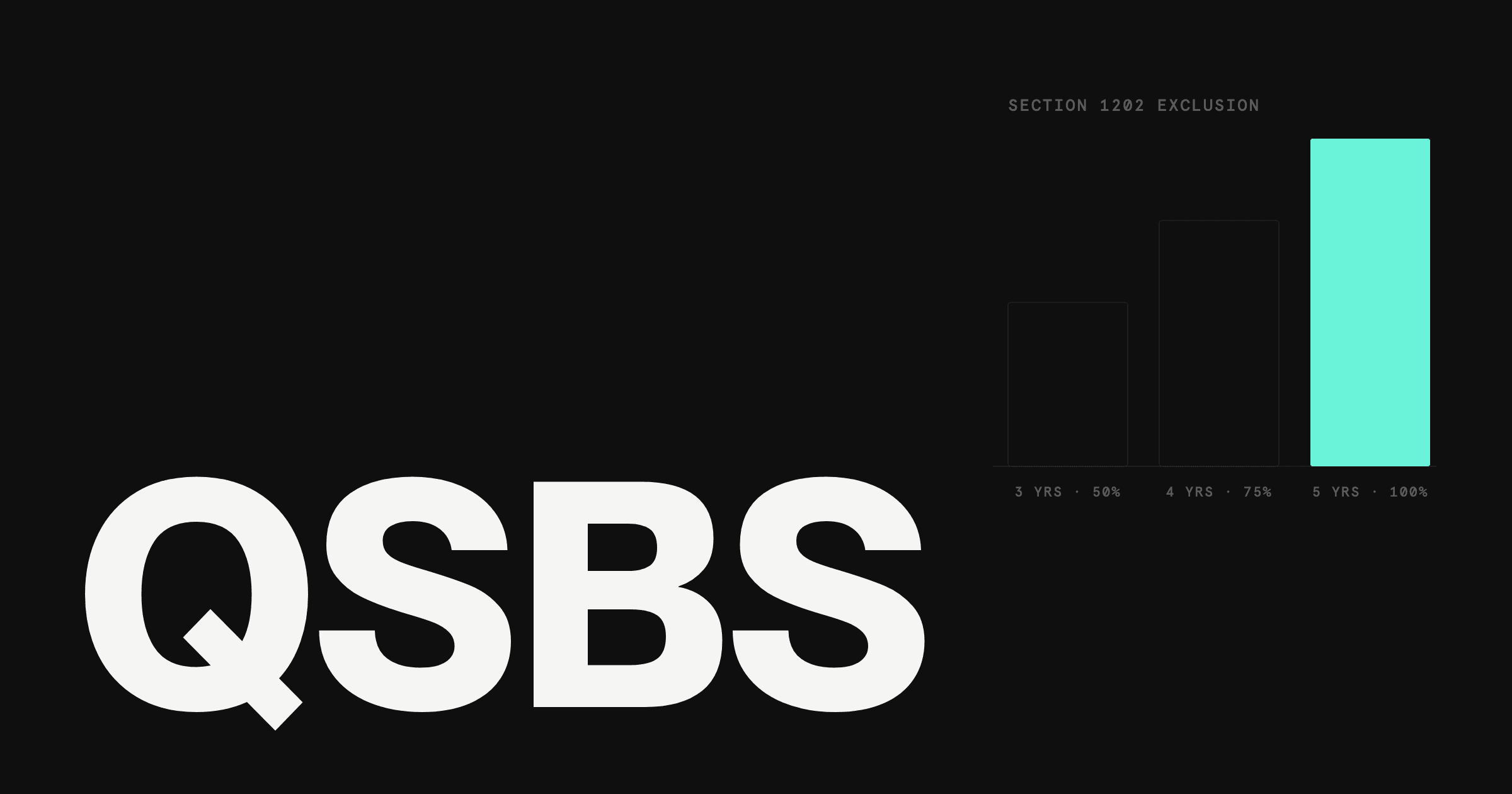
For stock issued after July 4, 2025: 50% exclusion at 3 years, 75% at 4 years, 100% at 5 years, a per-issuer cap of the greater of $15 million or 10x basis, and a $75 million gross asset ceiling.
Stock issued on or before July 4, 2025 keeps the old rules: 100% exclusion only at 5 years, $10 million or 10x basis cap, $50 million asset ceiling.
Service businesses like law, health, consulting, and finance are excluded, along with banking, farming, hospitality, and extraction.
S corps and LLCs never issue QSBS. Only stock issued while the company is a C corporation can qualify.
What QSBS is
Section 1202 of the tax code lets non-corporate shareholders exclude gain on the sale of qualified small business stock from federal income tax, up to a generous per-issuer cap. Congress wrote it to push capital toward early-stage operating companies, and it works: for founders and early employees of eligible startups, QSBS routinely turns a taxable eight-figure exit into a federally tax-free one.
Eligibility has two halves. The company must qualify, and your specific shares must qualify. Both are tested at specific moments, which is why early decisions matter so much.
The eligibility checklist
1. Domestic C corporation
The issuer must be a U.S. C corporation both when the stock is issued and for substantially all of your holding period. Stock in an S corporation or an LLC never qualifies, no matter how long you hold it. This is the foundational reason venture-scale startups form as Delaware C corps from day one. If you started as an LLC, converting to a C corp starts your QSBS clock at conversion, and value built during the LLC years does not qualify for the exclusion. If you are still weighing structures, our C corp vs. S corp guide covers the tradeoffs.
2. Original issuance
You must acquire the stock directly from the corporation, in exchange for money, property, or services. Founder shares at incorporation, employee stock from option exercises or restricted stock grants, and investor shares from a priced round all count. Shares bought from another shareholder on a secondary sale do not. There are limited exceptions for stock received by gift or inheritance, which inherit the original holder's status.
3. The gross asset test
The corporation's aggregate gross assets must not have exceeded the ceiling at any time before your stock was issued, or immediately after. The ceiling depends on when your stock was issued:
Issued after July 4, 2025: $75 million, indexed for inflation after 2026.
Issued on or before July 4, 2025: $50 million.
Gross assets means cash plus the adjusted tax basis of other property, not market valuation. A startup can have a unicorn valuation and still pass, because the test looks at what is on the balance sheet, not what investors think the company is worth. Once the company crosses the ceiling, previously issued qualifying stock stays qualified, but new issuances stop qualifying.
4. Active business requirement
At least 80% of the corporation's assets, by value, must be used in the active conduct of a qualified trade or business during substantially all of your holding period. Two practical implications for startups:
Excluded industries. Section 1202 disqualifies businesses where the principal asset is the reputation or skill of employees, including law, health, accounting, consulting, financial services, brokerage, and performing arts, along with banking, insurance, farming, hotels, restaurants, and oil, gas, and mining. Most software, hardware, biotech product, and e-commerce companies qualify.
Idle cash can be a problem. A large treasury position held for years without a deployment plan can strain the 80% active-business test, although working capital held for reasonably required needs is protected. If your startup is sitting on a big raise, read our guides on whether treasury investments affect QSBS status and QSBS and T-bills.
5. Holding period
How long you must hold, and what you get, now depends on when your stock was issued. That brings us to the new rules.
What changed on July 4, 2025
The One Big Beautiful Bill Act rewrote three numbers in Section 1202, all applying to stock issued after July 4, 2025:
A tiered exclusion replaces the five-year cliff. Under the old rules, selling at four years and eleven months meant zero exclusion. New-issue stock now phases in:
3 years held: 50% of gain excluded
4 years held: 75% excluded
5 years held: 100% excluded
The non-excluded portion at the 50% and 75% tiers is taxed at a maximum 28% federal rate. Even a partial exclusion at year three is a major improvement over the all-or-nothing cliff, especially for companies acquired early.
The per-issuer cap rose from $10 million to $15 million. The exclusion cap is the greater of $15 million (indexed for inflation starting in 2027) or 10 times your basis in the stock. Stock issued on or before July 4, 2025 keeps the $10 million figure.
The gross asset ceiling rose from $50 million to $75 million. Later-stage companies can now issue qualifying stock for longer, which matters for employees joining at Series B and beyond.
Stock issued on or before July 4, 2025 stays under the old regime: five years for any exclusion, $10 million or 10x basis cap, $50 million asset test. Many cap tables now hold both vintages, and each share is tested under the rules in force when it was issued.
How entity choice and 83(b) timing interact with QSBS
QSBS outcomes are mostly determined by choices made at formation, long before an exit is in sight.
Form the C corp early. Your holding period starts when stock is issued, and the gross asset and valuation math is most favorable when the company is worth the least. Founders who wait to incorporate, or who convert from an LLC after the business has appreciated, give up months or years of clock and leave LLC-era gain outside the exclusion.
File your 83(b) election within 30 days. If your founder stock vests, an 83(b) election fixes your tax treatment at grant. Without it, unvested shares are generally not treated as owned for tax purposes until they vest, which pushes back the start of your QSBS holding period for each vesting tranche and stacks ordinary income tax on top. The 30-day deadline has no extensions and no exceptions.
Exercise options to start the clock. Employees holding options do not own stock yet. The QSBS holding period starts at exercise, not at grant. Early exercise combined with an 83(b) election starts the clock as soon as possible, though it means putting real money at risk, so weigh it carefully.
If you are forming now, Rho Incorporation handles the pieces that protect QSBS eligibility from day one: an attorney-reviewed Delaware C corp filing with 83(b) election support, registered agent included for the first year, and your SS-4 (EIN application) prepared and submitted for you. It costs $400, credited back when you deposit $10,000 of new money into your Rho checking account and keep your daily average balance $10,000 above where it started for the 60 days after you incorporate, and you get same-day access to Rho banking once approved.
FAQs
Non-corporate shareholders, meaning individuals, trusts, and pass-through entities, who acquired stock at original issuance from a domestic C corporation that passed the gross asset test and runs a qualified active business. Founders, early employees who exercised options, and direct investors are the typical beneficiaries. Corporate shareholders are not eligible.
Check both halves: the company (C corp status, gross assets under the ceiling when your stock was issued, qualified active business) and your shares (original issuance, holding period met). Ask the company for a QSBS representation letter or gross asset records, keep your stock purchase and 83(b) documents, and have a tax advisor confirm before you file a return claiming the exclusion.
For stock issued after July 4, 2025: a tiered exclusion of 50% at three years, 75% at four, and 100% at five; a per-issuer cap of the greater of $15 million or 10 times basis, indexed for inflation from 2027; and a gross asset ceiling of $75 million, indexed after 2026. Stock issued on or before that date keeps the old five-year, $10 million, $50 million regime.
Businesses whose principal asset is the reputation or skill of their people, including law, health, accounting, consulting, financial services, and brokerage, plus banking, insurance, farming, hotels, restaurants, and oil, gas, and mining. Most software, hardware, biotech product, and e-commerce companies qualify.
Your gain is taxed under normal capital gains rules, up to 20% federal long-term capital gains plus the 3.8% net investment income tax. If you are close to qualifying, options may exist: holding until a tier vests, or a Section 1045 rollover, which lets you defer gain by reinvesting proceeds from QSBS held over six months into new QSBS. Talk to a tax advisor before selling.
No. Only C corporations produce QSBS under Section 1202. S corps and LLCs are not eligible, regardless of how long the stock is held.
Yes. Only domestic C corporations can issue qualifying stock under Section 1202. S corporations and LLCs are not eligible, and if you convert from an LLC to a C corporation, your QSBS clock starts at conversion, meaning value built during the LLC years does not qualify for the exclusion.
Businesses whose principal asset is the reputation or skill of their employees, including law, health, accounting, consulting, financial services, and brokerage, are excluded, along with banking, insurance, farming, hotels, restaurants, and oil, gas, and mining. Most software, hardware, biotech product, and e-commerce companies qualify.
The corporation's aggregate gross assets must not have exceeded the applicable ceiling at any time before your stock was issued or immediately after. Gross assets means cash plus the adjusted tax basis of other property, not market valuation, so a company can have a high investor valuation and still pass the test.
The holding period begins at exercise, not at grant, so employees holding unexercised options have not yet started their QSBS clock. Early exercise combined with an 83(b) election starts the clock as soon as possible, though it means putting real money at risk.