
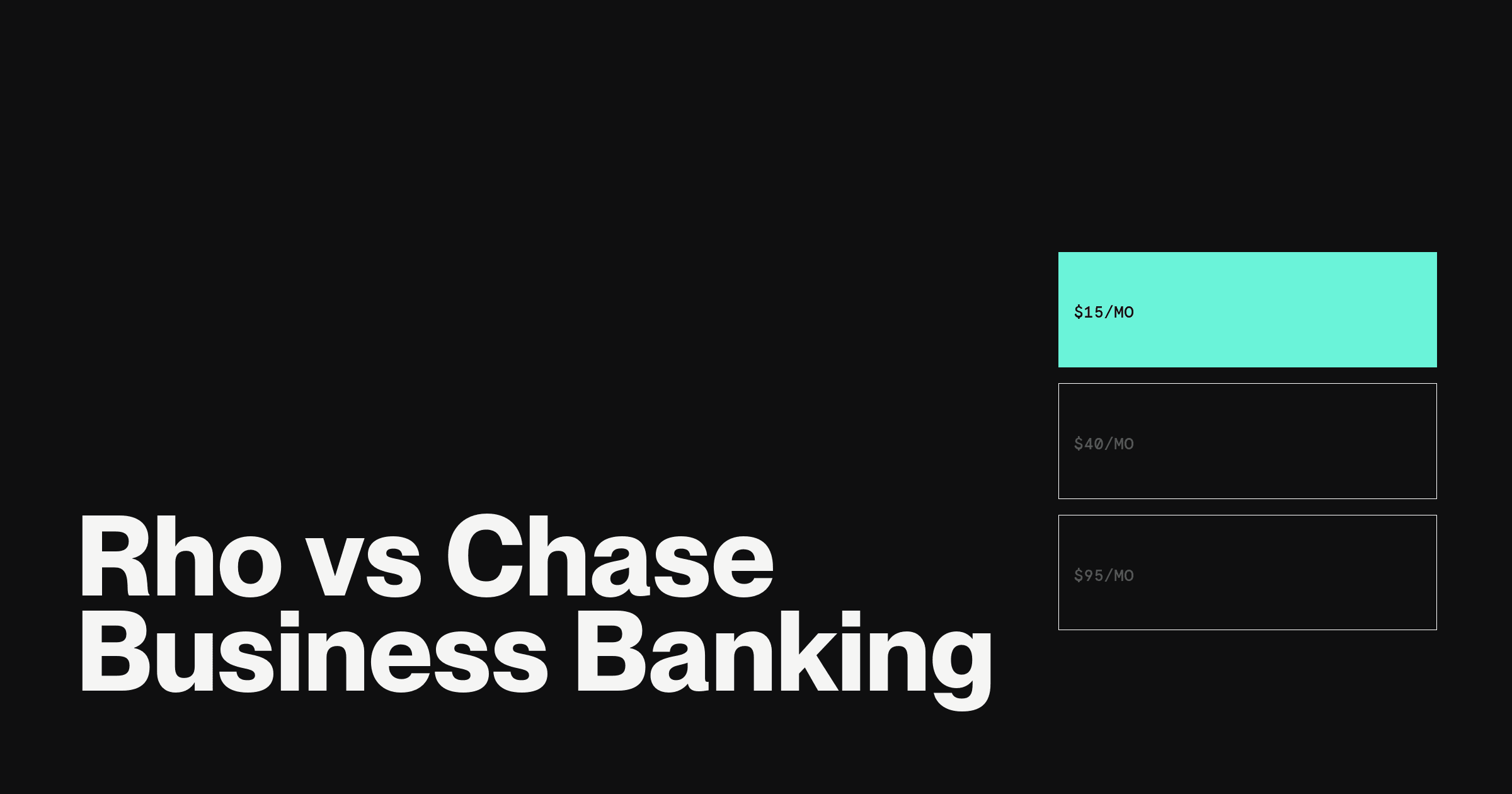

Compare Rho and Chase for business banking: monthly fees, cashback, wire costs, FDIC coverage, and branch access, so you can pick the right fit for your business.
Chase and Rho solve two different problems. The honest answer to "which one should I use" depends on what your business actually needs day to day.
If you take cash over the counter or want a branch to walk into, that's a real requirement. If you run everything from a laptop and just want checking, cards, payables, and savings in one place without a fee-waiver checklist, that's a different requirement entirely.
This comparison walks through the actual numbers on both sides: monthly fees, transaction costs, cashback, FDIC coverage, and eligibility. No hype, just what each platform charges and what you get for it.
Rho vs. Chase Business Banking at a Glance
Rho | Chase Business Complete Banking | Chase Performance Business Checking | Chase Platinum Business Checking | |
|---|---|---|---|---|
Monthly fee | $0 | $15 (waivable) | $40 (waivable) | $95 (waivable) |
Fee waiver | Not applicable, always $0 | $2,000 minimum balance, or equivalent card/payment activity | $35,000+ average balance | $100,000+ average balance |
Domestic ACH | $0 | Included | Included | Included |
Domestic outgoing wire | $0 | $25 online / $35 in-branch | 2 free per cycle, then standard fees | 4 most expensive free per cycle, then standard fees |
Incoming wire | $0 | $15 | Free | Free |
International wire (SWIFT) | $15 | $40 online / $50 in-branch (USD) | Included in balance-waiver tier | Included in balance-waiver tier |
Free in-branch cash deposits | Not applicable, no branches | $5,000 per statement period | $20,000 per statement period | $25,000 per statement period |
Cashback (top tier) | Up to 2% on card spend with Rho Platinum (terms apply) | 2% unlimited with Ink Business Premier ($195 annual fee) | Same Ink card lineup applies | Same Ink card lineup applies |
Branch and ATM access | None, fully digital | 5,000+ branches, 14,000+ ATMs | Same network | Same network |
Numbers above are drawn from each company's own published pricing pages as of this writing. Chase's fees can change, so confirm current terms directly with Chase before making a decision.
Monthly Fees and Balance Requirements: Rho's Flat $0 vs. Chase's Three Tiers
Chase structures business checking as three separate products, each with its own monthly fee and its own way to get that fee waived.
Business Complete Banking runs $15 a month. That fee is waived by keeping a $2,000 minimum daily balance, by routing $2,000 through Chase Payment Solutions or Chase business-card spend, or by linking a qualifying Chase Private Client account.
Move up to Performance Business Checking and the fee jumps to $40 a month, waived at $35,000 or more in average beginning-day balances across linked accounts. Platinum Business Checking tops out at $95 a month, waived at $100,000 or more in average balances (or $50,000 if linked to certain premium personal Chase accounts).
Here's the tradeoff: each tier buys more free wire allowances and more free cash-handling capacity, which matters if your business actually uses those features.
Rho checking has no monthly fee, no per-user fee, and no minimum-balance fee, and that's the whole structure. There's no tier to climb and no balance to maintain to avoid a service charge. Whether that's an advantage depends on whether you'd have hit a Chase waiver anyway, and whether you need what the higher Chase tiers include.
Everyday Transaction Fees: ACH, Wires, and Checks
Rho charges $0 for domestic ACH transfers, $0 for domestic wires, and $0 for checks, across the board, with no tier to qualify for. The one fee on the checking side is $15 for outbound SWIFT or international wires, and in some corridors that fee is mandatory with no opt-out.
Chase's fee schedule depends heavily on which tier you're on. On the base Business Complete Banking tier, incoming wires cost $15 regardless of origin. Outgoing domestic wires run $25 online or $35 in-branch. Outgoing international wires in USD cost $40 online or $50 in-branch, and international wires in foreign currency cost $5 (waived above $5,000).
Move up a tier and some of that gets absorbed. Performance Business Checking includes all incoming wires and two free outgoing domestic wires per statement cycle. Platinum Business Checking includes all incoming wires and the four most expensive outgoing wires free per cycle.
The tradeoff: a business doing frequent wires can buy down per-transaction costs by carrying a higher balance and paying a higher monthly fee, a tradeoff Rho's flat structure doesn't ask you to make.
Corporate Card and Cashback: Rho Platinum vs. Chase Ink
Rho's cashback is tied to the checking relationship itself rather than sold as a separate credit card product. Platinum cardholders earn up to 2% cashback on card spend using the Rho Corporate Card with Daily Terms, or 1.75% cashback on card spend with Monthly Terms (terms apply).
Standard, non-Platinum accounts earn 1.25% cashback on card spend with Daily Terms and 1% cashback on card spend with Monthly Terms (terms apply). Rewards are capped at $1,000,000 in eligible card spend per calendar year, and the Rho Corporate Card itself carries no annual fee, no subscription fee, and no per-card fee.
Chase's cashback lives in its Ink Business credit card lineup, sold and priced independently of its checking accounts. Here's the lineup: Ink Business Unlimited has no annual fee and pays unlimited 1.5% cash back on every purchase.
Ink Business Cash, also with no annual fee, pays 5% cash back on select business-essentials categories up to $25,000 in combined annual spend, and 1% on everything else. Ink Business Preferred charges a $95 annual fee for 3x points on travel and select categories up to $150,000 in combined annual spend.
Ink Business Premier, at $195 a year, pays unlimited 2% cash back on all eligible purchases and 2.5% on any single purchase of $5,000 or more.
What that means in practice: Chase's higher cashback rates come with an annual fee attached, while Rho's top rate is bundled into the Platinum relationship with no separate card fee. Which one nets out ahead depends entirely on your spend volume and categories, so it's worth running your own numbers rather than comparing headline percentages alone.
FDIC Coverage and Deposit Insurance
Rho checking deposits carry standard FDIC coverage of $250,000 per entity, not per account, meaning multiple accounts under the same business share that single limit.
Rho Business Savings works differently. It sweeps deposits across a network of more than 400 FDIC- and NCUA-insured institutions, creating pass-through coverage capacity of up to $75,000,000 per entity. That figure describes network capacity, not a contractually guaranteed limit.
Chase, as a nationally chartered bank, provides standard FDIC coverage on deposit accounts up to the federal limit per depositor, per ownership category, the same baseline protection any FDIC-member bank offers.
One structural point worth knowing either way: Rho itself is a fintech company, not a bank or an FDIC-insured depository institution. Checking account and card services are provided by Webster Bank, a division of Santander Bank, N.A., Member FDIC, and by Lead Bank, Member FDIC.
Branch Access and Cash Deposits: Where Chase Has the Edge
This is the section where Chase's model has a real, unambiguous advantage. Chase gives business customers access to more than 5,000 branches and 14,000-plus ATMs nationwide.
It also offers free cash-deposit allowances that scale by tier: $5,000 per statement period on Business Complete Banking, $20,000 on Performance, and $25,000 on Platinum. Cash deposits above the free threshold on the base tier cost 0.30% on the excess.
Rho is a fully digital, branchless fintech platform. There's no physical location to walk into and no in-person cash deposit capability at all.
For a retail shop, restaurant, or any business that regularly handles physical cash, that's not a minor inconvenience. It's a structural gap Rho doesn't fill. If cash handling and in-person service are part of how your business runs day to day, Chase's branch network is a genuine reason to bank there.
Eligibility and Account-Opening Requirements
Rho checking requires a US-incorporated entity, plus either a US operating address or at least one business owner in the US with a valid SSN. Sole proprietorships aren't eligible; the business has to be incorporated first. The application happens entirely online, with no branch visit required at any point.
Chase, as a full-service retail and commercial bank, serves sole proprietorships and incorporated entities alike, and account opening can happen either online or by walking into a branch, whichever fits how you prefer to do business.
Which Is Right for Your Business? A Self-Selection Guide
Here's the honest framing: this isn't a story about a good bank and a bad one. It's two different operating models built for two different kinds of businesses.
Chase makes sense if your business handles meaningful cash volume, if you want a branch you can walk into for deposits or questions, or if you already bank personally with Chase and can stack fee waivers across accounts.
Those are real, legitimate reasons plenty of small businesses choose Chase, and its tiered structure is genuinely built to reward exactly that kind of relationship.
Rho makes sense if your business is digital-first and never needs a branch. If you'd rather have checking, corporate cards, accounts payable, and savings on one login with flat $0 fees instead of a balance ladder to climb, that's the operating model Rho is built around.
If you're ready to see what moving off Chase would actually look like for your business, Rho vs. Chase walks through the product side by side. And if you want to see how Rho stacks up against other alternatives beyond just Chase, the full roundup of business bank accounts is a good next stop.
FAQs
It depends on what your business needs. Rho is one of the strongest alternatives for digital-first businesses: it bundles checking, corporate cards, accounts payable, and savings on one login with $0 monthly fees and no balance tiers to climb. Businesses that handle significant cash volume or want in-person branch service will find Chase's tiered account structure, with its branch network and cash-deposit allowances, a legitimate alternative in its own right.
It depends on how your business operates. Rho is a strong fit for digital-first businesses that want checking, corporate cards, accounts payable, and savings unified with flat $0 fees and no balance tiers. Businesses that handle significant cash or want in-person branch service will find Chase's network a real advantage Rho doesn't offer.
No. Rho checking has $0 monthly fees, no per-user fees, and no minimum-balance fee. Chase's three checking tiers charge $15, $40, or $95 a month respectively, each waivable by meeting a balance or activity requirement.
No. Rho is a fully digital, branchless fintech platform with no physical branch network, so it doesn't accept in-person cash deposits. Chase offers free cash-deposit allowances ranging from $5,000 to $25,000 per statement period depending on account tier, plus access to more than 5,000 branches and 14,000-plus ATMs.
No. Rho is a fintech company, not a bank or an FDIC-insured depository institution. Checking account and card services are provided by Webster Bank, a division of Santander Bank, N.A., Member FDIC, and by Lead Bank, Member FDIC. Chase is itself a nationally chartered bank.