

"C corps get taxed twice" is one of the most repeated lines in business formation content, and it scares founders away from the entity that nearly every venture-backed startup uses. The claim is technically true and practically misleading. Double taxation only happens when a C corporation pays dividends, and startups almost never pay dividends.
This guide explains how C corp taxation actually works, when double taxation really bites, why it matters far less for startups than the internet suggests, and the legitimate ways to reduce it. It also covers the one move you should not make.
C corporations pay a flat 21% federal income tax, plus state corporate tax where applicable.
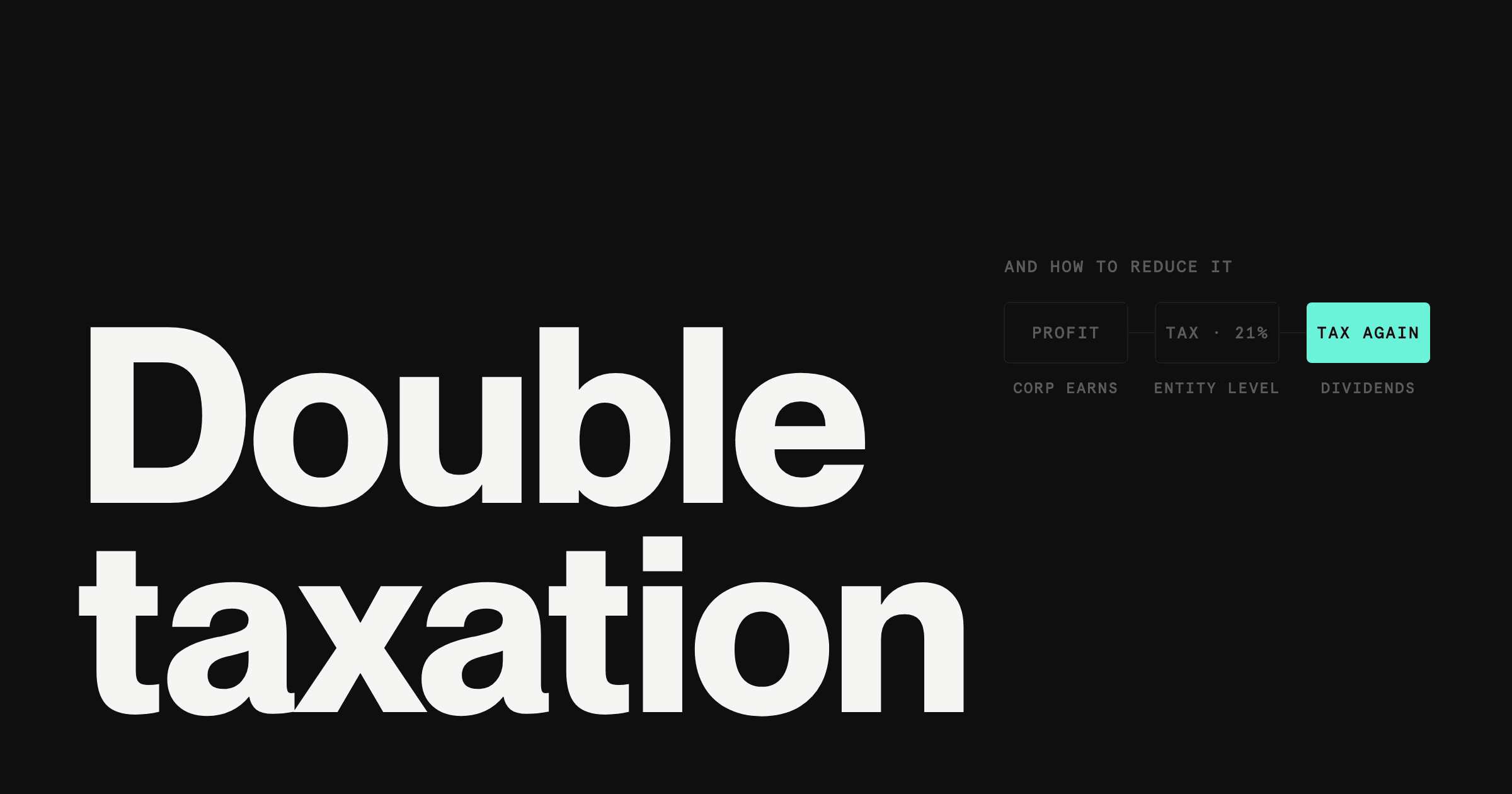
Double taxation only occurs on distributed dividends: the corporation pays tax on profits, then shareholders pay tax again on dividends received.
Startups rarely trigger it because they reinvest earnings instead of distributing them, and QSBS can eliminate federal tax on much or all of the gain at exit.
Legitimate reducers include reasonable salaries, retained earnings, fringe benefits, R&D credits, income timing, and an S election when the business fits.
Disguised dividends, such as inflated salaries or personal expenses run through the company, invite IRS reclassification and penalties.
How C corp taxation works
A C corporation is a separate taxpayer. It files its own return (Form 1120) and pays a flat 21% federal tax on its taxable income. Most states add their own corporate income tax on top, commonly in the 4% to 9% range depending on where you operate. Note that Delaware's annual franchise tax is a separate, smaller charge for the privilege of incorporation, not an income tax.
That flat 21% is the whole story until money leaves the company as a dividend. Compare that with pass-through entities like LLCs and S corps, where profits flow to the owners' personal returns and are taxed at individual rates up to 37% whether or not the owners take the cash out. Our C corp vs. S corp guide walks through that comparison in detail.
What double taxation actually means
Double taxation describes a specific sequence:
The corporation earns profit and pays 21% federal corporate tax on it.
The corporation distributes some of the after-tax profit to shareholders as a dividend.
Shareholders pay personal tax on that dividend, generally at qualified dividend rates of 0%, 15%, or 20% depending on income, plus the 3.8% net investment income tax for higher earners.
The key word is *distributes*. Profit that stays in the company is taxed once, at 21%. There is no second layer of tax on retained earnings, on reinvested profits, or on money spent growing the business. Double taxation is a tax on paying dividends, not a tax on being a C corporation.
Why the fear is overblown for startups
For a venture-backed or growth-stage company, double taxation is mostly a theoretical problem, for three reasons.
Startups do not pay dividends. Early-stage companies reinvest every dollar into product and growth. Many are not profitable at all, which means no corporate tax and certainly no dividends. Venture investors would generally view a dividend from a seed-stage company as a misuse of their capital.
Founders and employees are paid in salary, not dividends. Salaries and bonuses are deductible business expenses. They reduce corporate taxable income and are taxed once, on the recipient's personal return. Most cash that moves from a startup to the people who run it already avoids the double layer.
QSBS can wipe out the exit tax. The real payday for startup shareholders is selling stock, not collecting dividends. Qualified Small Business Stock under Section 1202 can exclude a large portion, and often all, of that gain from federal tax when the requirements are met. For stock issued after July 4, 2025, the exclusion phases in at 50% after three years, 75% after four, and 100% after five, with a per-issuer cap of the greater of $15 million or 10 times basis. See our QSBS eligibility guide for the full checklist. A structure that is "taxed twice" on paper can produce a federally tax-free exit in practice, something no LLC can offer.
Legitimate ways to reduce C corp taxes
If your company is profitable and you want to be efficient about it, these strategies are standard and defensible.
Pay reasonable salaries and bonuses
Compensation for actual work is deductible to the corporation and taxed once to the recipient. For owner-operators, a fair salary is the primary channel for getting cash out efficiently. The operative word is reasonable: pay what the role would command on the open market.
Retain and reinvest earnings
Profit you keep in the business is taxed once at 21% and then compounds. For a growing company, reinvesting in hiring, product, and sales is both the best business move and the simplest tax move. Be aware that the accumulated earnings tax can apply to profits hoarded far beyond the reasonable needs of the business, but funding documented growth plans is exactly what the rules permit.
Use fringe benefits
C corporations can deduct the cost of many employee benefits, including health insurance premiums, group term life coverage, HSA contributions, and retirement plan contributions, and employees generally receive them tax-free. Owner-employees of C corps can participate more fully in these programs than owners of pass-through entities.
Capture R&D credits
Startups building technology often qualify for the federal research and development credit, and qualifying small businesses can apply a portion of it against payroll taxes even before they owe income tax. If you employ engineers, this is frequently worth five to six figures a year.
Time income and expenses
Accelerating deductible expenses into the current year or deferring revenue recognition where the rules allow can smooth taxable income across years. This is standard year-end planning your accountant should be running.
Elect S corp status when the business fits
If your company will be consistently profitable, wants to distribute cash to owners, and will never raise venture capital, an S election converts the company to pass-through taxation and removes the dividend layer entirely. The tradeoffs are real: one class of stock, a 100-shareholder limit, no entity or foreign shareholders, and no QSBS. Our C corp vs. S corp comparison and types of corporations overview cover when the election makes sense.
What not to do: disguised dividends
The IRS has seen every trick for dressing a dividend up as something deductible. The common ones:
Inflated salaries. Paying an owner far above market rate for the work performed. The excess can be reclassified as a dividend, taxed twice, and penalized.
Personal expenses through the company. Cars, travel, housing, and entertainment that primarily benefit the owner are not deductible business expenses.
Sham loans to shareholders. "Loans" with no notes, no interest, and no repayment schedule get reclassified as distributions.
Excessive rent. Renting property from an owner at above-market rates to move cash out deductibly.
Reclassification means the corporation loses the deduction, the shareholder owes dividend tax, and penalties and interest stack on top. Every strategy in the previous section works precisely because it reflects economic reality. Disguised dividends fail because they do not.
The bottom line for founders
If you are building a startup that will reinvest its earnings and aim for an acquisition or IPO, double taxation should be near the bottom of your list of concerns, far below what investors require and what QSBS can save you. That is why the Delaware C corp remains the default for venture-scale companies.
Ready to form one? Rho Incorporation sets up an attorney-reviewed Delaware C corporation for $400, credited back when you deposit $10,000 of new money into your Rho checking account and keep your daily average balance $10,000 above where it started for the 60 days after you incorporate. Registered agent for the first year is included, your SS-4 (EIN application) is prepared and submitted for you, and you get same-day access to Rho business checking, corporate cards, and treasury once approved.
This article is general information, not tax advice. Talk to a CPA about your specific situation.
FAQs
Only on distributed dividends. The corporation pays 21% federal tax on its profits, and shareholders pay personal tax only on profits actually paid out as dividends. Retained and reinvested earnings are taxed once. A company that never pays dividends never experiences the second layer.
Reasonable salary and bonuses for work performed, deductible fringe benefits like health insurance and retirement contributions, and reimbursement of legitimate business expenses all move cash out with a single layer of tax. At exit, QSBS can exclude some or all of your stock gain from federal tax entirely.
An S corporation. Its profits pass through to shareholders' personal returns, so there is no separate corporate tax and no dividend layer. The tradeoffs include a 100-shareholder cap, one class of stock, no entity or foreign owners, and no QSBS eligibility, which is why venture-backed startups stay C corps.
Potential double taxation on dividends, plus somewhat heavier compliance: a separate corporate tax return, board and stockholder formalities, and annual state franchise tax. For profitable owner-operated businesses that distribute cash, those costs are real. For startups reinvesting everything, they are minor next to the fundraising and QSBS advantages.
Largely, yes. Startups reinvest rather than distribute, pay their teams in deductible salaries, and target returns through stock sales where QSBS can eliminate federal tax on millions in gain. Double taxation is a genuine consideration for a profitable family business paying out earnings; it is rarely relevant to a venture-track startup.
An S corporation passes profits directly through to shareholders' personal returns, eliminating the corporate tax layer and the dividend layer. The tradeoffs include a 100-shareholder cap, one class of stock, no entity or foreign owners, and no QSBS eligibility.
Qualified Small Business Stock under Section 1202 can exclude a large portion of capital gains from federal tax when shareholders sell their stock after holding it for the required period. For stock issued after July 4, 2025, the exclusion phases in at 50% after three years, 75% after four, and 100% after five, up to the greater of $15 million or 10 times basis per issuer.
Common strategies include paying reasonable salaries and bonuses, retaining and reinvesting earnings, using deductible fringe benefits, capturing R&D credits, timing income and expenses strategically, and electing S corp status when the business structure fits.
Disguised dividends are attempts to dress up dividend payments as deductible expenses, such as inflated owner salaries, personal expenses run through the company, sham shareholder loans, or above-market rent paid to an owner. The IRS can reclassify these as dividends, causing the corporation to lose the deduction while the shareholder owes dividend tax plus penalties and interest.
The accumulated earnings tax is a penalty that can apply to C corp profits retained far beyond the reasonable needs of the business. Funding documented growth plans is permitted, but hoarding cash solely to avoid paying dividends to shareholders can trigger this additional tax.