
A corporate card policy should fit on one page and answer five questions: who gets a card, what it can buy, how much each person can spend, what proof is required, and what happens when a rule is broken. Write those five answers down before the first card is issued, then give every cardholder a copy.
Best for team cards with no per-user fees: Rho. There are no per-user fees on Rho expense management. Cashback up to 1.25% on Daily Terms and up to 1% on Monthly Terms (terms apply). The comparison below looks at per-user cost and how each provider describes its card Cashback or points.
What should a corporate card policy include?
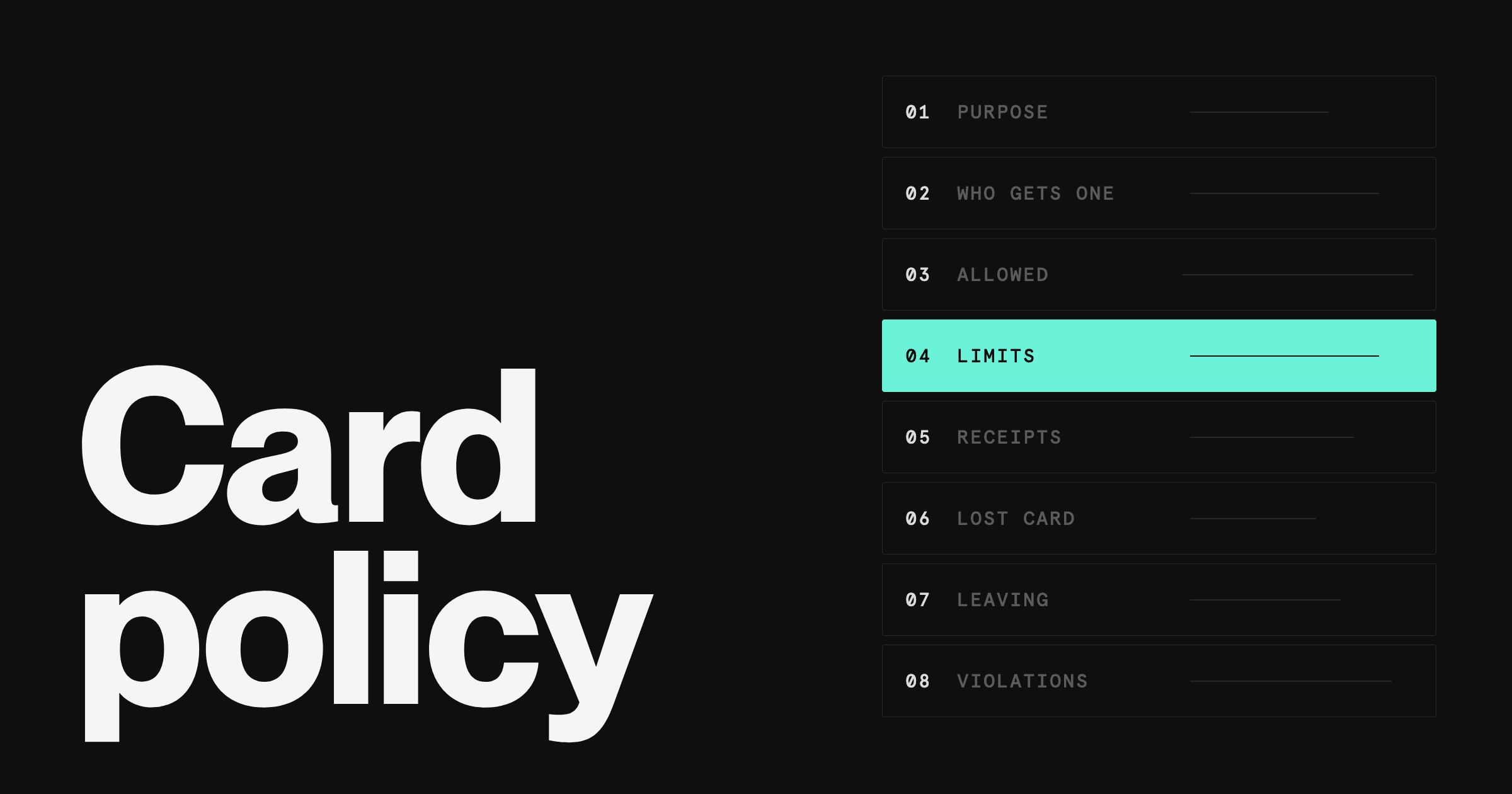
Cover these six sections. Each can be two or three sentences.
Purpose and eligibility: Say what the card is for and who qualifies. A simple rule works: anyone who regularly buys for the company and would otherwise expense it.
Allowed and prohibited spend: List the categories the card is meant for, such as software, ads, travel, and supplies, and the ones it is not, such as personal purchases and cash-like transactions.
Limits by role: Set a spending ceiling for each group, for example one limit for team leads and a lower one for contractors.
Receipts and memos: State what proof is required, how soon, and where to submit it.
Approvals and exceptions: Name who approves purchases above a threshold and who handles one-off requests.
Lost cards, departures, and violations: Say how to report a lost card, that a card is closed when someone leaves, and what follows a policy breach.
A one-page template you can copy
Replace the brackets with your own numbers and names.
Purpose: Company cards are for business purchases that [Role or team] makes on the company's behalf.
Who gets one: [Roles] receive a card after manager approval. [Program owner] issues and closes cards.
Allowed: [Categories]. Not allowed: personal purchases, cash advances, and [other categories].
Limits: [Role A] up to [amount] per [period]; [Role B] up to [amount] per [period]. Requests for more go to [approver].
Receipts: Upload a receipt and a one-line memo within [number] days of each purchase.
Lost or compromised card: Report it to [program owner] right away. The card is frozen and replaced.
Leaving the company: The card is closed on the last day of employment.
Violations: [Consequence], applied the same way to every cardholder.
How card type changes the policy
The card type decides how much of the policy the card itself can carry.
Virtual cards suit online and recurring spend such as software and ads. A card tied to one purpose is easier to police than a shared one.
Physical cards suit travel and in-person purchases.
If the provider supports merchant or merchant-category controls, the policy can lean on them. With Rho, a card with merchant or merchant-category controls enabled declines purchases outside its permitted list at the point of sale. Rho also sends receipt notifications: an SMS at the time of an in-person purchase that requires a receipt, an email for online purchases, and a daily reminder for expenses still missing a receipt.
How Rho, Ramp, and Brex compare
Here is how Rho compares with Ramp and Brex on per-user cost and stated Cashback or points. The table summarizes what each company states on its own pages. Terms change, so check each provider before you decide.
| Feature | Rho | Ramp | Brex |
| Per-user cost | No per-user fees on Rho expense management | Free plan at $0 per user per month; Plus at $15 per user per month plus a platform fee | Essentials at $0 per user per month; Premium at $12 per user per month |
| Cashback or points | Up to 1.25% Cashback on Daily Terms, up to 1% on Monthly Terms (terms apply) | No Cashback rate stated on its pricing page | Points by category, up to 7x on rideshare, 1x on everything else |
The differences that can be verified from published pages are per-user cost and the Cashback or points each provider states on its pages.
Where Rho fits
Rho is a banking platform for US-incorporated startups and small businesses. Rho corporate cards are available to US-incorporated businesses. Rho Platinum is a separate program with its own eligibility requirements and higher Cashback rates (terms apply). To apply you need a US-incorporated business (LLC, C-corp, or other US-incorporated entity). Sole proprietors and unincorporated businesses are not eligible.
Ready to set one up? See how Rho corporate cards work.
When a card policy is not the fix
The team is two people. One or two cards and a shared note are enough.
Spend is mostly vendor invoices. A bill payment tool matters more than a card policy.
Nobody owns the program. A policy with no owner is not enforced.