

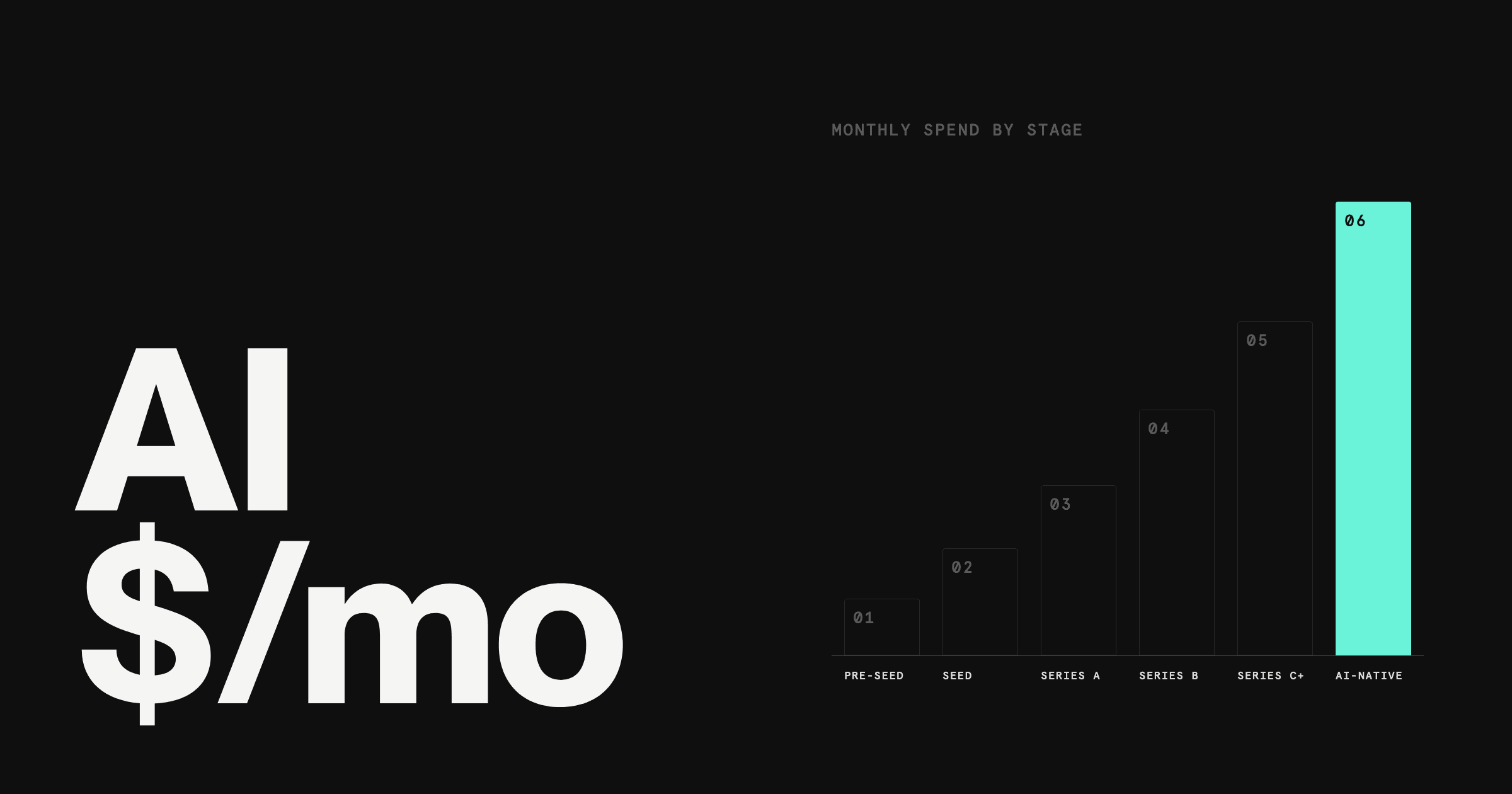
*A stage-by-stage view of startup AI budgets, a breakdown by spend category, the public benchmarks behind the numbers, and a worked estimate you can adapt to your own company.*
Published November 5, 2026.
Most startups spend roughly $100 to $10,000 a month on AI, and the median VC-backed startup sits near the bottom of that range. Startups whose product runs on a model can spend $10,000 to $100,000 or more, because inference scales with customers, not headcount. These ranges are illustrative planning estimates built from the public data and list prices cited below, not the result of a single survey.
This piece covers monthly spend by stage, where the money goes by category, what named public studies actually found, a worked estimate using current per-token prices, and how to keep the number visible as it grows. Figures were verified against each source on November 5, 2026.
How much do startups spend on AI each month?
The typical startup spends less than headlines suggest, and the average is pulled up by a small group of heavy spenders. Kruze Consulting's 2024 data on VC-backed startups put the median above $130 a month and the average at $5,000 to $6,000. That gap is the whole story.
Your number depends on one question: is AI a tool your team uses, or is it part of the product you sell? Internal productivity spend scales with headcount. Product (inference) spend scales with usage, and it is the line that surprises people.
Monthly AI spend by startup stage
These ranges are illustrative estimates derived from the sources cited below and public list prices as of November 5, 2026. They are not survey results.
| Stage | Team size | Internal tools per month | Product inference per month |
| Pre-seed | 1 to 5 | $50 to $300 | $0 to $200 |
| Seed | 5 to 15 | $300 to $2,000 | $100 to $2,000 |
| Series A | 15 to 50 | $2,000 to $10,000 | $1,000 to $20,000 |
| Series B and later | 50 to 200 | $10,000 to $50,000 | $5,000 to $100,000 |
| AI-native product, any stage | Any | Same as stage | $10,000 to $100,000 or more |
Read the two columns separately. The internal column assumes one to three paid AI tools per person at roughly the $20 to $30 entry-level subscription price that JPMorganChase Institute reports, plus coding assistants for engineers. The inference column assumes the product calls a model API and moves with customer usage.
Here's the catch: a seed-stage company with an AI feature in production can sit in the Series B row for inference. Stage predicts the internal number much better than the product number.
Where startup AI spend goes: costs by category
Startup AI budgets rarely live in one place. They are scattered across subscriptions, API invoices, cloud bills and add-ons bundled into software you already pay for. The ranges below are illustrative estimates for a seed to Series A company, derived from the sources and list prices in this piece.
| Category | What it covers | How it is billed | Illustrative monthly range |
| Chat assistant seats | General-purpose AI chat and writing tools | Per seat, monthly or annual | $100 to $2,000 |
| Coding assistants | AI pair-programming and code review tools | Per seat, sometimes plus usage | $100 to $3,000 |
| Model API usage | Calls to model providers from your product or internal scripts | Per million tokens, input and output priced separately | $0 to $20,000 or more |
| Support automation | AI agents and drafting in the help desk | Per seat, per resolution or per conversation | $200 to $5,000 |
| Infrastructure | GPU compute, vector databases, hosting for self-run models | Usage-based cloud billing | $0 to $10,000 or more |
| AI add-ons in existing software | AI tiers bolted onto tools the team already uses | Per seat upgrade or plan tier | $50 to $1,500 |
Two rows do most of the damage. Seats grow quietly with every hire, and API usage grows loudly with every customer. Everything else tends to be a rounding error until a company starts hosting its own models.
What public benchmarks show
There is no single authoritative survey of startup AI spend. There are several good partial views. Each one below names its publisher, report and year, and links to the source.
JPMorganChase Institute, "Understanding the use of AI among small businesses" (April 2026) (source).
- Among small businesses that pay for AI, median monthly spend was about $28 in 2025, with the 25th percentile near $20 and the 75th near $90. The median was about $78 in 2022.
- In 2025, 63% of paying firms spent $1 to $40 a month, 22% spent $41 to $150, and 16% spent more than $150.
- Entry-level generative AI subscriptions typically cost $20 to $30 a month, and 9.44% of adopters paid for three or more AI services in 2025.
- The share of firms that have ever paid for AI reached 17.7% at the end of 2025, up from 1.7% in January 2019. Adoption reached 39.3% in the Information sector, where most software startups sit.
Kruze Consulting, "How startups are using AI" (2024, updated November 2024) (source).
- About 70% of the 1,000+ VC-backed startups in Kruze's data paid for at least one AI tool as of August 2024.
- Average monthly AI spend rose from about $2,000 in the first half of 2023 to $5,000 to $6,000 in 2024.
- The median passed $130 a month by August 2024.
- It is one of the few startup-specific public datasets, and it is now two years old.
Menlo Ventures, "2025: The State of Generative AI in the Enterprise" (December 2025). Enterprise generative AI spend reached $37 billion in 2025, up from $11.5 billion in 2024, including $12.5 billion on foundation model APIs and $4.0 billion on coding tools (source). These are enterprise figures, useful as market direction rather than a startup benchmark.
ICONIQ, "2025 State of AI Report: The Builder's Playbook" (2025). AI-enabled software companies in ICONIQ's survey of 300 executives allocate 10% to 20% of R&D budgets to AI development (source). The report adds that cloud, inference and governance take over the budget as products mature.
Stanford HAI, "2025 AI Index Report" (2025). The inference cost for a system performing at GPT-3.5 level dropped more than 280-fold between November 2022 and October 2024 (source). Falling unit prices are why total bills keep rising: cheaper calls invite more calls.
What that means in practice: the median small business paying for AI spent about $28 a month in 2025, the median VC-backed startup in Kruze's data spent a little over $130 a month in 2024, and the average startup spent thousands. Product inference is what separates the three.
How to estimate your AI budget: a worked example with AI token costs
You do not need a benchmark to size your own AI budget. You need a headcount, a rough token count and the provider's price page. The example below is illustrative and uses list prices published on November 5, 2026.
Take a 12-person seed-stage startup with one AI feature in production.
1. Subscriptions. 12 people x 2 tools x $25 a seat = $600 a month. The $25 is the middle of the $20 to $30 entry-level range JPMorganChase Institute reports; check each vendor's current price.
2. Product feature on a mid-tier model. 50 million input tokens and 10 million output tokens a month on Claude Sonnet 5.5 at $2 and $10 per million tokens (Anthropic pricing): 50 x $2 + 10 x $10 = $200 a month.
3. Background jobs on a small model. 200 million input tokens and 20 million output tokens on Claude Haiku 5.5 at $0.10 and $0.50 per million: 200 x $0.10 + 20 x $0.50 = $30 a month. Those Haiku prices apply to prompts up to 100,000 tokens.
Total: $600 + $200 + $30 = $830 a month.
The same product workload on OpenAI's gpt-5.4-mini at $0.75 input and $4.50 output per million tokens (OpenAI pricing) works out to 50 x $0.75 + 10 x $4.50 = $82.50 a month.
Either provider's Batch API halves the token cost for work that can wait. For every model and tier side by side, see Claude API pricing vs OpenAI.
Suggested monthly AI budgets: lean, growth and AI-first
Scale the same method up and down and you get three budget shapes. These are illustrative estimates using the list prices above.
| Budget shape | Subscriptions | Model API usage | Monthly total |
| Lean (5 people, light API use) | 5 x 1 x $25 = $125 | 10M in, 2M out on Sonnet 5.5 = $40 | $165 |
| Growth (12 people, one AI feature) | 12 x 2 x $25 = $600 | Sonnet 5.5 plus Haiku 5.5, as above = $230 | $830 |
| AI-first (30 people, AI is the product) | 30 x 2 x $25 = $1,500 | 2,000M in, 400M out on Sonnet 5.5 = $8,000 | $9,500 |
The AI-first row is where model choice matters. Move that same workload to Claude Opus 5.5 at $4 and $20 per million tokens and the API line doubles to $16,000 a month. One configuration change, one extra $8,000.
Internal AI spend vs product AI spend
The single most useful thing you can do with an AI budget is split it in two. The lines behave differently, belong to different owners and land in different places on the P&L.
Internal productivity spend. Chat seats, coding assistants and AI add-ons that help the team work faster. It scales with headcount, it is usually owned by whoever approves software, and it is generally booked as operating expense. It is predictable, which is also why it drifts: nobody reviews a $25 seat.
Product (inference) spend. Model API calls and infrastructure that power what customers use. It scales with usage, it is owned by engineering, and many companies treat it as cost of revenue because it moves with every customer served. It is the line that can jump in a single quarter.
Your accountant should make the final classification call. How to allocate AI costs across teams and products walks through the methods.
How to keep AI spend visible
AI costs get out of hand for a boring reason: they arrive on a dozen different invoices, cards and cloud bills, and nobody adds them up. Three habits fix most of it.
1. Put each AI vendor on its own card or bill. One payment method per provider turns the card statement into a per-vendor AI ledger. When the charge on the coding-assistant card jumps, you know exactly where to look.
2. Set a budget and a hard limit per provider. Most model providers let you cap monthly API spend in their console. Pair that with a matching limit on the payment side so a runaway job stops at a number you chose. LLM API spending limits covers how to set both.
3. Review AI spend monthly against usage. Compare each vendor's bill to the seats or tokens behind it. Seats nobody opened and models nobody downgraded are where the savings are. The full routine is in AI spend management for startups.
Rho corporate cards and bill pay can pay AI vendors directly. Issue a card per vendor with a recurring limit and a merchant restriction, so out-of-policy charges decline at the point of sale. Transactions sync to supported accounting software for the monthly review, while token-level usage stays in each provider's console. Explore the Rho Card.
Keep reading
AI spend management for startups: the full playbook for tracking and controlling AI costs.
Claude API pricing vs OpenAI: what each model costs per million tokens, with three workload sizes.
LLM API spending limits: how to cap provider spend before a bad loop does it for you.
How to allocate AI costs across teams and products: splitting one AI bill across departments and product lines.