

By Rho | Published November 2, 2026 | 8 min read
You are picking an entity before you have a product, a cap table, or a cofounder who has read the operating agreement. Fair enough. This is the page that makes the decision fast.
The short answer: C corp vs LLC comes down to one question: will you issue stock? If you plan to raise venture capital or issue stock options, form a Delaware C corp. If you are bootstrapping, want income to pass straight through to your personal return, and have a small, simple ownership group, a Delaware LLC is the better fit.
Everything below is the reasoning behind that sentence, plus the numbers you need to act on it.
LLC vs C Corp for a Startup: The Short Answer
Raising VC or angel money: Delaware C corp. Investors expect preferred stock, and a C corp is the structure built to issue it.
Hiring with stock options: Delaware C corp. Option plans are a corporate-stock tool.
Bootstrapped, profits to the owners: Delaware LLC. Income passes through to your personal return by default.
Both cost money to keep alive in Delaware. Franchise tax and annual tax are real. Rho lists the figures and the dates below.
You can change your mind later, but converting costs time and sometimes tax. The section below covers that and links to the full walkthrough.
Rho forms both Delaware C corps and LLCs, so the entity can follow your plan. Details are in the Best for section near the bottom.
Rho forms Delaware C corps for $400 and LLCs for $349 all-in, state filing fee included.
C Corp vs LLC at a Glance
A C corp is a separate taxpayer that issues stock. That makes it the standard vehicle for venture-backed companies: investors buy preferred shares, employees get options, and the rules for all of it are well understood.
An LLC is a flexible contract between owners, and by default its profits flow through to their personal tax returns. That suits a business funded by its own revenue. Delaware is the usual home for either because its corporate law is predictable and investors already know it.
Delaware LLC vs Delaware C corp, side by side
Figures below come from delaware.gov and irs.gov pages as of November 2, 2026. Rules change, so check the current page before you file.
| Delaware LLC | Delaware C corp | |
| Best fit | Bootstrapped, small ownership group, profits to owners | Venture-backed, stock options, preferred stock |
| Investor expectations (raising capital) | Investors often ask you to convert first | The default structure for VC rounds |
| Stock and options (employee equity) | No stock. Equity is membership interests defined in the operating agreement. | Common and preferred stock, option pools |
| Default federal tax | Partnership (multi-member) or disregarded entity (single-member). Income passes through. | Entity-level tax. Files Form 1120. |
| Change tax treatment | Can elect corporate treatment with Form 8832, or S corp treatment | S corp election available if eligibility rules are met |
| Delaware annual cost | $400 annual LLC tax, due on or before June 1 | Franchise tax due on or before March 1, plus a $50 annual report fee for a non-exempt domestic corporation |
| Franchise tax range | Not applicable | Minimum $175, maximum $200,000, depending on method and share count |
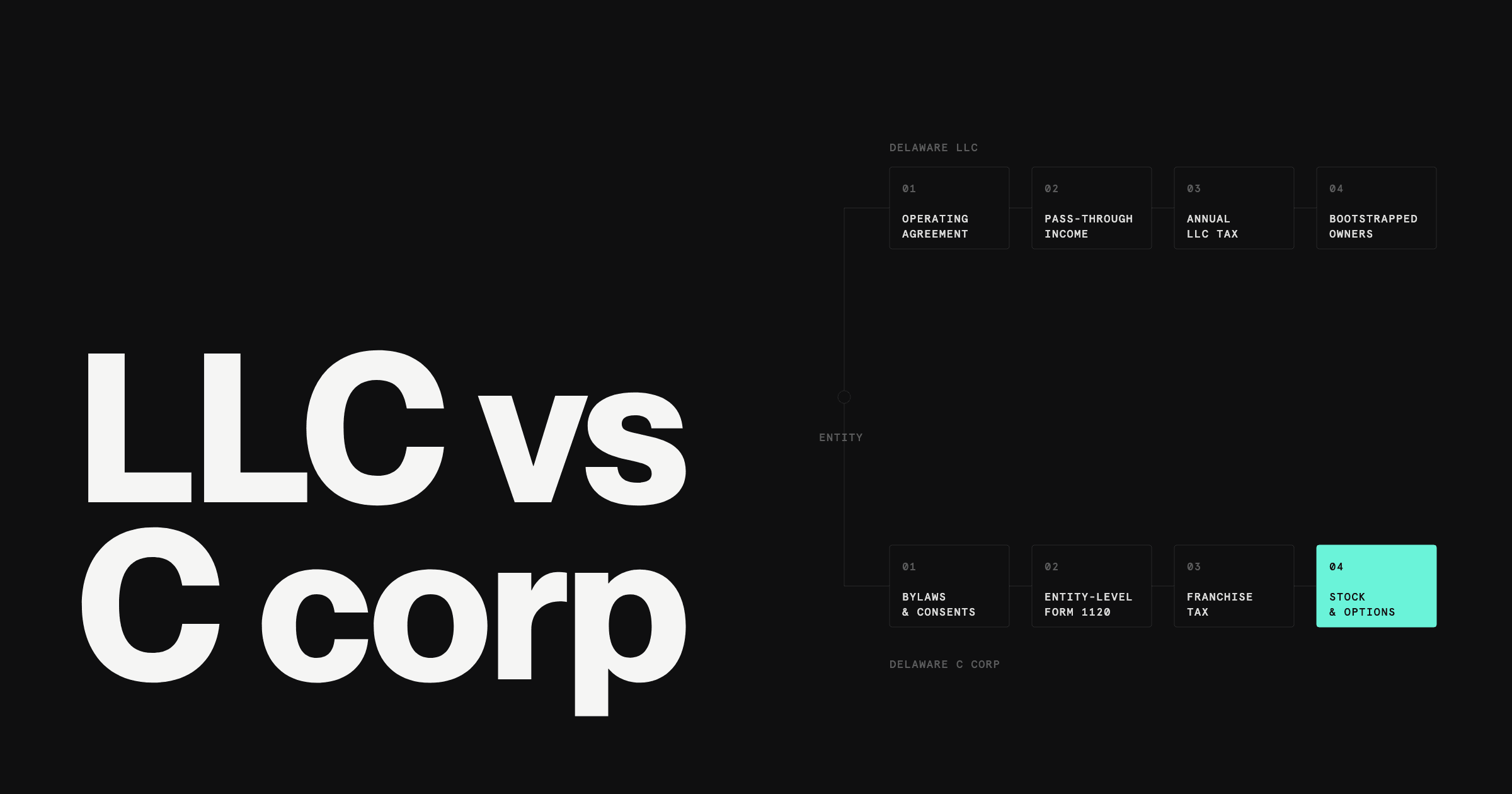
| Paperwork | Operating agreement | Bylaws, board and stockholder consents, stock ledger |
| Late penalty | $200 plus 1.5% interest per month | $200 plus 1.5% interest per month on tax and penalty |
Sorted which one fits? Rho forms either: Delaware C corp $400, LLC $349 all-in with the state filing fee included. Start with Rho Incorporation.
LLC vs C Corp Taxes
An LLC passes income through to its owners by default. A C corp pays tax at the entity level and files its own return on Form 1120.
How an LLC is taxed
By default, the IRS treats a multi-member LLC as a partnership and a single-member LLC as a disregarded entity. In both cases the business income shows up on the owners' personal returns. The IRS page notes a single-member LLC is still treated as separate for employment tax and certain excise taxes (irs.gov, page updated October 10, 2026).
An LLC can also choose corporate treatment by filing Form 8832, the Entity Classification Election. The election can take effect up to 75 days before you file it or up to 12 months after.
How a C corp is taxed
A C corp files its own return on Form 1120 and pays tax at the entity level. The IRS describes the S corp election as a way to avoid double taxation (irs.gov, updated June 11, 2026).
An S corp is a tax election, not a third entity.
The rules are narrow: a domestic corporation, no more than 100 shareholders, one class of stock, and only certain kinds of shareholders. Venture funds generally cannot hold S corp stock, which is why most venture-backed companies stay C corps. The full breakdown is in C corp vs S corp.
Why startups usually accept the C corp tax layer
Many early-stage startups are not profitable for years, so the entity-level layer stays theoretical for a long time. In exchange you can issue the stock investors and employees actually want.
If you expect to make real profit in year one and never raise outside money, run the numbers with a tax professional. That is the case where an LLC, or an LLC taxed as an S corp, often wins.
Why Investors Prefer a C Corp Over an LLC
Investors prefer a C corp because it issues preferred stock and options natively, while an LLC needs a custom operating agreement to approximate either.
Ask a venture investor to wire money into an LLC and you will usually get a polite request to convert first. The reasons are practical.
1. Preferred stock
VC rounds are built on preferred stock with its own rights and preferences. A corporation issues that stock natively. An LLC can mimic it with a custom operating agreement, but the investor's lawyers will not enjoy reading it.
2. Stock options
Employees want options at a strike price with a vesting schedule, and the process for granting them is a corporate one. An LLC has to approximate the same economics with profits interests or similar structures, which are harder to explain to a new hire and harder to administer.
3. Fund eligibility
Some investors are set up in ways that make pass-through income from an LLC unwelcome.
A C corp keeps income at the entity level and hands them stock, which is exactly what they are built to hold.
If the plan has outside funding in it, form the C corp up front. The guide to the Delaware C corp covers what goes into one.
What Delaware costs you every year
A Delaware LLC owes $400 a year; a Delaware C corp owes franchise tax from $175 to $200,000, both as of November 2, 2026.
Delaware is not free to keep. Both entities carry a recurring state charge, and both carry a penalty if you miss the date.
Delaware LLC. A $400 annual tax is due on or before June 1 for the prior year. Late filing carries a $200 penalty plus 1.5% interest per month (corp.delaware.gov, as of November 2, 2026).
Delaware C corp. The annual report and franchise tax are due on or before March 1. The annual report fee is $50 for a non-exempt domestic corporation. The late penalty is $200 plus 1.5% interest per month on the tax and penalty (corp.delaware.gov, as of November 2, 2026).
Franchise tax depends on the method you use:
Authorized Shares Method: $175 minimum for 5,000 shares or fewer, $250 for 5,001 to 10,000 shares, plus $85 for each additional 10,000 shares or portion thereof.
Assumed Par Value Capital Method: $400 per million dollars of assumed par value capital, or portion thereof, with a $400 minimum on the franchise tax.
Floor and ceiling: never less than $175, never more than $200,000.
What that means in practice: a startup that authorizes millions of shares can see a large number on its first invoice under the Authorized Shares Method.
Founders with many authorized shares generally calculate under the Assumed Par Value Capital Method instead. Delaware publishes a franchise tax calculator on corp.delaware.gov; run it before you file your annual report.
When an LLC is genuinely the better choice
Rho forms both Delaware C corps and LLCs, and an LLC is often the right call.
You are bootstrapped and plan to fund the business from revenue.
You want profits on your personal return without a second layer of entity-level tax.
Ownership is simple: one founder, or a few people who trust each other.
You run a service or lifestyle business where stock options and preferred shares will never come up.
You are holding assets or real estate and want the flexibility of an operating agreement.
The cost of picking an LLC and changing your mind is real but manageable. That is the next section.
Changing your mind later: LLC to C corp
You can convert a Delaware LLC to a C corp. It takes a formal filing, new corporate documents, and a conversation with your accountant about the tax treatment of the change.
Timing matters, so talk to your accountant before you issue equity or sign term sheets. The full walkthrough is in How to convert an LLC to a C corp. If you are already weighing a priced round, convert before the lawyers ask you to.
LLC or C Corp for Your Startup: Pick by Situation
Match your situation to the line that fits.
"I'm raising a pre-seed or seed round in the next 12 months." Delaware C corp.
"I want to give early hires equity." Delaware C corp.
"I'm a solo founder building a profitable service business." Delaware LLC, and revisit with an accountant when profit grows.
"I'm not sure yet." If outside money is even plausible, start with a C corp. It is the structure investors expect, and converting later takes time and a tax review.
"I'm choosing between LLC, C corp and S corp." Read C corp vs S corp (vs LLC) next.
Know your answer? Form your Delaware C corp ($400) or LLC ($349 all-in, state filing fee included) with Rho Incorporation. Still weighing it up? Read how to incorporate a startup first.
Delaware incorporation providers compared
The vendor comparison below uses three criteria, each chosen because it changes what a founder actually pays or waits for:
Entity types offered. Can you form the entity you need, or only one kind?
All-in price, as stated on each vendor's own page. Each row notes what the vendor states is included, because a low headline price with fees added on top is not low.
Stated turnaround. Each vendor's own words, dated.
Rho is one of the providers reviewed, so the footer carries a Comparison Disclosure.
| Provider | Entity types (per vendor page) | Stated price (as of Nov 2, 2026) | Government fees and registered agent | Stated turnaround |
| Rho | Delaware C corp and LLC | C corp $400. LLC $349 all-in, LLC state filing fee included. | LLC: state filing fee and first-year registered agent included. C corp: registered agent covered for year one. | See the Rho Incorporation page |
| Stripe Atlas | C corporation, LLC, subsidiary | $500 one-time | Includes first year of registered agent services | Not stated here |
| Clerky | Pricing page describes Delaware C corporation incorporation | $427 (pay per use) or $819 (lifetime package) | Includes $203 Delaware expedited filing fees and $125 first-year Delaware registered agent fee | Filed certificate typically returned within 2 to 3 business days |
| LegalZoom | LLC and corporation packages | LLC $0, $249 or $299; corporation $149, $329 or $349; plus state fees | Filing fees added on top. Registered agent not listed in packages. | Corporation: standard, 5-day priority or 1 to 2 days express, excluding Secretary of State time. LLC: not stated. |
Where Rho fits
You have the entity picked. Now you need it filed, a registered agent, and an EIN application, and ideally a place to bank before your first customer asks where to send the wire.
Best for founders who want to choose the entity on the merits and have it formed in one place: Rho forms Delaware C corps for $400 and LLCs for $349 all-in, state filing fee included.
For a Delaware C corp, the Rho account opens in the same flow, subject to approval. Your EIN application is filed for you after incorporation. Registered agent services are covered for the first year.
Your formation is filed on your behalf, and your EIN application is filed for you after incorporation.
Eligibility: at least one US-based owner or officer, a physical US operating address, and a business in a non-excluded industry.
Not sure which structure you need? Three places to go next:
The walkthrough on how to incorporate a startup
Best incorporation services, to see where Rho sits among the providers and what each is best for
Or go straight to Rho Incorporation.