
Most gig workers pick a bank account by monthly fee and regret it by tax season. Here is what actually separates a growth account from a temporary fix, and which 13 accounts hold up when the money gets real.
Gig workers who delay opening a separate account often operate under a specific assumption: “The account I have is fine for now; the financial complexity will come later, and I can always switch when I'm a 'real business.'” The common assumption is that separation, structure, and scrutiny are problems for a future, more established version of their business, not for someone whose income still feels unpredictable, whose setup sounds like it requires a lawyer, an LLC, and a free afternoon, and whose current account technically works.
The problem is that “technically works” is doing a lot of quiet damage every single month. See our business bank for startups for how this works in practice.
“I mix personal and business income in the same account, making it difficult to track earnings and expenses accurately at tax time, a core reason a separate bank account is needed before feeling 'ready.'”
According to Tax Lawyers Group (April 2025), commingling personal and business funds is a primary audit red flag for sole proprietors. When personal and business transactions run through the same account, the IRS cannot cleanly distinguish deductible business expenses from personal spending. That documentation deficit grows with every additional transaction.
Schedule C filers, the form every gig worker uses, face disproportionately higher audit rates than W-2 employees, with risk rising sharply as gross receipts increase. The belief that financial scrutiny arrives only after you become a “real business” is directly contradicted by IRS enforcement data. The scrutiny starts with the first dollar.
As the IRS confirms, no LLC, corporation, or EIN is required to open a business bank account or file Schedule C. A sole proprietor can establish clean financial separation from day one using only a Social Security Number.
The tax obligations, including self-employment tax, quarterly estimated payments, and deduction substantiation, begin with the first dollar earned, not the day you file incorporation paperwork. Self-employment income is not withheld, meaning the IRS expects quarterly estimated tax payments, and missing them carries a real cost.
71% still commingle: Roughly 71% of freelancers run all their income through a personal checking account, not out of laziness, but because they're waiting for a milestone that never feels official enough to justify the switch.
Fees aren't the real risk: The wrong account isn't the one with the highest fees. It's the one you'll have to rip out and replace the moment you form an LLC, bring on a contractor, or cross five figures in monthly deposits.
Every deposit is taxable: Mixing gig income with personal spending isn't a bookkeeping inconvenience. The IRS treats every deposit as taxable income, so every untracked transaction is reconciliation debt that compounds until April 15th.
Most guides stop at day one: Most gig worker banking guides optimize for low fees, easy signup, and a 1099-friendly badge, and ignore whether the account can actually scale when the side hustle becomes a real business.
Structure beats preference: The digital-only vs. traditional bank decision isn't a preference question. The structure of your account determines whether your banking can keep pace with how your income actually grows.
Waiting has a cost: Choosing a bank account before you feel ‘ready’ is the move. The cost of waiting shows up not as a fee, but as hours of manual transaction sorting at tax time.
Rho closes the loop: It's an all-in-one business banking platform with corporate cards, bill pay, expense management, and accounting integrations built in. No subscription fees, real human support, and infrastructure that holds up from the day you form your LLC through a fully scaled operation.
What to Look for in a Bank Account for Gig Workers, and What Most Guides Get Wrong
The most common mistake gig workers make when choosing a bank account has nothing to do with the bank they pick. It has everything to do with the criteria they use to pick it.
The common assumption is: “The account I have is fine for now; the financial complexity will come later, and I can always switch when I'm a 'real business.'” That assumption is exactly what makes the mistake so easy to make and so costly to undo.
Most comparison guides rank accounts by monthly fee and app design, then call the research done. That framing feels reasonable on day one.
It stops feeling reasonable around month four, when you're manually exporting Stripe CSV files into a spreadsheet at 11pm before a quarterly tax deadline.
Or month fourteen, when you form an LLC and discover your current account can't support the transition without starting over entirely.
What Most Guides Get Wrong
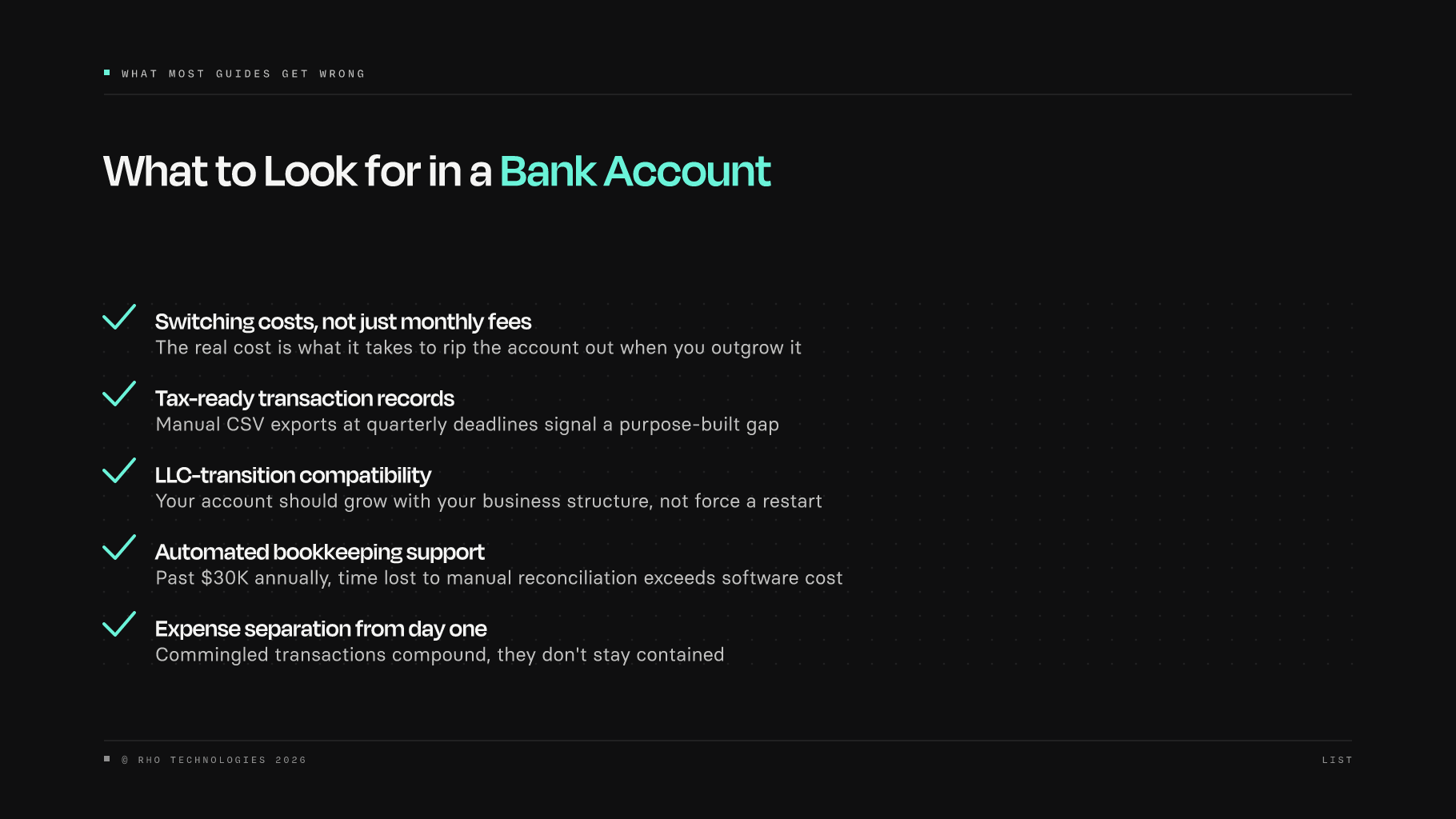
The fee table is easy to build and easy to read. Zero dollars per month beats fifteen dollars per month.
But that table leaves out the column that actually determines cost: what it takes to rip the account out when you outgrow it. Commingled transactions, missing expense records, and unreconciled payouts don't stay contained. They compound.
Once a freelancer's income reaches roughly $30,000 annually, the time lost to manual bookkeeping exceeds what purpose-built software would cost, and switching at that point carries real cleanup debt.
Three Scale-Readiness Questions to Ask First
Before opening any account, ask three things.
First: can this account survive LLC formation without forcing me to start over? Second: does it support contractor payments, or will I need a separate tool the moment I bring on help?
Third: if a client asks for a formal invoice with real business banking details, can this account support that today?
If any answer is no, the account is a temporary solution dressed as a permanent one.
Integrations and Invoicing: Gig Account vs. Growth Account
A freelance developer who chose an account with no Stripe integration and manually exported transaction CSVs every month wasn't saving money. They were spending three to five hours monthly doing work that a native integration eliminates.
Platforms like Lili are built around exactly this gap, offering accounting integrations and invoice support designed for independent workers from day one.
Quick-Reference Scale-Readiness Checklist for Gig Worker Bank Accounts
Before opening any account, run it through these criteria:
Criterion | What to Look For | Red Flag |
|---|---|---|
LLC compatibility | Can the account attach to an EIN without a full re-application? | Requires closing and reopening the account |
Cash deposit support | Native branch or retail network deposit at low/no fee | $4–$5 per cash deposit via third-party kiosk |
Accounting integration | Native Stripe, QuickBooks, or FreshBooks sync | Manual CSV export only |
Tax bucketing | Automatic set-aside per deposit (e.g., Found's tax pocket) | No tax reserve feature at all |
Contractor payments | Supports ACH to 1099 contractors or built-in AP tools | Domestic wire requires branch visit |
If an account fails two or more criteria relevant to your current setup, it is a temporary tool, not a growth platform.
The 13 Best Banks for Gig Workers in 2026, Ranked and Reviewed
The 13 accounts ranked below exist precisely because that gap is real and measurable. A gig worker whose monthly deposits cross five figures inside a personal checking account has quietly made the most expensive decision they never consciously made.
That account cannot separate tax obligations automatically, sync with accounting software, or produce a clean transaction history that a lender will actually trust.
The majority of freelancers and independent contractors still run gig income through personal accounts, treating the separation problem as something to solve later.
The cost of “later” is a compounding behavioral record, one that lenders, fintech platforms, and the IRS are already reading.
The 13 accounts below are ranked and reviewed for gig workers at every stage, from first 1099 to first contractor hire. Each entry is built around a single honest answer to the question: who is this actually right for, and what is the one tradeoff that matters most?
1. Rho, Best All-in-One Banking Platform for Gig Workers Who Have Formed a Business
Most gig workers piece together a tax app, a separate checking account, a corporate card, and an invoicing tool, then spend Sunday evenings reconciling all four.
Rho replaces that entire fragmented stack with a single platform: banking, cards, bill pay, and expense management at $0 platform fee, no per-user charges, and no minimum balance.
Here's the catch: Rho is built for gig workers who have turned their work into a registered business. Once you've formed an LLC or incorporated, it's the strongest infrastructure on this list.
Still earning your first $500 gig payment as an unincorporated individual? Not yet the right fit.
2. Bluevine, Best High-Yield Checking for Freelancers Who Want to Earn on Idle Cash
Bluevine's Standard plan offers up to 1.3% APY (as of 08/11/2026) on balances up to $250,000 with no monthly fee, provided you either spend $500 per month on the Bluevine Business Debit Mastercard or receive $2,500 per month in deposits.
Miss both thresholds and that month earns 0.00% APY. The Premier plan pays 3.0% APY with no balance cap (as of 08/11/2026).
FDIC coverage extends up to $3,000,000 per depositor through Coastal Community Bank and program banks, which matters for freelancers holding large retainer payments between invoices.
One gap to know about: there's no built-in tax bucketing here. Bluevine's strength is high-yield idle cash, not tax prep.
Update (October 2026): Valley National Bank announced it will acquire Bluevine for $340 million, with the deal expected to close in early 2027. Bluevine will become Valley's small-business banking division; existing accounts aren't expected to change before then.
3. Relay, Best for Gig Workers Who Want Envelope-Style Budget Separation
Relay lets you open up to 20 individual checking accounts on its Starter and Grow plans (up to 50 on Scale, as of 08/11/2026), plus 50 virtual cards inside one business banking relationship. It's the closest digital equivalent to the envelope budgeting method.
For a gig worker managing separate income streams, rideshare, freelance design, and a side product business, say, Relay makes it easy to keep each one visually and functionally separated without opening accounts at multiple institutions.
What it won't do: set aside tax money automatically the way Found does. You're moving funds into your tax envelope by hand, which takes discipline, not software.
4. Wise Business, Best for Gig Workers Paid Across Multiple Currencies
Wise Business earns its spot when a meaningful share of your gig income arrives in euros, pounds, Canadian dollars, or any of the 40-plus currencies Wise supports natively.
It holds balances in multiple currencies at once, converts at the mid-market rate with a transparent fee, and gives you local account details in major markets, so international clients can pay you without a wire transfer.
What often gets missed: Wise isn't a full-service US business checking account, and it doesn't offer FDIC-insured checking. That matters if you're planning to make it your primary operating account.
5. Lili, Best Dedicated Banking App Built Specifically for Freelancers
Lili was designed from the ground up for freelance workers, and it shows in features other accounts bolt on as afterthoughts.
The app includes automatic tax categorization, a dedicated tax bucket that separates a portion of income for quarterly estimated taxes, and a built-in profit and loss summary, no additional accounting software required.
Where it runs out of road: Lili lacks the AP automation, accounting integrations, and multi-user controls you'll need once you bring on a contractor or form an LLC.
6. Mercury, Best for Tech-Forward Gig Entrepreneurs and Solo Founders
Mercury is a go-to choice for digitally native founders and solo operators who want a clean, API-forward banking experience.
It offers a published API, native Stripe and QuickBooks integrations, and a free account with no minimum balance, putting it in the same league as Brex and Rho for tech-oriented operators.
Mercury also offers a treasury product for idle cash, though it carries a $250,000 minimum balance threshold, out of reach for most early-stage gig workers.
It's excellent infrastructure for a solo founder already running a structured operation. For a gig worker still figuring out quarterly taxes or basic bookkeeping, though, the guidance runs thin.
7. Found, Best Banking and Tax Tool Combo for Self-Employed Sole Proprietors
For gig workers who want automatic tax savings built into their banking, Found is among the most direct purpose-built options available.
It's one of the only business banking apps that auto-calculates and quarantines a tax reserve per deposit, a feature absent from general-purpose accounts like Bluevine and Mercury.
Found sets aside a percentage of each deposit into a tax pocket, sized to your income and estimated tax liability, so you're not manually moving money before every quarterly deadline.
On a $5,000 deposit, that mechanism might quarantine roughly $1,250 automatically, keeping it out of your spending balance.
That matters more than it sounds: the IRS charges underpayment penalties that can run into hundreds of dollars per quarter for self-employed workers who miss estimated payments. Found's auto-bucketing genuinely protects against that.
Where it comes up short: Found's banking infrastructure is lighter than dedicated business checking platforms. It's built for sole proprietors, not gig workers who've already formed an LLC or taken on employees.
8. Novo, Best Fee-Free Business Checking for Gig Workers Who Invoice Clients
For gig workers who want deep integration with payment processors and invoicing software, Novo is a standout choice.
It offers native, no-fee connections to Stripe, PayPal, QuickBooks, and Shopify in a single free account, a combination most traditional and fintech business accounts need third-party middleware to replicate.
That makes Novo the practical pick for e-commerce sellers, freelance creatives, and service providers who need their payment infrastructure to talk to their bank without manual imports.
One thing to flag: Novo does not accept physical cash deposits. That rules it out immediately for rideshare drivers, market vendors, or any gig worker whose income arrives in cash.
For fully digital earners, the integration depth is a genuine differentiator.
9. Bank of America Business Advantage, Best Traditional Bank Option for Gig Workers Who Need Branch Access
For gig workers who regularly handle cash, rideshare drivers, event vendors, or tradespeople, Bank of America's Business Advantage checking provides nationwide branch and ATM access alongside digital tools.
Preferred Rewards for Business can offset monthly fees for higher-balance customers.
What stings in a slow month: the monthly maintenance fees and minimum balance requirements, which hit lower-income gig workers hardest when cash flow dips.
10. Primis Bank, Best Community Bank Option for Sole Proprietors Wanting Personalized Service
Primis Bank earns its place on this list for gig workers who value a direct banking relationship over app sophistication.
Community banks like Primis offer something that fintech accounts structurally cannot: a named business banker who knows your account, can advocate for a credit decision, and picks up the phone.
If you anticipate needing a small business loan or line of credit within the next 12 to 24 months, building that documented relationship early has real credit-access value.
What you give up: Primis doesn't offer the automated tax tools, accounting integrations, or expense management features that gig workers with complex income streams tend to need.
11. Instant Financial, Best for Gig Workers Who Need Same-Day Access to Earned Wages
Instant Financial solves a specific and urgent problem: gig workers who complete a job today and need access to those funds today, not in two to three business days.
It's built around earned wage access, letting workers pull completed earnings before the standard settlement cycle clears.
That's most valuable in high-frequency, low-ticket categories, delivery, rideshare, task-based platforms, where cash flow timing creates real friction.
Keep the scope in mind: this is a cash-access tool, not a full business banking platform. It doesn't touch tax planning, expense tracking, or accounting integration, so use it alongside a primary business account, not instead of one.
12. QuickBooks Money, Best for Gig Workers Already Using QuickBooks for Accounting
QuickBooks Money makes the most sense when your accounting already lives inside QuickBooks and you want your banking to follow.
The account syncs transactions directly into QuickBooks, eliminating the manual import step that wastes hours every month for gig workers who reconcile their own books.
For a freelancer or independent contractor already paying for QuickBooks Self-Employed or QuickBooks Online, adding QuickBooks Money creates a unified financial picture with minimal setup friction.
If you're not already a QuickBooks user, though, think twice: adopting both the accounting software and the banking account at once is a harder case to make than picking a standalone alternative.
13. Oxygen, Best Lifestyle-Focused Banking App for Creative and Gig Economy Freelancers
Oxygen is built for creative freelancers and gig economy workers who want a banking experience that matches their brand identity, with cashback rewards on categories like food, travel, and subscriptions that reflect how independent workers actually spend.
The app is clean, mobile-first, and designed for people who treat their gig work as a lifestyle business rather than a corporate operation.
Worth knowing before you grow: Oxygen's feature set is built for day-one simplicity and spending rewards, not the accounting integrations, tax automation, or spend controls that matter once income gets serious.
It is the right pick for the creative freelancer who wants a polished experience today, with the understanding that the account may not hold as the business scales.
How to Choose Between Digital-Only Banks and Traditional Banks as a Gig Worker
That decision filter starts with a single honest question about how you actually work, not how you plan to work.
Picking between a digital-only account and a branch-enabled bank feels like a minor preference question. It isn't. The structure of your account determines whether your banking can keep up when your gig income grows into a real business.
As Human Rights Watch documented in May 2025, algorithmically opaque platform payouts frequently fall below legal wage floors, creating chronic income volatility.
Layer on a 15.3% self-employment tax on net earnings, plus quarterly estimated payments, and idle cash between gig payouts needs to earn yield while staying precisely partitioned. A basic personal account can't do both at once.
A business account with a built-in savings layer, like Rho Savings, changes that math. It's included at $0 and backed by the American Deposit Management Co. network of partner banks, with up to $75M in FDIC coverage across roughly 400 partner banks.
That gives irregular earners a place to park tax reserves and operating buffers in the same platform where they bank and pay bills, no juggling separate institutions required.
How to Choose Your Gig Worker Bank Account: Start With the Cash Question
Gig workers who regularly handle physical cash face a structural wall with most digital-only accounts. Platforms like Novo and Found have no native cash deposit capability; some route deposits through third-party retail networks that charge $4 to $5 per transaction.
For a mobile dog groomer collecting $40 in daily tips, that fee structure quietly erodes margin in a way no monthly fee comparison would surface. A UX consultant invoicing through Stripe never touches cash and has no reason to care.
The tiebreaker is whether your income ever exists as paper.
12-Month Forward Test: Will This Account Survive Your LLC, Your First Contractor, and a Client Who Wants a Wire?
Ask this before you open anything: will this account still work if I form an LLC, pay a subcontractor, and receive a wire from a corporate client within the next year?
Industry data suggests a significant share of active freelancers formalize their business structure within the first two years of consistent gig income.
A digital-only account that can't send domestic wires or attach to an EIN without a full re-application fails that test immediately. Scale-readiness is a selection criterion, not a bonus feature.
Rho is built precisely for that forward test.
Domestic wires are $0, same-day ACH is included at $0 (initiated before 2 p.m. ET for amounts under $1M), and the platform supports pre-EIN onboarding, so founders can open an account before their EIN arrives and start using it immediately.
When the LLC is formed and the first subcontractor needs to be paid, the account doesn't need to be replaced. Bill pay, AP automation, and unlimited reimbursements are all included at $0 from day one, on a single unified platform with no tier upgrades and no per-user fees.
Banking, cards, and expense workflows connect automatically, so the focus stays on hiring, selling, and scaling rather than stitching together financial tools.
The accounting integration question matters here too. Gig workers who graduate to managing a small team quickly discover that the real cost of a cheap bank account is hours of manual data entry between their bank and their general ledger.
Rho's native integrations with QuickBooks Online, Oracle NetSuite, Sage Intacct, and Xero eliminate that reconciliation drag.
The benefit is most pronounced for businesses already on a cloud accounting platform that want transactions, receipts, and expense data to sync automatically without a manual export step.
As Human Rights Watch's research on platform work underscores, gig workers already absorb unpredictable income swings. Administrative overhead on top of that is a compounding cost that a well-integrated banking platform can meaningfully reduce.
Most gig workers who handle irregular, algorithmically-set income need fast, modern banking with real support and genuine control from day one.
Rho's dedicated point of contact is available to every customer via chat, email, or phone, responding in under a minute, 24/7, at no extra cost. That isn't a feature reserved for large accounts; it's the baseline for every customer, at every stage.
Next Steps
If your gig income is flowing through an account that was never built to separate tax obligations, document deductions, or survive LLC formation, the path forward starts with treating your banking choice as a risk-management decision, not a preference.
The logic is plain: algorithmically volatile platform payouts combined with a 15.3% self-employment tax obligation from dollar one mean idle cash must earn yield and stay precisely partitioned, which a basic personal account cannot do.
It compounds further: every month of commingled transactions adds to a documentation deficit that makes deduction substantiation harder and quietly caps future credit access. Lenders and fintech platforms are already reading that behavioral record before you ever apply.
Together, they point to one move: open purpose-built business banking before the reconciliation debt gets any deeper.
Start with business bank for startups. From there, the account handles what the duct-tape stack never could: automatic expense sync, $0 domestic wires, same-day ACH, and savings yield on idle cash, all on one platform with no monthly fee and no minimum balance.
FAQs
Wise Business is built for gig workers who receive a meaningful share of income in euros, pounds, Canadian dollars, or any of 40-plus supported currencies. It holds balances in multiple currencies simultaneously and converts at the mid-market rate with a transparent fee. The key limitation to know upfront: Wise is not a full-service US business checking account and does not offer FDIC-insured checking, so it may not be the best fit as your sole primary operating account.
Found automatically sets aside a percentage of each deposit into a dedicated tax pocket, calculating the reserve based on your income and estimated tax liability. On a $5,000 deposit, for example, it might quarantine roughly $1,250 automatically. This matters because the IRS charges underpayment penalties that can run into hundreds of dollars per quarter for self-employed workers who miss estimated payments, making the auto-bucketing a genuine financial protection rather than just a convenience feature.
No. As the IRS confirms, no LLC, corporation, or EIN is required to open a business bank account or file Schedule C. A sole proprietor can establish clean financial separation from day one using only a Social Security Number. Your tax obligations, including self-employment tax, quarterly estimated payments, and deduction substantiation, begin with the first dollar earned, not the day you file incorporation paperwork.
Bank of America Business Advantage is the strongest option for gig workers who regularly deposit physical cash, offering branch and ATM access across thousands of locations along with the full-service relationship, credit lines, merchant services, and business credit cards that become important as your operation grows. Fintech-native accounts like Novo explicitly do not accept physical cash deposits, which eliminates them entirely for rideshare drivers, market vendors, or any gig worker whose income arrives in cash.
Commingling personal and business funds is a primary audit red flag for sole proprietors, according to Tax Lawyers Group, because the IRS cannot cleanly distinguish deductible business expenses from personal spending when transactions run through the same account. That documentation deficit grows with every additional transaction. Schedule C filers, the form every gig worker uses, already face disproportionately higher audit rates than W-2 employees, with risk rising sharply as gross receipts increase, so the scrutiny starts with the first dollar, not after you become a ‘real business.’