
Most Georgia business bank rankings were built for cash registers, not incorporated startups. Here is the framework that actually predicts whether your bank survives contact with your growth.
Searching for the best banks in Georgia for small business is a reasonable starting point, but nearly every article you find was built to answer a different question than the one you're actually asking. Most comparison pieces rank institutions on branch count, ATM access, and minimum balance waivers.
Those criteria make sense for a sole proprietor running a cash register in Savannah. They tell you almost nothing useful if you're an incorporated startup that needs AP automation, corporate cards, and accounting integrations from the moment you open your doors.
The gap between what those lists measure and what you actually need is where founders lose time, money, and momentum. A common pattern: founders spend an afternoon reading comparison articles, build a shortlist around fee tables, open an account, then discover within 90 days that the bank has no native accounting sync, no way to issue corporate cards without a separate application, and no bill pay tooling that connects to anything.
The bank was fine. It just wasn't built for them.
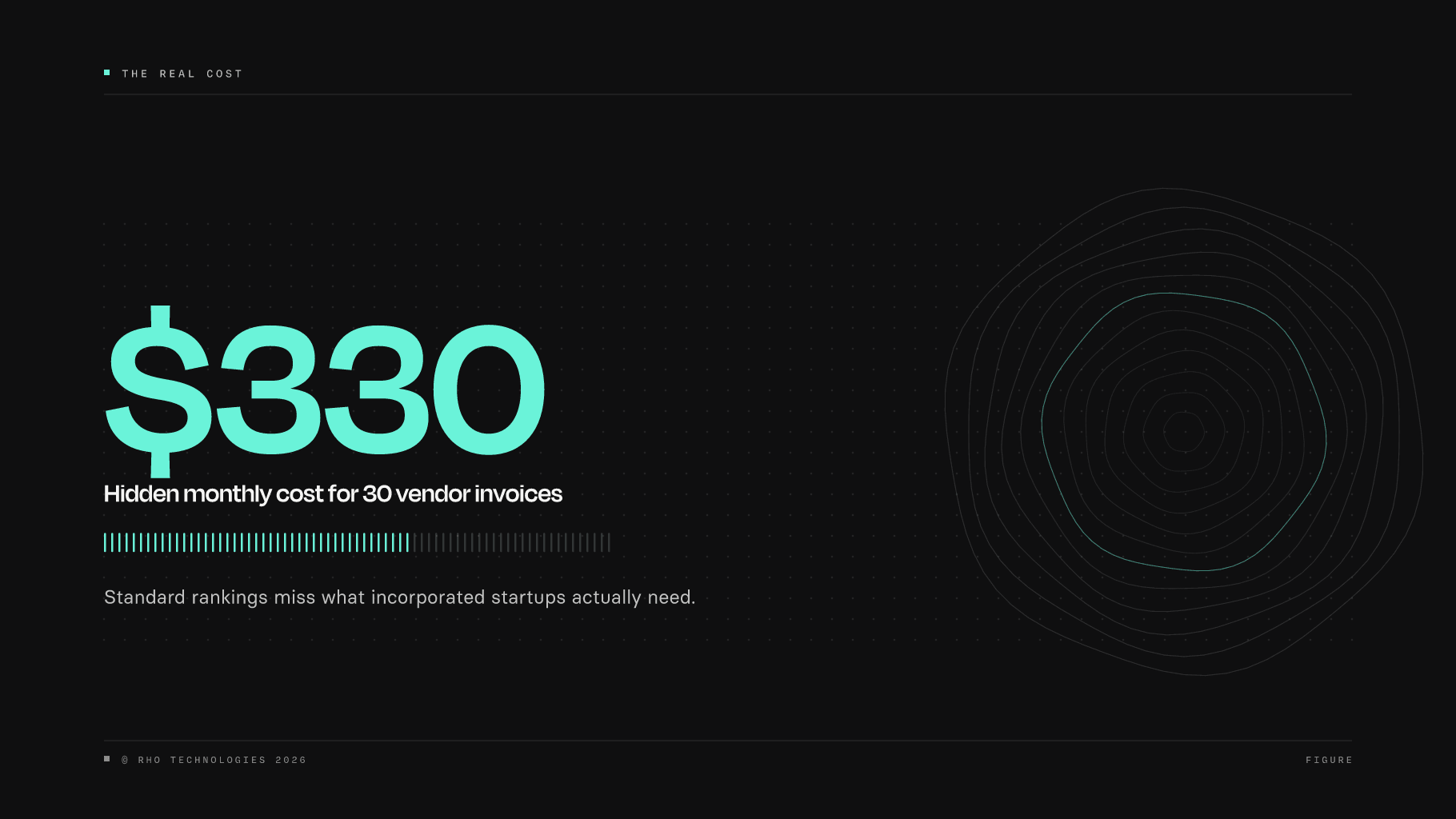
Standard rankings optimize for monthly fees and ATM network size, visible, easy to compare, and largely irrelevant to operational cost for an incorporated startup. What drives cost is how many tools you have to stitch together to run basic finance operations. The moment a company incorporates, it needs a finance stack, not just a place to hold cash.
Most 'best banks in Georgia' lists rank branch density and waivable monthly fees; neither predicts whether a bank can keep up with a growing startup at month fourteen.
The bank that fails you rarely fails you on day one. It fails you when transaction volume triples and your platform can't sync with QuickBooks or issue a card to a new hire without a branch visit.
Traditional Georgia business checking fees run $15–$30 a month, waivable only if you park $1,500–$25,000 in minimum balances, a quiet tax on early-stage cash flow.
Georgia's strongest SBA lenders and its best operating banks are almost never the same institution. Conflating the two decisions costs founders real money.
Cash-heavy businesses (restaurants, retail) need branch density for deposits. Digital and SaaS businesses don't, and paying for that infrastructure is pure overhead.
Every disconnected tool in your finance stack multiplies manual reconciliation time at month-end. Fragmentation isn't a minor inconvenience; it compounds into hours lost every close cycle.
Rho closes that gap by putting banking, corporate cards, bill pay, expenses, treasury, and accounting on one platform, no subscription fees, no duct tape, and infrastructure that doesn't need to be rebuilt when you raise your next round.
How to Choose a Business Bank Account in Georgia - The Criteria That Actually Matter
Most comparison tables rank business bank accounts by monthly fee, which turns out to be the least predictive variable on the list.
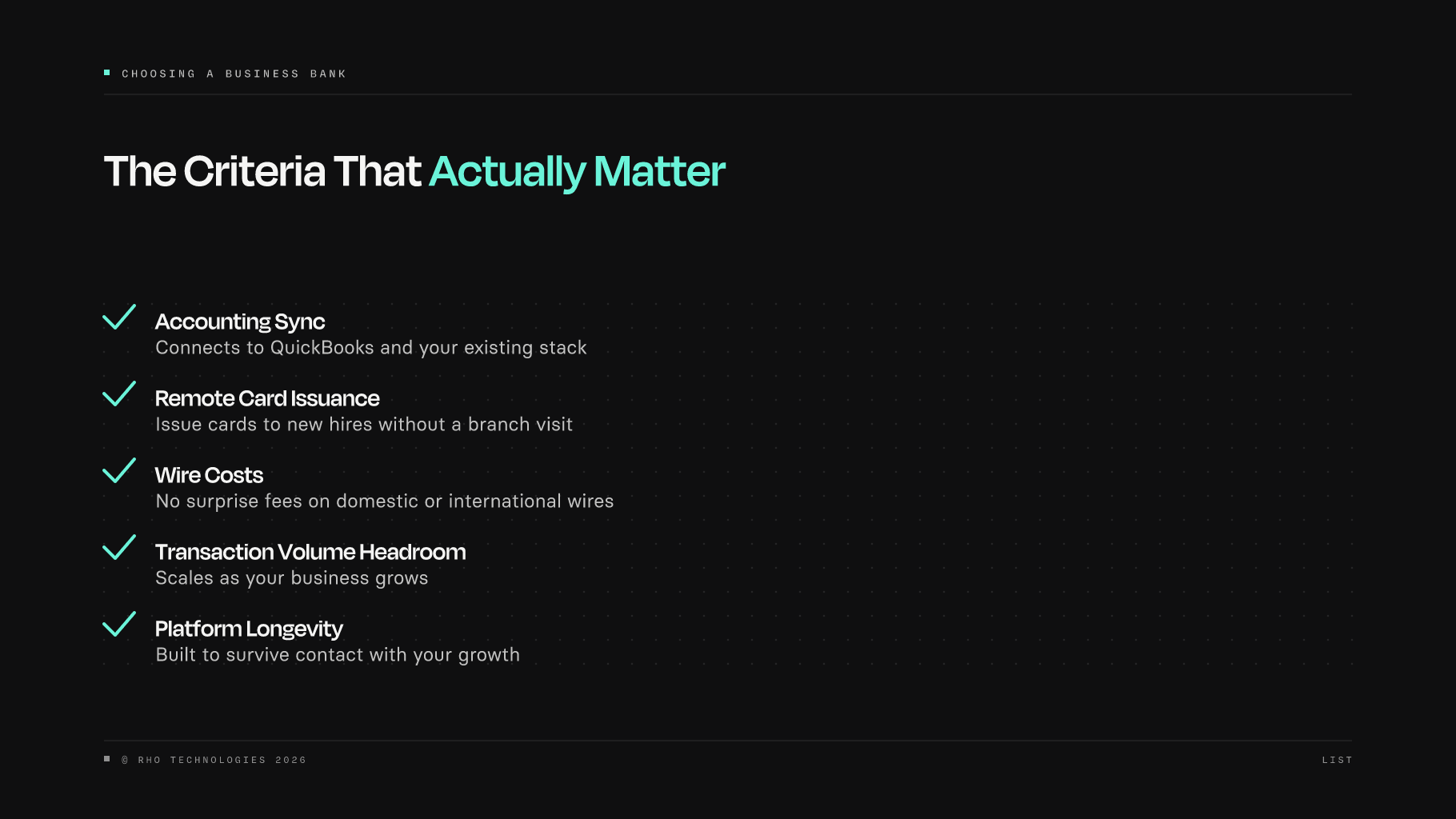
The bank that looks fine on day one tends to fail you at month fourteen, when transaction volume has tripled, your team needs cards issued remotely, and the platform you chose can't sync with your accounting software or process a wire without charging for the privilege. The five axes covered here are the ones that actually determine whether a banking platform survives contact with your growth.
The Five Axes That Actually Predict Long-Term Fit
The bank you pick on day one rarely fails you on day one. It fails you at month fourteen, when your team has grown, your transaction volume has tripled, and the platform you chose because it had a branch near your accountant's office can't sync with QuickBooks, won't issue a card to your new operations hire without a branch visit, and charges $25 per domestic wire.
That is the real cost of optimizing on the wrong axis, and it happens to Georgia founders constantly. The common assumption among most YC and accelerator founders is that this fragmentation is just the cost of doing business, that every company stitches together the same stack, and that a "good enough" bank with low fees is all they really need to anchor it.
"As a new LLC founder, I feel overwhelmed by the sheer number of banking options, big national banks vs. online-only platforms, and I don't know what criteria actually matter at my stage."
Most comparison tables rank banks by monthly fee. That is the least predictive variable on the list.
The five axes that determine whether a platform survives contact with your growth are: onboarding speed (minutes versus days matters most right after incorporation or a funding event), fee structure across the full transaction stack, accounting integration depth, spend management controls, and scale-readiness as headcount and entity count grow.
A bank that scores well on fee structure but fails on accounting integration will cost you more in reconciliation hours than it ever saved on monthly charges.
Across the market, digital platforms can compress onboarding to minutes while in-branch processes at traditional banks can take days.
That gap is a momentum issue.
A Marietta restaurant owner and an Atlanta B2B SaaS founder are solving different banking problems. Cash-first businesses (restaurants, retail, service businesses with register transactions) should weight branch access and cash deposit infrastructure above everything else. Digital-first businesses (agencies, consultants, e-commerce) need clean ACH, accounting sync, and low wire fees.
Scale-first businesses (incorporated startups, funded companies adding headcount) need a platform that absorbs operational load without requiring a rebuild at Series A. Some small businesses are cash-intensive, but the majority of incorporated startups fall into the digital-first or scale-first categories, yet most comparison lists treat all three the same.
Quick-Reference: The 5-Axis Bank Evaluation Framework for Georgia Founders
Axis | What to Measure | Why It Matters to Startups | Red Flag |
|---|---|---|---|
Onboarding Speed | Minutes vs. days to open | Delays cost momentum post-incorporation or post-funding | Requires branch visit to open |
Fee Structure | Monthly fee + full transaction stack (wires, ACH, per-deposit) | Headline fee hides real cost | Fee waiver tied to high minimum balance |
Accounting Integration Depth | Native sync vs. CSV export | Determines monthly close time | No QuickBooks/NetSuite connector |
Spend Management | Corporate cards issuable without branch visit; per-card controls | Scales with headcount without manual overhead | Card issuance requires separate application |
Scale-Readiness | Multi-entity support; AP automation; treasury yield | Avoids a rebuild at Series A | Workflow breaks at ~10 employees or second entity |
Score each candidate bank across all five axes before shortlisting. A platform that wins on fee structure but loses on accounting integration will cost more in reconciliation hours than it saves on monthly charges.
Top Regional and Local Georgia Banks vs. National Banks - Branch Networks, Fees, and Fit
The choice between a regional bank and a national bank feels like the central decision for most Georgia small business owners. The real decision is whether your banking infrastructure can keep pace with your business two years from now, and whether it gives you the foundation you wish you'd inherited from the start.
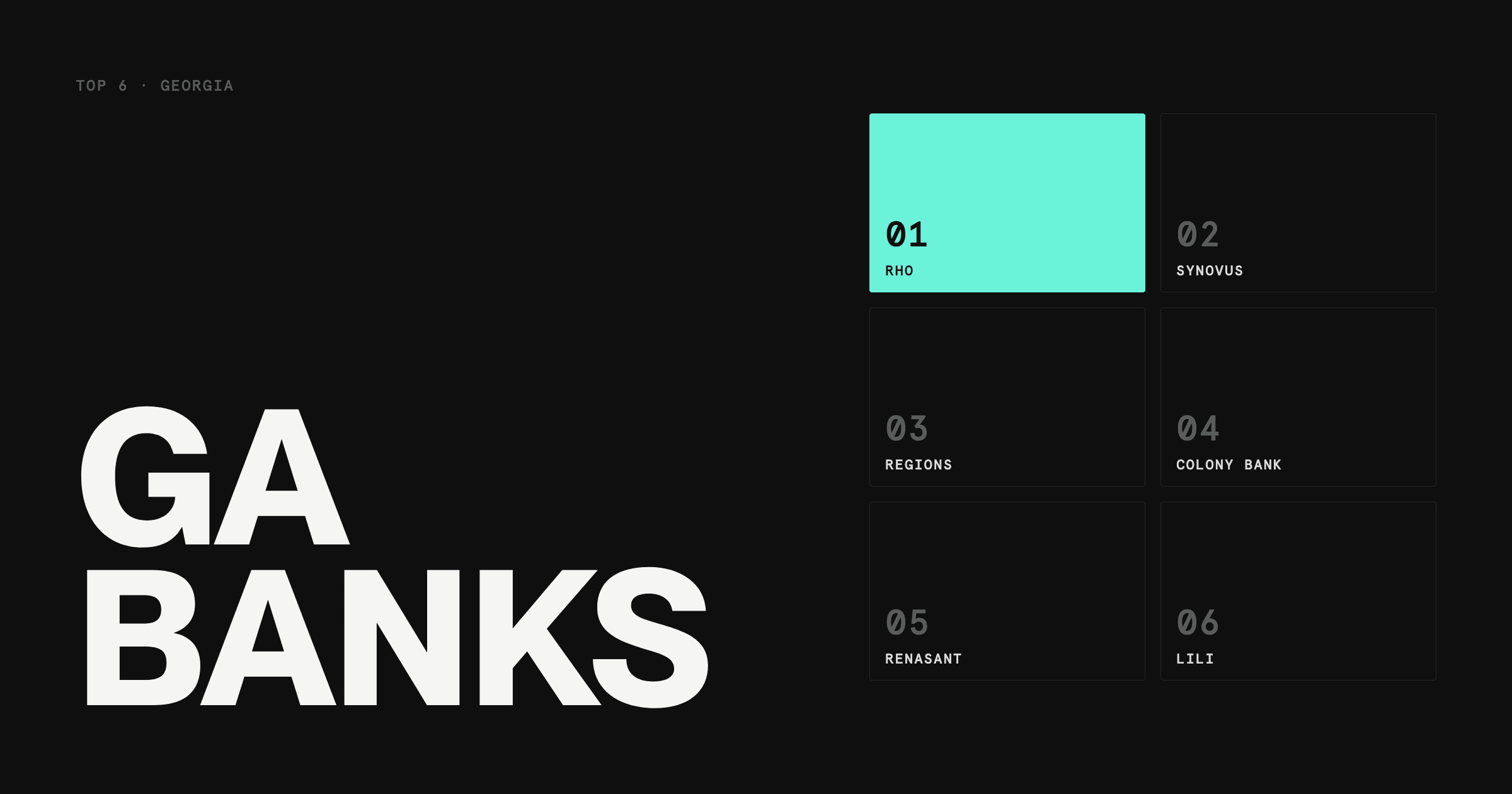
The top regional and local Georgia banks versus national banks breaks down clearly: Synovus, Colony Bank, Renasant, and United Community Bank anchor the regional and community tier, each with genuine relationship depth and Southeast roots. Regions Bank and national players bring broader physical footprints and standardized product menus. Both paths have a ceiling, and that ceiling shows up at the worst possible moment.
Synovus, founded in Columbus, Georgia, built its identity around relationship banking across the Southeast. That model works well for middle-market businesses that want a banker who knows their industry and can advocate internally for a loan exception. Expand outside the Southeast, though, and Synovus stops being enough on its own. You'll need a second institution to cover the gap.
United Community Bank earns consistently strong marks for customer care in North and Middle Georgia, particularly for businesses in smaller markets where a branch relationship still drives credit decisions. Regional institutions such as Truist, Ameris Bank, and Synovus each serve distinct segments of the Georgia market, and the right fit depends on where your business operates and how it accesses credit.
Here's where it costs you.
The operational drag that accumulates when a relationship bank's digital tooling can't connect cleanly to your expense management platform, your bill pay workflow, or your accounting system is a cost that doesn't show up on the monthly fee line.
Founders who spend weeks negotiating minimum balance tiers with a regional bank, then discover the bank's API doesn't talk to QuickBooks, lose days they can't recover. Cash visibility suffers most in this scenario: when banking, spend, and accounting data live in separate systems, forecasting becomes guesswork rather than a real-time view of the business.
One real example:
Platforms built for business banking consolidate checking, corporate cards, bill pay, expense management, and treasury into one system with no monthly fee and no per-user fee, centralizing banking and spend data so that cash visibility and forecasting improve as a direct byproduct of how the platform is structured.
Anti Agency Group, a multi-entity marketing firm founded in 2019 and growing 120% year over year, cut its month-end close time in half and saved roughly 80 hours managing spend and cash after consolidating onto a single platform; their finance team stopped chasing receipts and started doing actual financial work. That outcome isn't available from a relationship bank that requires separate tools for every function.
1. Rho - Best All-in-One Banking Platform for Georgia Startups and Scale-Ups
Here's the pick, and why it holds up.
Rho is the right pick for incorporated Georgia businesses, funded startups, and growth-stage companies that need banking, corporate cards, bill pay, expense management, and treasury in one place from day one. The platform runs on a $0 monthly fee, $0 per-user fee, and $0 subscription fee regardless of company size or headcount; the only fees charged are on FX transfers and treasury management.
Checking accounts are provided by Webster Bank, a division of Santander Bank, N.A. (Member FDIC; $85.5 billion in assets per FDIC call-report data as of 03/31/2026, founded 1935), with FDIC coverage up to $250K on checking; savings, provided by American Deposit Management Co. and its partner banks (approximately 400 institutions), carries coverage up to $75M per depositor.
Georgia founders who are still waiting on their EIN can open an account before it arrives and start setting up their finance stack in the interim.
Once live, corporate cards are issued immediately with no minimum balance required, same-day ACH is included at $0 (for payments initiated before 2pm ET under $1M), and domestic wire transfers are $0. Native integrations with QuickBooks Online, Oracle NetSuite, Sage Intacct, and Xero mean transactions, receipts, and expense data sync automatically to the ledger, no manual export, no middleware.
For companies with employees incurring business expenses across multiple functions, the corporate card program ties directly into Rho Expenses, which includes the Gmail Connector (in beta) at no extra cost: it uses read-only, scoped access to find receipt-matching subject lines and attachments, and retains no inbox data after disconnection, so the finance team gets receipt capture without the privacy tradeoff.
For companies with larger operating balances, Rho Treasury (investment management and advisory services provided by RBB Treasury LLC dba Rho Treasury, an SEC-registered investment adviser and subsidiary of Rho) makes yield-bearing instruments accessible from the same platform, with no need to open a separate account or work with a separate provider. Options include Treasury Bills and mutual funds; T-Bills settle in 2–3 business days.
A management fee of 15–60bps annually applies based on cost to provide the service (see the ADV-2A Wrap Fee Brochure); Rho Treasury requires a $50,000 minimum investment. Rho Treasury investments are not deposits and are not FDIC insured.
That combination, operating account, spend management, and treasury yield in one interface, is what it means to get the banking foundation you wish you'd inherited: no stitched-together stack, no reconciliation across three portals, no surprise per-user charges as headcount grows.
Every customer receives a dedicated point of contact accessible via chat, email, or phone, with a response time under a minute, 24/7, at no additional cost.
One thing Rho won't do: take your cash. There's no branch network, so daily in-person deposits are a dealbreaker here, not a footnote.
2. Synovus - Best Regional Bank for Georgia Businesses Wanting Relationship Banking at Scale
Synovus is the strongest regional option for Georgia businesses that rely on banker relationships to access credit, navigate loan exceptions, or manage treasury services through a single Southeast-based institution. Its branch concentration across Georgia and the broader Southeast makes it a practical choice for middle-market companies with local roots.
National branch coverage and deep digital integrations simply aren't here, and businesses that need either will hit that ceiling faster than they expect.
3. Regions Bank - Best National Bank for Georgia Small Businesses Needing Broad Branch Access
Regions brings a broad physical footprint across Georgia and active SBA lending volume in the Southeast, making it a credible option for small businesses that need both in-person access and growth financing under one roof. It is most beneficial for established brick-and-mortar businesses with consistent revenue that qualify easily under standard criteria.
4. Colony Bank - Best Community Bank for Rural and Small-Town Georgia Businesses
Colony Bank serves rural Georgia counties where larger regional and national banks, including Ameris Bank and Truist, have reduced branch presence, making it the most accessible relationship-banking option for businesses where an in-person branch still drives day-to-day operations and credit decisions.
5. Renasant Bank - Best for Georgia Small Businesses Seeking SBA Lending Expertise
Renasant holds SBA Preferred Lender status, which accelerates loan approvals and gives Georgia small business owners a meaningful edge when seeking SBA 7(a) or 504 financing. For businesses in growth or acquisition mode that need structured debt capital alongside a checking relationship, Renasant's combined lending and banking platform is compelling. Its Georgia branch network is thinner than Synovus's or Regions's, and its treasury tools lag the more tech-forward platforms.
6. Lili - Best Digital-First Option for Georgia Freelancers and Sole Proprietors
Lili targets freelancers, gig workers, and sole proprietors who want a no-frills, mobile-first business bank account with built-in expense categorization and tax tools, no branch visits required. For Georgia solopreneurs who operate entirely digitally and want to avoid monthly fees, Lili removes friction at account opening and day-to-day management. What Lili doesn't do: lending products, cash deposits, or the scalability a business needs once it starts hiring.
Which Georgia Banks Are Best for Businesses That Handle Frequent Cash Deposits?
For Georgia businesses that handle cash daily, the branch question is real. A restaurant group running three locations in Athens needs reliable deposit infrastructure within reasonable distance of each site. Branch density is a legitimate variable, but it is rarely the most expensive one on the P&L.
The costs that compound fastest are per-deposit fees, monthly minimum balance requirements, transaction caps, and the logistical overhead of third-party deposit networks. A bank with 50 branches in Georgia can still cost a high-volume cash business hundreds of dollars a month in fees that never appear in the headline rate. Proximity and cost are separate problems, and solving one does not solve the other.
The pattern repeats.
Most cash-deposit-heavy businesses start by solving the branch problem, then discover six months later they have also accumulated a separate payroll tool, a disconnected expense card, and a bill-pay process that lives in someone's email inbox.
A platform like Rho will not replace your teller window for daily cash drops, but it eliminates every other layer of that patchwork by consolidating banking, cards, bill pay, expense management, and treasury into one platform with no subscription fees and real human support.
Pros and cons at a glance
Broadest physical branch and ATM network across Georgia's metro and rural corridors | Per-deposit fees and monthly minimums can accumulate quickly for high-frequency depositors |
Most practical traditional option for businesses that deposit cash daily | Branch convenience is often offset by fees that only surface after the first full billing cycle |
1. Rho - Best All-in-One Banking Platform for Georgia Startups Scaling Fast
Rho is built for startups and scale-ups that need more than a basic checking account, combining banking, corporate cards, bill pay, expense management, treasury, and accounting in one platform.
For Georgia businesses that handle frequent cash deposits alongside complex financial operations, Rho's real human support and no-subscription-fee model make it a compelling hub. Just don't expect a teller window. Rho is fintech infrastructure, not a branch bank, so cash-heavy operations still need a local arrangement alongside it.
2. Bluevine - Best High-Yield Digital Business Checking for Georgia Cash-Flow-Heavy Businesses
Bluevine's business checking account offers a competitive APY on balances, no monthly fees, and unlimited transactions, making it attractive for Georgia small businesses with high deposit volumes and tight margins.
Its digital-first model simplifies cash flow management without branch overhead. Frequent cash depositors hit a wall fast here: Bluevine routes cash deposits through Green Dot locations, adding a per-deposit fee and an extra logistical step that traditional branch banking doesn't have.
Update (October 2026): Valley National Bank announced it will acquire Bluevine for $340 million, with the deal expected to close in early 2027. Bluevine will become Valley's small-business banking division; existing accounts aren't expected to change before then.
3. Regions Bank - Best Traditional Branch Network for Georgia Businesses Depositing Cash Daily
Regions Bank operates one of the broadest physical branch and ATM networks across Georgia's metro and rural corridors, so it is the most practical traditional option for businesses that deposit cash daily. Per-deposit fees and monthly minimums add up fast for high-frequency depositors. The branch convenience that draws cash-heavy businesses in often gets erased by fees that don't show up until the first full billing cycle.
4. Credit Union of Georgia - Best Member-Owned Option for Cost-Conscious Georgia Small Businesses
Credit Union of Georgia offers business checking with lower fee structures than most traditional banks, reflecting its member-owned model. Growth-stage businesses hit a digital tooling gap fast, though: credit unions typically lack native accounting integrations, API access, and corporate card infrastructure, so the monthly fee savings can disappear into manual reconciliation hours once transaction volume starts rising.
5. Lili - Best Sole-Proprietor and Freelancer Banking Option for Georgia's Self-Employed
Lili targets freelancers, sole proprietors, and micro-businesses in Georgia with a simple mobile banking experience that includes built-in expense categorization and tax tools.
For self-employed Georgians who handle occasional cash deposits rather than daily retail volumes, Lili's simplicity and low barrier to entry are genuine advantages. Heavy cash use is where Lili falls apart. Deposits route through a third-party retail location and carry fees, which rules it out for cash-intensive operations.
Which Georgia Banks Offer the Best Options for 100% Digital and Online Businesses?
Digital Banking for Georgia Online Businesses
Georgia's growing base of online businesses, from Savannah e-commerce founders to Atlanta SaaS startups, has driven real demand for digital banking platforms that eliminate branch requirements, high fees, and slow onboarding. Switching from a traditional Georgia bank to a digital platform feels like the problem solved.
No branch required, no $15–$30 monthly fee (the range most traditional Georgia business banks charge, often waivable only by maintaining $1,500–$25,000 in minimum balances), and onboarding that takes an afternoon instead of a week. For a Savannah e-commerce founder or an Atlanta SaaS startup, that trade looks clean on paper.
The reality is messier. Eliminating the monthly fee is the smallest win available. Most digital banking platforms solve the fee line item while quietly recreating fragmentation: checking lives in one tool, corporate cards in another, bill pay in a third, and expense tracking in a spreadsheet.
The patchwork is cheaper per line item but more expensive in aggregate, in time, reconciliation errors, and the operational drag that compounds as headcount grows. Founders who process recurring vendor payments feel this most acutely: every tool boundary is a manual handoff, and manual handoffs are where errors and late payments accumulate.
For Georgia digital businesses, the better question is which platform eliminates the most stitching, so you can stay focused on hiring, selling, and scaling instead of reconciling.
1. Rho - Best All-in-One Banking Platform for Georgia-Based Startups and Scale-Ups
The pattern across every option above is the same. Each solves one problem cleanly while leaving adjacent problems for another tool.
A Georgia founder using one of those platforms for checking still needs a separate card solution, a separate bill pay workflow, and a manual sync to their accounting system. That operational drag is what Rho is built to eliminate.
Here's how Rho closes those gaps.
Rho operates as a single unified platform: checking account, corporate cards, bill pay, AP automation, expense management, and accounting integrations are all included at $0 platform fee, $0 per-user fee, and $0 monthly subscription fee. There is no minimum balance required to access the core platform.
The checking account is provided by Webster Bank, a division of Santander Bank, N.A. (Member FDIC; $85.5 billion in assets per FDIC call-report data as of 03/31/2026, founded 1935), and savings coverage extends up to $75M through American Deposit Management Co.'s network of approximately 400 partner banks.
Where Rho is most valuable is when a company processes recurring vendor payments and wants to consolidate AP with banking in the same tool.
Accounts payable automation is included at $0: it scans invoices, routes approvals, and syncs receipts directly to the ledger. Corporate cards earn up to 2% Cashback with Rho Platinum (terms apply), on up to $1M in eligible annual card spend; 1.25% standard, credited directly to the account, with no minimum balance required to use them.
The Gmail Connector (in beta), built into Rho Expenses at no extra cost, scans subject lines and attachments matching receipt keyword rules so receipt capture happens without a separate workflow. Transactions, receipts, and expense data sync automatically to QuickBooks Online, Oracle NetSuite, Sage Intacct, and Xero, eliminating the manual export and import steps that cause reconciliation errors at scale.
For Georgia founders with idle operating cash, Rho also offers Rho Treasury, a separate, fee-bearing registered investment adviser product accessible from the same Rho platform, with Treasury Bills and mutual fund options; T-Bills settle in 2–3 business days.
Treasury access requires a $50,000 minimum investment (current rates are available at rho.co/treasury). Rho Treasury investments are not deposits and are not FDIC insured.
Notably, Rho Treasury carries no $250,000 minimum balance requirement, whereas some competing treasury products require a $250,000 minimum to access a comparable yield product.
For a Georgia SaaS company or e-commerce operator that wants fast, modern banking with real support and control from day one, the core platform includes 24/7 dedicated support with a response time under a minute via chat, email, or phone, at no added cost. Onboarding is supported before an EIN arrives, which matters for founders incorporating through Stripe Atlas or Clerky who want to start building financial infrastructure immediately.
Banking, cards, and expense workflows that connect automatically give operators visibility and time back to focus on hiring, selling, and scaling. Platforms such as Bluevine serve a different segment of this market, but for Georgia digital businesses that need a fully integrated operating stack, Rho's unified approach removes the most friction at the lowest cost.
2. Mercury - Best Digital-First Business Bank for Early-Stage Georgia Startups
Mercury offers $0 monthly fees, no minimum balance requirement, and a REST API that developers can use for programmatic account management; see Mercury's public API documentation at mercury.com/api for scope details. It is a strong early-stage fit for Georgia founders who want fast onboarding and a modern interface.
Mercury stops at banking, though. It isn't a finance operations platform, so expense management, bill pay, and accounting sync all need separate tools, and reconciliation overhead comes right back once volume grows.
3. Relay - Best for Georgia Small Businesses Needing Multi-Account Cash Flow Control Online
Relay lets owners open up to 20 individual checking accounts and issue up to 50 virtual cards, with native QuickBooks and Xero integrations; transactions auto-categorize on import, eliminating the manual tagging step that typical CSV-import workflows require.
For a Georgia agency or services business that wants to run a profit-first cash allocation system, Relay is purpose-built for that workflow. Founders who also need AP automation or treasury yield from the same platform will outgrow it quickly.
4. Airwallex - Best for Georgia Online Businesses with International Payments and Multi-Currency Needs
Airwallex is the clearest choice for Georgia businesses with meaningful cross-border revenue or vendor payments. It supports multi-currency accounts and offers FX conversion at rates that beat standard bank markups, making it a practical tool for e-commerce operators or agencies billing international clients.
But Airwallex is payments and FX infrastructure, not a full operating account. Domestic banking, expense management, and local ACH workflows all run thinner here than on a dedicated business platform.
5. Georgia's Own Credit Union - Best for Georgia Digital Businesses Wanting Local Roots with Online Banking Access
Georgia's Own Credit Union offers digital business banking tailored to Georgia-based small businesses, combining the trust and community focus of a local credit union with online account management tools.
For digital businesses that value a Georgia-chartered institution, member-owned structure, and access to local business lending relationships alongside online banking, it's a strong community-anchored option. Its digital toolset won't satisfy a tech-forward team, though. Integrations are thinner than a pure fintech platform, and API access or advanced automation just isn't there.
Which Georgia Banks Are Strongest for SBA Loans and Business Financing?
Here's the split most guides miss.
Georgia's strongest SBA lenders and its best operating banks are almost never the same institution. That distinction costs founders real money when they conflate the two decisions, and it is a gap that surfaces constantly for early-stage companies trying to build a coherent finance stack.
Mortgage loan officers and business advisors in Georgia frequently struggle to identify reliable commercial and SBA lenders to refer clients to, and founders building their first operating infrastructure often make the mistake of anchoring that infrastructure to whichever institution approved their loan.
Here's the catch banks don't advertise.
The clearest proof of why these are separate decisions: United Community Banks, Inc. is a well-established SBA 7(a) lender across Georgia and the broader Southeast. That is a genuine lending operation, but here is the synthesis that most founder guides miss: the structural qualities that make a bank excellent at SBA lending are precisely the qualities that make it a poor operating infrastructure choice for an incorporated startup.
A bank built to approve large SBA loan portfolios is built around relationship managers, branch presence, and credit underwriting, not API connectivity, native accounting integrations, or automated reconciliation.
Choosing Synovus or United Community for its SBA lending strength and then anchoring your operating stack to it compounds what might be called Finance Stack Drag, the hidden friction cost of running a growth-stage company through infrastructure designed for a different job.
A Georgia manufacturer running an SBA 504 equipment loan through Wells Fargo while keeping daily operations on a separate, purpose-built platform is not an edge case. It is the right architecture.
The loan relationship and the operating layer are two separate jobs. Platforms built for startup finance operations, like Rho, handle banking, corporate cards, bill pay, and accounting integrations in one place, so the SBA lender decision stays purely about loan terms, not about which checking product comes bundled with it.
The operating layer matters especially as headcount grows. Rho Corporate Cards are most beneficial when a company has multiple employees incurring business expenses and needs centralized spend oversight, which is precisely the inflection point when Finance Stack Drag becomes most expensive.
When every employee swipe flows into the same platform that handles bill pay, expense management, and accounting integrations, the month-end close that once consumed days compresses into a process the finance team can actually control. Native direct integrations with QuickBooks Online, Oracle NetSuite, Sage Intacct, and Xero, included at $0, mean transactions, receipts, and expense data sync automatically rather than requiring manual export and reconciliation.
The goal is to grow the business without adding operational or financial overhead, and to scale headcount and entity count without a proportional increase in finance overhead. A founder who picks the right SBA lender for their equipment loan and the right operating platform for their daily stack achieves both.
Multi-entity support is available on Rho at no additional platform fee, and the $0 subscription and $0 per-user fee structure holds regardless of company size, so the architecture that works at ten employees does not need to be rebuilt at fifty.
1. Rho - Best All-in-One Banking Platform for Georgia Startups and Scale-Ups
Rho is the strongest pick for venture-backed and growth-stage Georgia businesses that need more than a checking account. It combines banking, corporate cards, bill pay, expense management, treasury, and accounting integrations in one platform, with no subscription fees and real human support. Rho won't help with a traditional SBA real estate loan, though. It's built for startups and scaling companies, not brick-and-mortar borrowers.
2. United Community Bank - Best Georgia-Rooted SBA 7(a) Lender by Volume
United Community Bank is one of the most active SBA 7(a) lenders headquartered in Georgia, with genuine lending depth across the state and the broader Southeast.
Its strength is relationship-driven credit underwriting, the exact capability a founder should evaluate when selecting an SBA lender, and the exact capability that has nothing to do with whether that same institution can automate a month-end close or keep pace with a finance team trying to reclaim time for core business operations.
3. Live Oak Bank - Best for Industry-Specific SBA Loans Accessible to Georgia Businesses
Live Oak Bank is a nationally chartered SBA Preferred Lender that specializes in vertical-specific financing, veterinary practices, funeral homes, pharmacies, and more, making it ideal for Georgia small business owners in niche industries who need larger SBA loan amounts with a faster approval process. Live Oak has no branch network at all, though. Owners who want a face-to-face relationship with their banker will find the digital-only model impersonal.
4. Wells Fargo - Best for Georgia Small Businesses Needing SBA 504 Real Estate and Equipment Financing
Wells Fargo offers both SBA 7(a) and SBA 504 loan programs, making it a strong option for established Georgia small businesses looking to purchase commercial real estate or heavy equipment with low down payments and long repayment terms. Its broad branch footprint across Georgia adds accessibility. Large-bank bureaucracy is the cost of that scale. Decisions move slower, and early-stage or credit-challenged businesses get less flexibility.
5. Georgia SSBCI Program - Best State-Backed Credit Enhancement for Underserved Georgia Small Businesses
The Georgia State Small Business Credit Initiative, administered by the Department of Community Affairs, strengthens lending programs for small businesses and manufacturers that may not qualify for conventional financing.
It's the right fit for Georgia entrepreneurs in underserved communities or early-stage manufacturers who need credit support to access bank loans. SSBCI isn't a lender itself, though, it's a program layer, so businesses still have to go through a participating bank to use it.
Which Georgia Credit Unions Offer the Best Small Business Banking?
Georgia credit unions have long marketed themselves as lower-cost alternatives to traditional banks for small business owners, and for certain established businesses, that reputation holds. Delta Community Credit Union is the best-known answer to the question of low-fee business checking in Georgia, and for the right business, it genuinely delivers.
Headquartered in Atlanta, Delta Community structures its business checking around the member-owned, not-for-profit model: accounts earn dividends rather than generating fee income for shareholders, and the cost structure reflects that. For an established professional services firm in East Cobb or a locally rooted retail operation that values relationship banking over API connectivity, that trade-off lands well.
Pros and Cons at a Glance
Accounts earn dividends rather than generating fee income for shareholders | No API access, no native integrations with accounting software, and no built-in expense management |
Cost structure suited for established, locally rooted businesses valuing relationship banking | Long-term members report finding themselves without responsive support when questions arise |
The ceiling arrives faster than most founders expect, though. The product includes a Business Visa Debit Card, online banking, and online deposit, but references no API access, third-party software integrations, or expense management tooling.
That gap has real operational cost. Manual accounts payable processes cost businesses an average of $15 per invoice to process, compared to $3 to $4 when automated.
A startup processing 50 invoices a month absorbs around $600 in hidden operational drag monthly, and no dividend return offsets that. The "low-fee" label loses accuracy once reconciliation time enters the ledger.
There's a quieter cost too.
There is also a harder service-quality risk that established businesses quietly absorb. Long-term members of Georgia credit unions, including members of Credit Union of Georgia and Georgia's Own Credit Union, some with decades of relationship history, report finding themselves without responsive support when questions arise, leaving them feeling abandoned at exactly the moments that matter most.
For a business that depends on fast answers during payroll runs, vendor disputes, or time-sensitive wire transfers, unresponsive support is operational exposure.
Founders who hit that ceiling typically patch the gap with separate card tools, expense platforms, and accounting integrations bolted on top of their credit union checking. That rebuild is exactly what a unified financial foundation eliminates.
Rho combines banking, corporate cards, bill pay, expense management, and accounting integrations, including native direct connections to QuickBooks Online, Oracle NetSuite, Sage Intacct, and Xero, in one platform at $0 in subscription or per-user fees.
Accounts payable automation, unlimited reimbursements, and same-day ACH are all included. Dedicated support responds in under a minute, 24/7, via chat, email, or phone, at no added cost, so the fast, responsive banking a growing team needs is built in from day one.
For businesses managing spend across multiple entities, Rho's multi-entity support lets finance leads maintain oversight from one platform rather than juggling separate logins and reconciliation workflows. Corporate cards are issued immediately with no minimum balance required and earn up to 2% Cashback with Rho Platinum (terms apply), on up to $1M in eligible annual card spend; 1.25% standard, credited directly to the account.
And for businesses that have capital working in operating accounts, Rho Treasury, a separate, fee-bearing RIA product accessible from the same Rho platform, offers access to eligible securities including U.S. Treasury Bills and mutual fund options, with a $50,000 minimum investment (T-Bills settle in 2–3 business days) and a management fee of 15–60bps annually.
Rho Treasury investments are not FDIC insured and are not deposits; details are available in the ADV-2A Wrap Fee Brochure at rho.co/treasury.
The infrastructure that works on day one at Rho still works when the team scales, because it was never stitched together from separate tools in the first place.
1. Rho - Best All-in-One Banking Platform for Georgia Startups and Scale-Ups
Rho replaces the patchwork of banking tools most growing businesses cobble together, combining business checking, corporate cards, bill pay, expense management, treasury, and accounting integrations in one platform. It's purpose-built for startups and the accountants who support them, with real human support and no subscription fees.
What you give up is a branch. Rho is a fintech platform, not a credit union, so there's no physical location in Georgia to walk into.
2. Delta Community Credit Union - Best Georgia Credit Union for Established Small Business Owners
Dividend-earning business checking with no profit-extraction motive and a straightforward fee structure built for stability. It suits established, locally rooted Georgia businesses where relationship banking and cost savings outweigh the need for digital tooling.
What's missing shows up fast: no API access, no native accounting integrations, no built-in expense management. Those gaps compound as headcount and transaction volume grow. Centralized spend oversight, automated bill pay, and responsive 24/7 support all stay out of reach on this account as it's built today.
3. Georgia United Credit Union - Best for Georgia-Based Businesses Seeking Community-Focused Banking
Georgia United Credit Union offers small business owners a member-owned banking alternative with competitive rates and a community-first philosophy. It's well-suited for Georgia-based businesses that value personalized service and lower fees over feature-rich digital tools. Membership eligibility rules can shut some business owners out entirely, and the digital banking tools here lag well behind fintech alternatives.
4. LGE Community Credit Union - Best for Metro Atlanta Small Businesses Wanting Flexible Checking Options
LGE Community Credit Union serves businesses across Bartow, Cherokee, Cobb, Fulton, and Paulding counties with flexible business checking accounts and convenient digital banking tools. It's a smart choice for small businesses in northwest metro Atlanta that want credit union pricing with practical day-to-day banking features. Operate outside those core counties, though, and LGE's narrower geographic footprint makes it a harder fit than a statewide bank.
5. Navy Federal Credit Union - Best for Veteran-Owned Georgia Small Businesses Needing Business Loans
Navy Federal Credit Union stands out for veteran-owned and military-affiliated small businesses in Georgia, offering business loans for equipment, working capital, vehicles, and commercial real estate at credit union rates. It's the top pick when financing is the primary need rather than day-to-day banking features. Membership eligibility is strict and non-negotiable: only military members, veterans, and their families qualify, which rules out most Georgia small business owners.
Which Banks Have the Most Branches Across Georgia Metro Areas: and Why That Matters Less Than You Think
Branch count is one of the most visible ways banks market themselves to business owners, and in Georgia, a few institutions genuinely do dominate the physical landscape. But for most small businesses, and especially for digital-first companies, the question of which bank has a location nearby turns out to matter far less than the question of which bank is built for how you operate.
Georgia's Branch Density Leaders by Metro Area
Truist holds the broadest statewide footprint in Georgia by physical presence, with locations spanning Atlanta, Savannah, Augusta, Columbus, and Macon. That reach is a direct inheritance from the SunTrust and BB&T merger, which gave Truist outsized density across the Southeast relative to national competitors. In the Atlanta metro specifically, both Wells Fargo and Chase operate concentrated networks, making the city one of the most branch-competitive markets in the region.
South and coastal Georgia skew toward Synovus, founded in Columbus, and Ameris Bank, both of which built their footprints around community and regional relationship banking rather than national scale. Worth noting: Truist has also been consolidating that footprint, closing branches in Georgia even as it retains a leading presence statewide.
The Two Legitimate Reasons Branch Proximity Still Matters
Cash-heavy operations are the clearest case. Restaurants, retailers, and service businesses processing daily register transactions need frequent teller deposits and, in some situations, in-person medallion signature or notary services that cannot be completed remotely. For those businesses, branch proximity is a genuine operational variable.
That is the full list. For incorporated digital-first companies, including most startups and accelerator-backed founders, branch access solves a problem they do not have. What those companies need is a financial backbone that moves as decisively as they do: systems that work and don't break as the company scales, and a platform that gives operators real-time visibility into spend as headcount and transaction volume grow.
How Technology Eroded the Branch Proximity Advantage
Same-day ACH has become standard infrastructure. Remote online notarization is legally valid in Georgia as of 2024, removing one of the last credible in-person requirements for most business transactions.
Instant card issuance means a new corporate card does not require a branch visit or a five-day wait. The practical result: the services that once made branch proximity feel essential are now delivered faster without one.
For growing companies specifically, the gap compounds quickly. Real-time spend visibility, across corporate cards, bill pay, and reimbursements, is operationally critical at scale in a way that a branch teller window cannot address.
Rho's platform is built around that reality: corporate cards issued immediately with no minimum balance required, same-day ACH at $0, unlimited reimbursements included, and 24/7 dedicated support that responds in under a minute via chat, email, or phone.
The fine print, in full:
Checking is provided by Webster Bank, a division of Santander Bank, N.A. (Member FDIC), whose parent-division assets totaled $85.5 billion per FDIC call-report data as of 03/31/2026, and which traces its founding to 1935, with FDIC coverage up to $250K on checking and up to $75M through the ADM partner-bank network on savings, all accessible at $0 platform fee and $0 per-user fee.
For companies that want to put idle cash to work, Rho Treasury is available from the same platform, with access starting at a $50,000 minimum investment (T-Bills settle in 2–3 business days), and a management fee of 15–60 basis points annually based on cost to provide the service (see ADV-2A Wrap Fee Brochure; not FDIC insured).
Truist's dense Georgia network remains a real asset for businesses whose operations genuinely depend on in-person banking. For everyone else, the branch map is an answer to a question most scaling companies stopped asking.
The Banking Option Georgia's Incorporated Startups Keep Overlooking - An Integrated Platform Built for Speed and Scale
For incorporated Georgia startups, the bank account decision is rarely about the account itself.
It's about what the account forces you to build around it: separate card programs, disconnected expense tools, manual reconciliation, and a close cycle that compounds in cost every month it goes unaddressed. This section examines why fragmented finance stacks carry a hidden operational tax, and why the architecture of a banking platform matters as much as its fee structure.
The Hidden Cost of Fragmented Georgia Business Banking - Finance Stack Drag
The real cost of a fragmented finance stack isn't any single monthly fee. It's the hours lost every close cycle reconciling transactions across systems that were never designed to talk to each other. What most founders report is consistent: each additional platform without a native integration multiplies the manual data-entry and reconciliation burden.
That's not a one-time setup cost. It compounds every month, invisibly, until the company is large enough to feel the pain acutely and the switching cost is enormous: new account numbers, new card programs, new integrations, and a finance team rebuilding institutional memory from scratch.
The fee line on the bank statement was never the real cost.
Why Incorporated Georgia Startups Need Infrastructure, Not Just an Account
A basic checking account with a $0 monthly fee solves exactly one problem.
Addition Finance is direct on this point: without integrated expense management, bill pay, and accounting sync, a low-fee bank account alone does not reduce the administrative overhead of closing the books each month. An incorporated B2B SaaS company in Buckhead running separate tools for banking, cards, expenses, and AP still faces the same reconciliation drag as a company paying $30 a month for a traditional bank account.
The fee structure changed. The architecture didn't.
Georgia's incorporated startups also face a parallel challenge traditional banks rarely acknowledge: high minimum balance requirements that are misaligned with the capital reality of early-stage companies. Founders are forced to park idle funds in accounts that demand them, funds that would otherwise be reinvested directly into growth. That capital constraint is structural, and it compounds the administrative drag that fragmented tooling already creates.
Georgia's incorporated startups need a platform, not a product.
What an Integrated Platform Actually Includes and What That Eliminates
Digital-first platforms are already purpose-matched to Georgia's incorporated startups on fee structure and FDIC coverage, but the architectural advantage of a fully integrated platform is measurable. Across the market, eliminating manual data movement between systems is the single highest-leverage lever for reducing monthly bookkeeping time, meaning a platform that consolidates banking, cards, and accounting sync in one layer demonstrably outperforms a low-fee account that still requires three separate reconciliation passes.
Here's what actually changes:
The goal is a modern system that works at enterprise standards but with startup speed, one that consolidates fragmented financial systems into a single platform to improve the speed and accuracy of financial reporting, and that helps companies run more efficiently and scale cleanly.
Growth-stage startups that consolidate banking, cards, expense capture, and accounting sync into one platform eliminate Finance Stack Drag before it embeds as a structural constraint on Series A readiness, a dynamic that standalone accounts, however well-priced, cannot address.
Rho's Specs for Georgia Founders - The Numbers That Change the Build vs. Bolt-On Math
Rho's all-in-one platform charges $0 monthly fees, $0 per-user fees, and $0 for domestic wires. Same-day ACH is included at $0.
The numbers, straight through:
Up to 2% Cashback with Rho Platinum (terms apply), on up to $1M in eligible annual card spend; 1.25% standard, credited directly to the account.
Checking is provided by Webster Bank, a division of Santander Bank, N.A. (Member FDIC; $85.5 billion in assets per FDIC call-report data as of 03/31/2026), with FDIC coverage up to $250K on checking; savings, provided by American Deposit Management Co. and its partner banks (approximately 400 institutions), carries coverage up to $75M per depositor.
Expense management, unlimited reimbursements, bill pay, AP automation, and basic invoicing are all included at $0. Native accounting integrations with QuickBooks Online, Oracle NetSuite, Sage Intacct, and Xero mean transactions, receipts, and expense data sync automatically, eliminating the manual data movement that drives most bookkeeping overhead.
Rho also requires no minimum balance for core platform access and no personal guarantee, a direct answer to the idle-capital trap that traditional banks impose on early-stage founders.
For companies ready to put idle cash to work, Rho Treasury, a registered investment advisor (RIA) product accessible from the same Rho platform, offers access to eligible securities including U.S. Treasury Bills and mutual fund options, with a management fee of 15–60 basis points annually; T-Bills settle in 2–3 business days. Treasury access requires a $50,000 minimum investment.
Rho Treasury investments are not deposits and are not FDIC insured. There is no $250K minimum balance requirement, unlike competing treasury products that gate access at that threshold.
Founders who have already made the consolidation shift describe the change in concrete terms. That is precisely the dynamic an integrated platform is built to produce, and the one a fragmented stack, however low its individual fees, structurally cannot.
Next steps
If your Georgia startup is still treating banking, cards, expenses, and bill pay as four separate decisions, the path forward starts with consolidating them into one platform before Finance Stack Drag embeds itself as a structural constraint on Series A readiness.
The evidence from this post makes the sequence clear. Credit unions like Delta Community appear to save money until you factor in $15-per-invoice manual reconciliation costs: a startup processing 50 invoices monthly absorbs roughly $600 in hidden operational drag that no dividend return offsets.
And choosing a regional SBA powerhouse like United Community for its lending strength, then anchoring your operating infrastructure to it, compounds the problem further, because the qualities that make a bank excellent at approving large SBA loan volumes are precisely the qualities that make it a poor fit for API connectivity, accounting sync, and automated reconciliation.
Together, these two dynamics point to the same action: stop selecting a bank and start selecting a platform.
Start with business bank for startups through Rho, where checking, corporate cards, bill pay, AP automation, and native accounting integrations with QuickBooks Online, NetSuite, and Sage Intacct are included at $0 platform fee and $0 per-user fee.
Once your account is live, corporate cards are issued immediately, same-day ACH runs at $0, and every transaction syncs automatically to your ledger, so the month-end close your team currently spends days on becomes a process they can actually control.
FAQs
Rho is the wrong choice for cash-heavy businesses that need daily in-person deposits; it has no branch network. For businesses that deposit cash daily, a traditional bank with broad physical branch coverage is the practical solution for that specific need, though Rho can still handle every other layer of your finance stack, cards, bill pay, expense management, and treasury, without subscription fees.
Credit unions like Credit Union of Georgia do offer lower fee structures than most traditional banks, which can look attractive upfront. The meaningful limitation for growth-stage businesses is the digital tooling gap: credit unions typically lack native accounting integrations and API access, which means more manual work and reconciliation overhead as your business scales.
Rho runs on a $0 monthly fee, $0 per-user fee, and $0 subscription fee regardless of company size or headcount, the only fees charged are on FX transfers and treasury management. Same-day ACH and domestic wire transfers are also $0, so the cost structure is transparent rather than hidden behind minimum balance waivers or per-transaction charges.
Rho has native integrations with QuickBooks Online, Oracle NetSuite, Sage Intacct, and Xero, meaning transactions, receipts, and expense data sync automatically to your ledger with no manual export or middleware required.
Most comparison articles rank banks on branch count, ATM access, and minimum balance waivers, criteria built for sole proprietors, not incorporated startups. What actually drives cost for a startup is how many tools you have to stitch together to run basic finance operations: manual accounts payable processes cost an average of $15 per invoice to process, compared to $3 to $4 with automation, a gap that never appears in any fee comparison table.