

By Justin Wolz | Published November 3, 2026 | 8 min read | Incorporation
Yes, in practice. Venture capital investors expect your company to be a C corporation, and Delaware is the standard place to incorporate one. The reason is mechanical: the investor documents, preferred stock and tax treatment that venture deals rely on are built around a Delaware C corp.
You can legally raise money in other structures, and you can convert later. But if venture capital is the plan, starting as a Delaware C corp removes a step, a legal bill and a diligence question from your first round.
The rule of thumb
The rule of thumb: C corp is the requirement. Delaware is the default.
Venture funds typically invest in C corporation stock, often preferred stock, under standard documents that assume Delaware law. A Delaware C corp gives investors and their lawyers a structure they have used thousands of times. A different state is not disqualifying, but it usually means extra questions, and some firms will ask you to reincorporate before closing.
Three things drive that expectation:
Standard investor documents. Term sheets, stock purchase agreements and SAFEs are written for Delaware corporations.
Preferred stock. Venture rounds issue a separate class of stock with investor rights. A C corp can do this cleanly.
Founder tax planning. QSBS eligibility and the 83(b) election both assume you hold stock in a corporation.
None of this forces you to incorporate in Delaware on day one. It does mean that starting elsewhere puts the cost of switching on you later.
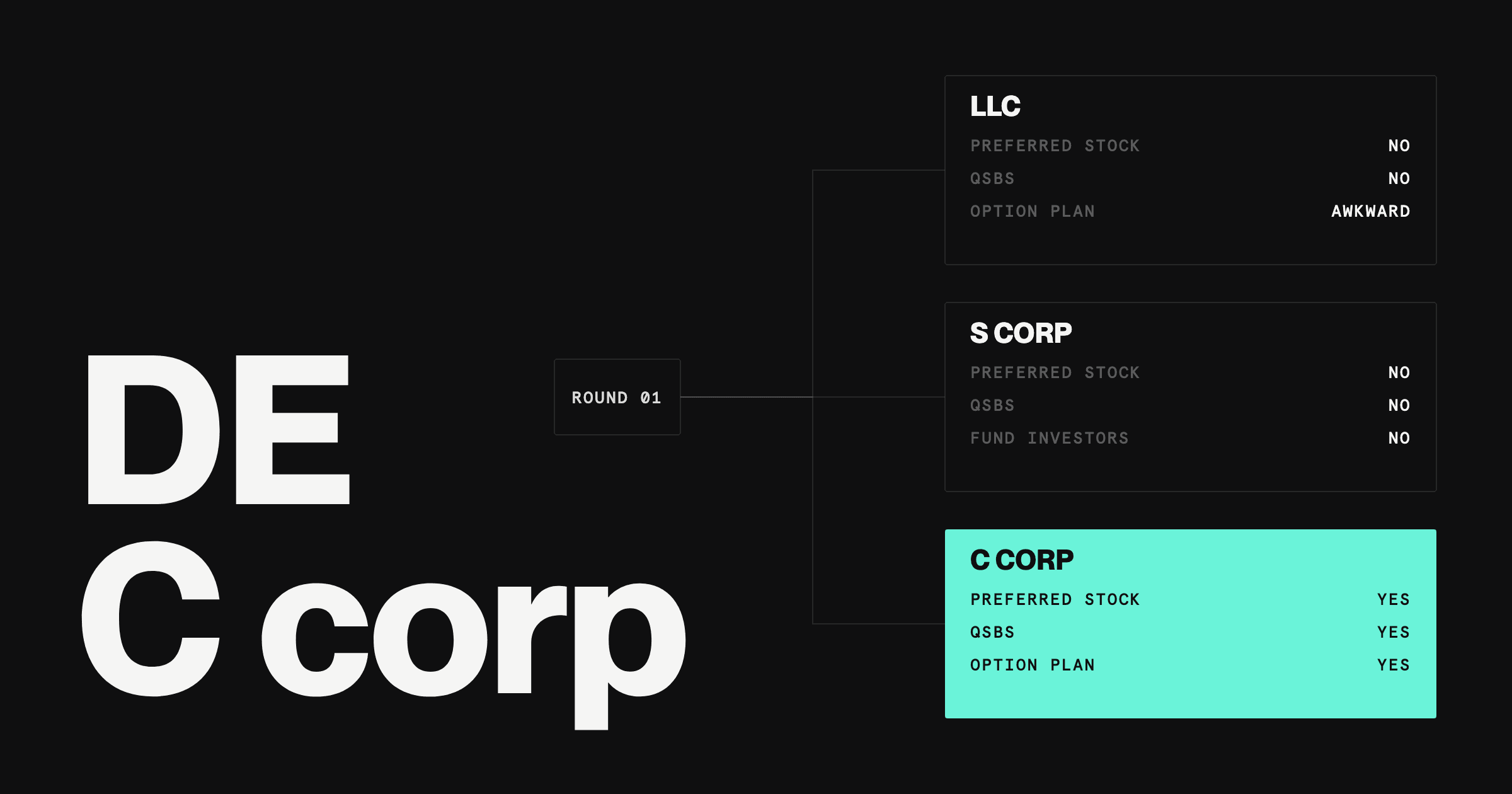
Delaware C corp vs LLC vs S corp for venture funding
Which structure fits depends on who is writing the check. This table covers the venture-funding view only. For the full tax and cost comparison, see the guide to Delaware LLC vs C corp.
*Scroll to see more.*
| Delaware C corp | LLC | S corp | |
| Best fit | Startups planning to raise venture capital | Small businesses, bootstrapped companies, real estate | Profitable small businesses with a few owners |
| What VCs expect | The standard. Most term sheets assume it. | Usually a conversion before a priced round | Usually a conversion before a priced round |
| Preferred stock | Yes | Not in the usual form. Needs custom units and a heavier operating agreement | Not allowed. S corps are limited to one class of stock |
| Stock options for employees | Yes, with a standard option plan | Awkward. Profits interests are not the same as options | Possible, but constrained by the single-class rule |
| Who can invest | Individuals, funds, entities | Anyone, but many funds avoid pass-through reporting | Restricted to certain individuals and trusts. Funds and most entities cannot hold shares |
| QSBS potential | Yes, if the company and stock meet the eligibility rules | No, unless it converts to a C corp | No. QSBS requires C corp stock |
| Default taxation | Taxed at the corporate level | Pass-through to owners | Pass-through to owners |
Why VCs expect a Delaware C corp
1. Their documents and their lawyers assume it
Law firms that run venture financings work from Delaware-based templates. Delaware's corporate statutes and its dedicated business court give investors predictable answers on questions like board duties, stock rights and what happens in a dispute. The state publishes the basics for founders at corplaw.delaware.gov.
Investors are not betting on your choice of state. They are saving time on every other decision in the deal.
2. Preferred stock needs a corporation
A priced round typically issues preferred stock: a class of shares with liquidation preferences, anti-dilution terms and board rights. Common stock goes to founders and employees. This two-class structure is routine in a C corp and unusual in an LLC.
3. Many funds cannot comfortably hold pass-through entities
LLCs and S corps pass income through to their owners. Venture funds often have limited partners, such as pensions, endowments and foreign investors, that prefer not to receive pass-through tax reporting from portfolio companies. A C corp keeps tax at the company level, which keeps the fund's own reporting simple.
4. Founders get tax tools that only exist for corporations
Qualified small business stock (QSBS) can give founders and early investors a potential federal tax exclusion on gains, subject to holding periods, caps and eligibility rules. It applies only to C corporation stock. The 83(b) election lets founders with vesting stock choose to be taxed on the stock's value at grant, which is typically close to zero at formation. The deadline is 30 days from the grant, and it is not extendable.
Talk to a tax advisor before relying on either one.
What investors check in diligence
Before a round closes, an investor's lawyer reviews your corporate records. Expect a checklist that looks like this:
Entity and state. A Delaware C corp in good standing, with the certificate of incorporation on file.
Cap table. Who owns what, with stock issued under the right documents.
Founder stock. Founder stock purchase agreements with vesting, signed and dated.
83(b) elections. Filed within 30 days, with proof of filing or mailing.
Board and stockholder consents. Approvals for stock issuances, option plan and officer appointments.
IP assignment. Each founder assigning company-relevant IP to the corporation.
Tax standing. An EIN, tax filings current, and the Delaware franchise tax and annual report up to date.
Missing paperwork is a common reason a closing slips. Clean records from day one make diligence much faster.
Setting up the company correctly the first time is also what keeps the later steps simple. Rho's guide to incorporating in Delaware covers the details, and what it costs to incorporate breaks down the fees you will see along the way.
If you started as an LLC
Plenty of founders form an LLC first and then meet an investor. That is fixable.
An LLC can convert to a Delaware C corp before a round. The usual paths are a statutory conversion or forming a new corporation and moving the business into it. Which one fits depends on your state, your contracts and your tax position, so involve a lawyer or tax advisor.
What to keep in mind:
Timing. Converting before you take investor money is simpler than converting during a financing.
Taxes. A conversion can have tax consequences, especially if the LLC holds appreciated assets.
Contracts and accounts. Your EIN, bank accounts and customer agreements may need updating.
Rho's step-by-step guide to converting an LLC to a C corp walks through the options.
If you decide to form a new Delaware C corp rather than convert, Rho can set that up.
Ways to incorporate, compared
Founders who want a Delaware C corp have several options. Rho is one of the providers reviewed here, so see the Comparison Disclosure at the bottom of the page.
Criteria: entity types offered, what the stated price includes (government fees, first-year registered agent), 83(b) handling, what is bundled with incorporation (such as a bank account application or a document package) and how the price is structured (single fee or tiers). State fees are shown where the provider states them.
*Scroll to see more.*
| Provider | Entity types | Stated price | What the provider says is included | 83(b) |
| Rho | Delaware C corp and LLC | $400 for a Delaware C corp. $349 for an LLC, state filing fee included. See the incorporation cost guide for ongoing Delaware costs such as franchise tax. | First-year registered agent for the C corp. Your EIN application is filed for you | Not covered in this comparison |
| Stripe Atlas | C corporation, LLC and subsidiary, incorporated in Delaware | $500 one-time | Government fees, first-year registered agent, EIN, 83(b) election submission, board consents, post-money SAFE templates | Included |
| Clerky | Delaware C corporation | $819 Company Lifetime Package. Pay Per Use incorporation is $427 | Lifetime Package includes $203 of Delaware expedited filing fees and a $125 first-year Delaware registered agent fee | 83(b) election support with a pre-filled election and automated reminders |
| LegalZoom | Corporation tiers: Economy, Standard and Express Gold | $149, $329 or $349, each plus filing fees | State filing fees are not included in the tier prices | Not covered in this comparison |
Prices and inclusions change. Check each provider's current page before you buy.
Best for, by situation:
Best for incorporation plus a Rho account in one flow: Rho. A Delaware C corp for $400, and your Rho account application opens in the same flow, subject to approval.
Ready to start? Incorporate your Delaware C corp with Rho.
Best for an all-in-one fee that includes government fees: Stripe Atlas. Stripe publishes a $500 price that includes government fees, a first year of registered agent service and its 83(b) election submission.
Best for a lifetime document package with 83(b) reminders: Clerky. The Lifetime Package at $819 includes Delaware filing fees and first-year registered agent, and its 83(b) support comes with a pre-filled election and automated reminders.
Best for tiered entry pricing: LegalZoom. Three corporation tiers at $149, $329 or $349, each plus state filing fees.
Each option above can produce a C corp. The difference is what comes bundled around it. For a longer review, see the guide to the best incorporation services.
Where Rho fits
Best for Delaware C corp founders who want incorporation and a Rho account in one flow.
Rho forms Delaware C corps and LLCs. A Delaware C corp is $400. An LLC is $349, with the state filing fee included.
Here is what that looks like for a Delaware C corp:
Formation documents reviewed and approved by a licensed attorney.
Registered agent covered for your first year.
Formation in about 24 hours. The clock starts the next business day after you submit.
Your EIN application is filed for you.
Rho account application in the same flow, before your EIN arrives. Account opening is subject to approval, and funds can move once your EIN is issued.
Day-one products: Banking, invoicing, cards, and bill pay, all live the moment your account is approved.
Some costs continue after formation, including partner fees and Delaware franchise tax, so plan for them in your first-year budget.
To incorporate with Rho, you need at least one US-based owner or officer, a US operating address and a business in an eligible industry. A US Social Security number is not required, though the EIN can take longer without one.