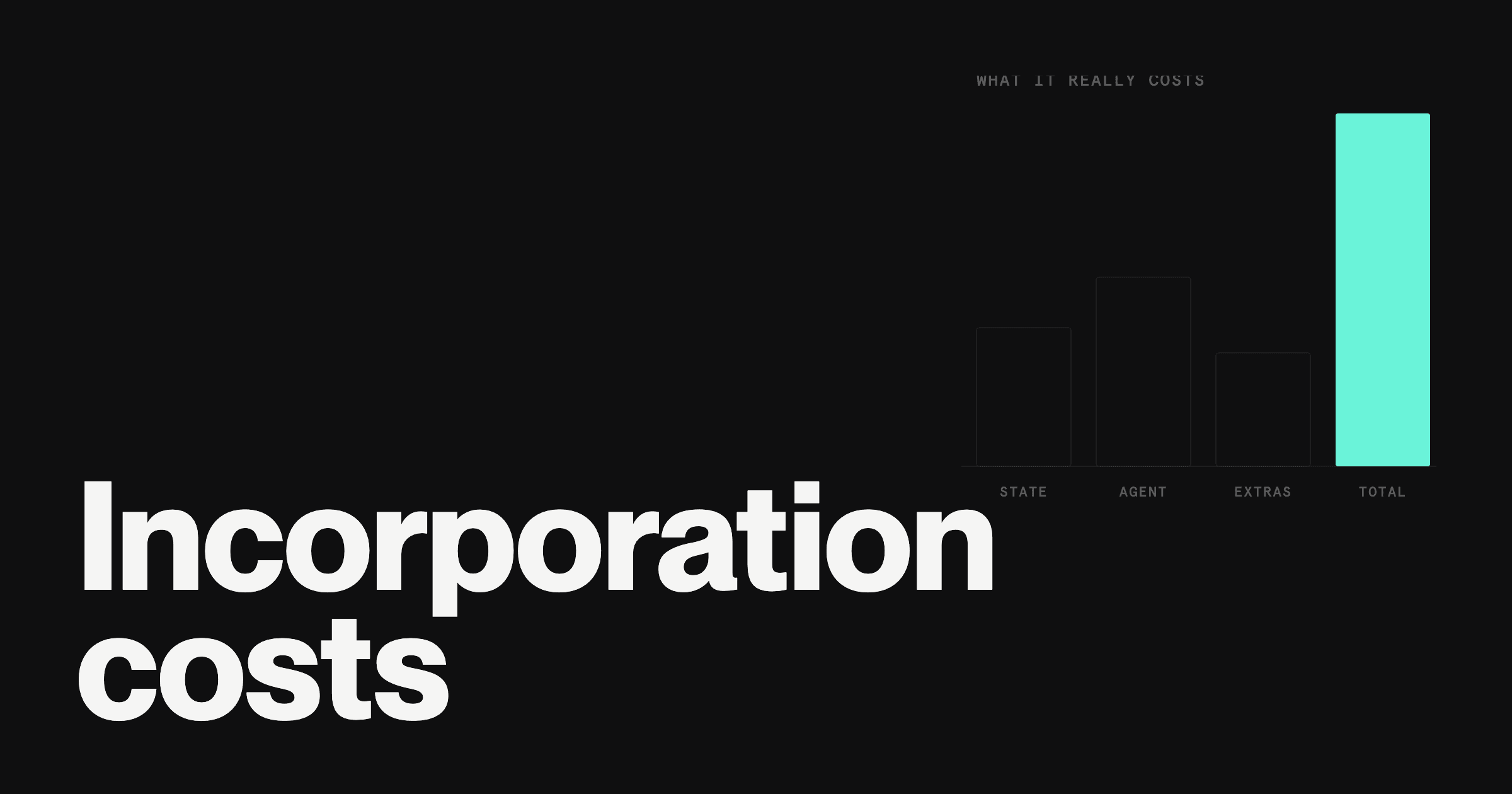

Incorporating costs anywhere from about $50 to over $1,500 in year one, and the spread comes down to three choices: which state you file in, whether you use a service, and what kind of company you are building. This page is the full cost reference, with every fee category priced out and a first-year total for three common founder profiles.
If you want the step-by-step process rather than the price list, start with our guide on how to incorporate a startup. This page covers what each of those steps costs.
State filing fees run from $35 to $500 depending on state and entity type. Delaware charges $109 minimum for a corporation and $110 for an LLC.
Service fees range from $0 at budget providers to $819 for Clerky's lifetime package. The service tier you need depends on whether investors will ever see your documents.
Recurring costs are the part founders underestimate: a registered agent at $50 to $300 per year plus annual franchise taxes, such as Delaware's $175 minimum for corporations and flat $400 for LLCs.
An EIN is free from the IRS. Any service charging for the number itself is selling you paperwork you can do in minutes.
A realistic first-year total: roughly $35 to $500 for a DIY home-state LLC, around $510 for a budget-service Delaware LLC, and about $850 to $1,100 for a venture-track Delaware C corp.
One-time costs
State filing fees
Every state charges a fee to file your formation document, and it is the only truly unavoidable cost.
Corporations: roughly $50 to $300 in most states. Delaware's certificate of incorporation starts at $109, which holds as long as you authorize 1,500 or fewer no-par shares or keep authorized shares times par value under $75,000.
LLCs: $35 to $500 nationally. Montana is the cheapest at $35, Kentucky is $40, a large group of states charge $50, and Massachusetts tops the list at $500. The national average is about $132.
Service fees: $0 to $819
On top of the state fee, formation services charge anywhere from nothing to several hundred dollars. The current market, cheapest to priciest:
Bizee, Inc Authority, ZenBusiness: $0 plus state fee on their base tiers.
LegalZoom: corporation formation from $149 plus state fees, up to $399 for the top tier.
Rho Incorporation: $400 for an attorney-reviewed Delaware C corp filing, credited back when you deposit $10,000 of new money into your Rho checking account and keep your daily average balance $10,000 above where it started for the 60 days after you incorporate.
Stripe Atlas: $500 flat.
Clerky: $819 lifetime package.
The gap is not arbitrary. The $0 tiers file a form. The startup-grade services produce investor-standard documents, handle the EIN, and include a first-year registered agent. Our best incorporation services review breaks down what each tier actually includes.
Expedite fees
Standard processing takes weeks in most states. If you need it faster, Delaware's menu is representative: $50 for 24-hour service, $100 for same-day, $500 for two-hour, and $1,000 for one-hour processing, all on top of the base filing fee. Most founders who expedite spend $50 to $100 here.
Recurring costs
Formation is the cheap part. These repeat every year the company exists.
Registered agent: $50 to $300 per year
Every state requires a registered agent with an in-state address. Unless you live in the formation state, you will hire one. Budget standalone agents start around $50 per year, formation-service renewals typically run $119 to $249. See our Delaware registered agent guide for how to keep this line item low.
Franchise taxes and annual reports
Delaware, the default home for startups, charges corporations an annual franchise tax of $175 minimum under the authorized-shares method. Startups with standard venture cap tables usually owe $400 under the assumed-par-value method, plus a $50 annual report fee, due March 1. Delaware LLCs pay a flat $400 per year, due June 1, raised from $300 by HB 400 effective the 2026 tax year. Run your own numbers with our Delaware franchise tax guide, because the authorized-shares method can produce alarming default bills that recalculation fixes.
Other states have their own versions: annual report fees, minimum franchise taxes, or both, commonly $20 to $300 per year.
Foreign qualification
If you incorporate in Delaware but operate somewhere else, you register there as a foreign entity and pay twice: two filing fees, often two registered agents, two sets of annual obligations. The numbers vary widely. Texas charges $750 to register a foreign entity, and California layers its $800 minimum annual franchise tax on top of registration. For many small businesses this single line item erases the benefit of leaving home, which is why we usually point non-venture founders to our analysis of the best state to form an LLC.
Hidden and optional costs
EIN: free. The IRS charges nothing for an employer identification number. Services bundle "EIN filing" into paid tiers or sell it as a $50 to $100 add-on, which is worth it only if you value the time saved on the SS-4, not because the number costs money.
Bylaws and operating agreement templates. Free to cheap online, included in better formation packages, or a few hundred dollars from a lawyer. Worth real money only when your ownership structure is not standard.
83(b) election: postage now or a tax bill later. Filing the election costs you a stamp, but missing the 30-day window on founder stock with vesting can turn every future vesting event into taxable income. It is the cheapest expensive mistake in startup formation. Read our 83(b) election guide before you issue founder shares.
Total first-year cost: three founder profiles
Cost | DIY home-state LLC | Budget-service Delaware LLC | Venture-track Delaware C corp |
|---|---|---|---|
State filing fee | $35 to $500 | $110 | $109 (often bundled by the service) |
Service fee | $0 | $0 | $400 to $819 |
Registered agent, year 1 | $0 if you serve yourself | $0, free first year | Included at Rho, Bizee-class bundles vary |
EIN | $0 | $0 | $0, prepared and submitted for you at the startup-grade tier |
Franchise tax and report, first 12 months | Varies, often $0 to $100 | $400, due June 1 | About $450, assumed-par $400 plus $50 report |
Realistic first-year total | $35 to $500 | About $510 | About $850 to $1,100 |
Two things stand out. First, the Delaware LLC's flat $400 franchise tax means Delaware is rarely the cheap option for an LLC that could have stayed home. Second, on the venture track, the service fee is not really the cost driver, the recurring Delaware obligations are, and those are identical no matter who files for you.
For funded startups there is one asterisk worth knowing: Rho Incorporation refunds its $400 fee when you deposit $10,000 of new money into your Rho checking account and keep your daily average balance $10,000 above where it started for the 60 days after you incorporate, which most funded companies would do anyway. That takes the effective service fee for the venture-track column to $0 and brings the first-year total close to the state's own unavoidable charges, while still including attorney-reviewed documents, a first-year registered agent, 83(b) election support, and same-day access to Rho banking once approved.
How to keep costs down
Incorporate in your home state unless you have a specific reason, usually venture capital, to be in Delaware.
Never pay for an EIN, and decline checkout add-ons you have not priced against standalone alternatives.
Note every renewal price before buying a free tier, since registered agent renewals are where $0 services earn their money.
If you are a Delaware corporation, recalculate your franchise tax under the assumed-par-value method before paying the state's default bill.
Put your compliance dates on a calendar. Late fees and penalties are the only formation costs that are pure waste.
Related incorporation guides
The full ranking: See our roundup of the best incorporation services for startups, scored on price, speed, and what comes after filing.
Shopping on price: Our cheapest incorporation service comparison ranks every major provider by true first-year cost.
The process: Our step-by-step guide to incorporating a startup runs from entity choice through your 83(b) election.
Firstbase pricing: Our Firstbase pricing guide itemizes the formation fee and every add-on subscription.
The budget route: Our Bizee (formerly Incfile) review covers the $0 plus state fees option.
Ready to incorporate? Rho Incorporation forms your Delaware C corp with attorney-reviewed filings, includes your first year of registered agent service, and gives you same-day access to Rho banking, corporate cards, and treasury once approved.
FAQs
The state charges $109 minimum to file a certificate of incorporation, assuming 1,500 or fewer no-par authorized shares. Add a registered agent at $50 to $300 per year if you are out of state, optional expedite fees from $50, and an annual franchise tax of $175 minimum, typically $400 plus a $50 annual report for startups on the assumed-par method.
Home-state filing fees are often comparable to Delaware's, but you avoid paying twice. A Delaware entity operating elsewhere needs foreign qualification in its home state, which means a second filing fee, a second agent, and two sets of annual obligations. Unless investors expect a Delaware entity, incorporating where you operate is usually cheaper.
Yes, and they usually exceed the formation cost within a couple of years. Expect a registered agent at $50 to $300 per year, your state's franchise tax or annual report fees, such as Delaware's $175 minimum for corporations or flat $400 for LLCs, and foreign qualification renewals if you operate outside your formation state.
Yes. The IRS issues EINs at no charge, online in minutes if you have an SSN or ITIN, or by fax or mail using Form SS-4 if you do not. Services that charge for an EIN are charging for form preparation, not for the number, so treat any EIN fee as an optional convenience.
From $0 to $819. Bizee, Inc Authority, and ZenBusiness offer $0-plus-state-fee tiers, LegalZoom runs $149 to $399 for corporations, Rho Incorporation is $400 with a refund available through its banking relationship, Stripe Atlas is $500, and Clerky's lifetime package is $819. Higher tiers exist for investor-grade documents, not faster filing.
It depends on your setup: a DIY home-state LLC runs $35 to $500, a budget-service Delaware LLC comes to about $510, and a venture-track Delaware C corp lands around $850 to $1,100 once you factor in state fees, a registered agent, and franchise taxes.
Expedite fees are optional charges to speed up state processing. In Delaware, they range from $50 for 24-hour service to $1,000 for one-hour processing, on top of the base filing fee. Most founders who expedite spend $50 to $100.
The most common surprises are registered agent renewal fees, Delaware's flat $400 LLC franchise tax introduced for the 2026 tax year, and foreign qualification costs if you operate outside your formation state. Late fees and penalties for missed compliance deadlines are the only costs that provide no value in return.