


Key takeaways
B2B payment solutions help businesses automate accounts payable and accounts receivable, improving cash flow and accuracy.
Leading payment platforms include Rho, Bill, Stripe, Adyen, and PayPal Business.
By 2026, real-time payments, automation, and API integrations will dominate global finance operations.
Automation reduces human error and gives finance teams data they can act on in real time.
Rho is a top choice that integrates banking, cards, and treasury into one system for full financial visibility.
Running a company today means managing complex business-to-business transactions across multiple systems and currencies. Traditional methods can’t keep up with new B2B payment methods. Paper checks delay operations, wire transfers cost more than they should, and manual processes leave room for error.
Modern B2B payment solutions eliminate that friction. No more late payments.
They combine automation, visibility, and control—so finance teams can move funds faster, minimize errors, and maintain predictable cash flow. Overall, a better payment cycle and payment experience for everyone involved.
Time-consuming funds transfers? We’ll never hear of him again.
This guide breaks down the best payment platforms, emerging trends through 2026, and how Rho helps finance teams automate payment workflows and optimize every dollar in B2B transactions.
What is a B2B payment solution?
A B2B payment solution is the software and infrastructure businesses use to send and receive payments for goods and services. These tools sit between your bank accounts, payables/receivables workflows, and accounting system.
Modern payment systems combine invoice processing, electronic payments, payment terms, accounts payable automation, and accounts receivable tracking across multiple payment methods—including ACH payments, wire transfers, and credit card payments.
Altogether, they help you issue payments, accept funds, reconcile transactions, manage approvals, and monitor risk.
Common B2B payment types
ACH: Low-cost domestic bank-to-bank transfers that typically settle in 1–3 business days; same-day and early ACH windows accelerate some flows.
Wire transfers: High-value, time-sensitive transfers that settle same day domestically, and 1–2+ days cross-border.
Checks: Paper payments still used for certain vendors or industries; slow and fraud-prone without secure controls.
Card payments: Corporate, virtual, or ghost cards; fast to issue and control; fees often sit with the merchant (interchange and assessments) or buyer (surcharges, convenience fees).
Real-time payments: Networks like RTP® in the U.S. and FedNow® enable instant clearing and settlement with 24/7/365 availability.
International transfers: Cross-border payments via SWIFT or local rails; increasingly intermediated by fintechs leveraging local payout partners.
Modern platforms also orchestrate multiple rails behind one interface, routing each payment based on cost, speed, limits, and counterparty.
Plus, unlike consumer payments or accounting software, these B2B payment systems handle large sums, multiple approvals, and detailed compliance requirements.
Comparing B2B payment methods
Method | Typical cost | Speed | Best for | Watch-outs |
ACH | Low (often <$1) | 1–3 biz days (same-day possible) | Recurring vendor payables, payroll | Cut-off times, returns, holds |
Wire (domestic) | $10–$30 | Same day | High-value, time-sensitive payments | Fees, irreversibility |
Wire (intl) | $20–$50+ | 1–2+ days | Cross-border settlements | FX spreads, intermediary fees |
Check | Print & mail costs | 3–10+ days | Vendors that require checks | Fraud risk, lost mail |
Corporate/virtual card | Interchange/assessments or surcharges | Instant authorization; settlement T+1–2 | Controlled purchases, rebates | Acceptance policies, fees |
RTP®/FedNow® | Low to medium | Instant | Urgent vendor payouts, disbursements | Per-transaction limits, coverage |
How B2B payment solutions changed from paper to real-time payments
Ten years ago, B2B payments were a patchwork of paper checks, wire transfers, and ACH payments that left founders waiting days—or weeks—for funds to clear. Every step involved manual processes, from invoice processing to reconciliation, creating bottlenecks that slowed growth.
What real-time payments change day to day
Now, B2B payment solutions are automated, digital, and intelligent. They’ve evolved from reactive accounting tools into real-time systems that power how companies operate. What used to be a back-office function is now a strategic lever for founders who want to control cash flow, reduce processing fees, accelerate growth, and provide a better customer experience at checkout.
The emergence of real-time payment systems—supported by the McKinsey Global Payments Report—marks the shift toward instant transfers between bank accounts. These systems support credit card, debit, and ACH payments, while also enabling recurring billing and one-time vendor payments across currencies
One platform to run AP, AR, and cards
Modern payment platforms integrate accounts payable and accounts receivable automation, credit card processing, and digital payment systems into one connected ecosystem. These tools connect directly to ERP and accounting systems, turning fragmented payment methods—like wire transfers, ACH payments, credit card payments, and digital wallets—into seamless financial transactions.
The biggest shift came with automation and API connectivity. Leading payment providers like Rho, Stripe, and PayPal Business introduced APIs that allow payment services to embed directly into business software, giving founders control over payment workflows, approvals, and reconciliation in one dashboard.
Speed and security by default
The new standard for B2B payment processing emphasizes speed and transparency. Real-time payment systems now allow instant transfers between bank accounts, supporting credit card and debit transactions, recurring billing, and one-time vendor payments. This shift has also strengthened security measures like authentication and encryption, ensuring secure payments across borders.
What this means for founders
For startups and scaling companies, this evolution means less time managing manual workflows and more time optimizing operations. Founders can use automated payment tools to handle everything from vendor onboarding to compliance, while monitoring every dollar moving through their payment systems.
B2B payment platforms have also democratized access to global commerce. Small and mid-sized teams now use the same payment technology as enterprises to process online payments, cross-border payments, and in-person transactions at POS terminals. Whether it’s Visa, Mastercard, or ACH, the focus is now on speed, visibility, and control.
In practice, B2B payment solutions combine automated clearing house transfers, wire transfers, credit card payments, and digital wallets into a single workflow that founders can oversee in real time. These integrations reduce human error, shorten processing times, and provide a unified view of working capital across currencies and geographies.
Turning payments into a growth lever
The last decade has proven that B2B payments aren’t just evolving—they’re redefining what operational excellence looks like for founders. Businesses that once managed payments reactively now run them as a core growth strategy, using automation and payment technology to optimize every decision, every transaction, and every line of cash on their balance sheet.
10 leading B2B payment solutions
1. Rho
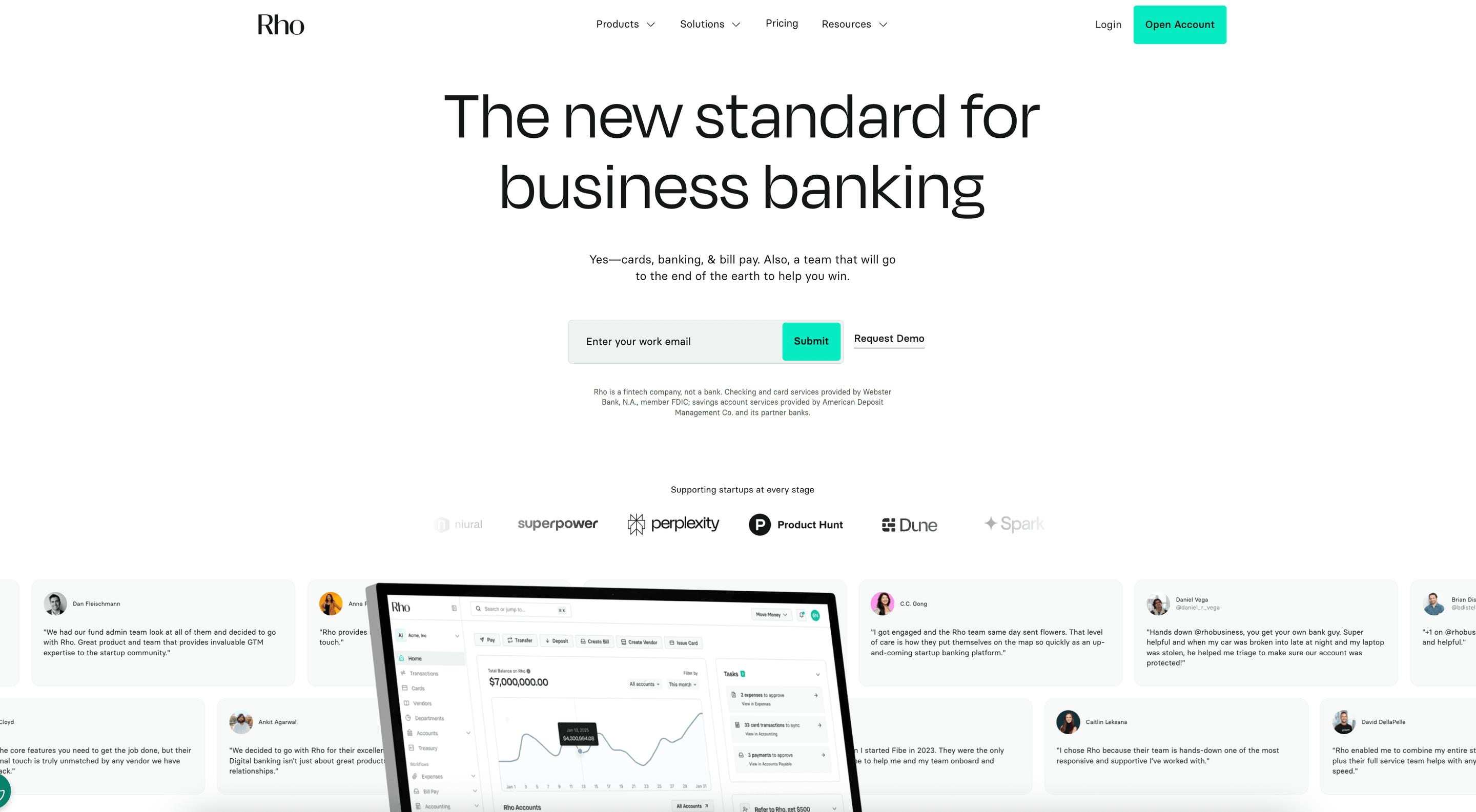
Rho offers a unified platform that connects accounts payable, corporate cards, and treasury under one roof. It provides real-time visibility into bank accounts, supports ACH, wire transfers, and credit card payments, and automates approvals for faster closes. Rho is ideal for mid-size and enterprise companies that want to simplify finance operations and centralize control.
Strengths: Integrates banking and payments in one dashboard, eliminating tool sprawl.
Weaknesses: Too comprehensive for very small businesses.
Pricing: No platform fee; revenue from interchange and treasury yield.
2. Bill.com
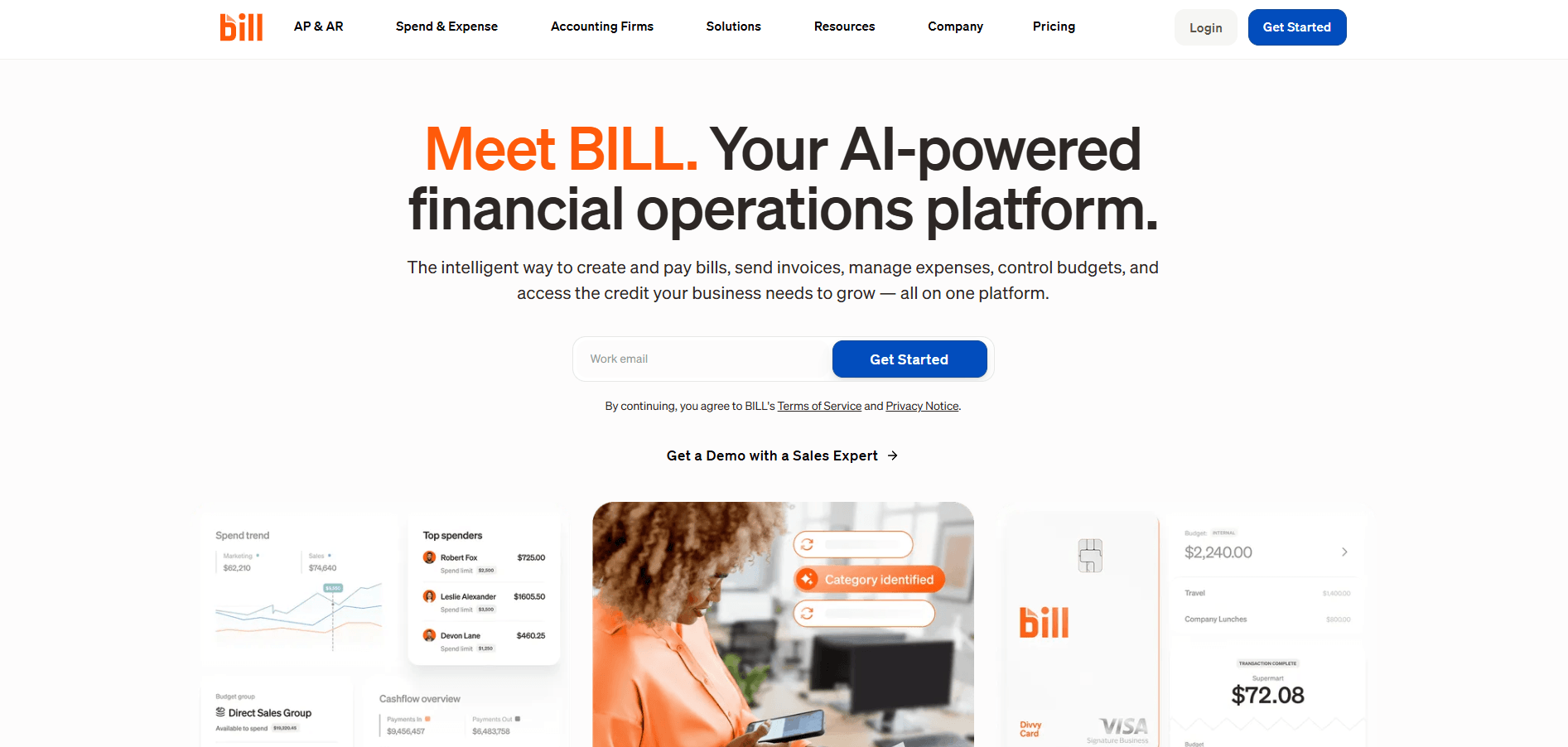
Bill.com is designed for small to mid-sized teams automating accounts payable and accounts receivable. It digitizes invoice processing, approval workflows, and ACH payments.
Strengths: Quick setup, easy integrations with QuickBooks, Xero, and NetSuite.
Weaknesses: Slower processing times for international transactions.
Pricing: Starts at $45 per month on the essentials plan.
Read our comparisons between Stripe vs Brex, Stripe vs Ramp, and more on our blog.
3. Stripe
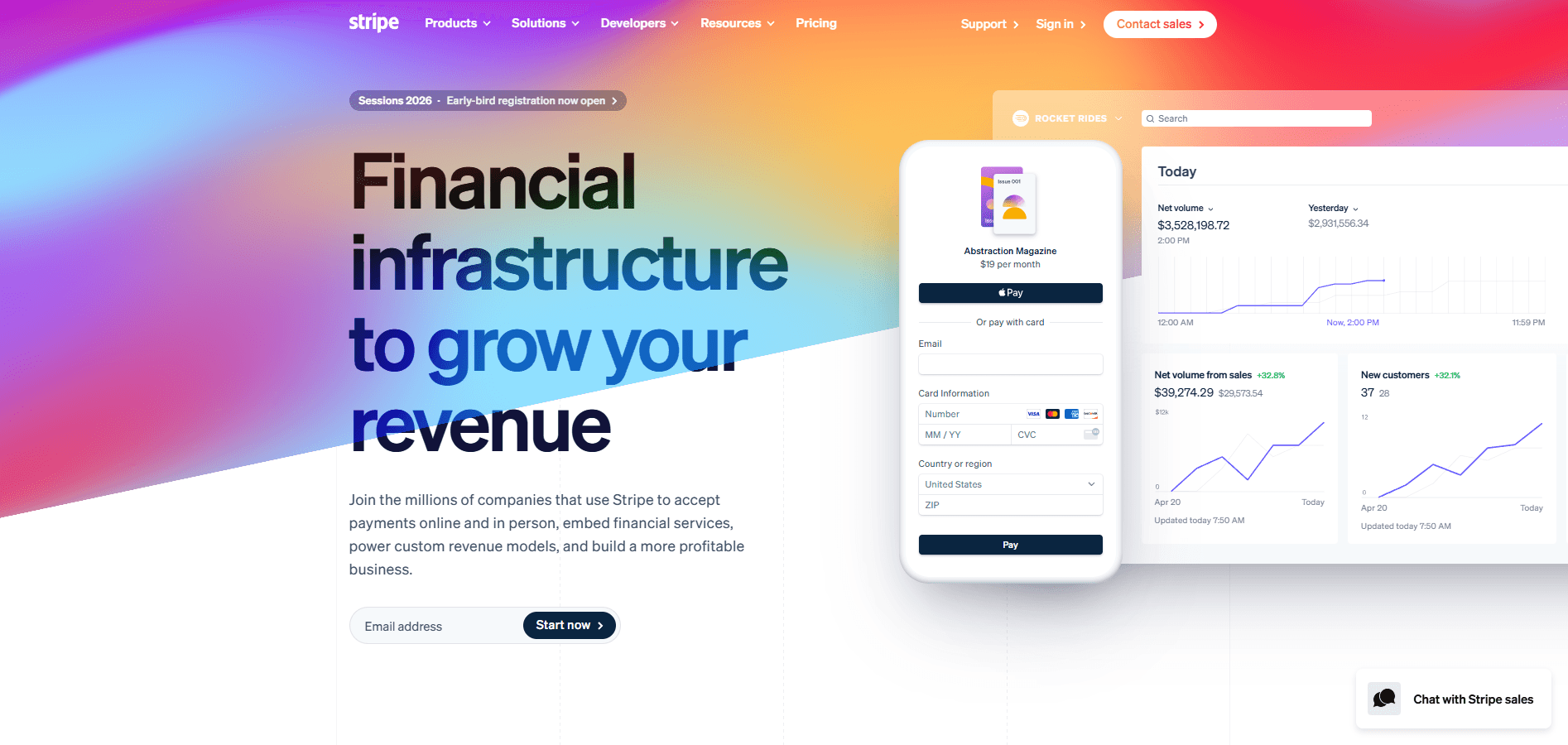
Stripe is built for SaaS and ecommerce companies that rely on developer-friendly APIs. It powers online payments, credit card processing, and subscription billing.
Strengths: Unmatched customization through APIs and strong fraud detection tools.
Weaknesses: Limited accounts payable automation.
Pricing: 2.9% + 30¢ per successful credit card transaction.
4. Adyen
Adyen caters to enterprises managing global, multi-channel payment processing. It supports Visa, Mastercard, and digital wallets across online and in-person transactions.
Strengths: Unified global dashboard for omnichannel payment gateways.
Weaknesses: Complex onboarding for smaller finance teams.
Pricing: Adyen uses a transparent Interchange++ model, adding a fixed fee to variable bank and card network costs.
5. PayPal Business
PayPal Business is a trusted payment provider for freelancers and small companies handling international clients. It offers online payments, credit card processing, and recurring billing.
Strengths: High trust factor, global coverage, quick setup.
Weaknesses: Higher transaction fees; slower settlement for large payments.
Pricing: PayPal charges 3.49% + $0.49 per online transaction, with no monthly fees for a standard account.
6. Airbase
Airbase is a spend management solution combining accounts payable automation, expense tracking, and virtual cards.
Strengths: Strong control features and integration with ERP systems.
Weaknesses: Steeper learning curve for new users.
Pricing: Custom quotes available based on organization size.
Read our breakdown on Airbase alternatives, and comparisons between Airbase vs Brex, Airbase vs Ramp, and more on the Rho blog.
7. Ramp
Ramp is built for startups looking to manage expenses and optimize spending. It provides corporate cards, ACH transfers, and automated reconciliation.
Strengths: Intuitive design, cash-back rewards, and spend alerts.
Weaknesses: Limited international payment processing.
Pricing: Free for their core platform, with paid options for Ramp Plus and Ramp Enterprise.
Read our breakdown on Ramp alternatives, and comparisons between Ramp vs Brex, Ramp vs Expensify, and more on the Rho blog.
8. Brex
Brex helps venture-backed and distributed companies manage spend through corporate cards, accounts payable, and reimbursement automation.
Strengths: Flexible credit, instant virtual cards, and team-wide spending visibility.
Weaknesses: Better suited to high-growth startups than SMBs.
Pricing: Free tier with premium add-ons.
Read our breakdown on Brex alternatives, and comparisons between Brex vs Bluevine, Brex vs Mercury, and more on the Rho blog.
9. Tipalti
Tipalti simplifies cross-border payments, tax compliance, and supplier onboarding for global businesses. It supports ACH, wire transfers, and over 120 currencies.
Strengths: Excellent for compliance-heavy, multinational operations.
Weaknesses: Costlier implementation and complex UI.
Pricing: Starts at $99 per month.
Read our breakdown on Tipalti alternatives, and comparisons between Tipalti vs Airbase, Tipalti vs Mineraltree, and more on the Rho blog.
10. Melio
Melio targets small businesses that need flexible vendor payments. It enables ACH payments and credit card payments to vendors, even if they only accept checks.
Strengths: Clean interface, quick onboarding.
Weaknesses: Limited reporting features and automation scope.
Pricing: Starts with a free plan that includes 5 ACH payments per month; additional ACH payments are $0.50 each, and credit card payments are charged at 2.9%.
Read our comparisons between Melio vs Ramp and Melio vs Stripe.
The 2026 landscape: Real-time, integrated, and automated
Global B2B payment transaction value is projected to exceed $224 trillion by 2030, up from $186 trillion in 2025. Automation, APIs, and real-time payments are becoming the standard.
Automation is standard. Invoice approvals and matching happen instantly.
Real-time payment systems improve cash flow visibility.
Integrated ERP connections remove reconciliation friction.
Enhanced security reduces payment fraud.
Global payments become borderless through multi-currency bank accounts.
How automation improves operational efficiency in B2B payment processing
Automation doesn’t replace finance—it refines it. Automated B2B payment processing replaces manual follow-ups and spreadsheet checks with reliable, live data.
Accounts payable automation captures invoices, matches purchase orders, and schedules ACH payments or wire transfers automatically. On the accounts receivable side, automation improves forecasting and collections accuracy.
With Rho, every transaction—from credit card payments to wire transfers—is tracked in real time. Finance teams gain complete visibility into cash flow and working capital to make faster, data-driven decisions. Learn more about finance automation in Rho’s blog.
Take control of your B2B payments with Rho
Rho gives your finance team one system for B2B payment processing, corporate cards, ACH transfers, wire transfers, and treasury.
See every transaction live. Manage global operations securely. Optimize cash flow and reduce overhead with confidence.
Start managing your B2B payments with Rho today.
FAQ
What are B2B payment solutions?
They are platforms that manage business payments—handling ACH, credit card, and wire transfers—with built-in automation and compliance.
Which payment platforms are best for businesses?
Rho, Stripe, Adyen, and PayPal Business lead for B2B payment processing, depending on company size and complexity.
What payment methods do B2B companies use?
Common methods include ACH payments, credit card payments, wire transfers, and digital wallets.
How does payment automation improve efficiency?
By linking payment systems, accounts payable, and accounts receivable, teams reduce errors and gain real-time visibility into cash flow.
What makes Rho different?
Rho unites banking, corporate cards, and treasury management into one system built for modern finance teams.