

Your bank choice is not a one-time admin task. It is one of the most expensive operational decisions you make in year one, and most Arizona founders get it wrong before they know what they actually need.
Choosing a bank feels like a one-time admin task. The common assumption is that picking the bank with the most Arizona branches and the lowest monthly fee is the safest, most practical choice for a small business, and that any missing functionality can be added with a second or third tool later.
For a cash-heavy retail shop in Scottsdale, that logic holds. For a fast-scaling Arizona startup, it quietly becomes one of the most expensive operational decisions you make in year one. See our business bank for startups for how this works in practice.
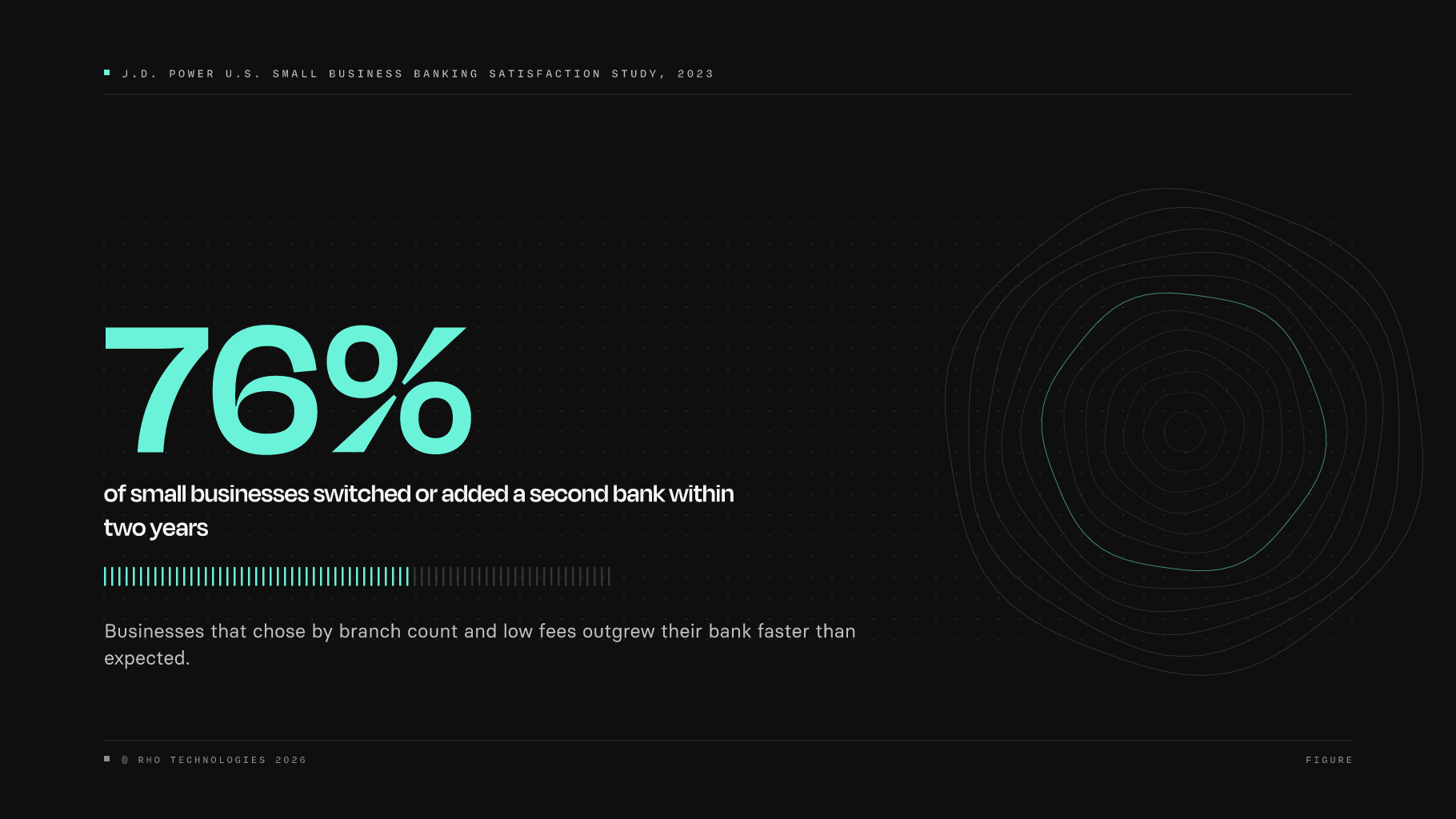
According to the J.D. Power U.S. Small Business Banking Satisfaction Study (2023), 76% of small businesses that started with a traditional bank based on branch count and low fees reported switching or adding a second financial institution within two years because their original bank could not support their growth needs.
This aligns with broader industry data: according to McKinsey's 2023 survey, 13 percent of small-business respondents switched their primary bank in the past two years, a share more than double that of prior years.
Three out of four founders made the wrong call on day one, then paid the switching cost later, after the account was embedded in payroll routing, vendor payments, and accounting software.
Rho is a fintech company, not a bank or an FDIC-insured depository institution. Checking account and card services provided by Webster Bank, a division of Santander Bank, N.A. Member FDIC, and by Lead Bank, Member FDIC. Savings account services provided by American Deposit Management Co. and its partner banks.
The branch-count-plus-low-fee framework ignores the capabilities that become non-negotiable as transaction volume and headcount grow, specifically virtual card issuance, API-based accounting integrations, automated expense controls, and multi-user access. These are the features that compound in value as a business scales, and they rarely appear on a traditional bank's fee schedule. Whether your business handles physical cash is the single most important variable in any honest Arizona banking comparison.
A Tucson restaurant needs branch access and ATM density because cash deposits are a daily operational reality. A Tempe SaaS startup almost never touches physical cash. These two businesses have almost nothing in common from a banking-needs perspective, yet most listicles hand them the same ranked list.
Federal Reserve survey data on small business credit conditions has consistently documented what founders already know: traditional bank account opening frequently requires in-person visits, physical documentation, and review queues that can stretch from days to weeks, a timeline that creates real operational risk for a startup that needs to move immediately after incorporation.
Most Arizona business banking guides optimize for branch count and monthly fees, two metrics that matter for a cash-heavy retail shop and almost nothing else for a scaling startup.
Choosing the wrong bank at the wrong growth stage doesn't announce itself as a single bad day; it compounds quietly in per-deposit fees, manual reconciliation hours, and wire requests that hit a wall at 10 p.m. on a Friday.
Regional banks and credit unions offer real advantages, a banker who knows the local market, SBA lending relationships, lower fees, but those advantages have a ceiling that shows up fast once headcount, spend velocity, or entity count starts to grow.
The two highest-stakes decisions inside any Arizona banking setup are where you deposit cash and which lender holds your SBA relationship; getting either wrong costs more than any monthly fee comparison will show.
Opening a business bank account in Arizona no longer requires a branch visit, a notary, or a two-week wait, but the document checklist still trips up new LLCs on one requirement most guides skip.
Rho closes the gap by combining banking, corporate cards, bill pay, expense management, treasury, and accounting in one platform, no subscription fees, real human support, and infrastructure that doesn't need to be replaced the moment your company outgrows its first checking account.
How to Choose the Best Bank for Your Arizona Small Business - The Framework That Actually Scales
Every Arizona founder eventually reaches the same moment: they've compared monthly fees across six bank websites, noted the branch count in their zip code, and still feel like something's missing from the decision. That feeling is correct.
The common assumption is that picking the bank with the most Arizona branches and the lowest monthly fee is the safest, most practical choice for a small business, and that any missing functionality can be added with a second or third tool later. But that assumption was built for a 2005 sole proprietor, not a 2026 company with a growing team, accelerating spend, and a second entity on the horizon.
The Three Arizona Business Archetypes and Why Each Needs a Different Feature Set
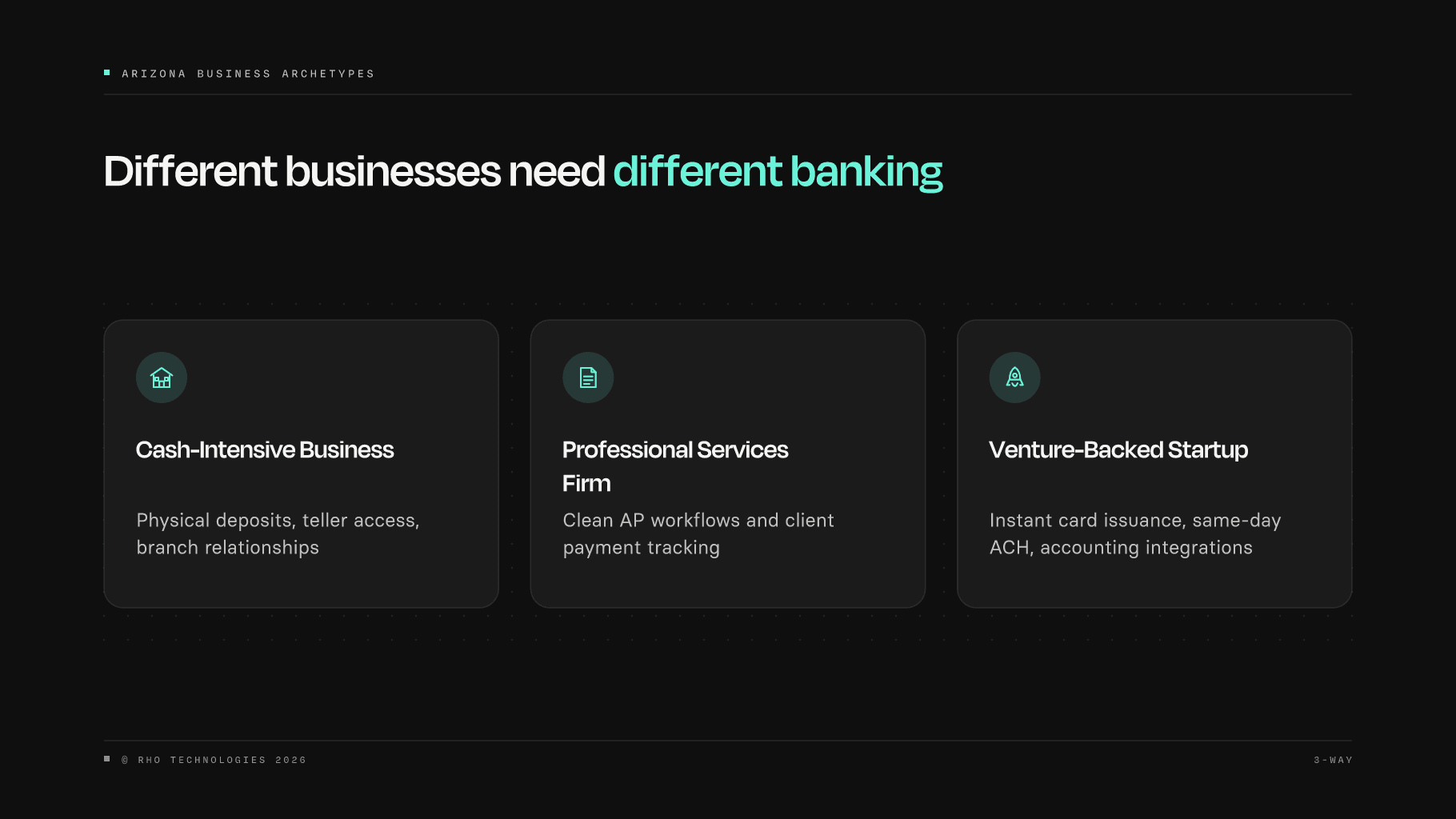
Not every Arizona small business has the same banking problem. A cash-intensive restaurant in Scottsdale needs physical deposit access and teller relationships. A professional services firm in Tempe needs clean AP workflows and client payment tracking.
A venture-backed startup in Phoenix needs instant card issuance, same-day ACH, and accounting integrations that work on day one. Treating these three businesses as identical, then handing them the same fee comparison table, is where most bank evaluations go wrong.
Same state. Three completely different banking problems.
Why Fees and Branch Count Are Table Stakes, Not a Decision Framework
Monthly fees matter. So does branch access, if your business handles physical cash. But once those two boxes are checked, they stop being differentiators.
Here's what that actually costs you.
The real cost of a fee-optimized bank shows up later, when your ops person is spending a Friday afternoon manually reconciling three disconnected tools because the bank doesn't talk to your accounting software.
Research on SME time allocation consistently finds that finance administration, reconciliation, manual exports, and disconnected tool management consumes a meaningful share of a founder's working week, with estimated opportunity costs that can easily dwarf the monthly fees most business owners focus on avoiding.
Australian SME owners, for example, spend 8–12 hours per week on finance admin, which at a $150/hour opportunity cost equals $62,400–$93,600 per year in lost productivity. That dwarfs any $15 monthly fee you avoided.
$93,600 yearly cost of finance admin lost productivity
The companies we work with that get ahead of this problem share a common trait: they build systems that work and don't break as the company scales, so founders can fund payroll, wire vendors, and manage capital without relying on banks that don't understand their business or timeline.
Banking, cards, and automation that just work, with visibility and control to stay ahead of risk, is what separates a high-functioning finance stack from a patchwork of disconnected tools.
So how do you actually test for this?
The Scale-Readiness Threshold - Five Questions to Ask Before You Sign Anything
Before you open any business account in Arizona, run these five questions against every option you're considering:
Can I issue a corporate card to a new hire in another state before their first day?
Does the bank connect natively to my accounting software, or will I be exporting CSVs?
Are same-day ACH payments included on the standard plan, or do they require an upgrade or per-transaction fee?
Let's take these one at a time.
On question one, the answer matters most once you have multiple employees incurring business expenses simultaneously. That's exactly when centralized spend oversight through corporate cards becomes a practical necessity rather than a nice-to-have.
Rho Corporate Cards are included at $0, issued immediately, require no minimum balance, and carry no per-user fee, making them most beneficial precisely at the stage when a growing Arizona team needs spend visibility across every employee in one dashboard.
On question two, native accounting integrations, not CSV exports, are what determine whether your month-end close takes hours or days. Rho's platform includes native direct integrations with QuickBooks Online, Oracle NetSuite, Sage Intacct, and Xero at $0, with transactions, receipts, and expense data syncing automatically. Rho also includes:
AP automation
Unlimited invoicing (white-labeled with your logo and colors)
Expense management with the Gmail Connector (in beta) for receipt capture
Rho Close for AI-suggested first-pass transaction coding
All at $0, with no platform tier gating and no per-user fees regardless of company size or headcount.
On question three, same-day ACH is included at $0 on Rho's standard plan (no upgrade required) for payments created before 2 p.m. ET under $1M, and domestic wires are $0 with same-business-day settlement if initiated before 4:45 p.m.
Scale-Readiness Checklist, Run Every Arizona Bank Option Through These Five Gates
Here's how Rho scores against its own checklist.
Rho passes all five gates. Corporate cards are issued immediately with no minimum balance; accounting integrations are native and included at $0; same-day ACH is standard; multi-entity support is available within the same platform under existing account permissions.
The entire platform, checking (provided by Webster Bank, a division of Santander Bank, N.A., member FDIC), savings (provided by American Deposit Management Co. with up to $75M FDIC coverage through ~400 partner banks), AP automation, expense management, invoicing, and cards, carries a $0 monthly fee, $0 subscription fee, and $0 per-user fee.
The only fees on the core platform are a 1% foreign currency conversion fee and optional $15 SWIFT fee for international wires.
If a bank fails two or more gates, it is optimized for a business profile smaller or simpler than where you are heading.
So who actually wins in this category?
The Best Regional and Local Banks for Small Business in Arizona
The best regional and local banks for small business in Arizona share a genuine strength: a banker who picks up the phone, knows the local market, and can advocate for your loan inside a credit committee. That relationship has real value, especially when you are building credit history or navigating an SBA application for the first time. The honest question is which structure scales.
"New LLC owners in Arizona are overwhelmed by generic small business banking advice that doesn't apply to simple, single-person contractor setups, making it hard to identify the right local or regional bank option."
1. Rho - Best All-in-One Banking Platform for Arizona Startups and Scale-Ups
Rho is built for founders and the accountants who support them, combining business banking, corporate cards, bill pay, expense management, treasury, and accounting integrations in one platform with no subscription fees. Arizona startups that have raised capital and need infrastructure that scales are the clear fit.
Worth knowing before you sign up: Rho is purpose-built for growth-stage companies, so a very early, pre-revenue sole proprietor may find its feature depth more than they need right now.
2. National Bank of Arizona - Best Local Bank for Relationship-Driven Small Business Lending
According to National Bank of Arizona's own about page, NB|AZ operates nearly 60 locations across Arizona as a subsidiary of Zions Bancorporation (Nasdaq: ZION), giving it both local reach and the capital backing of a large parent institution. That combination makes it a credible choice for established small businesses that need in-state branch access and traditional lending relationships.
Where it comes up short: NB|AZ's infrastructure is built for relationship banking, not for startups that need instant card issuance or native accounting integrations out of the box.
3. Vantage West Credit Union - Best for Arizona Startups Seeking Low-Fee Member-Owned Banking
Vantage West Credit Union is an Arizona-based credit union with business banking designed specifically for start-up organizations, offering simple tools, clear guidance, and a member-owned structure that typically means lower fees and more favorable rates than traditional banks.
Early-stage Arizona businesses that are cost-conscious and value community alignment tend to do well here. One catch: credit union membership eligibility requirements and a smaller branch footprint may limit accessibility for some businesses.
4. Regions Bank - Best Regional Bank for Arizona Small Businesses Needing Flexible Checking Options
Regions Bank offers a range of business checking accounts designed for small businesses, with flexible features, low fees, and a $100 minimum to get started, making it accessible for businesses at various stages.
Arizona small business owners who want a recognizable regional bank with branch access and scalable account tiers will find a lot to like. What it lacks: the deep Arizona-local roots of state-specific institutions, so it can feel less personalized than community banks.
The Best Credit Unions for Small Business in Arizona - Lower Fees, But Know the Trade-Offs
Arizona's credit union landscape includes institutions such as OneAZ Credit Union, Arizona Financial Credit Union, Desert Financial Credit Union, and Vantage West Credit Union, each offering member-owned structures, lower fees, and in some cases meaningful SBA lending advantages.
The best credit unions for small business in Arizona offer lower fees, member-owned structures, and in some cases real SBA lending advantages that regional banks cannot match at the same price point. For a cash-based sole proprietor or a brick-and-mortar operator keeping transaction volume predictable, that value is real.
The trade-off only becomes visible once you start connecting your financial stack to the rest of your business.
The core tension is this: credit unions are built on legacy core banking infrastructure that was never designed to sync with modern accounting software, payroll platforms, or expense management tools.
That same legacy core wasn't built to sync natively with modern accounting platforms like QuickBooks or Xero, so every transaction that cannot sync automatically becomes a manual reconciliation task. For a founder running 200 transactions a month, that overhead compounds fast.
The bank saving you $30 in monthly fees can quietly cost your team three to five hours a month in manual bookkeeping, a trade-off almost no comparison guide surfaces.
Founders we work with describe the same experience: they joined a credit union to solve the fee problem and ended up becoming part-time finance operators just to keep their books clean. That is the opposite of what building a company should feel like.
Here's the tally, side by side.
Pros and cons at a glance
1. Rho - Best All-in-One Banking Platform for Arizona Startups and Scale-Ups
Rho is the strongest pick for venture-backed or growth-stage Arizona businesses that need more than a checking account. Banking, corporate cards, bill pay, expense management, treasury, and accounting integrations live in one platform, with real human support and no subscription fees.
Not the fit if you're a sole proprietor or a cash-heavy brick-and-mortar business. Rho is built for startups and scaling companies first.
2. Arizona Financial Credit Union - Best for Phoenix-Area Small Businesses Wanting Low-Fee Local Banking
Arizona Financial Credit Union holds SBA Preferred Lending Partner status, which means it can approve SBA loans in-house without waiting for SBA review, delivering faster processing than most non-preferred lenders, a well-established advantage of preferred lender designation.
For Phoenix-area businesses actively pursuing SBA financing, that processing speed is a concrete operational advantage. On the digital side, though, its integration footprint is thin, so founders who need live accounting sync should plan for manual reconciliation or a third-party connector.
3. Vantage West Credit Union - Best for Arizona Startups and New Businesses Seeking Credit Union Simplicity
Vantage West serves as an economic anchor across southern and central Arizona, with startup-friendly banking packages designed for early-stage operators who want straightforward, low-friction access to business checking, a pattern that holds across most member-owned institutions in this tier.
It is a strong fit for Tucson-area founders who value local relationships and modest fee structures over digital-first features. Corporate card issuance, same-day ACH at scale, and native integrations with NetSuite or Sage Intacct are outside what it offers.
4. Mountain America Credit Union - Best for Arizona Small Businesses Prioritizing SBA Loan Access
Mountain America has built a broad Arizona footprint and a business banking suite that works well for established small businesses with straightforward deposit and lending needs. Its SBA loan access makes it relevant for operators seeking growth capital without moving to a national bank.
Here's the ceiling, though: like most credit unions, its technology layer was not built for multi-entity support or automated expense management, so businesses adding headcount and spend velocity will eventually outgrow what it can handle without adding third-party tools.
The pattern across all three is consistent. Credit unions solve the fee problem that frustrates Arizona small business owners, but they create an integration ceiling at exactly the growth stage where financial controls matter most. A Tucson-based founder who joins a credit union for fee savings but still needs a separate card product and a third-party AP tool has redistributed complexity rather than reduced it.
That is where platforms purpose-built for modern business finance become relevant. Rho, for example, is where founders are consolidating real operating capital onto a platform that lets them move money via ACH and wires at $0 in fees and know exactly when it will arrive.
The alternative is stitching together a credit union account, a card product, and a manual bookkeeping workflow. The goal is to build a company without becoming a finance operator in the process.
Credit unions solve the fee problem that frustrates Arizona small business owners, but they create an integration ceiling at exactly the growth stage where financial controls matter most.
Now for the banks built digital-first.
The Best National and Digital Banking Options for Arizona Small Businesses - Including the One Built for Startups
Pick the wrong banking tier at the wrong growth stage and you will not notice the cost on any single line item. You will notice it at 10 p.m. on a Friday, when a wire needs to move, the partner bank is unreachable, and your accountant is waiting on a reconciliation export that lives in three different systems.
That is the real risk hiding inside the "lowest fee wins" framework. The national and digital banks below are not equivalent. Each is optimized for a specific business profile, a specific cash-flow pattern, and a specific tolerance for manual work.
Choosing based on app design or ATM density is a reasonable shortcut for a sole proprietor. For a funded startup or a fast-scaling Arizona SMB, it is how Finance Stack Drag begins.
Here is how the five strongest national and digital options stack up, and exactly who each one is and is not built for.
1. Rho - Best All-in-One Banking Platform for Arizona Startups and Scale-Ups
The best national and digital banking option for Arizona startups is Rho, the only platform on this list where banking, corporate cards, bill pay, expense management, treasury, and native accounting integrations (QuickBooks Online, NetSuite, Sage Intacct, Xero) operate inside a single workflow at a $0 platform fee.
According to Rho's 2025 product documentation, the Business Savings account provides up to $75 million in FDIC coverage through the ADM sweep network, a materially higher ceiling than the standard $250,000 single-institution limit, making it a concrete differentiator for post-raise founders sitting on significant idle cash.
For founders who also want to put that cash to work, Rho Treasury (investment management and advisory services provided by RBB Treasury LLC dba Rho Treasury, an SEC-registered investment adviser and subsidiary of Rho) is accessible from the same platform with a $50,000 minimum investment; a management fee of 15–60 basis points annually applies, and Treasury investments are not FDIC insured.
Most beneficial when your finance team is small, transaction volume is growing fast, and month-end close needs to happen without detective work across disconnected tools. One thing to flag: Rho is purpose-built for incorporated businesses (primarily C-Corps and LLCs with operating scale), so a solo freelancer with minimal spend won't use most of what the platform offers.
2. Mercury - Best Digital-First Bank for Early-Stage Arizona Startups
Mercury is a widely used first account for pre-revenue or early-revenue Arizona startups that need digital banking with no monthly fees and a straightforward interface. It consistently ranks among the top-rated startup bank accounts on G2 (4.5/5, 300+ reviews, G2 2025).
Worth flagging: Mercury relies on partner banks for wire infrastructure, and some founders have reported wire transfer friction during high-volume periods, particularly around funding closes. That's a conversation worth having with your team before committing.
Most beneficial when your transaction volume is low, you have no immediate AP automation needs, and you plan to revisit your banking stack after your first institutional round.
3. BlueVine - Best High-Yield Checking Account for Arizona Small Business Owners
Bluevine offers one of the higher APYs available on a business checking account (rates vary and are published on Bluevine's current rate page) without locking funds into a separate savings product, which makes it worth considering for Arizona small business owners optimizing for yield on idle operating cash.
Cash deposits are where it struggles: Bluevine has no branch network, and while deposits are possible through the Green Dot network, the per-deposit fees and location friction make it a poor fit for any Arizona business handling regular cash.
Most beneficial for service-based businesses, consultants, or digital agencies with predictable cash inflows and minimal cash-handling needs.
Update (October 2026): Valley National Bank announced it will acquire Bluevine for $340 million, with the deal expected to close in early 2027. Bluevine will become Valley's small-business banking division; existing accounts aren't expected to change before then.
4. Chase Business Banking - Best National Bank for Arizona SMBs Ready to Scale
Chase Bank provides the most extensive branch network of any national bank across the Phoenix, Tucson, and Mesa metros, which matters for businesses that need teller access, cash deposits, or in-person relationship banking.
The Chase Business Complete Banking account carries a $15 monthly fee, waivable by maintaining a $2,000 minimum daily balance or meeting qualifying activity thresholds. That fee structure becomes cost-effective somewhere in the $100,000 to $200,000 annual revenue range, where the branch access and brand credibility justify the tradeoff.
Where scaling startups hit a wall: Chase does not offer native AP automation, integrated expense management, or accounting sync out of the box, so every additional tool you bolt on creates reconciliation overhead that compounds as headcount grows.
5. National Bank of Arizona - Best Local Option for Arizona Businesses Seeking SBA Financing
National Bank of Arizona, a subsidiary of Zions Bancorporation with more than 50 Arizona branches, earns its place on this list for one specific use case: businesses that need a local banking relationship to support SBA loan applications or commercial lending.
The branch density across Tucson, Phoenix, and the surrounding metro areas gives business owners access to in-person bankers who understand the Arizona market.
Same trade-off as every traditional bank on this list, though: the digital tools are functional but not built for startups, and any founder who needs instant card issuance, same-day ACH, or accounting integrations will need to supplement with additional platforms, reintroducing the reconciliation overhead a modern banking stack is designed to eliminate.
A founder who opens a basic digital account at incorporation, adds a corporate card platform at the seed round, and exports CSVs into QuickBooks every month is not running a lean stack. They are running three systems that were never designed to talk to each other.
The cost is not the $0 monthly fee on any individual tool. It is the hours spent reconciling, the cash-flow blind spots between platforms, and the single point of failure that appears when a wire needs to move on a deadline and the partner bank is unreachable.
According to Rho's 2025 product documentation, the platform eliminates that overhead by combining banking, cards, bill pay, expense management, treasury, and accounting integrations into one workflow, with no monthly platform fee, no per-user fee, and no manual CSV export required to close the books.
Two more decisions left, and they're the ones with the sharpest teeth.
Which Arizona Banks Are Best for Cash Deposits, SBA Loans, and Lines of Credit - The Two Remaining Picks
Two decisions inside your Arizona banking setup carry more operational weight than most founders realize: where you deposit cash and which lender holds your SBA relationship. Getting either one wrong does not show up as a single bad day. It compounds quietly, in per-deposit fees that chip away at margins and in underwriting queues that stretch across months when your runway cannot afford months.
The cash-deposit problem is sharpest for businesses handling physical revenue daily. Digital-only platforms are genuinely excellent for most workflows, but a Tucson restaurant or a Mesa-based retailer depositing cash every afternoon faces a structural mismatch: per-deposit fees at cash-unfriendly institutions can reach several dollars per transaction, and that math accumulates fast across 250 operating days. For those businesses, a branch-network bank is a margin decision.
The SBA lending problem is subtler and more dangerous. Small Business Administration Preferred Lender Program status grants approved institutions delegated authority to make final credit decisions in-house, without sending the loan file back to the SBA's central office for review.
That single structural difference is what separates a weeks-long closing from a months-long one. The hidden trap: that speed advantage only materializes for borrowers who already have a banking relationship with the preferred lender.
A founder who optimized for low fees at account opening and picked a non-preferred or relationship-thin institution arrives at the point of need carrying the full SBA review timeline, precisely when runway compression makes speed the variable that determines survival.
The two picks below address the cash-deposit and SBA lending gaps directly. Neither one, however, solves the visibility problem that runs underneath both: founders who juggle multiple tools to track cash, outstanding invoices, and card spend lose the thread at exactly the moment clarity matters most. That is a separate problem worth naming, and we address it after the two picks.
1. Rho - Best All-in-One Banking Platform for Arizona Startups and Scale-Ups
Choosing the right branch bank and the right SBA lender still leaves a day-to-day operational gap that founders we work with consistently underestimate: knowing, in real time, what cash is on hand, what invoices are outstanding, and what employee cards have spent, without logging into three separate tools to piece it together.
That gap is where Rho's invoicing and expense infrastructure fits. Rho includes:
Unlimited invoicing at $0, white-labeled with your logo
A checking account, corporate cards, and expense management in one platform, so outstanding receivables and current cash balance live in one view rather than two or three
$0 subscription fee and $0 per-user fee
Founders who previously stitched together a standalone invoicing tool, a separate card program, and a bank portal get that time back without paying a platform or per-user fee to do it.
Corporate cards are issued immediately with no minimum balance required and earn up to 2% Cashback with Rho Platinum (terms apply), on up to $1M in eligible annual card spend; 1.25% standard, credited directly to the account.
Expense management, receipt capture, and the Gmail Connector (in beta) are all included at $0.
For a founder preparing a business line of credit application at National Bank of Arizona or a loan file for Mountain America, having clean, categorized transaction history and automatically synced receipts is the difference between a credible package and a slow, back-and-forth one.
Rho accounts can be opened in minutes, cards issued immediately, and the platform requires no minimum balance. The checking account is provided by Webster Bank, a division of Santander Bank, N.A., member FDIC.
FDIC coverage on the checking account runs up to $250K standard; the savings account, provided through American Deposit Management Co. and its partner bank network of approximately 400 banks, extends that coverage up to $75M.
For Arizona businesses that want visibility into cash and spend without juggling multiple tools, that combination, branch bank or credit union for cash deposits and SBA lending, Rho for daily financial operations, covers the full stack without redundancy.
2. National Bank of Arizona - Best Traditional Arizona Bank for Business Lines of Credit
National Bank of Arizona suits cash-intensive Arizona businesses that need teller infrastructure and revolving credit from the same institution. With more than 50 Arizona branches under Zions Bancorporation's backing, it offers the deposit access a daily-cash business genuinely requires.
Its business lines of credit give operators a draw-and-repay structure suited to seasonal cash flow. Relationship depth matters here, though, and a thin or new relationship will slow underwriting. Not the right pick for a founder who opened an account last month and needs capital next week.
3. Mountain America Credit Union - Best Arizona SBA Loan Provider for Small Business Borrowers
Mountain America Credit Union holds SBA Preferred Lender status, which the U.S. Small Business Administration confirms grants delegated authority to approve loans without prior SBA review, materially compressing the timeline from application to funding. For a small business borrower whose growth timeline cannot absorb a months-long SBA review queue, that delegated authority is a concrete operational advantage, provided a prior banking relationship with Mountain America is already in place.
How to Open a Business Bank Account in Arizona - Without the Branch Visit, Notary, or 2-Week Wait
Opening a business bank account in Arizona is straightforward on paper and surprisingly slow in practice, with document gaps, branch visits, and multi-week review queues turning a one-hour task into a two-week delay.
What you bring, where you apply, and whether you even have your EIN yet all determine how fast your account goes live and how capable that account will be once it does.
The sub-sections below break down exactly what Arizona banks require, what their timelines actually look like, and which platforms let you move forward before every piece of paperwork is in place.
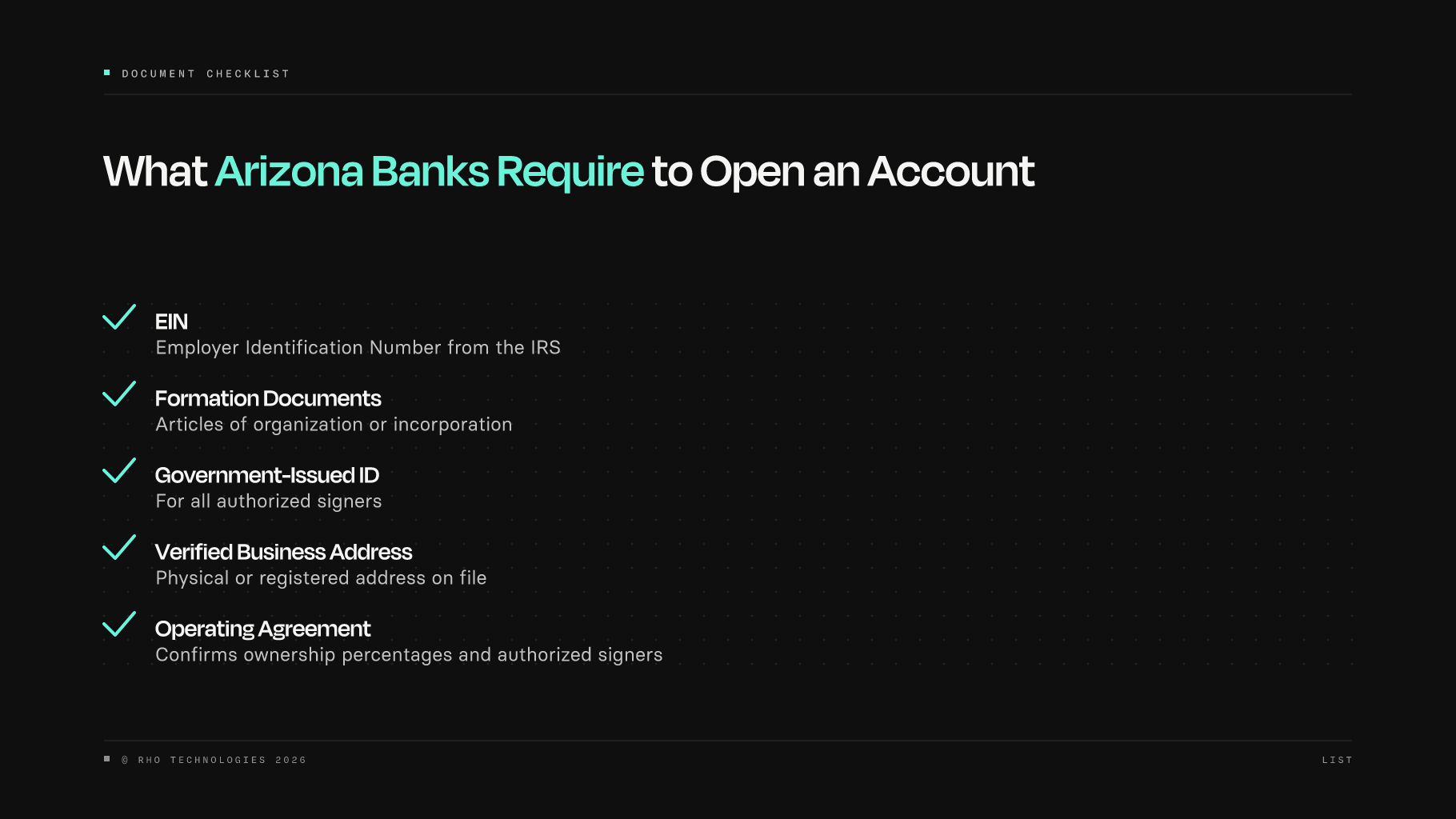
Here's exactly what to have ready.
Arizona Business Bank Document Checklist
Every Arizona business bank will ask for roughly the same core package: your EIN, articles of organization or incorporation, a government-issued ID, and a verified business address. Across the market, that list also typically includes formation documents specific to your entity type.
The surprise for new LLCs is the operating agreement. Many founders treat it as optional paperwork, but banks use it to confirm ownership percentages and authorized signers. Arrive without it and you restart the process.
Traditional Arizona Bank Timelines
Traditional banks typically extend the business bank account opening timeline to days or weeks through in-branch visits, notarization requirements, and document verification queues, as most teams opening accounts quickly discover. In practice, "we'll be in touch" often means 5 to 14 business days before a decision lands.
That timeline carries real cost. A bank that cannot open an account in under an hour almost certainly cannot sync transactions in real time either. The onboarding experience is a leading indicator of the entire infrastructure underneath it.
The Pre-EIN Problem
The IRS issues EINs instantly when you apply online, but founders who miss that window or incorporate through a formation service sometimes wait weeks for the number to arrive by mail.
That creates a compounding delay: no EIN, no account, no ability to accept payment or move funds, a gap that can stretch weeks for founders who incorporated by mail or through a slower formation service. Rho supports pre-EIN onboarding, so founders can open an account and begin using Rho before the EIN arrives, eliminating that delay entirely.
That's the paperwork. Here's what to do with it.
Next steps
If your banking setup is quietly becoming a second job, pulling you into manual reconciliation and disconnected tools instead of building the business, the path forward starts with treating your finance stack as a single system, not a collection of lowest-fee decisions. Start with our business bank for startups.
Branch density is a vanishing asset, because the banking tasks that require physical presence are rare friction points while the bottlenecks that compound daily, including ACH timing, virtual card issuance, and accounting integrations, are entirely determined by core processing infrastructure.
The credit union integration ceiling confirms the same logic from another angle: lower fees invert into higher costs at exactly the growth stage where financial controls matter most, when payroll, expense management, and accounting need to reconcile into one ledger automatically.
Together, those two realities point toward a single action: consolidate onto a platform where banking, cards, bill pay, and accounting sync operate inside one workflow before the patchwork multiplies.
Start with Rho. Checking, corporate cards, AP automation, expense management, and native integrations with QuickBooks Online, NetSuite, Sage Intacct, and Xero are all included at a $0 platform fee, with no per-user fee and no minimum balance required. Accounts open in minutes, cards issue immediately, and every transaction lands in the same place your accountant already needs it.
FAQs
It depends on your transaction mix and how much manual work you're willing to absorb. Credit unions can offer lower fees and SBA lending advantages, Arizona Financial Credit Union holds SBA Preferred Lender status, which speeds up loan approvals, but most credit unions run on legacy core banking infrastructure that wasn't built to sync natively with accounting platforms like QuickBooks or Xero, turning every unsyncable transaction into a manual reconciliation task. Traditional regional banks offer branch access and relationship lending but hit the same technology ceiling once you need virtual card issuance, multi-user controls, or native accounting integrations.
The post cautions against optimizing purely for low monthly fees, because the hidden cost, hours spent on manual reconciliation, CSV exports, and disconnected tools, can far exceed any fee you avoid. As an example, finance admin time at a $150/hour opportunity cost can easily reach tens of thousands of dollars per year, dwarfing a $15 monthly fee. Rho carries a $0 monthly fee, $0 subscription fee, and $0 per-user fee, with same-day ACH, corporate cards, and native accounting integrations all included at no additional cost on the standard plan.
Yes, Arizona Financial Credit Union holds SBA Preferred Lending Partner status, which means it can approve SBA loans in-house without waiting for SBA review, resulting in faster processing than most non-preferred lenders.
Yes, the post argues this is the core mistake most founders make. A bank optimized for an early-stage sole proprietor, low fees, nearby branches, quietly becomes an operational liability as headcount and transaction volume grow, because it lacks virtual card issuance, API-based accounting integrations, automated expense controls, and multi-user access. Nearly 76% of small businesses that started with a traditional bank based on branch count and low fees reported switching or adding a second financial institution within two years because their original bank couldn't support their growth needs.
The post doesn't directly address mixing personal and business accounts, but it does make clear that the features a growing business needs, multi-user access controls, corporate card issuance, AP automation, accounting integrations, and multi-entity support, are business-account capabilities that don't exist in a personal banking context, making a dedicated business account a practical necessity well before a company reaches meaningful scale.