

Rho is a fintech company, not a bank or an FDIC-insured depository institution. Checking account and card services provided by Webster Bank, a division of Santander Bank, N.A. Member FDIC, and by Lead Bank, Member FDIC. Savings account services provided by American Deposit Management Co. and its partner banks.
Most Colorado bank lists were built for a Denver deli owner. If your headcount doubled last quarter, here is what those rankings got wrong and what to look for instead.
Most founders assume that the right business bank for a Colorado startup is whichever local institution has the lowest monthly fee and the most convenient branch, that banking is a commodity, and that the differences between options are too small to matter until you're much bigger. Most "best banks in Colorado" lists were built for a Denver deli owner, not a seed-stage startup. They rank institutions by branch count, monthly fee waivers, and ATM access, criteria that matter enormously to a cash-heavy retail business and almost not at all to a founder who hired three engineers last quarter and needs to issue corporate cards before Monday. See our business bank for startups for how this works in practice.
The real question for a growth-stage company is whether the platform will still work when your team doubles. Traditional bank product pages segment customers by business size and differentiate primarily on monthly fees and cash deposit thresholds, not on API access, virtual cards, or same-day ACH. For a startup processing vendor invoices, reimbursements, and payroll funding in the same week, the $15 monthly fee is irrelevant. The operational drag from a platform that cannot enforce spend controls or issue a card to a new hire in minutes is the cost that compounds.
The operational drag from a platform that cannot enforce spend controls or issue a card to a new hire in minutes is the cost that compounds.
The failure mode rarely appears on day one. The gap opens the moment a fourth hire needs purchasing power, a vendor needs a dedicated card, and the bookkeeper needs transactions to sync automatically to QuickBooks or NetSuite. This is the scale-readiness gap. Colorado has hundreds of thousands of small businesses, and the vast majority operate with stable headcount and predictable transaction volumes. Community banks serve that majority well. Funded startups moving from 3 to 30 employees are a different category entirely.
Most 'best banks in Colorado' lists were built for a Denver deli owner, they rank by ATM count and branch proximity, not by whether the platform survives your Series A.
Transaction fees, balance minimums, and overage charges rarely surface during the sales pitch, they show up at month fourteen, when payroll is running, vendors are moving money at volume, and switching costs are real.
The right bank for a cash-heavy retail operation will quietly become the wrong bank for a startup the moment headcount, integrations, and AP complexity start compounding.
Expense reports average 20 to 45 minutes each, and 19% contain errors, manual reconciliation is the first friction point that signals a founder has outgrown their community bank.
Opening a business bank account in Colorado requires roughly the same four documents everywhere; the part guides skip is the dead time between filing and actually being able to spend money.
Rho closes that gap, banking, corporate cards, bill pay, expenses, treasury, and accounting in one platform, with no subscription fees and infrastructure that scales from day zero without forcing a rebuild every time the team grows.
Business Checking Account Fees, Minimums, and Transaction Limits at Colorado Banks - The Hidden Costs
Transaction fees, minimum balance traps, and overage charges rarely announce themselves during the sales process. They surface later, quietly, once payroll is running and vendor payments are moving at volume.
That gap between the pricing page and the actual cost of operating explains why the common assumption among early-stage founders, that the right business bank for a Colorado startup is whichever local institution has the lowest monthly fee and the most convenient branch, tends to be so expensive to correct.
Banking is a commodity, the thinking goes, and the differences between options are too small to matter until you're much bigger. Business checking fees in Colorado look simple on paper. They are not.
"Wells Fargo and other large banks charge fees for business checking accounts until a minimum capital threshold is built up, creating a barrier for newly formed LLCs and solo operators."
Controllers and finance teams who have inherited a banking relationship they didn't choose know this feeling well: the monthly fee was the number everyone noticed at account opening, and it was rarely the number that hurt the company six months later.
The real cost arrives in the form of per-transaction charges, wire fees, and balance thresholds that quietly erode operating cash, structures that are easy to miss when you're overwhelmed by the sheer number of banking options and lack clear guidance on which institutions actually offer favorable terms for small businesses.
Transaction Limits at Colorado Business Banks - The 100-Transaction Ceiling Explained
100 Transaction ceiling before overage fees hit
Most Colorado business checking accounts cap fee-free transactions at 100 per month. According to Chase's posted 2025 account terms, Business Complete Banking includes a limited number of free transactions per statement cycle before per-item fees apply.
Bank of Colorado's Business Growth Account imposes a comparable monthly transaction ceiling, per posted terms sourced by Wise. Wells Fargo's Initiate Business Checking also imposes a comparable cap on fee-free transactions per fee period.
One hundred sounds generous until you actually run a business. A five-person team paying six recurring vendors, processing payroll, covering contractor reimbursements, and handling a handful of incidentals can clear 100 transactions in the second week of the month.
Accounting teams we work with consistently flag this as the first structural surprise: the transaction ceiling was never discussed during onboarding, and the overage charges only appear on the statement.
Here's how that ceiling actually plays out across Colorado's most common business accounts:
Rho skips the ceiling entirely.
Rho's platform charges $0 in platform, subscription, or per-user fees, and does not impose transaction limits that trigger per-item charges. ACH payments are $0, same-day ACH is included, domestic wire transfers are $0, so a finance team processing high volumes of vendor payments or contractor reimbursements isn't watching a meter tick upward every time a payment clears.
Balance Minimums and Fee-Waiver Conditions at Colorado Business Banks
The fee waiver looks like a solution. It is a trap for any company with uneven revenue.
Chase's 2025 account terms require a minimum daily balance of $2,000 to waive the $15 monthly fee. Not an average. A daily minimum, meaning one slow collection day wipes out the waiver entirely, with no partial credit.
Bank of Colorado requires a minimum average daily balance to waive its monthly fee. Community Banks of Colorado ties its fee waiver to a combination of minimum balance thresholds and monthly debit card activity, meaning businesses that shift spending to a corporate card program can inadvertently forfeit the waiver entirely.
$2,000 Chase's daily minimum to waive monthly fee
These structures create a particular burden for newly formed LLCs and solo operators who haven't yet built a capital cushion, businesses that banks theoretically want to serve, but whose cash flow patterns make fee avoidance structurally difficult.
Founders in this position often discover that the checking account they chose because it had no monthly fee at sign-up actually requires maintaining a minimum daily balance they can't reliably sustain without sacrificing operational flexibility.
Rho requires no minimum balance to open or maintain a checking account. There is no minimum balance condition attached to any product feature, no daily balance floor to monitor, and no fee triggered by a single low-cash day. The platform fee is $0 regardless of company size or headcount.
Rho operates a single unified tier, so there is no lower tier to age out of and no premium tier required to unlock meaningful functionality.
The only fees on the platform apply to foreign currency transfers and, separately, to Rho Treasury, which is a distinct, fee-bearing RIA product with its own minimums and is not FDIC insured. Everything else, bill pay, AP automation, corporate cards, expense management, unlimited reimbursements, invoicing, and accounting integrations, is included at $0.
The 15 Best Banks for Small Business in Colorado (2026): Local, National, and Online
The fifteen options below were scored against exactly those criteria, transaction caps, balance minimums, overage rates, and AP integration, because the cost of ignoring them rarely surfaces at month one.
It surfaces at month fourteen, when you are closing a round, onboarding your eighth employee, and discovering your financial stack requires three logins, two spreadsheets, and a Friday afternoon to reconcile. That is the Scale-Readiness Threshold in practice: not a dramatic failure, but a slow accumulation of operational drag that hits hardest when you have the least time to fix it.
The institutions below earn their place on this list. Each one does something genuinely well.
But every item also carries an honest ceiling, the point where its account structure, digital tooling, or support model stops keeping pace with a growing company. Read the list with that lens, and you'll shortlist the right institution in ten minutes instead of spending a week filling out the wrong application.
1. Rho - Best All-in-One Banking Platform for Colorado Startups and Scale-Ups
Most Colorado founders open a business checking account expecting to bolt on corporate cards, expense tracking, and bill pay later. The patchwork feels manageable at two employees.
By employee ten, it costs a significant number of hours a week in manual reconciliation, AP chasing, and month-end scrambles. That hidden overhead is the real price of a fragmented financial stack, and it compounds faster than any monthly maintenance fee.
Rho eliminates that drag by unifying banking, corporate cards, bill pay, expense management, treasury, and accounting integrations in one platform with no subscription fees and real human support that responds in under a minute.
A Fort Collins SaaS startup can issue cards to three new hires on onboarding day, set spend controls by department, and close the month in under an hour via native NetSuite sync, a workflow that addresses the manual overhead industry data, including Extend's October 2025 expense report analysis, attributes to fragmented financial stacks, with no reconciliation backlog.
Banking services are provided by Webster Bank, a division of Santander Bank, N.A., Member FDIC, and by Lead Bank, Member FDIC. Rho Treasury, available from the same platform, requires minimum balances for access; Treasury investments are not FDIC insured and carry an annual management fee.
Scale-Readiness Threshold: none for core banking. The platform that works at incorporation still works at Series B without a rebuild.
2. Bank of Colorado - Best Community Bank for Colorado-Based Small Businesses
A Durango retail shop that stays under 100 monthly transactions and maintains a modest average daily balance can operate cost-effectively at Bank of Colorado for years. It's the right call for established Colorado businesses with predictable, low-volume transaction patterns and a preference for local relationship banking.
Digital tooling is limited here, and accounting integrations are thin. The account structure does not scale cleanly past the point where you need spend controls, multi-entity support, or same-day ACH.
Scale-Readiness Threshold: roughly 10 to 15 employees, or the moment AP automation becomes a daily need.
3. Community Banks of Colorado - Best for Rural and Multi-Location Colorado Businesses
Rural operator, or running locations across less-served Colorado markets? Community Banks of Colorado offers multiple business checking tiers, Small Business, Everyday, and Business Plus, each with fee waiver conditions tied to minimum balance thresholds or debit card spending activity.
That tiered structure works because it gives local decision-makers real authority. The limitation shows up as you grow: transaction caps, limited accounting software integrations, and no native expense management mean the account outgrows the business faster than founders expect.
Scale-Readiness Threshold: appropriate through early operations; reconsider at the first full-time finance hire.
4. Elevations Credit Union - Best Credit Union Option for Colorado Small Businesses
Elevations Credit Union serves the Boulder and Denver metro area with treasury management services and commercial real estate lending alongside standard business checking, a stronger lineup than most credit unions offer businesses with more complex financial needs.
Its member-owned structure typically means lower fees and more attentive service, which matters to founders who feel like a number at larger national institutions. The catch: as Partner Colorado Credit Union's May 2026 business checking guide notes, credit unions often carry more limited digital banking tools and fewer integrations with business financial software than their national bank counterparts.
Scale-Readiness Threshold: solid through growth; treasury management extends the ceiling, but AP automation and multi-entity support will eventually require a separate tool.
5. Bluevine - Best Online Business Checking Account for Fee-Conscious Colorado Owners
No monthly fee. A competitive interest rate on balances. Bluevine competes on yield and low fees, which is exactly what appeals to cost-conscious Colorado owners who want more than a bare-bones account without paying national bank prices.
The ceiling is narrow, though: bill pay and expense management are limited compared to full-platform alternatives, so businesses that need deep accounting integrations or corporate cards with granular spend controls will outgrow the account quickly.
Scale-Readiness Threshold: well-suited for solo operators and micro-businesses; less so once a second finance stakeholder joins the team.
Update (October 2026): Valley National Bank announced it will acquire Bluevine for $340 million, with the deal expected to close in early 2027. Bluevine will become Valley's small-business banking division; existing accounts aren't expected to change before then.
6. Live Oak Bank - Best for Colorado Small Businesses Seeking SBA Loans
Live Oak Bank is a national SBA preferred lender with a specific focus on small business lending. It earns its place on this list for Colorado owners whose primary need is SBA 7(a) or 504 financing rather than a full-service operating account.
The bank operates without a branch network, which keeps overhead low and loan processing efficient. The honest limitation is that Live Oak is a lending-first institution: its business checking and day-to-day banking features are not the reason to choose it.
Pick Live Oak when SBA loan access is the decision driver; pair it with a separate operating account if your daily banking needs are more complex. Scale-Readiness Threshold: not applicable as a primary operating bank; strong as a lending partner at any stage.
7. Canvas Credit Union - Best for Colorado Small Business Loans with Credit Union Rates
Want credit union loan rates without sacrificing digital convenience? Canvas Credit Union is a competitive option: fee-free ATM access through its local Colorado network, plus a mobile app that, per its app store ratings as of early 2026, maintains above-average usability scores relative to comparable Colorado credit unions.
The ceiling is predictable, though: like most credit unions, Canvas does not offer AP automation, corporate card programs with real spend controls, or native ERP integrations that scaling businesses eventually require.
Scale-Readiness Threshold: appropriate for businesses under ten employees with straightforward transaction volumes; the account structure does not support finance team workflows at scale.
8. Chase Business Banking - Best National Bank for Colorado Businesses Needing Branch Access
Chase Business Complete Banking carries a $15 monthly fee, waivable by maintaining a $2,000 minimum daily balance, spending $2,000 on a Chase Ink Business Card, processing $2,000 in Chase QuickAccept card transactions, or linking a Chase Private Client Checking account.
The branch network across Colorado's urban hubs is the genuine strength here, and the QuickAccept feature for in-person payment processing adds real value for retail and service businesses. The critical tradeoff for early-stage companies is structural: the fee waiver mechanics are built around consistent card-processing volume and stable daily balances.
Founders with invoice-heavy, irregular-revenue cash flow will find that the daily-minimum fee-waiver mechanic, rather than an average-balance waiver, can trigger maintenance fees during slow collection periods, making total cost of ownership higher than the headline fee implies.
Scale-Readiness Threshold: strong for cash-heavy brick-and-mortar businesses; a poor structural fit for startups with variable revenue cycles.
9. Wells Fargo Business Banking - Best for Colorado Businesses Needing Integrated Merchant Services
Process a lot of in-person payment volume? Wells Fargo's value is concentrated in its merchant services integration and broad branch footprint. Account tiers and fee structures are competitive for businesses that can meet balance requirements consistently.
The recurring friction point for growth-stage companies is support quality: businesses that feel like a number at large national institutions will find that experience amplified here. Digital tools have improved, but the platform is not built for startups that need same-day ACH, multi-entity support, or automated AP workflows.
Scale-Readiness Threshold: well-matched for established retail and service businesses; not the right infrastructure for venture-backed or rapidly scaling companies.
10. Relay Financial - Best Online Business Banking for Colorado Businesses Managing Multiple Accounts
Relay's core differentiator is its multi-account structure. Per published account terms, businesses can open multiple checking and savings accounts under one login, which appeals to Colorado owners who use the envelope budgeting method or need to separate funds across projects, entities, or expense categories.
The platform is online-only with no branch access, a non-issue for founders comfortable with digital banking.
The practical ceiling: expense management and AP automation are functional but not as deeply integrated as full-platform alternatives, so finance teams at scale will still need additional tooling to close the books cleanly.
Scale-Readiness Threshold: strong for organized small business owners; the multi-account structure adds value through growth, though AP and accounting integration depth will eventually become a constraint.
11. Mercury - Best Business Banking Platform for Colorado Tech Startups Pre-Revenue
Thousands of YC-backed startups use Mercury as their first business account: a clean interface, fast account opening, no monthly fees. For pre-revenue Colorado startups that need a credible business account quickly and don't yet have complex financial operations, it's a reasonable starting point.
The tradeoff becomes visible as the company grows: dedicated human support requires a higher-tier relationship, Mercury Treasury requires a substantial minimum balance across all accounts, and the AP automation and expense management tools, while improving, do not match the depth of a unified platform built for finance team workflows.
Scale-Readiness Threshold: a solid pre-revenue and early-revenue option; plan for a reassessment when a finance hire joins or when monthly transaction volume exceeds a few hundred items.
12. U.S. Bank Business Banking - Best Regional Bank for Colorado Businesses Seeking SBA and Term Loans
U.S. Bank carries a heavy regional presence across Colorado and is recognized as a strong SBA lending partner, a credible choice for established small businesses pursuing SBA 7(a) or term loan financing alongside their operating account.
Relationship banking is a genuine differentiator here: U.S. Bank's Colorado teams have the authority to make local credit decisions, which shortens approval timelines compared to purely centralized underwriting.
The limitation for startups is the standard one: onboarding requires in-person visits, digital tooling is built for retail banking customers rather than finance teams, and accounting integrations require third-party connectors rather than native sync.
Scale-Readiness Threshold: strong for businesses with established revenue seeking growth capital; a friction-heavy starting point for incorporated startups that need speed and automation from day one.
13. Firstbank Colorado - Best Colorado-Headquartered Bank for Business Checking and Local Lending
FirstBank is Colorado-headquartered and operates one of the largest branch networks in the state, real local presence and decision-making authority for small business lending.
Its digital banking tools are more developed than most community banks, and its business checking accounts are competitive for Colorado businesses that want a local institution with more scale than a single-branch community bank.
The honest limitation: FirstBank's account structure and digital tooling are built for established small businesses, not for startups that need instant card issuance, same-day ACH, or native accounting integrations.
Scale-Readiness Threshold: appropriate for established Colorado businesses through significant growth; not the fastest path to a functional financial stack for newly incorporated companies.
14. Novo - Best Free Business Checking for Colorado Freelancers and Micro-Businesses
Novo is built for freelancers, sole proprietors, and micro-businesses that want a free, digital-first checking account with no minimum balance and no monthly fee.
The platform integrates with Stripe, Shopify, and QuickBooks, covering the basic connectivity needs of a one-person operation. The ceiling is low by design: Novo does not offer corporate cards with spend controls, multi-user access with permission tiers, AP automation, or treasury management.
It is not trying to be those things, and that honesty is worth respecting. Pick Novo when simplicity and zero cost are the only requirements. Scale-Readiness Threshold: appropriate for solo operators and very early-stage freelancers; the account structure is not built to support a team.
15. Vectra Bank Colorado - Best Full-Service Bank for Colorado Businesses Needing Local Expertise and National Reach
Vectra Bank operates as a Colorado-focused institution with the backing of Zions Bancorporation, local decision-making authority combined with the product depth of a larger banking organization.
Business lending, treasury management, and merchant services are all available under one relationship, which matters for established Colorado companies that want a single banking partner as they grow.
The tradeoff for startups is the standard community-plus-regional bank friction: onboarding is not instant, digital tooling is not built for finance teams managing high transaction volumes, and accounting integrations require third-party connectors.
Scale-Readiness Threshold: strong for established businesses with $1M or more in annual revenue; a slower starting point for newly incorporated companies that need speed.
How to Choose the Right Business Bank in Colorado - A Decision Framework for 2026
That two-minute decision tree works by collapsing four variables, business stage, monthly transaction volume, credit access needs, and expected headcount growth, into a single branching path that ends at an institution type rather than a brand name.
Not every Colorado business owner is the same customer, and the bank that works perfectly for a cash-heavy retail operation will quietly become a bottleneck for a growth-stage startup the moment headcount climbs past three. The question is whether your banking platform will still fit your business in eighteen months.
Four Archetypes - Which Bank Type Fits Your Stage
Community banks and credit unions serve Colorado businesses with strong local roots exceptionally well, particularly when relationship lending, in-person service, and seasonal cash-flow conversations matter.
National banks add scale, deeper SBA infrastructure, and broader digital tools. Online platforms exist for a different archetype entirely: incorporated startups that need accounts opened before an EIN arrives, cards issued the same day, and accounting integrations that don't require a branch visit.
The Decision Tree
Cash-heavy operations, SBA borrowers, and growth-stage startups are not the same customer. If your business handles significant daily cash, a community bank with a nearby branch is the practical choice.
If you're pursuing an SBA 7(a) loan, national banks and established regional lenders carry higher approval infrastructure and dedicated SBA teams. If you're a venture-backed or accelerator-stage founder, neither of those paths fits.
Across the market, real-time payments and automation capabilities are now the defining selection criteria for growth-stage companies, with branch proximity secondary.
Hidden Switching Costs - Why Colorado Startups Outgrow Their First Business Bank
Most founders assume they can layer on better tools later. The problem surfaces when those tools stop talking to each other and month-end close becomes a manual reconstruction project.
This is a Runway Integrity risk. Industry research suggests a meaningful share of expense reports contain errors that each require additional time and cost to correct, and finance teams are structurally making decisions based on outdated information.
A startup that selects a bank without native spend controls and automation integrations is systematically degrading the accuracy of every financial signal used to make sound resource decisions.
Two-Minute Decision Tree - Matching Your Colorado Business to the Right Bank Type
Find your row below.
How to use this table: identify the row that matches your current situation.
If two rows apply (e.g., you need an SBA loan AND you're scaling headcount fast), prioritize the institution type for your most urgent constraint now, and plan to add a second product (e.g., a lending-only relationship with Live Oak alongside a primary operating account at Rho) rather than forcing one institution to do both jobs.
How to Open a Business Bank Account in Colorado: and What to Have Ready
The document checklist is the part every guide covers. The part most guides skip is the dead time between when you file and when you can actually spend money, which lands at the worst possible moment for a founding team trying to maintain momentum.

The Document Checklist Every Colorado Bank Will Ask For
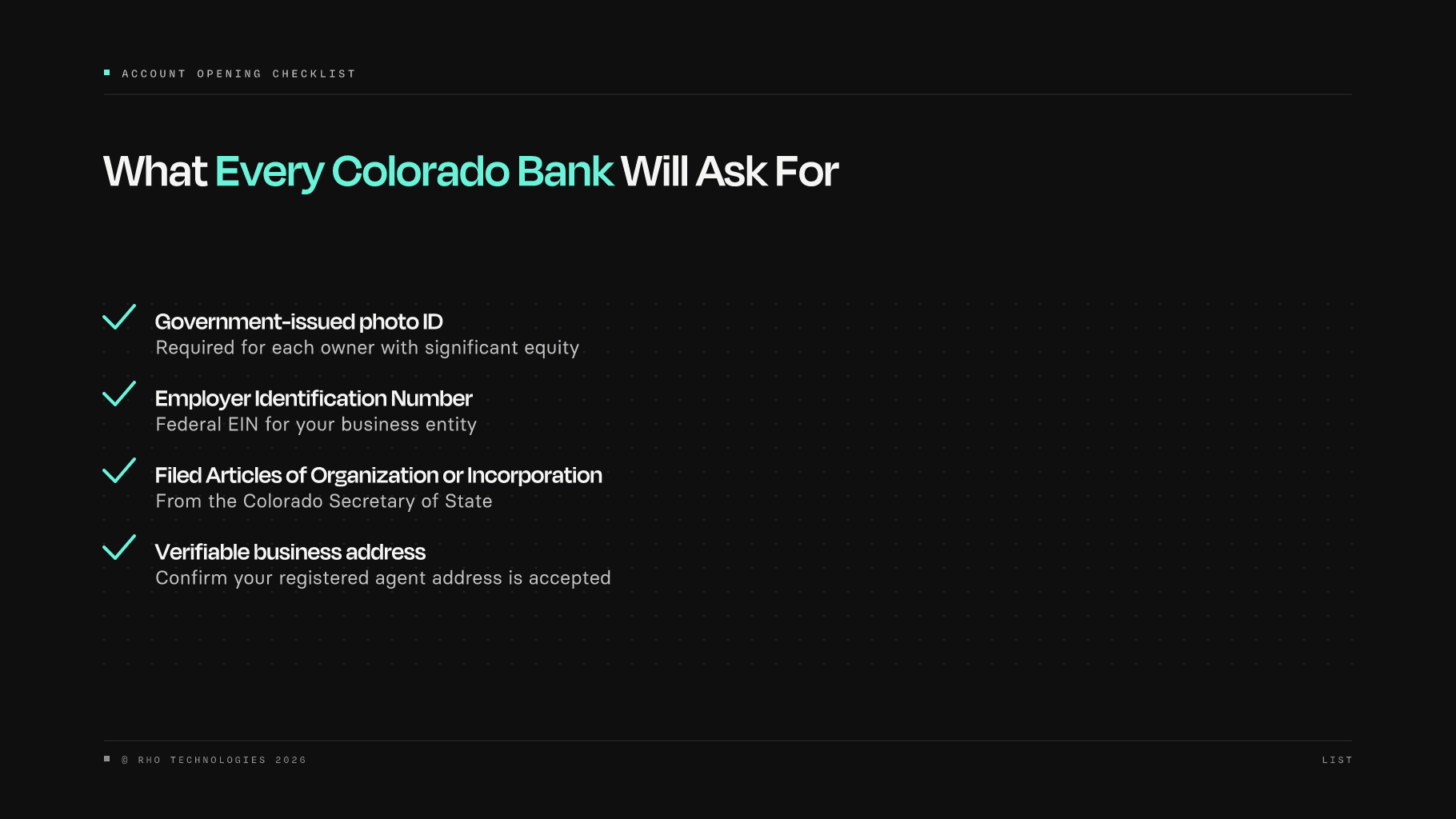
Every Colorado bank and credit union will require roughly the same four items. Missing any single item restarts the clock.
Government-issued photo ID for each owner with significant equity
Employer Identification Number
Filed Articles of Organization or Certificate of Incorporation from the Colorado Secretary of State
Verifiable business address
Some institutions also request an operating agreement for LLCs or corporate bylaws for C-Corps. For founders using a registered agent address, confirm in advance that the bank accepts it; some branch managers require a physical Colorado street address, which catches remote and out-of-state founders off guard.
Where In-Person Requirements Create Real Delays
Traditional banks generally require in-person visits to verify identity and complete account opening, while online platforms complete the same process through digital document submission alone. Teams consistently report same-day access to debit cards and payment features with online platforms, whereas traditional banks typically involve multi-day approval timelines.
The in-person requirement is the first indication that the institution's product was designed around a branch-dependent operating model. It assumes you have the time and proximity to show up in person rather than the urgency to start transacting the same day.
Next steps
If your banking setup is quietly costing you more than the monthly fee line suggests, the path forward starts with treating banking infrastructure as a growth decision, not an administrative one.
A platform that can't keep pace with your fourth hire doesn't fail loudly. It fails in reconciliation backlogs, manual expense corrections, and a month-end close that eats Friday afternoons. Start with our business bank for startups.
The fee-waiver mechanics at traditional Colorado banks are architected around consistent card-processing volume and stable daily balances, which means the account that looks cheapest on paper becomes the most expensive precisely when revenue is uneven.
At the same time, selecting a bank without native spend controls and accounting integrations means every financial signal your team uses for burn, hiring, and fundraising decisions is degraded in real time by manual errors.
Those two realities together point to one conclusion: the conventional bank-selection checklist evaluates none of the infrastructure features that determine whether a platform can actually scale with you.
Start with Rho. From there, you can issue cards the same day, set spend controls by department, and connect directly to QuickBooks Online, NetSuite, or Intacct at $0, so the next month-end close takes under an hour instead of a weekend.
FAQs
For a growth-stage LLC, the post points to platforms that eliminate transaction caps, balance minimums, and the need to bolt on separate tools for corporate cards, bill pay, and accounting integrations. Rho is highlighted as the option that works at incorporation and still works at Series B without a rebuild, with $0 platform fees and no minimum balance required.
Community banks like Bank of Colorado and Community Banks of Colorado serve stable, low-transaction businesses well but carry limited digital tooling, thin accounting integrations, and transaction caps that create friction once headcount grows. National banks impose similar transaction ceilings and daily balance minimums that can quietly erode operating cash. Online platforms built for scaling businesses remove those caps and integrate directly with tools like QuickBooks and NetSuite, which is why the post argues the choice matters most not at day one, but at month fourteen.
Yes, the post covers both Elevations Credit Union and Canvas Credit Union as options for Colorado small businesses. Elevations serves the Boulder and Denver metro area and also offers treasury management and commercial real estate lending, while Canvas provides fee-free ATM access and above-average mobile app ratings. Both carry the same ceiling as the post flags for most credit unions: limited AP automation, no corporate card programs with granular spend controls, and few native ERP integrations.
The post doesn't state a universal opening deposit figure, but it does highlight that minimum balance requirements vary significantly once the account is open. Chase requires a minimum daily balance of $2,000, not an average, to waive its $15 monthly fee, while Rho requires no minimum balance to open or maintain an account and charges $0 regardless of company size or headcount.
At most Colorado business checking accounts, including Chase Business Complete Banking, Bank of Colorado's Business Growth Account, and Wells Fargo Initiate Business Checking, exceeding the fee-free transaction cap triggers per-item overage charges. The post notes that a five-person team can clear 100 transactions in the second week of the month, and that accounting teams consistently flag this ceiling as the first structural surprise. Rho imposes no transaction limits and charges $0 per-item fees, including $0 for ACH, same-day ACH, and domestic wires.