

Most Massachusetts business bank rankings are built for sole proprietors. If you're incorporated, post-raise, or adding a finance lead, you're reading the wrong list.
Most YC and accelerator founders assume that picking the bank with the most branches and lowest monthly fee is the safe, reversible default, something you can always upgrade later when the business is bigger.
The problem is that this assumption is built on "best banks for small business in Massachusetts" lists written for a very specific business owner: a sole proprietor running a Main Street shop, optimizing for branch proximity and waived ATM fees.
That owner is real, and those lists serve them fine. The problem is that founders, finance leads, and incorporated startups reading the same list are working from a completely different set of needs, and the ranking criteria don't signal that gap anywhere. See our business bank for startups for how this works in practice.
Rho is a fintech company, not a bank or an FDIC-insured depository institution. Checking account and card services provided by Webster Bank, a division of Santander Bank, N.A. Member FDIC, and by Lead Bank, Member FDIC. Savings account services provided by American Deposit Management Co. and its partner banks.
According to the Massachusetts Executive Office of Economic Development, the majority of Massachusetts small businesses are sole proprietorships, and most official state guidance is calibrated to that majority. That's not a criticism; it's a structural reality.
But it means every listicle built on top of that guidance inherits the same blind spot: it measures what matters for a sole proprietor and presents those measurements as universal truth. The moment a business incorporates, adds a finance lead, or closes a seed round, the criteria flip entirely.
A YC-backed Boston SaaS startup that opened at a regional community bank post-incorporation spent three weeks waiting for a second signer to be added in-branch before payroll could go out. That story isn't unusual.
It's the predictable output of choosing a bank ranked on branch density rather than multi-user permissions and remote account management. The Small Business Administration frames opening a business bank account as a one-time setup task. That framing works for a sole proprietor.
For an incorporated startup holding a post-raise balance, it misses everything: FDIC coverage limits, multi-signer access requirements, same-day ACH and wire infrastructure, accounting integrations, and the question of what happens to $800K sitting in a single account after a seed close.
Most 'best banks in Massachusetts' lists were written for a sole proprietor with a storefront, not an incorporated startup that raised a round, runs payroll, and needs wires to clear on a Friday afternoon.
The monthly maintenance fee is the least consequential number on your banking decision; wire fees, per-transaction costs, and accounting integration gaps are where the real drag accumulates.
Choosing a branch-first bank early can quietly foreclose options later, deposit history and account tenure with relationship lenders are what unlock SBA access in year three.
Community banks win on local credit relationships; national banks win on branch density; online banks win on speed and integrations, no single-axis ranking tells you which tradeoff your business actually needs.
FDIC pass-through coverage matters the moment a seed wire lands: an $800K deposit sitting in a single uninsured account is a structural risk, not a paperwork detail.
Rho closes the gap by combining business banking, corporate cards, bill pay, expense management, treasury, and accounting sync in one platform, no subscription fees, no duct tape between tools, and infrastructure that holds from day zero through a liquidity event.
The Hidden Costs of Picking the Wrong Business Bank in Massachusetts
Hidden Costs of the Wrong Business Bank
Picking a business bank feels like a low-stakes decision until the bills come due, the wires stack up, and reconciliation day arrives. The common assumption among early-stage founders is that picking the bank with the most branches and lowest monthly fee is the safe, reversible default, something you can always upgrade later when the business is bigger.
That assumption rarely survives contact with reality. Massachusetts founders who chose a regional bank in good faith often discover the real cost months later, not on the fee schedule, but in the hours lost stitching together a patchwork of disconnected tools.
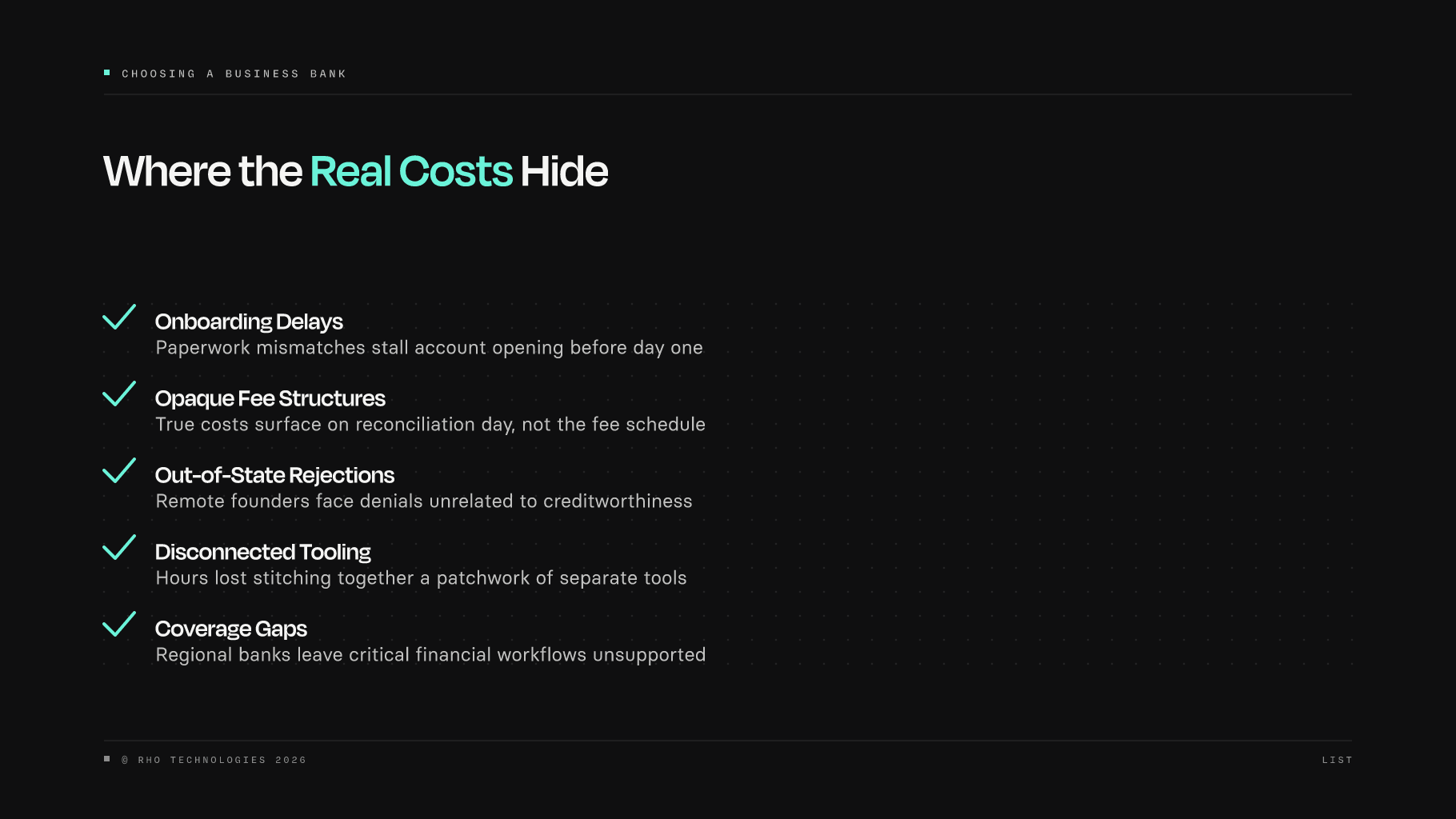
That friction is compounded for founders operating remotely in Massachusetts while registered in another state. We regularly see outright rejection from major banks that cannot verify a physical in-state address, a hidden onboarding cost that has nothing to do with creditworthiness and everything to do with paperwork mismatch.
Understanding where those costs actually live, in onboarding delays, fee structures, and coverage gaps, is the first step toward choosing a bank that does not become a liability.
"I struggle to identify which type of bank (national, local, or online-only) best suits my early-stage needs, there seems to be a real gap in guidance around how to choose a business bank in Massachusetts."
The Onboarding Tax
For Massachusetts founders, the cost of choosing the wrong bank often shows up before the first transaction clears. Industry data consistently shows that traditional branch-based banks often take longer to fully activate a business account than online-first platforms, a meaningful gap in the first weeks after incorporation or a funding close.
Established regional banks do offset that gap with relationship lending and in-person support that digital platforms do not replicate. But every day a card sits unactivated is a day vendor payments stall, employee reimbursements queue up, and the founder is on the phone with a branch manager instead of building.
A company that closes a $2M seed round on a Friday and banks with a regional institution may spend the following week unable to move capital.
That is a structural tax on momentum.
Rho is built to eliminate that tax. The platform supports pre-EIN onboarding, so founders can open an account and begin operating before their EIN arrives, and corporate cards are issued immediately with no minimum balance required.
For founders whose goal is to reduce operational time and cost spent on financial administration from day one, the difference between waiting and operating is measurable in deals closed, vendors paid, and days not lost.
The Fee Iceberg
Traditional banks charge $15 to $35 per outgoing wire transfer, fees that compound quickly for businesses making frequent payments. A company sending ten wires a month pays up to $350 in transaction costs alone, before touching the monthly maintenance fee.
Foreign exchange markup on top of per-wire charges means the true cost of each transfer is higher than the advertised figure. Founders who wire frequently often underestimate this by a factor of two.
There is no monthly platform fee, no per-user fee, and no subscription fee. The platform runs on a single unified tier available to every customer regardless of company size. For international wires, Rho does not charge a sending fee, though recipient, correspondent, or intermediary banks may apply their own charges, and an optional $15 SWIFT fee applies where relevant.
Foreign currency conversions carry a 1% fee. That structure, named, bounded, and visible, stands in direct contrast to the layered markups documented as the norm at traditional institutions.
Founders who want to fund payroll, wire vendors, and manage capital without relying on banks that do not understand their business or timeline can model the actual cost before they sign up, not discover it on a statement.
FDIC Coverage Gaps for Large Post-Raise Balances
Standard FDIC deposit insurance covers $250,000 per depositor, per FDIC-insured institution. A startup holding a $1M seed round in a single account has $750,000 sitting uninsured, a gap that treasury platforms and partner-bank network products are designed to close.
For balances beyond that threshold, Rho's savings account, provided by American Deposit Management Co. and its network of approximately 400 partner banks, extends FDIC coverage up to $75M through its network of partner banks, at $0 platform cost.
For founders who want their cash working harder, Rho Treasury is a separately managed, fee-bearing RIA product accessible from the same Rho platform. It offers Treasury Bills and mutual fund options (T-Bills settle in 2–3 business days), and an annual management fee of 15–60 basis points based on cost to provide the service.
Companies can grow without adding operational or financial overhead by keeping cash management, coverage, and yield within a single platform rather than assembling a separate stack of tools as balances grow.
How to Choose Between Local Community Banks, National Banks, and Online Banks in Massachusetts
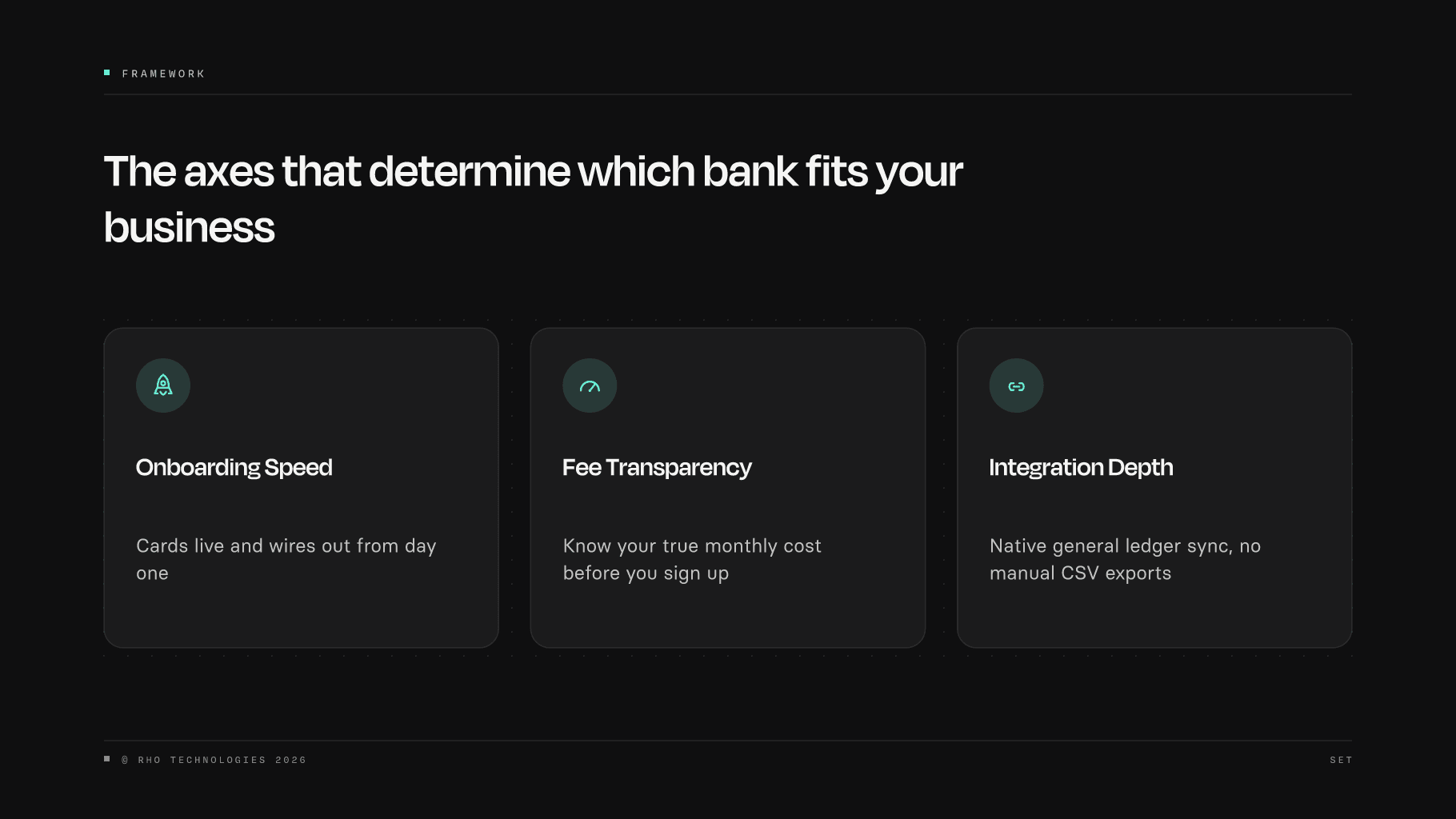
Three variables determine whether your banking setup accelerates your business or quietly taxes it every week: how fast you can get operational, what you actually pay per transaction, and how cleanly your bank connects to your accounting stack. Most founders discover all three the hard way, after incorporation paperwork is filed and the first wire needs to go out.
One thing most "best bank" content misses entirely: the ranking criteria used by mainstream listicles, branch count, ATM network, fee waivers, are calibrated almost entirely for sole proprietors, who represent the majority of Massachusetts small businesses.
Those criteria are structurally irrelevant to incorporated startups that require EIN-linked accounts, multi-signer access, and scalable wire/ACH infrastructure. Founders who use those rankings to choose a bank are optimizing for a business structure they don't have. The framework below is built for your actual business structure.
The Three Axes That Actually Determine Which Bank Type Fits Your Business
Onboarding speed is how long before your cards are live and your account can send wires. Fee transparency is whether you can calculate your true monthly cost before you sign up, before your first statement arrives. Integration depth is whether your bank connects natively to your general ledger or forces a manual CSV export every month.
These three axes are not equally weighted for every business. A cash-heavy restaurant group cares far less about integration depth than a SaaS startup reconciling hundreds of subscription charges monthly. Map your own priorities before you read a single review.
When a Massachusetts Community Bank Is the Correct Answer
Community banks hold approximately 60% of all small business loans under $1 million despite representing a fraction of total U.S. banking assets. That concentration exists because community bank loan officers use qualitative, character-based underwriting that larger institutions do not replicate.
If SBA 7(a) access, relationship lending, or cash deposit capacity is your primary need, a Massachusetts community bank is the structurally correct choice. The trade-off is real: deeper credit access in exchange for slower digital infrastructure.
60% of all small business loans under $1 million
When a National Bank Earns Its Place
National banks win on one specific dimension: vendor and landlord credibility. A recognized brand name on a business check matters when you are negotiating a commercial lease or setting up a net-30 account with a major supplier. Fee structure is where the shine wears off.
Average monthly fees for national bank business checking accounts run meaningfully higher than online alternatives, and per-wire charges ($15 to $35 each) compound fast once payroll, vendor payments, and contractor transfers stack up. Multi-location businesses with a genuine need for in-branch cash services are the clearest fit. Everyone else should do the math first.
When an Online-First Platform Is the Right Call
Online-first platforms win on three dimensions that matter most to incorporated startups:
Onboarding speed
Fee transparency
Accounting integration depth
If your business will never need to deposit physical cash, has no relationship lending requirement in the near term, and expects to run most of its financial operations digitally, payroll funding, vendor wires, expense reimbursements, treasury management, an online platform will fit the workflow better and cost less per transaction than a branch-heavy alternative.
One limitation worth planning around: if you later need an SBA 7(a) loan or a commercial line of credit backed by a long-standing bank relationship, you will want a plan for building that credit history in parallel.
The 13 Best Banks for Small Business in Massachusetts - Regional, National, and Online Options Ranked
A bank account feels like a solved problem right up until your wire fees eat your monthly fee savings, your expense tool stops syncing, and your CFO is spending a Friday afternoon doing manual reconciliation instead of closing the books.
The question most founders ask, "which bank has the lowest monthly fee?", is the wrong question entirely. The right question is: which platform will still fit in 18 months, when you have a finance lead, multiple signers, a post-raise cash balance, and vendors expecting same-day payments?
Here is the ranked list, built around that question.
1. Rho - Best All-in-One Banking Platform for Massachusetts Startups and Scale-Ups
Rho is the strongest fit for incorporated Massachusetts startups that need banking, corporate cards, bill pay, expense management, and treasury working together from day one. That ranking is based on the three evaluation axes used throughout this list, onboarding speed, fee transparency, and integration depth, applied consistently to all 13 options.
The platform runs on a single unified tier: $0 platform fee, $0 subscription fee, and $0 per-user fee, regardless of company size or headcount. Every feature, corporate cards, bill pay, AP automation, expense management, invoicing, accounting integrations, and 24/7 dedicated support, is included at that same $0 for all customers at every stage.
The only fees charged are a 1% foreign currency conversion fee on FX transfers and a 15–60bps annual management fee on Rho Treasury assets.
That single-tier structure is how the platform is designed to scale headcount and entity count without a proportional increase in finance overhead.
A four-person seed-stage team and a forty-person post-Series A team sit on the same infrastructure. The workflows your finance lead builds at month six still run cleanly at month thirty-six, without a painful platform migration or a surprise per-seat invoice when the next hire joins.
Cards are issued immediately, and same-day ACH is included at $0 for payments initiated before 2pm ET on amounts under $1M (larger or later payments settle in 1–3 business days).
Native integrations with QuickBooks Online, NetSuite, and Sage Intacct mean your accounting stack connects without a CSV export, a workflow that typically takes three to five business days and manual field mapping at traditional regional banks.
Month-end close becomes simpler and automatable, so reconciliation takes one pass instead of consuming hours that would otherwise go toward work that moves the business forward.
Here's a risk worth naming directly: small business owners who rely on national banks sometimes face sudden, unexplained account freezes and fund restrictions with no prior notification. That is a critical operational exposure for a Massachusetts startup running payroll, vendor payments, and investor distributions through a single account.
Rho's checking account is provided by Webster Bank, a division of Santander Bank, N.A., Member FDIC, with up to $250K in standard FDIC coverage on checking and up to $75M through the American Deposit Management Co. network of approximately 400 partner banks for savings.
That institutional depth reduces the operational fragility that comes with newer or lighter-regulated banking options.
Corporate cards are most beneficial when multiple employees are incurring business expenses and a finance lead needs centralized spend oversight from a single dashboard rather than a patchwork of disconnected tools.
The Rho Gmail Connector, in beta and included at $0 inside Rho Expenses, uses read-only, scoped access to find receipt-matching subject lines and attachments automatically, with no manual upload loop and no inbox data retained after disconnection.
Cardholders earn up to 2% Cashback with Rho Platinum (terms apply), on up to $1M in eligible annual card spend; 1.25% standard, credited directly to the account.
For companies holding post-raise cash balances, Rho Treasury is available directly from the same platform. Rho Treasury requires a $50,000 minimum investment; T-Bills settle in 2–3 business days.
For comparison, Mercury Treasury requires a $250,000 minimum across all accounts to access yield, a threshold that can lock early-stage companies out of the yield conversation entirely during the quarters when capital efficiency is most consequential.
A few trade-offs worth naming plainly: Rho is purpose-built for incorporated entities, so a sole-proprietor freelancer who wants a walk-in branch will find it a poor match. Founders whose primary goal is a points-based travel rewards card with lounge access should look elsewhere; Rho's cashback is operational, not points-based.
2. Rockland Trust - Best Regional Bank for Massachusetts Small Business Owners Who Want Branch Access
Rockland Trust covers Eastern Massachusetts, the South Shore, Cape Cod, and Worcester County with a branch network that genuinely matters if your business handles cash deposits or needs face-to-face banker relationships. It is a credible choice for retail, food service, or professional services firms that value in-person access and a local lending team.
Here's the catch: founders who later need AP automation, virtual cards, or native accounting integrations will find themselves bolting on third-party tools, which compounds reconciliation overhead fast.
3. Eastern Bank - Best Massachusetts-Based Bank for Mission-Driven and Minority-Owned Small Businesses
Eastern Bank has been named the number one SBA lender in Massachusetts for the 17th consecutive year, which makes it the most defensible choice for any business actively pursuing SBA 7(a) or 504 financing. That institutional depth in small business lending is a structural advantage no national bank can replicate through branch count alone.
High-growth startups pay for that lending depth somewhere else: Eastern's digital tooling and integration depth lag behind fintech-native platforms, so companies that do not need SBA access will find better infrastructure elsewhere.
4. Bristol County Savings Bank - Best for Massachusetts Small Businesses Seeking SBA Loans
Bristol County Savings Bank is a strong regional option for southeastern Massachusetts businesses that want an SBA-focused community lender with local decision-making authority. Loan officers who know the regional market can move faster than national underwriting teams, which matters when timing is tied to a lease, equipment purchase, or acquisition.
The limitation is geographic: businesses outside its core southeastern Massachusetts footprint will get less relationship value, and the digital banking experience is functional rather than modern.
5. Bay Coast Bank - Best for Massachusetts Small Businesses That Need Free Business Checking With No Minimums
Bay Coast Bank offers free business checking with no minimum balance requirement, which makes it a practical entry point for early-stage businesses in southeastern Massachusetts that want a local institution without fee pressure.
It is most beneficial for businesses that are pre-revenue or in their first operating year, where keeping overhead near zero matters more than integration depth.
Where it runs out of room: once a company needs multi-user access, virtual cards, or accounting sync, Bay Coast's platform will require supplemental tools, and that patchwork adds up quickly.
6. Chase Business Banking - Best National Bank for Massachusetts Small Businesses That Want Broad Branch and ATM Access
Chase is the largest U.S. bank by assets and offers Massachusetts small businesses a nationally recognized brand, extensive ATM network, strong online banking, and a full suite of lending products including SBA loans and business credit cards. It's a solid choice for businesses that travel frequently or operate across multiple states.
Where it comes up short: monthly fees on business checking accounts can be steep unless minimum balance thresholds are met, and customer service can feel impersonal compared to community banks.
7. Bank of America Business Advantage - Best for Massachusetts Small Businesses That Want Integrated Rewards and Cash Flow Tools
Bank of America Business Advantage is a reasonable fit for established small businesses that want rewards on card spend and access to a broad suite of credit products under one roof. The cash flow monitoring tools inside Business Advantage 360 are more developed than most national bank equivalents.
Where the math gets messy: monthly maintenance fees, minimum balance requirements across tiers, and per-wire charges mean the total cost of ownership is harder to forecast than the advertised headline fee suggests. It is not the right fit for a company optimizing for zero-overhead infrastructure.
8. Relay - Best Online Business Banking Platform for Massachusetts Small Businesses That Want Multi-Account Cash Flow Organization
Relay is a well-regarded online banking platform that lets small business owners create up to 20 checking accounts and 50 virtual cards, making it genuinely useful for businesses that want to envelope-budget their cash flow across departments or projects. There is no monthly fee and no minimum balance.
Scaling companies hit a wall here: Relay's treasury, AP automation, and accounting integration depth are lighter than platforms built specifically for venture-backed or multi-entity companies. It works best for owner-operated businesses that want organized cash management without needing a full finance stack.
9. Wells Fargo Business Banking - Best for Massachusetts Small Businesses That Need a Full-Service National Bank With Strong Lending
Wells Fargo offers one of the broadest lending product menus of any national bank, including SBA loans, business lines of credit, and equipment financing, which makes it a serious consideration for capital-intensive businesses that expect to borrow.
The branch presence in Massachusetts is solid, and the relationship banking model suits businesses that want a single institution for both operating accounts and credit facilities.
Fee structure is where it loses points: monthly fees, wire charges, and minimum balance requirements add up, and the digital experience for expense management and bill pay lags behind fintech-native alternatives.
10. Mercury - Best Online Bank for Massachusetts Tech Startups and Early-Stage Companies That Want a Clean, API-Forward Experience
Mercury is a respected digital-first banking platform built for startups, with a clean interface, API access, and a straightforward account setup that resonates with technical founders. It is a legitimate option for early-stage companies that prioritize a modern user experience and developer-friendly tooling.
For companies holding large post-raise balances, here's a number worth comparing: Mercury Treasury requires a $250,000 minimum across all accounts to access yield, while Rho Treasury starts at $50,000. That difference can matter when capital efficiency is a board-level conversation early in a company's life.
11. Citizens Bank - Best for Massachusetts Small Businesses That Want a Regional Bank With Strong SBA and Commercial Lending Relationships
Citizens Bank has deep Massachusetts roots and a strong commercial lending team, which makes it a credible choice for established small businesses that want a regional institution with SBA and commercial credit capacity. Branch access across Greater Boston and the rest of the state is meaningful for businesses that value in-person service.
Growth-stage companies run into the same wall most traditional regional banks share: the digital infrastructure for AP automation, virtual card issuance, and accounting integration requires third-party additions that fragment the finance stack.
12. Bluevine - Best Online Bank for Massachusetts Small Businesses That Want High-Yield Checking and Flexible Lines of Credit
Bluevine offers a competitive APY on business checking balances for accounts that meet its qualifying monthly spend or deposit threshold, making it one of the more compelling yield options among online-first platforms. The integrated line of credit product is a genuine differentiator for businesses that want liquidity access without a separate lender relationship.
Platform depth is the weak point: Bluevine's expense management and AP automation capabilities are lighter than all-in-one platforms, so businesses that need unified spend oversight across multiple employees will find themselves supplementing with additional tools.
Update (October 2026): Valley National Bank announced it will acquire Bluevine for $340 million, with the deal expected to close in early 2027. Bluevine will become Valley's small-business banking division; existing accounts aren't expected to change before then.
13. Needham Bank - Best Massachusetts Community Bank for Established Small Businesses in Greater Boston Seeking Personalized Service
Needham Bank is a well-regarded Greater Boston community bank known for responsive, relationship-driven service and local decision-making on credit. For established businesses that value a banker who knows their name and their business model, Needham delivers something national banks cannot.
The limitation is exactly what you'd expect from a community bank this size: digital tooling, integration options, and multi-entity support are limited relative to fintech platforms. It is best suited for businesses where the human relationship and local credit access matter more than automated financial workflows.
What to Look for in a Massachusetts Business Bank Account - The Framework Behind This List
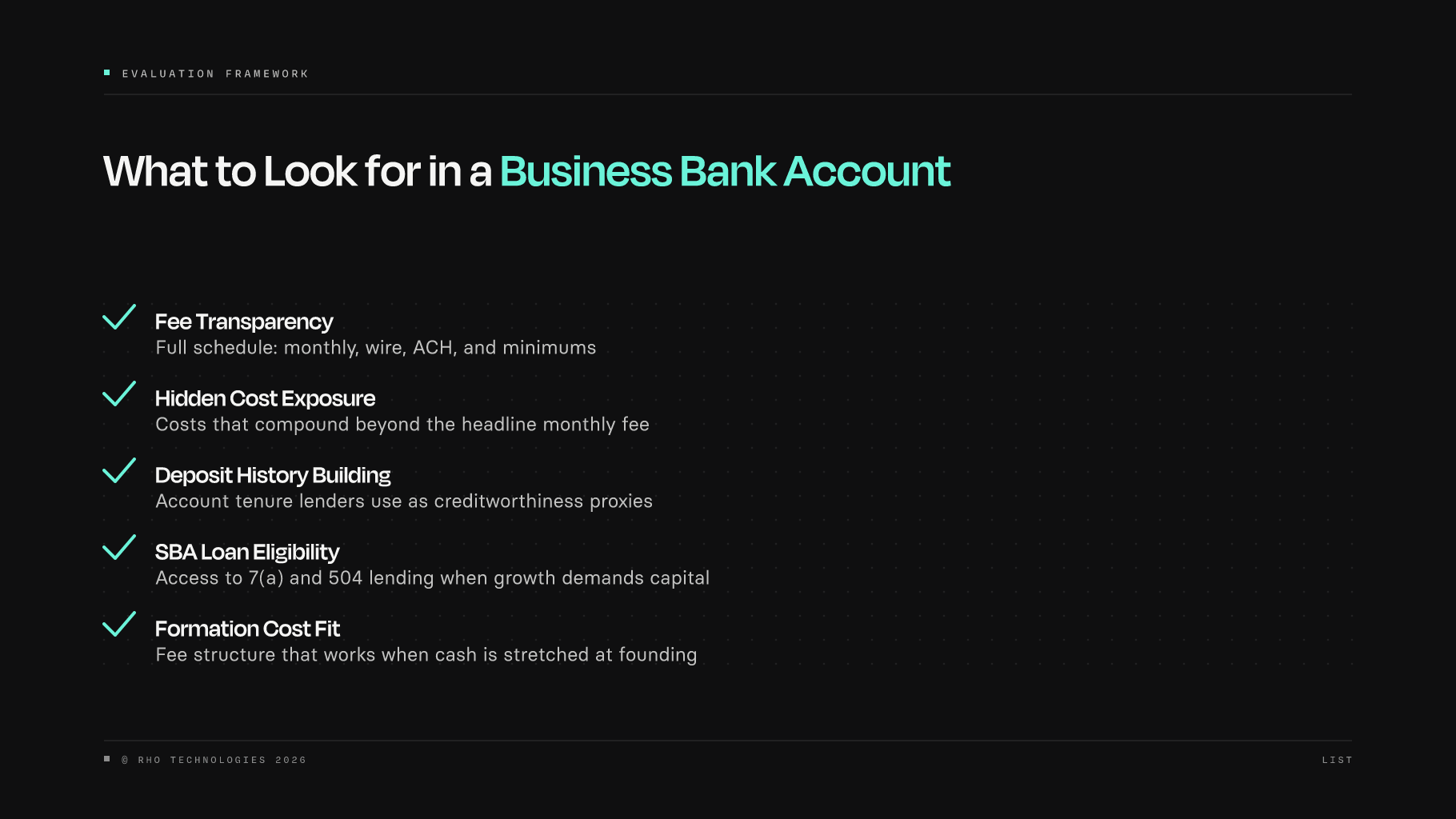
Most founders evaluate banks on monthly fees, but that single number obscures a more consequential decision. The real cost of choosing the wrong bank often shows up years later, when the deposit history and account tenure you never built become the proxies a relationship lender uses to deny an SBA loan at exactly the moment growth demands capital.
The criteria below are organized around that fuller picture, covering fee transparency, hidden costs, and the structural factors that compound well beyond the day you open the account.
The Five Numbers to Collect Before You Sign Anything
The real cost of choosing the wrong bank isn't the $15 monthly maintenance fee you avoided. It's the SBA loan you can't access in year three because you never built the deposit history and account tenure that relationship lenders use as proxies for creditworthiness.
Those same institutions dominate SBA 7(a) and 504 lending, meaning a day-one banking decision made on fee comparisons alone can actively cap borrowing power at the exact moment growth demands it.
Massachusetts founders face an additional layer of pressure here: LLC filing fees, DBA registrations, and early workspace costs mean cash is already stretched at formation. That makes fee transparency, covering the full schedule of wire fees, ACH costs, and minimum balance requirements, a genuinely consequential evaluation criterion.
The pattern shows up consistently: founders who skip this step discover the hidden costs only after the account is open and the first reconciliation cycle begins.
With that context established, here are the five numbers worth collecting before you sign anything.
Monthly fees are often the smallest line item in the total cost of a banking relationship. Fee transparency, including hidden charges, minimum balance requirements, and per-transaction costs, is a critical evaluation criterion that founders routinely miss because headline monthly fee comparisons obscure it.
The five numbers worth collecting: monthly maintenance fee, outgoing domestic wire fee (industry benchmarks place the average between $15 and $35 per wire), incoming wire fee, same-day ACH availability and cost, and FDIC coverage ceiling.
On that last point: Rho charges $0 for domestic wire transfers, $0 for ACH payments (same-day ACH included, settled same day if created before 2pm ET for amounts under $1M), and carries a $0 monthly platform fee with no per-user fee and no minimum balance requirement for the core platform.
That matters for early-stage founders who need to move money the day a round closes without watching a wire-fee line item accumulate.
That last FDIC number matters more than most founders expect. Standard FDIC coverage is $250K per depositor per institution.
For companies holding post-raise cash above that threshold, Rho's savings account, provided by American Deposit Management Co. and its network of partner banks, extends FDIC coverage up to $75M through its network of partner banks. If your balance is above $250K, that partner-bank network is the specific mechanism that closes the exposure gap.
For companies whose cash position grows further, Rho Treasury is a separate, fee-bearing RIA product accessible from the same Rho platform. Rho Treasury requires a $50,000 minimum investment.
Treasury Bills and mutual fund options; T-Bills settle in 2–3 business days and mutual fund redemptions settle next business day. A management fee of 15–60bps annually applies based on cost to provide the service (see the ADV-2A Wrap Fee Brochure).
Rho Treasury investments are not deposits and are not FDIC insured. That distinction matters for any founder or controller doing proper cash tiering.
Notably, Rho Treasury does not require a $250,000 minimum balance the way Mercury Treasury does.
Integration Depth vs. Integration Theater
A bank that lists "QuickBooks compatible" in its feature set may mean nothing more than a downloadable CSV. That is integration theater. Businesses that rely on manual CSV exports or disconnected tools face recurring reconciliation overhead every accounting period, overhead that compounds as transaction volume grows.
Addition Finance reinforces this: the time cost of bookkeeping is one of the most underestimated drains on early-stage finance teams. Native, direct sync, where transactions, receipts, and expense data flow automatically into your accounting ledger, is a fundamentally different product than a bank feed you have to babysit.
The controllers we talk to put it plainly: the integration question is whether it eliminates manual steps or merely reduces them.
Rho connects natively and directly to QuickBooks Online, Oracle NetSuite, and Sage Intacct, transactions, receipts, and expense data sync automatically. Xero connects via bank feed. The NetSuite integration is included at $0, with enriched NetSuite automations included. No third-party connector, no manual field mapping required.
Rho's expense management layer is included at $0, with no user or platform usage fees. It includes the Rho Gmail Connector (in beta; included at $0, built into Rho Expenses), which uses read-only, scoped access to match subject lines and attachments against receipt keyword rules and capture receipts automatically.
No inbox data is retained after disconnection, and unlimited reimbursements are included at $0.
For companies with multiple employees incurring business expenses, Rho's corporate cards are issued immediately with no minimum balance required and earn up to 2% Cashback with Rho Platinum (terms apply), on up to $1M in eligible annual card spend; 1.25% standard, credited directly to the account.
Rho's Rho Close feature, included in the platform, provides AI-suggested first-pass transaction coding. It requires a native accounting integration and works with QuickBooks Online, Oracle NetSuite, and Sage Intacct (direct), and Xero (bank feed).
Onboarding Speed as a Competitive Signal
The week after incorporation or a funding close is exactly when a company needs to start spending.
Remote founders in Massachusetts, and founders operating across state lines, face a specific friction point here: major banks that require proof of a physical business address or in-branch signer verification can delay activation by days or weeks, which is a direct tax on post-close momentum.
Finance leaders describe this as one of the most disruptive early-stage banking failures: cards aren't live, wires can't be sent, and the team is blocked on vendor payments and payroll setup at exactly the wrong moment.
Rho supports pre-EIN onboarding; founders can open an account before their EIN arrives, and corporate cards are issued immediately with no minimum balance required.
Through the Stripe Atlas integration, founders can open accounts and start using Rho before their EIN arrives. A one-click pre-fill of the Rho application is also available through Clerky. Rho has no personal credit pull and requires no personal guarantee.
Every Rho customer, across all company sizes and headcounts, with no platform tier gating, gets a dedicated point of contact accessible via chat, email, or phone, responding in under a minute, 24/7, at no additional cost. There is no tiered support model.
Massachusetts Business Bank Evaluation Checklist
Use this checklist before opening any business bank account in Massachusetts:
Criterion | Questions to Ask | Why It Matters |
|---|---|---|
Monthly fee & waivers | What is the monthly fee, and what balance or activity waives it? | Determines baseline fixed cost |
Outgoing wire fee | What does each domestic outgoing wire cost? | At 10–15 wires/month, this eclipses any monthly fee savings |
Same-day ACH | Is same-day ACH available, and at what cost? | Critical for payroll and time-sensitive vendor payments |
FDIC coverage | Is a partner-bank network available for balances above $250K? | Post-raise balances are uninsured without it |
Multi-user / signer access | Can additional signers or employees be added remotely? | In-branch-only signer adds create payroll risk |
Accounting integration | Does the bank sync natively to QuickBooks, NetSuite, or Sage Intacct, or only via CSV? | Manual exports compound reconciliation overhead |
Onboarding speed | How many business days until cards are live and wires can be sent? | A slow activation is a direct tax on post-close momentum |
SBA lending history | Is this bank an active SBA 7(a) or 504 lender in Massachusetts? | Matters for year-3 borrowing power even if irrelevant today |
Minimum passing score for an incorporated startup: all eight criteria answered in writing before you sign the account agreement.
Next steps
If your banking setup was chosen on branch count and monthly fees rather than wire costs, integration depth, and FDIC coverage access, the path forward starts with recognizing that those criteria were written for a different kind of business owner entirely.
Mainstream rankings calibrated for sole proprietors push incorporated startups toward infrastructure that was never designed for multi-signer access, same-day ACH, or post-raise cash protection. That mismatch is structural, not fixable with a better spreadsheet.
Per-wire fees of $15 to $35 compound fast enough to erase any monthly fee savings within a single quarter. Because wire infrastructure is embedded in payroll and vendor workflows, switching later means re-linking everything, which makes the initial cost asymmetry permanent.
Together, those two realities point to one action: open on a platform where the fee structure is bounded, the integrations are native, and FDIC coverage scales with your balance through that partner network from day one.
Start with business bank for startups at Rho. Cards issue immediately, domestic wires run at $0, same-day ACH is included, and native accounting integrations with QuickBooks Online, NetSuite, and Sage Intacct replace the CSV export loop that quietly compounds reconciliation overhead every month you stay on the wrong platform.
FAQs
Rho charges $0 platform fee, $0 subscription fee, and $0 per-user fee, with $0 domestic wire transfers and $0 ACH payments including same-day ACH for amounts under $1M initiated before 2 p.m. The only fees are a 1% foreign currency conversion fee on FX transfers and, if you use Rho Treasury, an annual management fee of 15-60 basis points.
Online-first platforms are the strongest fit for incorporated startups, winning on onboarding speed, fee transparency, and accounting integration depth, the three axes the post identifies as most relevant to businesses with EIN-linked accounts, multi-signer access, and scalable wire and ACH needs. A community or national bank calibrated for sole proprietors will not meet those structural requirements out of the box.
Rho offers native integrations with QuickBooks Online, NetSuite, and Sage Intacct at no added cost, eliminating the manual CSV exports that traditional regional banks typically require. The post notes that manual reconciliation at those institutions typically takes three to five business days and requires manual field mapping.
Community banks are the structurally correct choice if SBA 7(a) access or relationship lending is your primary need, because their loan officers use qualitative, character-based underwriting that larger institutions do not replicate. The post notes that community banks hold approximately 60% of all small business loans under $1 million despite representing a fraction of total U.S. banking assets.
Standard FDIC deposit insurance covers $250,000 per depositor per institution, meaning a startup holding a $1M seed round in a single account has $750,000 sitting uninsured. Rho's savings account, provided by American Deposit Management Co. and its network of approximately 400 partner banks, extends FDIC coverage up to $75M through its network of partner banks at $0 platform cost.