

The bank that saves you $15 a month today can cost you months of broken workflows when you scale. Here is what Ohio founders get wrong before they ever compare a single fee.
Most founders and CEOs assume that any business checking account with low fees and a recognizable brand name is fine for now, and that switching banks later, if they ever need to, is a manageable, low-risk project.
That assumption shapes the question they ask first: which bank has the lowest monthly fee or the most branches near their office, and that framing shapes every comparison they make from that point forward. It feels like responsible due diligence. For an incorporated startup with any growth ambition, it isn't. See our business bank for startups for how this works in practice.
The real question is whether the bank you open with today can still serve you when you add a second entity, close a seed round, or need AP automation without rebuilding your entire finance stack. That gap between the question founders ask and the question they should ask is where most banking regrets begin. Platforms like Rho are built specifically for the moment that gap becomes expensive.
Rho is a fintech company, not a bank or an FDIC-insured depository institution. Checking account and card services provided by Webster Bank, a division of Santander Bank, N.A. Member FDIC, and by Lead Bank, Member FDIC. Savings account services provided by American Deposit Management Co. and its partner banks.
Ohio has one of the most crowded banking markets in the country. According to the FDIC Summary of Deposits (June 2024), Ohio hosts over 3,700 FDIC-insured bank and thrift branch offices.
Yet the number of FDIC-insured institutions headquartered in Ohio has declined by more than 30% over the past two decades, according to the FDIC Summary of Deposits (2024), a consolidation wave that has quietly forced involuntary banking migrations on thousands of small business customers who never chose to switch.
The mismatch is structural. Standard banking rankings use FDIC data categories built around asset size and charter type, not around service capabilities like multi-entity support, API integrations, or accounting automation. A bank can rank highly on every published list and still have no native QuickBooks sync, no spend controls, and no path to AP automation.
A Columbus SaaS startup that picks a regional bank for its $0 monthly fee may find that the account works fine at five employees and becomes a structural bottleneck at fifteen, when native QuickBooks sync, multi-entity support, and AP automation all become non-negotiable and none of them are on the roadmap.
Choosing a bank based on monthly fees and branch count is the decision that manufactures a painful migration crisis 12 to 18 months later, when payroll, vendor payments, and investor scrutiny all arrive at once.
The real cost of the wrong Ohio business bank isn't the maintenance fee; it's the hours spent re-wiring accounting integrations, notifying vendors, and running two accounts in parallel while you switch.
Scale-readiness is the filter that matters before anything else: does this bank support multiple entities, automated reconciliation, and API-level integrations, or does it cap out at basic checking?
Ohio's published fee tables are remarkably similar across banks; the actual cost of running your books through them is not, because transaction limits, wire fees, and cash deposit thresholds compound fast on an active business.
Switching business banks is not a low-risk weekend project; it typically requires auditing every payment setup, migrating direct debits, and absorbing weeks of operational drag.
Rho's Business Banking lets Ohio startups open accounts quickly, earn yield on idle cash, and manage all money movement in one place, built to move at startup speed and scale without forcing a migration the moment the business grows.
The Hidden Cost of the Wrong Ohio Business Bank - Fees, Friction, and the Scale-Readiness Threshold
The number most founders circle first when comparing business bank accounts is the monthly maintenance fee. It is visible, concrete, and easy to compare across a spreadsheet row. But that visibility is precisely what makes it misleading.
Monthly fees represent a fixed, predictable cost that even a modestly active business absorbs without noticing, while the friction costs hiding elsewhere on the same account (wire limits, ACH delays, card controls, approval workflows) compound quietly in the background and scale with every new vendor, every additional card, and every entity added to the structure.
By the time those costs become obvious, they have already been absorbed into the team's weekly rhythm as normal overhead, invisible on the fee schedule and invisible on the income statement, but very real on the calendar.
One friction cost that catches Ohio founders off guard is specific to how certain incumbent banks handle check issuance: funds are deducted from the account the moment a check is issued, not when the check is actually negotiated by the recipient.
For a business managing payroll timing, vendor payments, and operating runway simultaneously, that gap between issuance and negotiation creates unexpected cash flow disruptions, a hidden cost of the wrong banking setup that never appears on any fee comparison spreadsheet.
The common assumption among founders is that any business checking account with low fees and a recognizable brand name is fine for now, and that switching banks later, if they ever need to, is a manageable, low-risk project.
The $15 monthly maintenance fee you avoided by opening a no-fee checking account feels like a win on day one. It stops feeling that way around month three, when you are manually exporting transactions from your bank, importing them into a separate expense tool, and reconciling the gap before your accountant can close the books.
According to industry research, small business owners spend an average of five hours per month on bookkeeping and accounting tasks, and that number climbs when banking, expense, and accounting tools are disconnected. Five hours a month is sixty hours a year. That is not a rounding error.
Finance Stack Drag - The Compounding Time-Tax of Disconnected Banking, Cards, and Expenses
Finance Stack Drag is what happens when your bank, your corporate card provider, your bill pay tool, and your accounting system each live in a separate login. Every month-end close requires a manual export-import cycle, and every cycle introduces the risk of a missed transaction or a mismatched category.
27% of small business owners spend more than ten hours per week on administrative and financial management tasks. Fragmented tools are a primary driver of that number.
The design premise behind Rho is that banking, corporate cards, bill pay, expense management, and accounting integrations should live in one place and talk to each other without manual intervention. At $0 in platform, subscription, and per-user fees, every Rho customer gets:
AP automation
Unlimited bill pay
Same-day ACH
$0 domestic wires
Unlimited reimbursements
Native direct integrations with QuickBooks Online, Oracle NetSuite, Sage Intacct, and Xero
These are standard features available to every customer from day one. Transactions, receipts, and expense data sync automatically to the ledger, removing the export-import cycle entirely.
The goal is concrete: enable a business to scale headcount and entity count without a proportional increase in finance overhead, and reduce the operational time and cost that disconnected financial administration quietly consumes.
The Scale-Readiness Ceiling Most Ohio Founders Don't See Until They Hit It
The scale-readiness ceiling usually hits at one of three inflection points:
Adding a second entity
Preparing for a fundraiser
Hiring a finance lead who immediately asks why there is no accounting integration
At that moment, the "free" checking account reveals the gap it was always hiding: no native integration, no multi-entity permissions, no AP automation path, and a migration project that arrives precisely when the team has the least bandwidth to run it.
Rho's single unified platform tier means multi-entity support, corporate cards with no minimum balance requirement, and native accounting integrations are already in place before that ceiling arrives.
A business that grows without outgrowing its finance stack can scale without adding operational or financial overhead. That return never shows up on a monthly fee comparison, but accumulates on the calendar every month.
How to Choose the Right Business Bank in Ohio - What to Look For Beyond the Fee Schedule
Most Ohio founders approach bank selection as a cost-minimization exercise, scanning fee schedules and sign-up bonuses before anything else. That framing is the problem.
The sub-sections below reorder the decision entirely, starting with the question of whether a bank can still support your operations 18 months from now, because the accounting integrations and reconciliation workflows you build around your banking infrastructure become expensive to unwind at exactly the moment you can least afford the disruption.

The Scale-Readiness Threshold - The One Filter Ohio Founders Should Apply Before Anything Else
Choosing a business bank based on headline fees and promotional bonuses manufactures a future migration crisis.
Because accounting integrations and automated reconciliation workflows become deeply embedded in month-end close processes over time, the longer an Ohio founder stays with a fee-optimized but integration-poor account, the more disruptive and expensive the eventual forced switch becomes, transforming a "low-stakes" Day 1 decision into a compounding liability that peaks at exactly the moment of fastest growth.
Before comparing fees, ask one question: will this bank still fit my business in 18 months? Switching banks mid-growth resets hard-won automation infrastructure and can push close timelines from the automated benchmark of 3 to 5 business days back toward the manual benchmark of 8 to 12 business days.
A finance-operations disruption of that size lands at exactly the moment your team has the least capacity to absorb it. Manual reconciliation creates cascading downstream errors, the kind that surface only after your team has already built its rhythm around the broken workflow.
Founders we work with through Rho experience this directly: they want to look like a real company, fund payroll, wire vendors, and manage capital, without depending on banks that don't understand their business or timeline.
The operational pressure is real. Payroll has to clear. Vendor wires can't stall. And when the accounting stack isn't native to the banking platform, every month-end close becomes a manual rescue operation.
The scale-readiness threshold is simple: does the bank support multi-entity structures, native accounting integrations, and transaction volumes beyond a starter tier, without requiring you to migrate to a new product or sign a new contract? If the answer is no, the low monthly fee is a deferred switching cost.
Rho is built around this reality. Every Rho customer, regardless of company size or headcount, operates on a single unified platform with a $0 subscription fee, $0 per-user fee, and no platform tier gating. Native direct integrations with QuickBooks Online, Oracle NetSuite, and Sage Intacct are included at $0, with Xero supported via bank feed.
Transactions, receipts, and expense data sync automatically. Multi-entity support is available under the same account settings, meaning a second operating entity doesn't require a new contract or a new product. When you wire a vendor, that wire is $0 domestic and settles same business day if initiated before 4:45 PM ET.
Same-day ACH is included at $0. That is the infrastructure a 12-person company actually needs, and it's accessible on Day 1, not gated behind a revenue milestone.
For Ohio founders eyeing treasury management: Rho Treasury is a separate, fee-bearing RIA product accessible from the same Rho platform. It requires a $50,000 minimum investment.
Treasury Bills and mutual fund options are available; T-Bills settle in 2–3 business days and mutual fund redemptions settle next business day. Rho Treasury investments are not deposits and are not FDIC insured.
Unlike Mercury Treasury, which requires $250,000 across all accounts, Rho Treasury's entry threshold is $50,000, a meaningful difference for growth-stage companies building their cash position.
Transaction Volume, Cash Handling, and Multi-Entity Needs - Building Your Decision Scorecard
The right bank for a solo founder processing 40 ACH payments a month is not the right bank for a 12-person company running payroll, vendor payments, and a second operating entity. Transaction caps, cash deposit fees, and per-wire charges compound quietly.
By the time they become visible, the operational workarounds (manual exports, spreadsheet reconciliation, duplicate data entry) are already baked into the team's weekly rhythm. This pattern is one of the most common sources of avoidable finance-team overhead in scaling businesses.
Build a simple scorecard before you evaluate any specific institution using the framework below.
Ohio Business Bank Decision Scorecard
Score each bank against those six variables first. Fee schedules come second.
Founders who want to look like a real company without losing operational agility need a platform that handles accounts payable automation, unlimited reimbursements, corporate cards earning up to 2% Cashback with Rho Platinum (terms apply), on up to $1M in eligible annual card spend; 1.25% standard, and basic invoicing, all at $0, from the same dashboard where they manage treasury and close the books.
That combination is what separates a scale-ready platform from a fee-optimized starter account that will need to be replaced.
Online Bank vs. Traditional Branch vs. Credit Union for Ohio Businesses
If your business regularly handles physical cash, a traditional branch relationship is not optional. Cash deposits through third-party ATM networks carry fees that accumulate fast for retailers, food service operators, or event-based businesses.
The 15 Best Banks for Small Business in Ohio (2026): Regional, National, and Digital Options Compared
Here's where the fee-table comparison actually breaks down.
Most Ohio startups discover the mismatch the hard way: the account that handled early transactions smoothly starts showing its limits the moment payroll, vendor payments, and investor scrutiny arrive at the same time. That gap between what a bank offers at signup and what your business actually needs twelve months later is where the real cost hides.
Most founders treat the initial banking decision like a utility hookup: pick the most recognizable name, confirm the monthly fee is low or zero, and move on. The logic feels sound. But the traditional Ohio bank tier structure creates what you might call a Scale-Readiness Threshold, an invisible ceiling built into the bank's product architecture, not your growth plan.
You cannot see it at account opening. It arrives without warning, typically the moment transaction volume climbs, a second entity appears, or a new investor asks why your AP process still runs through a spreadsheet.
The 15 options below are ranked not just by fee structure but by how far each will carry a growth-track Ohio business before that ceiling appears.
A Note on How to Read This List
Each entry names the one decision-relevant fact that changes your shortlist, the honest tradeoff, and the specific founder profile that fits best. Fee data is sourced from published 2025 pricing; where fee waiver conditions apply, they are stated explicitly. The list moves from highest scale-readiness to most specialized use case.
How Scale-Readiness Changes the Decision
Park National Bank, named the No. 1 Best Bank in Ohio for customer service, does not appear in the 15-item ranking above because its product profile fits a comparison callout better than a growth-stage listicle slot.
Its Business Checking carries an $8 monthly fee, waivable with a $1,000 minimum balance, and includes 150 free transactions per month. For Ohio founders who prioritize local service quality over scale-readiness, it is worth a direct conversation.
Choosing the right bank from this list is only half the decision. The published monthly fee is rarely the number that matters most: transaction overage charges, wire fees, and the compounding labor cost of manual reconciliation routinely exceed the headline maintenance fee within the first year of active use. The comparison below breaks those numbers out explicitly.
1. Rho - Best All-in-One Banking Platform for Ohio Startups and Scale-Ups
Most Ohio founders open a regional business checking account because it feels safe, then spend the next two years bolting on a separate corporate card provider, a bill pay tool, and a spreadsheet-based expense process that turns month-end close into a multi-day fire drill.
The real cost is the reconciliation hours, the approval bottlenecks, and the blind spots in cash visibility that compound every month.
Rho's business banking platform is one of the only options on this list purpose-built to eliminate the patchwork entirely.
Rho's product documentation describes a unified platform architecture that combines banking, cards, bill pay, and accounting sync in a single data model, so transactions, receipts, and expense data sync automatically to QuickBooks Online, Oracle NetSuite, and Sage Intacct without a middleware connector or a separate export step.
That value is most tangible when a company needs a fast, scalable banking setup without legacy bank overhead: banking, corporate cards, bill pay, expense management, and treasury in one platform at $0 subscription fee, with same-day ACH, $0 domestic wires, native integrations with QuickBooks Online, Oracle NetSuite, and Sage Intacct, and up to $75M in FDIC coverage via the ADM sweep network.
Rho Treasury requires a $50,000 minimum investment; advisory services are provided by RBB Treasury LLC dba Rho Treasury, an SEC-registered investment adviser and subsidiary of Rho, and investments are not FDIC insured. A management fee of 15–60bps annually applies; see the ADV-2A Wrap Fee Brochure for full details.
Banking services are provided by Webster Bank, a division of Santander Bank, N.A., Member FDIC, and by Lead Bank, Member FDIC. For Ohio founders who have already felt that friction, or want to avoid it entirely, Rho is the only option on this list where the bank account is the foundation of a complete finance operating system.
2. Huntington Bank - Best Regional Bank for Ohio Small Business Lending
Huntington Bank's published 2025 terms show the entry-level Business Checking 100 carries a $0 monthly maintenance fee and covers up to 100 transactions per month before overage fees apply. That is the right fit for an early-stage Ohio business with low transaction volume.
The real differentiator is lending access: Huntington's deep Ohio footprint and SBA preferred lender status make it the strongest regional choice for founders who need a credit relationship alongside their deposit account.
The ceiling is real, though. Once monthly transactions exceed 100, or once you need multi-entity support or AP automation, the product architecture pushes you toward a commercial banking tier that operates on a different relationship model entirely.
3. Fifth Third Bank - Best for Ohio Small Businesses Needing Full-Service Branch Banking
Fifth Third's published pricing shows the Preferred Checking tier carries a $25 monthly maintenance fee, waivable with $100,000 in combined Fifth Third balances, which signals this product is designed for businesses with meaningful existing assets at the bank.
For Ohio small businesses that handle physical cash regularly and want treasury management, merchant services, and branch staff in the same conversation, Fifth Third delivers. Getting there costs something up front, though: the fee structure and waiver conditions favor businesses that are already scaled, not those just starting out.
4. KeyBank - Best for Ohio Small Businesses Seeking Relationship-Based Credit Access
KeyBank's business checking carries a $12 monthly fee, waivable with a $2,500 average daily balance, and includes 200 free transactions per cycle, according to its published 2025 pricing. The KeyNavigator cash management platform gives finance teams real-time visibility into cash positions.
Dedicated small business relationship managers are a real differentiator too, for founders who want a human point of contact inside a national bank. Where it falls short: KeyBank's digital integrations with accounting platforms lag behind fintech-native alternatives, so finance teams that prioritize automated reconciliation will feel the gap at month-end.
5. Chase Business Banking - Best National Bank for Ohio Small Businesses Wanting Brand Ubiquity
Chase Business Complete Banking carries a $15 monthly fee, waivable with a $2,000 minimum daily balance, and includes 100 free transactions per cycle, based on its 2025 published rates. The built-in Chase QuickAccept credit card processing with same-day deposits is a real edge for Ohio businesses with high point-of-sale volume.
But those 100 free transactions per cycle are a tight ceiling for any business processing regular vendor payments, and the platform's AP and expense management capabilities require third-party tools to match what integrated platforms provide natively.
6. U.S. Bank - Best for Ohio Small Businesses That Want Transparent Fee Structures
U.S. Bank's Business Essentials Checking carries a $0 monthly maintenance fee with unlimited free electronic transactions, 25 free teller or paper transactions per statement cycle, and about $2,500 in free cash deposits per cycle (25 units), per the schedule effective August 10, 2026 (as of 08/11/2026).
For a low-volume Ohio startup that handles occasional cash and wants a recognizable bank name without a monthly fee, this is a clean entry point. What you give up is yield and headroom: no interest earned on checking balances, and the transaction and cash deposit caps mean businesses that grow quickly will outgrow this tier before they realize it.
7. Merchants Financial Group - Best Ohio Community Bank for Relationship-First Small Business Banking
Ohio's community banking sector is anchored by institutions like Merchants Financial Group, which prioritize local decision-making, flexible underwriting, and hands-on relationship banking over algorithmic credit scoring.
For Ohio small businesses in smaller markets, think Dayton, Lima, or Zanesville, a community bank can offer faster loan approvals and more personalized service than a national chain. Digital infrastructure and product integrations are where it falls behind larger banks and fintech platforms.
8. Relay - Best Digital Business Banking Alternative for Ohio Small Business Owners Who Want Fee-Free Simplicity
Relay is consistently cited by small business owners as the strongest digital option for Profit First budgeting, thanks to its multi-account allocation model that lets founders carve checking balances into purpose-built sub-accounts.
There are no monthly fees and no minimum balance requirements.
Compared to more integrated platforms, Relay reads more like a banking tool than a full finance operating system: bill pay is built in (bill creation on Starter, batch vendor payments on Grow, and bill-payment automation on Scale, as of 08/11/2026), but expense management and deeper accounting workflows require connecting external tools, which reintroduces the reconciliation overhead that integrated platforms eliminate.
9. Bluevine - Best Online Bank for Ohio Small Businesses That Want High-Yield Checking
Bluevine's published 2025 pricing shows three tiers: a free standard tier earning 1.30% APY on balances up to $250,000 (variable; earned only in months when you spend $500 on a Bluevine card or receive $2,500 in customer payments, otherwise that month pays 0.00% APY; as of 08/11/2026), Bluevine Plus at $30 per month (waivable) earning 1.75% APY, and Bluevine Premier at $95 per month (waivable) earning 3.00% APY on all balances.
For an Ohio business sitting on meaningful cash reserves and looking to earn yield without moving to a separate savings product, Bluevine's rate structure is the most accessible on this list.
What it doesn't do is bookkeeping or tax tools; businesses typically connect to external accounting software, which adds integration overhead.
Update (October 2026): Valley National Bank announced it will acquire Bluevine for $340 million, with the deal expected to close in early 2027. Bluevine will become Valley's small-business banking division; existing accounts aren't expected to change before then.
10. Wells Fargo Business Banking - Best for Ohio Small Businesses Needing Nationwide Branch Access
Wells Fargo offers Ohio small businesses a nationally recognized brand with extensive ATM and branch access, useful for businesses that travel frequently or have operations across multiple states. Its Initiate Business Checking account has a low monthly fee that's easy to waive.
For Ohio businesses with multi-state footprints or frequent travel, Wells Fargo's network is hard to beat. Weigh that against its well-documented history of regulatory issues and a customer service reputation that lags behind regional competitors.
11. Bank of America Business Advantage - Best for Ohio Small Businesses Wanting Rewards and Perks
Bank of America's Business Advantage accounts carry monthly fees between $10 and $30, waivable under qualifying conditions, per its 2025 published rate sheet. The Preferred Rewards program is the standout differentiator: businesses that consolidate deposits and lending with Bank of America unlock tiered rewards that compound over time.
The APY on checking balances is modest (0.01% to 0.04%), so this is not the right choice for businesses prioritizing yield on idle cash. It fits best for Ohio businesses that already have or plan to build a broader Bank of America relationship.
12. Ohio-Based Credit Unions (e.g., Credit Union of Ohio): Best for Member-Owned Small Business Banking
Ohio credit unions, including Wright-Patt Credit Union, KEMBA Financial Credit Union, and 7 17 Credit Union, offer a member-owned model that translates into lower fees and competitive rates on savings products.
Wright-Patt carries no monthly fee on business checking and provides access to at least two free out-of-network ATM transactions per month, plus 340 Co-Op branches in Ohio. KEMBA is an SBA preferred lender and partners with Kiva Columbus to provide 0% interest capital access.
7 17 Credit Union requires a $5 minimum deposit to open a Business Savings account, with a $50 minimum balance to earn dividends. Growth-track businesses tend to hit a wall here: credit unions typically lack the AP automation, multi-entity support, and accounting integrations that scaling companies need.
13. Ohio Micro-Loan Program - Best for Ohio Micro-Businesses and Startups That Can't Access Traditional Credit
For Ohio founders who cannot yet qualify for a traditional business loan, the Ohio Micro-Loan Program and partners like KEMBA's Kiva Columbus connection (which provides 0% interest capital alongside training and one-on-one business advising) represent a meaningful alternative path to early capital.
This is a credit access tool for pre-revenue or early-stage businesses that need working capital before a bank will extend a line. Scale is the constraint: loan sizes are small by design, and the program is purpose-built for micro-businesses, not growth-stage companies preparing to raise institutional capital.
14. Mercury - Best Digital Bank for Ohio Tech Startups and VC-Backed Companies
Mercury is frequently cited by tech founders and VC-backed companies as a digital banking option with a simple onboarding experience, a reputation supported by its strong App Store ratings and consistent appearance in startup community surveys such as the 2023 State of Startups report.
It carries no monthly fees and is built for companies that operate entirely online. Mercury also offers a treasury yield option, though it requires a $250,000 minimum balance across all accounts.
Mercury's expense management and bill pay features are less deeply integrated than platforms purpose-built around AP automation, and that's the real gap. Finance teams that need a unified close workflow, where receipts, approvals, and ledger sync happen in one place, will find themselves connecting external tools, which reintroduces the reconciliation overhead the platform otherwise reduces.
15. Airwallex - Best for Ohio Small Businesses with International Payments and Multi-Currency Needs
Airwallex is the strongest option on this list for Ohio businesses that operate across borders: it supports multi-currency accounts, competitive foreign exchange rates, and international payment rails that traditional Ohio banks price at a significant premium.
For an Ohio business with vendors, customers, or employees in multiple countries, Airwallex eliminates the per-wire fees and FX markups that compound quickly at scale. Domestic banking depth is where it thins out:
Airwallex is purpose-built for cross-border operations, not as a full-service domestic banking replacement, so businesses with primarily domestic operations will find the feature set narrower than regional or national bank alternatives.
Ohio Business Bank Fees Compared - Monthly Costs, Transaction Limits, and What They Don't Show You
Spend enough time reviewing Ohio business bank accounts and a pattern emerges: the fee schedules are remarkably similar, but the actual cost of running your books through them is not. The published table is where comparison shopping starts. It is rarely where the real cost story ends.
The Published Fee Table - Monthly Maintenance, Transaction Limits, and Wire Costs Across Ohio's Top Banks
Time to get specific.
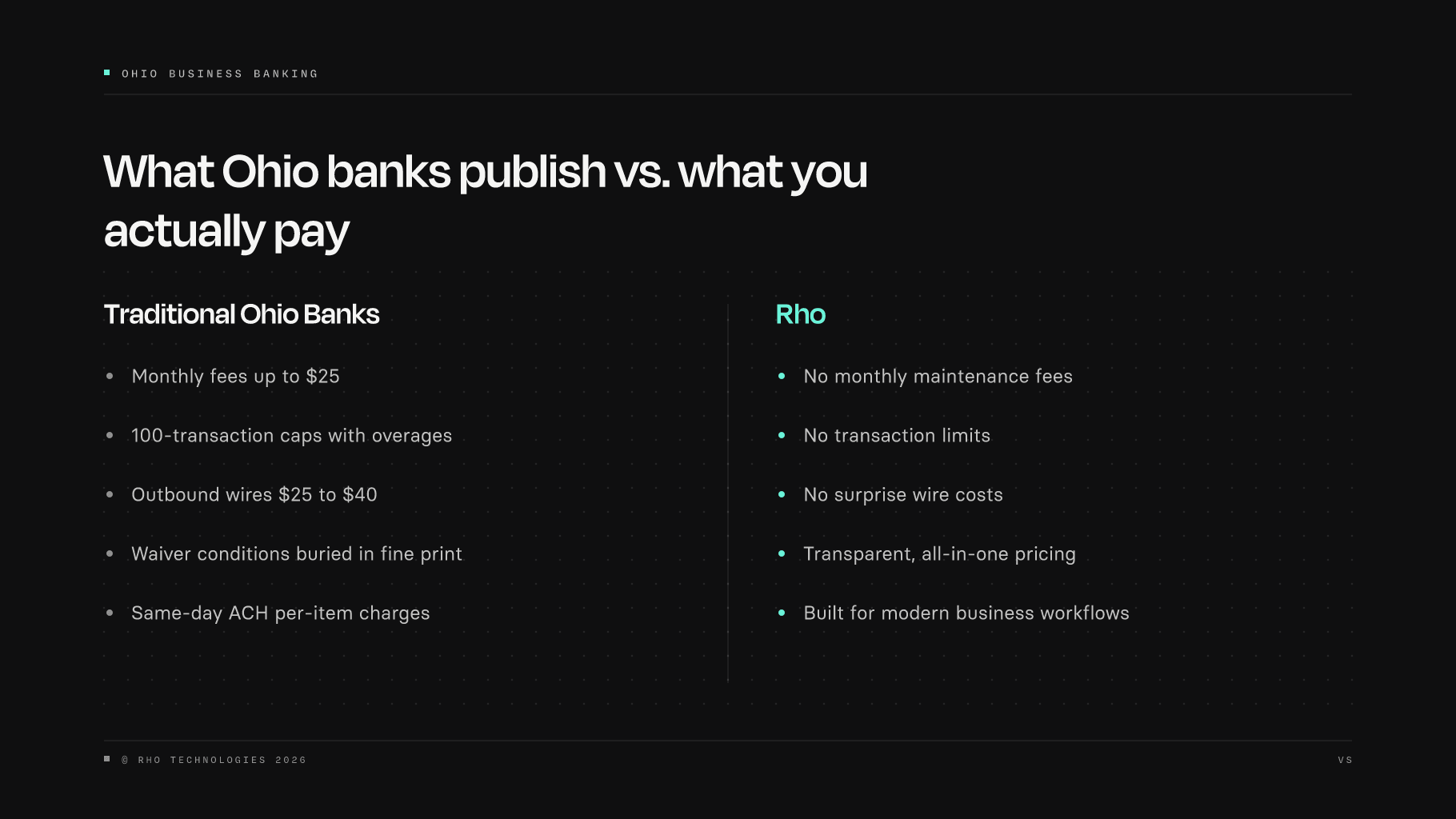
The headline numbers across Ohio's most-used business banks look like this: Huntington's Business Checking 100 carries a $0 monthly maintenance fee but caps free transactions at 100 per month, with fees applying above that limit.
Fifth Third's Business Essential Checking carries a $0 to $15 monthly fee depending on waiver conditions, while the Preferred Checking tier runs $25 per month (waivable with $100,000 in combined Fifth Third balances); the right tier depends on existing relationship depth and average deposit balances.
KeyBank and U.S. Bank both publish maintenance fees in the $15 to $25 range, with domestic wire fees typically landing between $25 and $40 per outbound transfer. Same-day ACH, where available, often carries a per-item charge that compounds quickly for businesses processing payroll or vendor payments weekly.
Transaction limits are the fee table's quiet multiplier. A business processing 300 transactions per month on Huntington's 100-transaction account pays overage fees on 200 of them, every month, without ever seeing that cost labeled clearly on a comparison page.
Waiver Conditions That Become Growth Traps
Read the fine print before you count on that waiver.
Minimum balances, linked products, and the fine print mean that fee waivers at Ohio's regional and national banks almost universally require either a minimum average daily balance or a linked product bundle.
Huntington's tiered structure, noted in its 2025 business checking disclosures, means that businesses growing their transaction volume get pushed toward higher-cost account tiers, with waiver conditions that tighten rather than loosen as the business scales.
The trap is structural. Maintaining a $10,000 minimum balance to waive a $15 monthly fee ties up capital that a growth-stage business could deploy elsewhere. That is an opportunity cost dressed as a discount.
Consistent with the labor-cost pattern noted above, at a bookkeeper or finance staff rate of roughly $25 to $30 per hour, a bank account that adds even five manual reconciliation hours per month generates $150 or more in real labor cost that never appears on a fee schedule.
A $0/month account with no integrations can cost more annually than a mid-tier account with native accounting sync, once the labor hours required to manually reconcile transactions, chase missing receipts, and re-enter data across disconnected tools are priced into the comparison.
Next steps
So where does that leave you?
If your Ohio business is running on a fee-optimized checking account that has no native accounting integrations and no multi-entity path, the road forward starts with choosing a bank whose architecture matches where you are going, not just where you are today. Start with our business bank for startups.
The reconciliation time tax is real: with 27% of small business owners already spending more than ten hours per week on financial management, a disconnected banking setup pushes month-end close from three to five days toward eight to twelve, and that labor cost quietly exceeds the fee differential between a legacy account and an integration-native platform.
The scale-readiness threshold compounds that problem: the ceiling built into most Ohio bank product tiers is invisible at account opening and arrives without warning, typically at the exact moment a second entity, a fundraise, or a new finance hire makes a banking migration most disruptive.
Together, those two dynamics point toward one action: choose a platform where multi-entity support, AP automation, and native accounting integrations are already in place on day one, before the ceiling appears.
Start with business bank for startups built on a unified platform at $0 in subscription, per-user, and wire fees. From there, banking, corporate cards, bill pay, expense management, and accounting sync are all in one place, so the finance stack scales with the business instead of against it.
FAQs
Ohio hosts over 3,700 FDIC-insured bank and thrift branch offices, making it one of the most crowded banking markets in the country. But the number of FDIC-insured institutions headquartered in Ohio has declined by more than 30% over the past two decades, meaning consolidation has quietly forced involuntary banking migrations on thousands of small business customers who never chose to switch.
Not necessarily. The monthly fee is the most visible cost, but the real expenses hide elsewhere. Wire limits, ACH delays, card controls, and the absence of accounting integrations create friction that compounds with every new vendor, employee, and entity you add, and manual reconciliation alone can consume sixty or more hours per year.
If your business regularly handles physical cash, the post is direct: a traditional branch relationship is not optional. Cash deposits through third-party ATM networks carry fees that accumulate fast for retailers, food service operators, or event-based businesses, making a digital-only platform a poor fit for cash-heavy Ohio businesses.
The scale-readiness ceiling typically hits at one of three inflection points: adding a second entity, preparing for a fundraise, or hiring a finance lead who immediately asks why there is no accounting integration. The problem is that by the time those moments arrive, switching banks can push close timelines from the automated benchmark of 3 to 5 business days back toward 8 to 12 business days, right when your team has the least bandwidth to absorb it.
The post recommends scoring banks on six variables first: monthly transaction count, cash handling volume, whether you will add a second entity within 24 months, whether you need an accounting integration, whether you need international payments, and how much minimum balance you can lock up. Fee schedules come second, because a low monthly fee on an account that lacks multi-entity support and native integrations is a deferred switching cost, not a savings.