
Most Michigan bank comparisons rank by branch count and monthly fees. Here is why those filters mislead founders, and how to match your stage to the bank that will not slow you down.
The common assumption among most YC and accelerator founders is that the best business bank in Michigan is whatever institution has the strongest local presence and lowest monthly fee, because all business banking is roughly the same once you get past the sign-on bonus.
The problem starts when a seed-stage founder in Ann Arbor or Grand Rapids types "best business bank Michigan" and gets the same list, ranked by the same criteria, with no signal that the filters being applied have almost nothing to do with their actual situation. See our business bank for startups for how this works in practice.
Rho is a fintech company, not a bank or an FDIC-insured depository institution. Checking account and card services provided by Webster Bank, a division of Santander Bank, N.A. Member FDIC, and by Lead Bank, Member FDIC. Savings account services provided by American Deposit Management Co. and its partner banks.
The stakes are real. Choosing the wrong bank at the wrong stage doesn't just mean a slightly higher monthly fee. It can mean a five-business-day account approval that blocks a vendor wire the week after you close your round. That kind of friction is invisible in every standard comparison table, and it compounds fast.
Standard Michigan bank rankings optimize for branch count, CD rates, and local relationship managers. Those are genuinely useful metrics for a business that handles cash daily or is building toward an SBA loan.
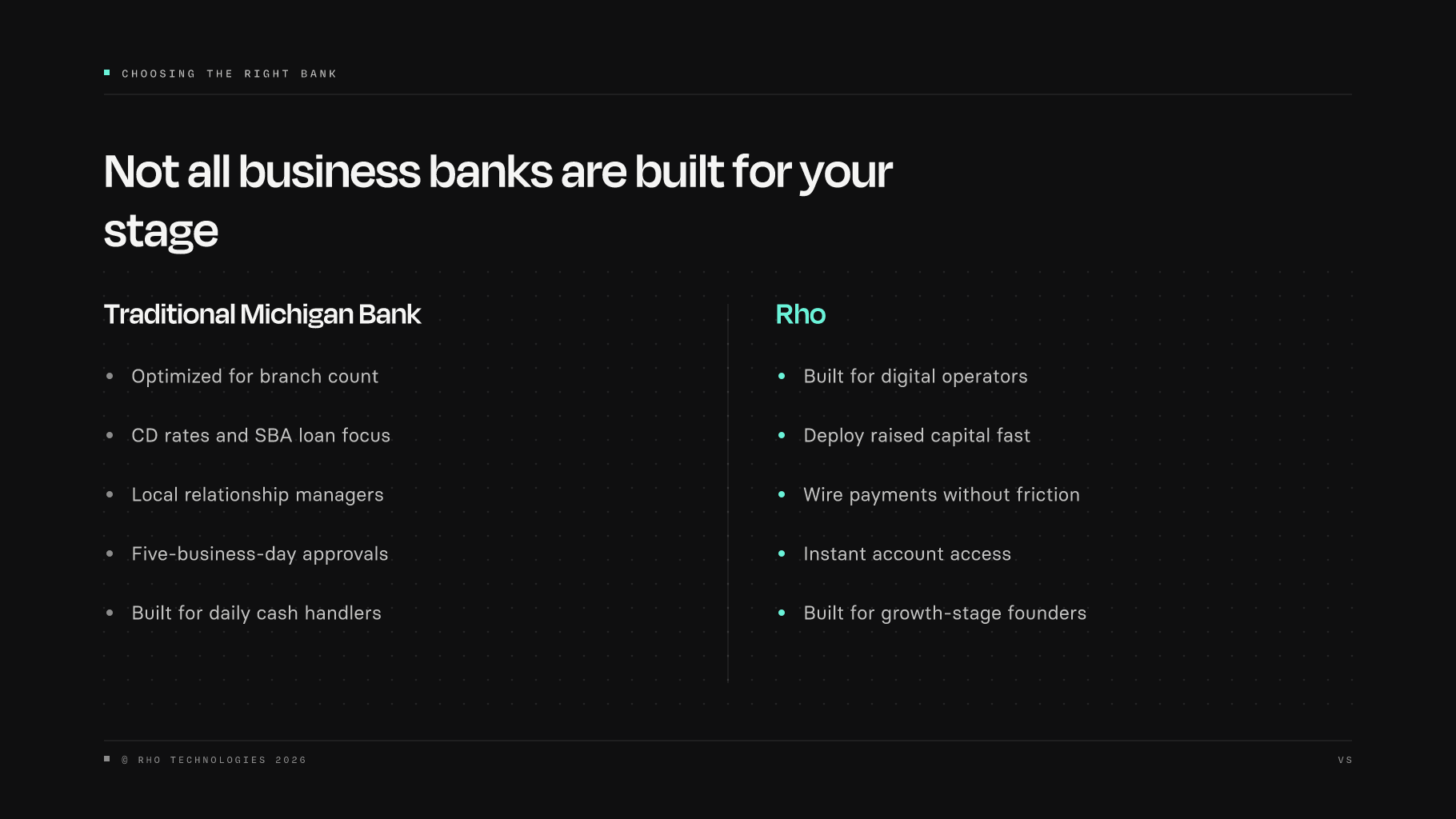
They are nearly useless for a growth-stage founder who operates digitally, pays vendors by wire, and needs to deploy raised capital before the week is out. Fintech banks and traditional banks are not interchangeable; the right choice depends entirely on the business's operating model.
Here is the cost that never appears in a fee comparison: the days you cannot operate because your account isn't open yet. Traditional bank business account openings routinely take five to seven business days, and some require an in-person branch visit before a card can be issued.
For a founder who just closed a pre-seed round, that gap is a hard block on paying the first contractor or wiring a deposit to a software vendor.
How to use this table: Match your row first. Only then compare monthly fees and wire costs within that tier; cross-tier fee comparisons are the primary source of bad Michigan banking decisions for founders.
Huntington, Comerica, and Fifth Third dominate Michigan SBA lending volume, but the bank that closes your $500K loan fastest isn't always the one with the most branches near you.
Most Michigan business banking guides rank institutions on branch count and CD rates, which are the right metrics for a cash-heavy brick-and-mortar and the wrong ones for a founder burning runway.
Traditional banks in Michigan almost universally require an EIN before opening an account, a real bottleneck when LLC formation through LARA and IRS processing can each take weeks.
Credit unions like LMCU and MSUFCU earn their reputation on low fees and member service, but their account infrastructure wasn't built for multi-entity cap tables, corporate cards, or same-day wire volume.
Fee disclosures across Michigan business checking accounts are written to obscure, not inform, the monthly headline number rarely reflects what a growing business actually pays.
Account opening isn't one hurdle; it's two distinct risk events (entity verification and banking access), and collapsing them into one is why founders stall at the wrong moment.
Rho closes the gap by letting startups open an account before an EIN arrives, issue cards on day one, and run banking, cards, bill pay, expenses, and treasury from a single platform, with no subscription fees and no wire charges.
Which Michigan Banks Have the Most Branches Statewide for In-Person Banking Access?
Huntington National Bank holds the largest branch footprint in Michigan, with over 300 locations statewide, according to Wikipedia.
That concentration is real, and for a business that handles daily cash deposits, needs an in-person notary, or wants a local SBA loan officer who knows the owner by name, that physical presence is a genuine asset. But branch density is a proxy metric. It answers one question well and several others poorly.
Here's how the top five actually compare:
1. Rho - Best All-in-One Banking Platform for Michigan Startups and Scale-Ups
Rho is built for founders and finance teams who need more than a branch; they need a complete financial operating system. With business banking, corporate cards, bill pay, expense management, treasury, and accounting integrations under one roof, Rho eliminates the tool sprawl that slows growing companies.
There are no subscription fees and real human support is included. Where it falls short: Rho has no physical Michigan branches, so cash-heavy businesses may need a supplemental local account.
2. Huntington Bank - Widest Michigan Branch Footprint for In-Person Business Banking
Huntington has the largest branch network in Michigan, with over 300 locations statewide, making it the bank with the most branches statewide in Michigan. It was also the nation's top SBA 7(a) lender by volume for the seventh consecutive year as of October 2024.
Its Business Checking 100 account carries no monthly fee at entry level, which reads as cost-neutral until transaction volume grows. At 101 transactions, per-item fees begin.
For a startup gaining traction, that fee cliff arrives quietly, and the onboarding process itself can take days, blocking card issuance and vendor wires at exactly the wrong moment.
3. Fifth Third Bank - Strong Michigan Presence and Established Small Business Lending
Fifth Third maintains a significant Michigan branch presence and holds preferred SBA lender status, making it a credible choice for established businesses that need credit access alongside their operating account.
The trade-off for founders is structural: fee schedules are layered, and account opening requires in-person document review at most locations.
It is most beneficial when the business already has stable cash flow, a predictable transaction volume, and a specific need for an SBA line of credit from a lender with local underwriting relationships.
For a company that does not need an SBA credit product and instead needs a fast, scalable banking setup without legacy bank overhead, the calculus is different. Rho supports pre-EIN onboarding, meaning founders can open an account before their EIN arrives, and the platform charges $0 in subscription, platform, or per-user fees.
Checking is provided by Webster Bank, a division of Santander Bank, N.A., Member FDIC, with up to $250K in standard FDIC coverage.
The savings account, provided by American Deposit Management Co. and its partner bank network of approximately 400 institutions, extends FDIC coverage up to $75M. That infrastructure is designed to work and scale with the company without requiring a branch visit to get there.
4. Flagstar Bank - Michigan-Headquartered Bank with Deep Community Roots
Flagstar was acquired by New York Community Bancorp in 2022, and the post-merger period has brought branch consolidations across Michigan. The current footprint is smaller and less stable than it appeared two years ago, which matters if branch proximity is a core reason you are choosing this institution.
Flagstar still serves Michigan businesses effectively, particularly in the mortgage and commercial lending space, but founders evaluating it for operating accounts should verify current branch availability in their market before committing.
The honest summary: every institution above serves a real customer. A cash-heavy retail business in Marquette has a different banking need than a software startup in Ann Arbor that just closed a seed round. The mistake is not choosing a branch-first bank.
The mistake is choosing one when your actual workflow is entirely digital, then absorbing the hidden costs: slower onboarding, per-item fees that scale with growth, and AP processes that were never designed to consolidate with your banking layer.
For companies that process recurring vendor payments, manage multiple employees incurring business expenses, and want centralized spend oversight without platform fees, Rho's single unified tier is built to remove that friction from day one.
That tier includes a $0 monthly fee, $0 per-user fee, unlimited reimbursements, basic invoicing, and native integrations with QuickBooks Online, Oracle NetSuite, Sage Intacct, and Xero.
5. Chemical Bank (now Dba TCF/Huntington): Legacy Upper Peninsula and Rural Michigan Coverage
For small businesses operating in Michigan's Upper Peninsula or rural Lower Peninsula communities, legacy Chemical Bank branches, now absorbed into the Huntington network, historically provided the most accessible in-person banking in underserved areas.
This coverage matters for businesses in agriculture, manufacturing, or tourism that need local banker relationships and cash handling in areas where national banks have thin presence. The catch is that product innovation and digital capabilities in these locations can lag behind metro-area branches.
Which Michigan Banks Are Top SBA Lenders for Small Business Loans and Lines of Credit?
Michigan's SBA lending landscape is dominated by a handful of institutions that consistently rank at the top of the state's approval volume, and knowing which ones they are changes how you approach a credit conversation before you ever walk into a branch.
"It's hard to tell which SBA 7(a) lenders are legitimate vs. those that will just waste your time, making it really difficult to find reliable Michigan-based SBA lenders."
Comerica Bank, Fifth Third Bank, and Huntington Bank are the dominant SBA lenders in Michigan, but the bank that closes your $500K loan in 60 days and the bank that should run your daily operations are rarely the same institution. That distinction costs founders real time when they conflate the two.
SBA lending dominance is optimized for established small businesses with documentable revenue history. Pre-revenue or seed-stage founders who need accounts open before their EIN arrives and virtual cards issued on day one will find Michigan's most decorated business banks among the least equipped for a founder's first 90 days.
Here's how the top five rank for SBA lending:
1. Rho - Best All-in-One Banking Platform for Michigan Startups and Scale-Ups
Rho is the strongest pick for Michigan startups that have just raised a round and need more than a basic checking account. It combines banking, corporate cards, bill pay, expense management, treasury, and accounting integrations in one platform, with real human support and no subscription fees.
The limitation: Rho is built for growth-stage companies, not brick-and-mortar businesses seeking traditional SBA loan origination.
2. Huntington Bank - Best for SBA 7(a) Loan Volume and Proven Small Business Lending Scale
Loan Volume and Proven Small Business Lending Scale
According to a Huntington Bancshares press release from October 2024, Huntington was the nation's top SBA 7(a) lender by volume for the seventh consecutive year, backing more than 7,500 entrepreneurs in a record year. That depth of SBA expertise is real and differentiated.
What you give up: that same institutional scale means account opening, card issuance, and day-to-day support move at a traditional bank's pace. Best for established small businesses with documentable revenue history pursuing SBA debt, and a poor fit for founders who need to operate from day one of a funding round.
3. Bank Michigan - Best Community SBA Lender for Washtenaw County Small Businesses
Bank Michigan holds the top SBA 7(a) lender position in Washtenaw County, making it the most relevant community bank option for Ann Arbor-area small businesses that want a local relationship alongside SBA credit access.
Local SBA officers who know the regional market can move faster on underwriting decisions than a national call center, a structural advantage for borrowers who prioritize speed, though approval timelines vary by application complexity and should be confirmed directly with Bank Michigan for current processing windows.
Outside Washtenaw County, however, Bank Michigan's footprint and product depth narrow considerably, and digital onboarding is not its strength.
4. Credit Union ONE - Best Michigan Credit Union for SBA Startup Loans with Member-First Rates
Credit Union ONE is a Michigan-based SBA lender specifically positioned to support startups and small businesses that may not yet qualify at larger banks. As a credit union, it offers member-focused underwriting and competitive rates on SBA loan programs tailored to early-stage companies.
Its weak point is that membership eligibility requirements and a narrower product suite mean it may not serve businesses needing complex treasury or multi-entity banking structures.
5. Comerica Bank - Best Established Michigan Bank for SBA Lines of Credit and Business Relationship Banking
Comerica, headquartered in Dallas but deeply rooted in Michigan's business banking history, is a strong choice for established small businesses seeking SBA-backed lines of credit alongside full-service commercial banking relationships.
Its Michigan market presence and business-focused product depth make it well-suited for companies with $1M+ in revenue needing revolving credit facilities. But newer or pre-revenue businesses will find Comerica's underwriting standards more demanding than community lenders.
What Are the Best Credit Unions in Michigan for Small Business Banking?
The best credit unions in Michigan for small business banking are Lake Michigan Credit Union (LMCU), MSUFCU, Lake Trust Credit Union, and a handful of regional players that consistently earn high marks for low fees and genuine member relationships. For the right type of business, that reputation is fully deserved.
For the wrong type, it costs real time and real money.
Same exercise, credit-union edition:
1. Rho - Best All-in-One Banking Platform for Michigan Startups and Scale-Ups
Rho is built for founders and their accountants who need more than a basic business checking account, combining banking, corporate cards, bill pay, expense management, treasury, and accounting integrations in one platform with no subscription fees. It's the right pick for Michigan startups post-raise that need infrastructure to scale.
The downside: Rho isn't a credit union, so it lacks the community-ownership model some local business owners prefer.
2. Lake Trust Credit Union - Best Michigan-Based Credit Union for Small Business Flexibility
Lake Trust operates across southeast and mid-Michigan with a fee structure built for established SMBs that carry predictable cash flow and maintain local vendor relationships. Its business checking is a strong fit for owners who want branch access without the overhead of a big-bank monthly fee.
The honest catch: its geographic footprint is concentrated, and founders outside its branch corridor will find onboarding friction that slows account activation by days, not hours.
3. Michigan State University Federal Credit Union (MSUFCU): Best for Tech-Forward Small Business Banking
MSUFCU publishes a broader digital product suite than most Michigan credit unions reviewed in this guide, including mobile deposit, online account management, and a digital loan application portal, making it a more viable option than peer credit unions for tech-adjacent small businesses in the Lansing area that cannot visit a branch regularly.
The limitation that matters most is structural: field-of-membership eligibility ties access to the MSU community and broader Michigan residency requirements.
A remote-first startup incorporated in Delaware but operating out of Michigan may clear that bar, or may not, and finding out takes time a founder closing their first customer contract cannot spare.
4. Dort Financial Credit Union - Best for Small Businesses in Mid-Michigan Seeking Low-Cost Accounts
Dort Financial serves the Flint and mid-Michigan corridor with genuinely low-cost business checking built for sole proprietors and early-stage brick-and-mortar operators. If your business takes cash, serves local customers, and values a personal banking relationship over digital speed, Dort delivers.
It is not the right pick for a team that needs cards issued on day one or ACH wires moving before the weekend.
5. United Federal Credit Union - Best for West Michigan Small Businesses Needing Full-Service Banking
United Federal Credit Union operates across West Michigan and offers a comprehensive small business banking suite including business checking, SBA lending support, merchant services, and business credit cards.
Its multi-state presence gives it slightly more infrastructure than purely local credit unions, while still maintaining the member-owned ethos that keeps fees lower than traditional banks. Best for growing small businesses in Grand Rapids and surrounding areas.
Here's the friction: its digital platform lags behind fintech-native competitors.
What Are the Best Digital-First Banking Options for Michigan Small Businesses That Don't Need Physical Branches?
Michigan small businesses that don't need physical branches have more capable digital-first options than ever, ranging from yield-bearing checking accounts to fully integrated finance platforms.
The best digital-first and online banking options for Michigan small businesses that don't need physical branches are Rho, Bluevine, Axos Bank, U.S. Bank Digital Payments, and UMCU Business Banking.
The right choice depends on whether you need yield on idle cash, a unified finance operations layer, or simply a no-fee checking account to replace your branch relationship.
Here's the part most comparisons skip:
Here is where most founders get tripped up: opening a no-fee digital checking account feels like solving the branch problem. It isn't. The account takes ten minutes.
The tools you bolt on afterward, a separate corporate card, a bill pay platform, an expense tracker, a treasury solution, take ten months to stitch together into something that doesn't fall apart at month-end close. There's a second trap that's less talked about: random account freezes and closures.
Small business owners who've worked with digital-first banks know the gut-punch of logging in on a Monday and finding their account restricted, a pattern that appears most often on bare-bones platforms with thin customer support infrastructure.
When the banking layer goes down unexpectedly, the admin drag that follows doesn't just slow operations; it can stall payroll, delay vendor payments, and burn the credibility you've spent months building with your team.
The real cost of digital-first banking isn't the monthly fee you're avoiding; it's the operational overhead that follows the account opening.
Bluevine illustrates the yield angle well.
The Standard plan pays up to 1.3% APY on balances up to $250,000 with no monthly fee, earned only in months when you spend $500 on a Bluevine card or receive $2,500 in customer payments; miss both and that month pays 0.00% APY (as of 08/11/2026), while the Premier plan reaches 3.0% APY for $95 per month (waivable).
A Michigan founder holding $500K in post-raise cash at a near-zero-yield institution isn't just leaving money on the table; they're silently shortening their own runway by a measurable number of weeks, a cost that dwarfs any monthly maintenance fee comparison.
Digital-first banking isn't only a fee-avoidance play; it's a capital efficiency calculation.
3.0% APY Bluevine Premier yield on business balances
1. Rho - Best All-in-One Banking Platform for Michigan Startups and Scale-Ups
Rho is an option absent from most Michigan startup bank comparisons, notable because it combines FDIC-insured checking, $0 domestic wires, corporate cards, bill pay, expense management, and treasury access at a $0 platform fee in a single product, a combination not offered by any traditional Michigan bank reviewed in this guide.
Where most digital banks hand you a checking account and a debit card, Rho's platform layers everything a lean finance team actually needs on top of that foundation, without charging for it.
Banking is held through a partner institution (member FDIC), covering up to $250K in standard FDIC insurance on the checking side and up to $75M through the ADM sweep network of roughly 400 partner banks on savings.
Cards earn up to 2% Cashback with Rho Platinum (terms apply), on up to $1M in eligible annual card spend; 1.25% standard, credited directly to your account. Domestic wires are $0, same-day ACH is $0, bill pay is $0, expense management is $0, and basic invoicing is $0.
The $0 platform fee and $0 per-user fee apply to every customer at every stage; there is no tier gating.
That combination matters most when your team is too lean to manage four separate finance tools without someone slowly drowning in reconciliation.
Banking, cards, and automation that remove admin drag so the team can focus on customers and revenue, that's what a unified platform actually delivers, and it's why the operational overhead argument above points directly at fragmented stacks rather than the monthly fee line on a comparison table.
Rho also provides a dedicated point of contact for every customer, reachable via chat, email, or phone and responding in under a minute, 24/7, which means when something goes wrong, a real support system that understands your account is a single message away rather than a ticket queue.
For founders with idle cash to put to work, Rho Treasury is available directly from the same platform. It is a separate, fee-bearing RIA product; management fees run 15–60 basis points annually based on the cost to provide the service (see the ADV-2A Wrap Fee Brochure).
Rho Treasury invests in Treasury Bills and requires a $50,000 minimum investment. T-Bills settle in 2–3 business days. Rho Treasury investments are not deposits and are not FDIC insured, that distinction matters and should inform how you size the allocation.
For context, some competing treasury products require a $250,000 minimum; Rho's entry point is $50,000.
Pre-EIN onboarding via Stripe Atlas or Clerky means founders can open an account before incorporation paperwork clears, a meaningful advantage in the weeks between formation and first payroll.
Native accounting integrations with QuickBooks Online, Oracle NetSuite, and Sage Intacct mean transactions, receipts, and expense data sync automatically; Xero connects via bank feed rather than piling up for a manual month-end push.
Rho Close, Rho's month-end close tool, runs AI-suggested first-pass transaction coding on top of those integrations, reducing the reconciliation workload that silently eats hours at growing companies.
Rho is most beneficial when your team is too lean to manage fragmented finance tools, when you're moving fast enough that account stability and 24/7 support aren't optional, and when you want the decision to reflect well on you as an operator, not just at account opening, but twelve months in when the audit trail and integrations actually get tested.
2. Mercury - Best Digital Bank for Early-Stage Michigan Startups Wanting Simplicity
Mercury has become a go-to digital banking option for early-stage startups that want a clean, developer-friendly interface with built-in invoicing, team permissions, and API access. For Michigan small businesses that operate entirely online and want a no-frills account with solid fintech integrations, Mercury delivers.
It's especially strong for tech-forward founders who want to move fast. The key limitation is that Mercury lacks the deeper financial operations infrastructure, like deeper bill pay workflows and treasury management, that more complex businesses eventually need.
3. Axos Bank - Best Online Bank for Michigan Small Businesses Wanting FDIC-Backed Accounts with No Fees
Axos Bank is a fully online FDIC-insured bank whose Basic Business Checking has no monthly maintenance fee or minimum balance (other tiers carry balance requirements, as of 08/11/2026), alongside savings and interest-bearing options, a strong fit for Michigan small businesses that want traditional banking credibility without branch overhead.
It's particularly well-suited for established small businesses, LLCs, and sole proprietors who want straightforward deposit accounts with competitive rates. One thing to know: Axos lacks the modern fintech workflow integrations, expense management, corporate cards, and accounting automation that fast-growing startups increasingly expect.
4. U.S. Bank Digital Payments - Best for Michigan Businesses Needing Hybrid Online-Physical Banking with ACH and Wire Capabilities
U.S. Bank offers a capable digital payments suite, including ACH, wire transfers, and instant payments, backed by a major national bank with physical branch presence across Michigan. For small businesses that occasionally need in-person banking but want strong digital payment infrastructure, U.S. Bank bridges both worlds.
It's a reliable choice for businesses with complex payment flows or vendor relationships requiring wire capabilities. Still, fees and account minimums are higher than pure digital-first alternatives, and the platform feels less modern than fintech competitors.
5. UMCU Business Banking - Best for Michigan Small Businesses Wanting a Local Credit Union with Low-Cost Digital Accounts
University of Michigan Credit Union (UMCU) offers Michigan-based small businesses flexible, low-cost business checking and savings accounts with minimal balance requirements and member-focused service.
For locally rooted Michigan businesses, especially those in the Ann Arbor area or affiliated with the university ecosystem, UMCU provides a community-oriented alternative to big banks with competitive rates and accessible digital account management.
The key limitation is geographic and membership scope: UMCU's digital capabilities and product breadth don't match national fintech platforms for businesses with complex operational needs.
Monthly Fees and Balance Requirements for Top Michigan Business Checking Accounts - Compared Honestly
Spend an hour reading fee disclosures across Michigan business checking accounts and you will notice something frustrating: the headline numbers rarely tell the full story.
The common assumption is that the best business bank in Michigan is whatever institution has the strongest local presence and lowest monthly fee, because all business banking is roughly the same once you get past the sign-on bonus.
Monthly fees get the most attention, but for any startup wiring vendors, paying contractors, or moving capital after a raise, the real cost lives in the line items buried three pages deep.
Controllers and finance teams who actually reconcile these accounts know this better than anyone: the headline "$0/month" can turn into a significant operating expense the moment wires, FX transfers, or per-transaction fees enter the picture.
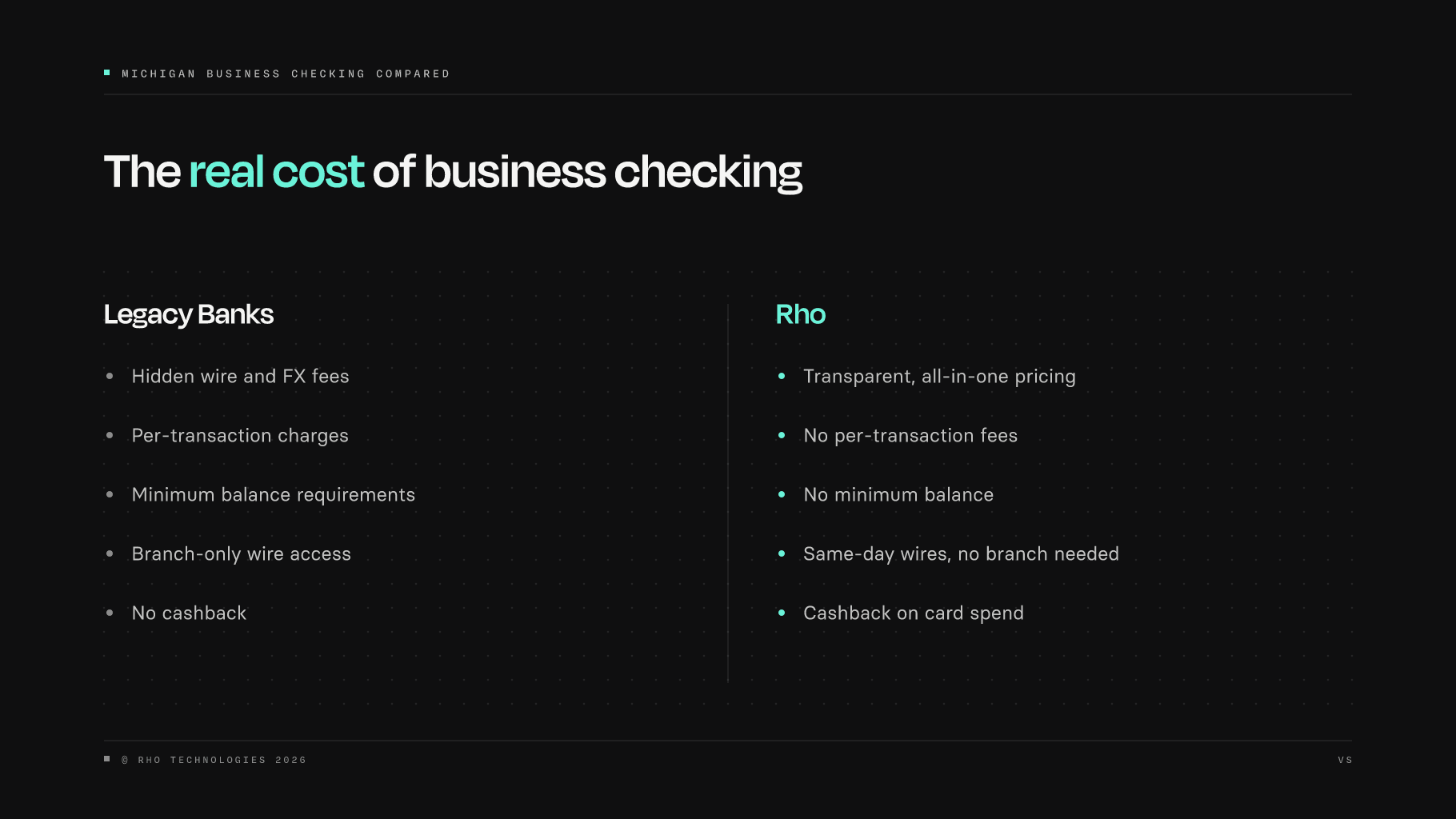
Here's where the sticker price stops telling the truth:
Monthly Fee, Wire Cost, Minimum Balance, and Cashback Compared
The table below uses only source-backed figures. Wire fee data for regional banks reflects published standard rates; where a specific figure was not available from a cited source, that cell is marked accordingly.
Sources: Huntington Bank, 2025; Bluevine, 2024.
The Wire Fee Trap
A founder wiring four vendors a month on a standard account carrying a $25 per-wire fee pays that same figure monthly in wire costs alone. At $35 per wire, that same payment cadence costs $140. Neither figure appears anywhere near the "no monthly fee" headline.
This is the wire fee trap. The account looks free, but it is not free. A startup wiring four vendors at $25 per wire pays that same figure per month in wire costs alone, a figure that compounds faster than any monthly maintenance fee in this comparison.
Accounting teams we work with flag this pattern immediately: the wire line item is the one that erodes cash runway while the founder is focused on the headline subscription cost.
Rho charges $0 for domestic wires and $0 for ACH payments, including same-day ACH, with no monthly platform fee and no per-user fee. That means the cost structure a controller sees in Rho's fee schedule is also the cost structure the company actually pays month over month. There is no hidden tier where wire costs suddenly appear.
Beyond eliminating wire fees, Rho includes up to 2% Cashback with Rho Platinum (terms apply), on up to $1M in eligible annual card spend; 1.25% standard on card spend, credited directly to the account, not as points, not as statement credits with conditions.
For teams with multiple employees making business purchases, that cashback accumulates against the same spend that would otherwise generate zero return in a traditional checking account. Rho's corporate cards are included at $0, issued immediately, with no minimum balance required and no personal credit pull or personal guarantee.
One additional line item worth understanding: if your company reaches a point where idle cash can be put to work, Rho Treasury is available from the same platform.
It is a separate, fee-bearing RIA product, not a deposit account and not FDIC insured, with a management fee of 15–60 basis points annually (detailed in the ADV-2A Wrap Fee Brochure). Treasury access requires a $50,000 minimum investment.
That fee structure is published and fixed by cost to provide the service, which is a different model than the buried per-wire charges that make traditional business checking accounts expensive for active startups.
Finance teams evaluating total cost of banking should account for both sides: the fees eliminated on the core platform and the explicit, disclosed fee on the treasury product.
For founders who want to move fast, open an account, get a card, and get back to building, Rho supports pre-EIN onboarding, meaning you can open an account before your EIN arrives.
The platform operates on a single unified tier: every feature, from bill pay and AP automation to unlimited reimbursements and native accounting integrations with QuickBooks Online, Oracle NetSuite, Sage Intacct, and Xero, is included at $0 for every customer regardless of company size or headcount.
Opening a Business Bank Account in Michigan - What Most Guides Don't Tell You
Most Michigan founders treat account opening as a single hurdle: submit documents, wait for approval, get access. In practice it splits into two distinct risk events, and standard guides collapse them into one, which is exactly why so many businesses stall at the wrong moment.
The standard Michigan business banking guide treats account opening as a one-time administrative task, but the evidence reveals it is a staged risk event with two distinct failure modes: a documentation bottleneck at origination and a hidden cost accumulation trap post-opening.
Founders who optimize only for the first stage, picking the bank that opens fastest, and ignore the second stage will discover that their "free" or "easy" account is compounding Finance Stack Drag from the first transaction.
The Standard Document Checklist and the One Item That Creates a Bottleneck
Traditional Michigan banks typically require your EIN confirmation letter, state-filed formation documents, a government-issued ID for each authorized signer, and an initial deposit before the application even moves to review. The EIN is the single item that can freeze the entire sequence.
The IRS issues EINs immediately through its online application, but founders who incorporate by mail or miss the online portal face processing windows of up to four weeks. For a founder who closed a pre-seed round on Friday and needs to pay a contractor on Monday, that gap is a direct operational cost.
Where Traditional Michigan Bank Onboarding Actually Stalls
The stall points are predictable:
An in-person branch visit to verify identity
A multi-day document review once materials are submitted
A separate card issuance step after the account activates
Traditional banks require in-person visits and multi-day document review as a structural part of onboarding, so the choice between bank types turns on operational speed as much as fees.
For a Michigan LLC incorporated online through the Secretary of State's portal (same-day processing for online filings versus weeks by mail), that speed advantage at formation evaporates the moment you walk into a branch.
Next steps
If your post-raise capital is sitting idle while account approval drags through a branch review queue, the path forward starts with treating bank selection as an operational speed decision, not a fee comparison. Start with our business bank for startups.
Bottom line:
Huntington's seven consecutive years as the top SBA 7(a) lender by volume means its systems are optimized for businesses with documentable revenue history, not for founders who need a card issued before the week is out.
The per-item fee cliff embedded in Business Checking 100 means the account that looks free at signup still penalizes you the moment traction arrives. Together, they point to a platform built for the first 90 days after a raise: pre-EIN onboarding, same-day card issuance, and $0 domestic wires from day one.
Start with Rho for business bank for startups. From there, you can open an account before your EIN arrives, issue corporate cards immediately, and connect your accounting stack without adding a separate expense tool, bill pay platform, or reconciliation workflow on top.
FAQs
A digital-first platform that offers $0 domestic wires, same-day ACH, and a 1-3 day account opening is the right fit at that stage, not a traditional bank. Traditional bank business account openings routinely take five to seven business days and can require an in-person branch visit before a card is issued, which is a hard block on paying your first contractor or wiring a deposit to a software vendor right after you close a round.
Rho offers native integrations with QuickBooks Online, Oracle NetSuite, Sage Intacct, and Xero, all included in its single unified tier with no platform fees.
They are rarely the same institution. Banks like Huntington, Comerica, and Fifth Third dominate Michigan's SBA lending because they are optimized for established businesses with documentable revenue history pursuing credit, not for founders who need accounts open quickly, virtual cards on day one, and vendor wires moving before the week is out. The post's core point is that conflating SBA lending strength with operational banking fit costs founders real time.