

The highest APY won't save you if your coverage structure is wrong. Here's what to solve before you ever look at a rate table.
Most YC and accelerator founders think that if they find the highest APY on a business money market account, they've solved their cash management problem, that rate is the only variable that matters.
Most founders who just closed a seed round do the same thing: they move the capital into a business checking account, watch it earn nothing, and then start Googling "best business money market account rates." That search returns dozens of APY comparison tables. What it rarely returns is the question worth asking first.
Rate is the last decision, not the first. Before comparing yields, a founder really needs to work through how much FDIC coverage this cash actually needs, how quickly the business needs to reach it, and whether parking it in a separate account quietly adds friction the team will end up absorbing for months.
Platforms built for startup financial operations, such as Mercury, Brex, and Relay, are increasingly designed around coverage structure, access speed, and integration, not just the rate column, reflecting a broader shift in how founders evaluate cash management tools.
A business money market account is not a cash management strategy; it's a single instrument, and choosing the wrong one costs more than a suboptimal rate ever saves.
The $250K FDIC limit printed on a bank's marketing page covers almost nothing for a startup that just closed a seed round; the real question is how much of your actual balance that insurance touches.
A 20-basis-point rate difference on $500K is $1,000 a year, a gap that disappears with one month of maintenance fees or a single missed minimum-balance threshold.
Rate comparisons routinely omit reconciliation friction, integration costs, and the operational drag of managing a standalone account that doesn't talk to your existing stack.
The vehicle choice (money market, Treasury, FDIC-insured savings) matters more than the APY spread between competing banks offering the same instrument.
Founders typically lose not on the application but in the ten minutes before it, when they haven't answered whether the account will still make sense after headcount doubles or burn accelerates.
Rho Savings closes the loop for teams that want a straightforward insured cash bucket: FDIC coverage via partner banks, next-day liquidity, and the option to run it alongside Treasury allocations for yield-seeking portions of the same balance.
How Much FDIC Coverage Does This Cash Actually Need?
A business money market account (MMA) is an interest-bearing deposit account that sits between a checking account and a savings account, in both yield and access. It typically earns a higher rate than a standard business checking account, allows limited debit or check-writing access, and is federally insured.
Here's a distinction worth getting right early: money market deposit accounts are not money market mutual funds. MMDAs are FDIC-insured products held at banks or credit unions, according to the FDIC, while money market mutual funds are investment products with no FDIC coverage.
That distinction matters enormously when a founder is deciding where to hold operating reserves.
The mechanics are straightforward. A business MMA pays tiered interest, meaning larger balances typically earn higher rates. Per the FDIC, deposits are insured up to $250,000 per depositor, per insured institution, for each account ownership category.
That coverage limit is a hard ceiling at a single bank. For a startup holding $500,000 post-raise, standard FDIC coverage at one institution protects only half that balance. That gap is where coverage structure, not rate, becomes the operative variable.
For a founder holding 18 months of runway, the cash is not truly idle; it is reserve capital with a deployment timeline, a coverage requirement, and an operational context. Choosing the wrong vehicle does not just cost basis points. That shift acknowledges a practical reality: friction absorbed quietly by a finance team has a cost that never appears in an APY comparison table.
Key Features and Benefits of Business Money Market Accounts (and Where the Costs Hide)
The common assumption among most YC and accelerator founders sounds something like this: find the highest APY on a business money market account and the cash management problem is solved. Rate is treated as the only variable that matters.
It's rarely that simple.
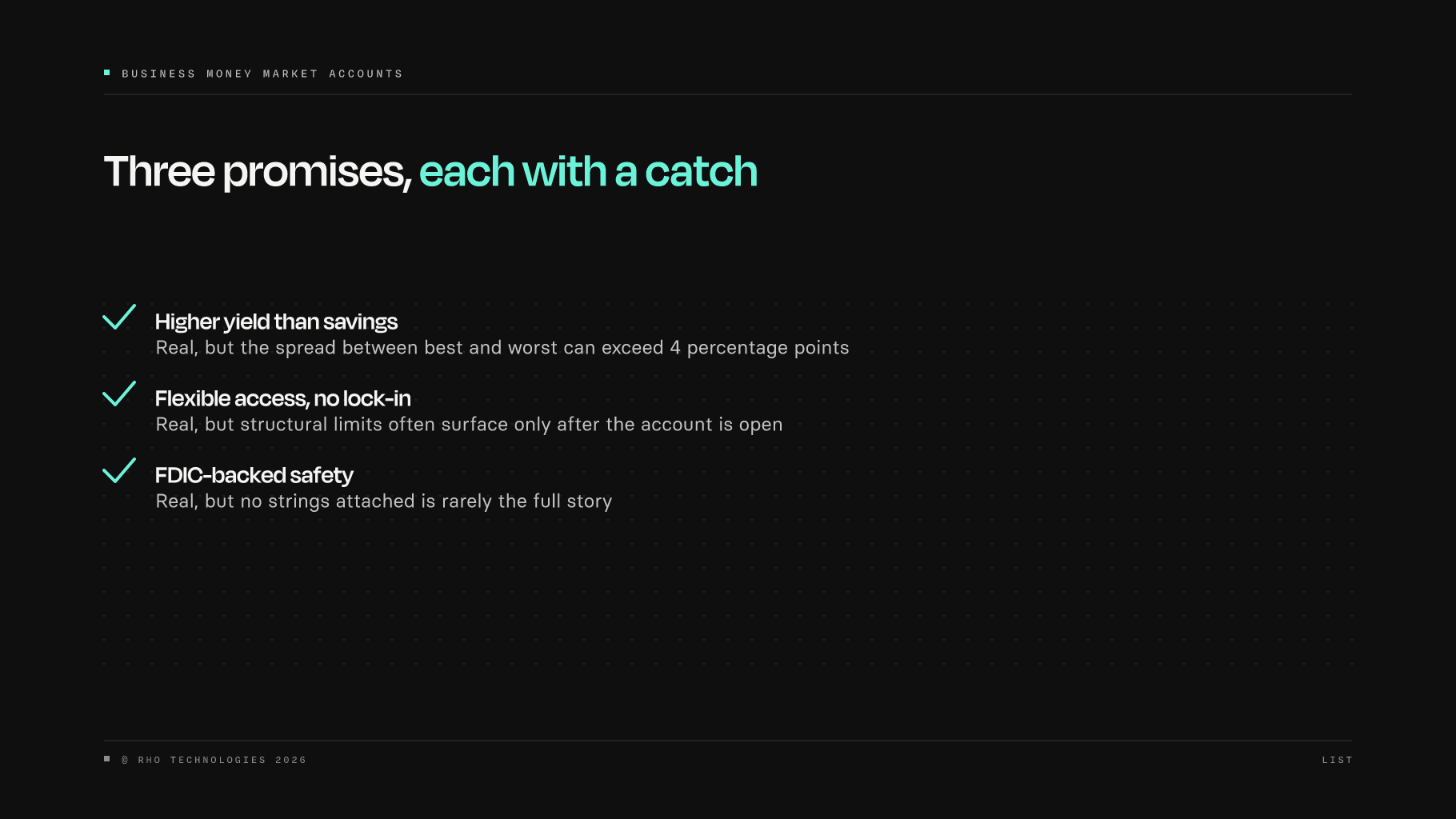
Business money market accounts are marketed with three promises: better yield than a standard savings account, flexible access unlike a certificate of deposit, and FDIC-backed safety with no strings attached. All three promises hold up. What tends to go unmentioned is the structural catch riding along with each one, the kind most founders only discover after the account is already open.
The founders we work with consistently face the same pressure: cut the operational time and cost spent on financial administration so they can get back to building, instead of reconciling bank statements across disconnected accounts.
Higher Yields, Flexible Access, and No Fixed Lock-In - What Business MMAs Actually Deliver
Business MMAs genuinely do outperform traditional savings accounts on yield. The best money market account rates currently reach up to 5.00% APY or higher, per Investopedia (2025), while many business MMAs still pay well under 1% APY. That spread, more than 4 percentage points between the best and worst accounts, is the entire argument for shopping carefully.
Key takeaway: The spread between the best and worst business MMA rates can exceed 4 percentage points, making account selection, not just the decision to open one, the variable that matters.
Unlike certificates of deposit, a business MMA carries no fixed term. Your cash stays accessible, and you can write checks or use a debit card without triggering a penalty. For a startup managing unpredictable cash timing, that flexibility is genuinely valuable.
What the MMA marketing rarely surfaces is the visibility problem that comes alongside it.
That single-pane visibility, checking, savings, cards, and treasury all on the same platform, is exactly what founders lose when they spread cash across a standalone MMA, a separate checking account, and a corporate card product from a third provider.
Rho's checking is provided by Webster Bank, a division of Santander Bank, N.A. (member FDIC), with up to $250K in standard FDIC coverage on checking and up to $75M through ADM's network of approximately 400 partner banks on savings. All of it is accessible from the same platform, at no monthly fee and no per-user fee.
Minimum Balance Requirements - How a $10K to $25K Floor Can Offset Your Interest Earnings
The yield story changes the moment your balance moves. Business money market accounts typically impose minimum balance requirements ranging from $10,000 to $25,000 or more, Investopedia (2025) notes, and failing to maintain that threshold triggers monthly maintenance fees that can erode or entirely offset the interest earned.
A founder who opens an account requiring a $25,000 minimum, then dips below it during a slow revenue month, does not just lose the rate premium. The fees activate automatically. No alert. No grace period at most institutions. The advertised APY becomes a fiction the moment your runway fluctuates.
This is where the structural design of Rho's platform matters in a concrete way. Rho's checking and corporate card products carry no minimum balance requirement whatsoever, $0 monthly fee, $0 per-user fee, $0 platform fee.
Up to 2% Cashback with Rho Platinum (terms apply), on up to $1M in eligible annual card spend, is credited directly to the account; 1.25% standard.
Rho Treasury offers Treasury Bills and mutual fund options at a $50,000 minimum investment; T-Bills settle in 2–3 business days and mutual fund redemptions settle the next business day.
Rho Treasury is not FDIC insured and carries a management fee of 15–60 basis points annually based on cost to provide the service (see the ADV-2A Wrap Fee Brochure). That is a meaningfully different structure from some competing treasury products, which require $250,000 across all accounts before access is granted. Rho Treasury requires no $250K threshold.
The goal the platform is designed around is straightforward: grow the business without adding operational or financial overhead. A $0-fee checking account, $0 ACH and domestic wire transfers, same-day ACH (for amounts under $1M created before 2 PM ET), and same-business-day domestic wire settlement (if initiated before 4:45 PM ET) mean founders are not paying friction costs just to move their own money.
Tiered Rates Look Great on Paper Until Your Balance Moves the Wrong Direction
Tiered interest structures reward higher balances with better rates, which sounds straightforward until your balance drops a tier mid-month. The rate resets downward, often without any notification, and the yield you modeled into your cash forecast no longer applies.
For early-stage companies whose cash position moves with each payroll cycle, customer payment delay, or vendor invoice, this creates a yield that is structurally unreliable precisely when you most need predictability.
The operational burden compounds the financial one. Founders we work with describe spending meaningful hours each month on financial administration tasks: reconciling MMA statements against accounting software, chasing receipts, manually categorizing transactions, time that does not move the business forward.
Rho is built to remove that overhead directly. Expense management, unlimited reimbursements, AP automation, bill pay, invoicing, and native accounting integrations with QuickBooks Online, NetSuite, Sage Intacct, Xero, Campfire, and Puzzle are all included at $0.
Transactions, receipts, and expense data sync automatically. The Gmail Connector (in beta), built into Rho Expenses at no extra cost, scans subject lines and attachments for receipts matching keyword rules, no email body content is read or stored. The result is less time on financial administration and more time building.
FDIC Insurance and Business MMA Safety - What $250K Actually Covers (and What It Doesn't)
The $250K figure printed on a bank's marketing page does real psychological work. It signals safety, signals government backing, and for most founders reviewing account options after a raise, it signals "done." The problem is that the label answers the wrong question. The right question is not whether FDIC insurance exists on your account. It is how much of your actual balance that insurance covers.
The $250K Rule Decoded - What the $250K Limit Actually Means for a Business Account
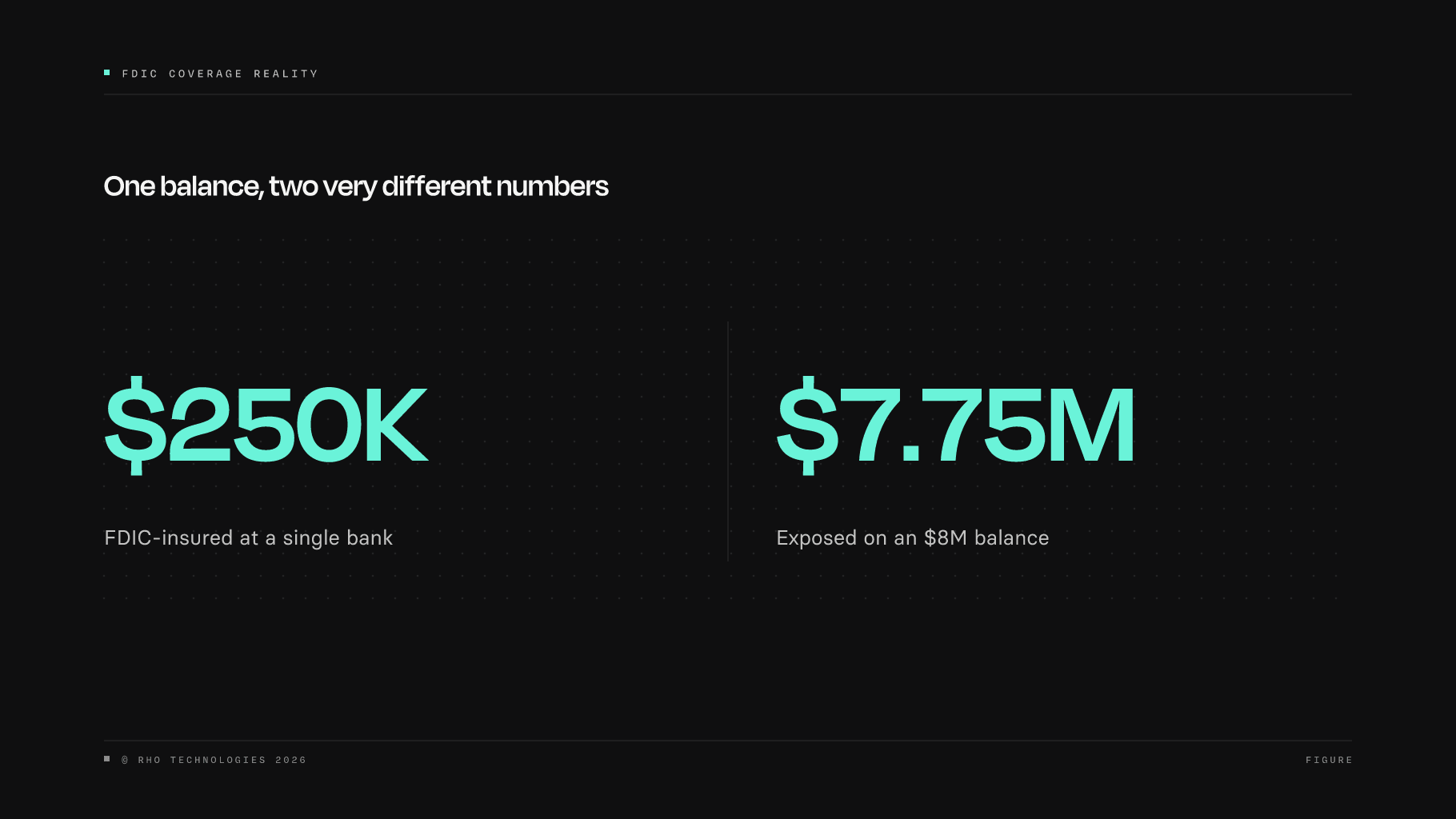
FDIC insurance covers depositors, not accounts. A business qualifies as its own depositor category, separate from its owners' personal accounts, according to the FDIC, giving it up to $250,000 in coverage at each FDIC-insured institution. That ceiling applies to the total of all deposit accounts held by that business at a single bank.
Here's what that looks like in real numbers: a post-Series A startup with $8 million sitting in one business MMA has that same figure protected and $7.75 million exposed. The gap is not a footnote. It is the entire balance.
Key takeaway: A post-Series A startup with $8 million in one business MMA has that same figure protected and $7.75 million exposed, the FDIC label on the marketing page is not the number that matters.
This is one of the most consequential misunderstandings founders carry into a banking decision. When businesses we work with are actively evaluating platforms based on FDIC insurance limits, the instinct is correct: deposit safety beyond the $250K threshold is a real and material risk.
But the number on the marketing page is not the number that matters. What matters is how much of your actual operating balance is covered after that first $250K.
Rho is a fintech company, not a bank or an FDIC-insured depository institution. Checking account and card services provided by Webster Bank, a division of Santander Bank, N.A. Member FDIC, and by Lead Bank, Member FDIC. Savings account services provided by American Deposit Management Co. and its partner banks.
Above $250K - How Partner-Bank Network Structures Extend Coverage
Partner-bank networks solve the coverage problem by distributing deposits across multiple FDIC-insured partner banks automatically. The founder never opens multiple accounts manually. The distribution happens behind the scenes, and each bank in the network insures its slice up to $250,000.
Rho's savings account, provided by American Deposit Management Co. and its partner banks, uses this network structure, extending FDIC coverage up to $75 million through a network of approximately 400 partner banks.
Rho's checking account is provided by Webster Bank, a division of Santander Bank, N.A. (member FDIC), which carries up to $250,000 in standard FDIC coverage. That combination, network-backed savings alongside a checking account at a large, established institution, is how Rho protects balances that far exceed what a single-bank account can insure.
This structure matters most for companies holding post-raise cash in the $1 million to $20 million range. Most standard business MMAs at legacy banks do not include a multi-bank network arrangement by default. Founders have to ask, and most never do.
Rho includes both structures in a single platform: no separate account applications, no manual coordination, accessible to all customers at $0 platform fee, not as an add-on for a top tier of customers.
For finance teams managing multiple entities, this matters even more. Rho's multi-entity support lets you manage spend and financial oversight across multiple business entities from one platform, which means FDIC-eligible network coverage and account infrastructure scale with your entity count without requiring a proportional increase in finance overhead or separate banking relationships.
The Coverage Cliff - What Happens to Startup Cash Outside FDIC and Partner-Bank Networks
The FDIC is explicit: insurance applies only to deposit products at FDIC-insured banks. It does not cover money market mutual funds, Treasury securities, or any investment product, even when purchased through an FDIC-insured institution.
Rho Treasury is a case where that distinction is stated plainly. Rho Treasury is a separate, fee-bearing advisory product; investment management and advisory services are provided by RBB Treasury LLC dba Rho Treasury, an SEC-registered investment adviser and subsidiary of Rho, and investments made through it are not deposits and are not FDIC insured.
None of that is a weakness Rho is trying to bury. It is a structural fact about any yield-generating investment in eligible securities such as U.S. Treasury Bills and mutual fund options.
The tradeoff for accepting that the FDIC label does not apply is access to instruments that can generate yield at a management fee of 15–60 basis points annually, with a $50,000 minimum investment; T-Bills settle in 2–3 business days and mutual fund redemptions settle the next business day.
Founders who treat FDIC coverage as a background trust signal, even when it is not the primary reason they are choosing an account, are right to use it as a baseline. Rho's answer is not to paper over the distinction between insured deposits and investment products.
It is to offer both structures in the same platform: FDIC-backed checking and network-protected savings for operating cash, and Rho Treasury for balances where yield-seeking is the priority and the non-FDIC nature of the investment is understood and accepted.
Business Money Market vs. Other Business Savings Options - How to Choose the Right Vehicle
Picking the highest APY on a business money market account feels like the responsible move, but the vehicle choice often matters more than the rate. For context: a 20-basis-point rate difference on $500,000 is $1,000 annually, a gap that can be eclipsed by a single month of maintenance fees or one missed minimum-balance threshold, as the fee and tier structures above illustrate.
Business owners using traditional bank savings accounts consistently tell us they feel like they're leaving money on the table, earning near-zero interest on idle business funds sitting at a large traditional bank.
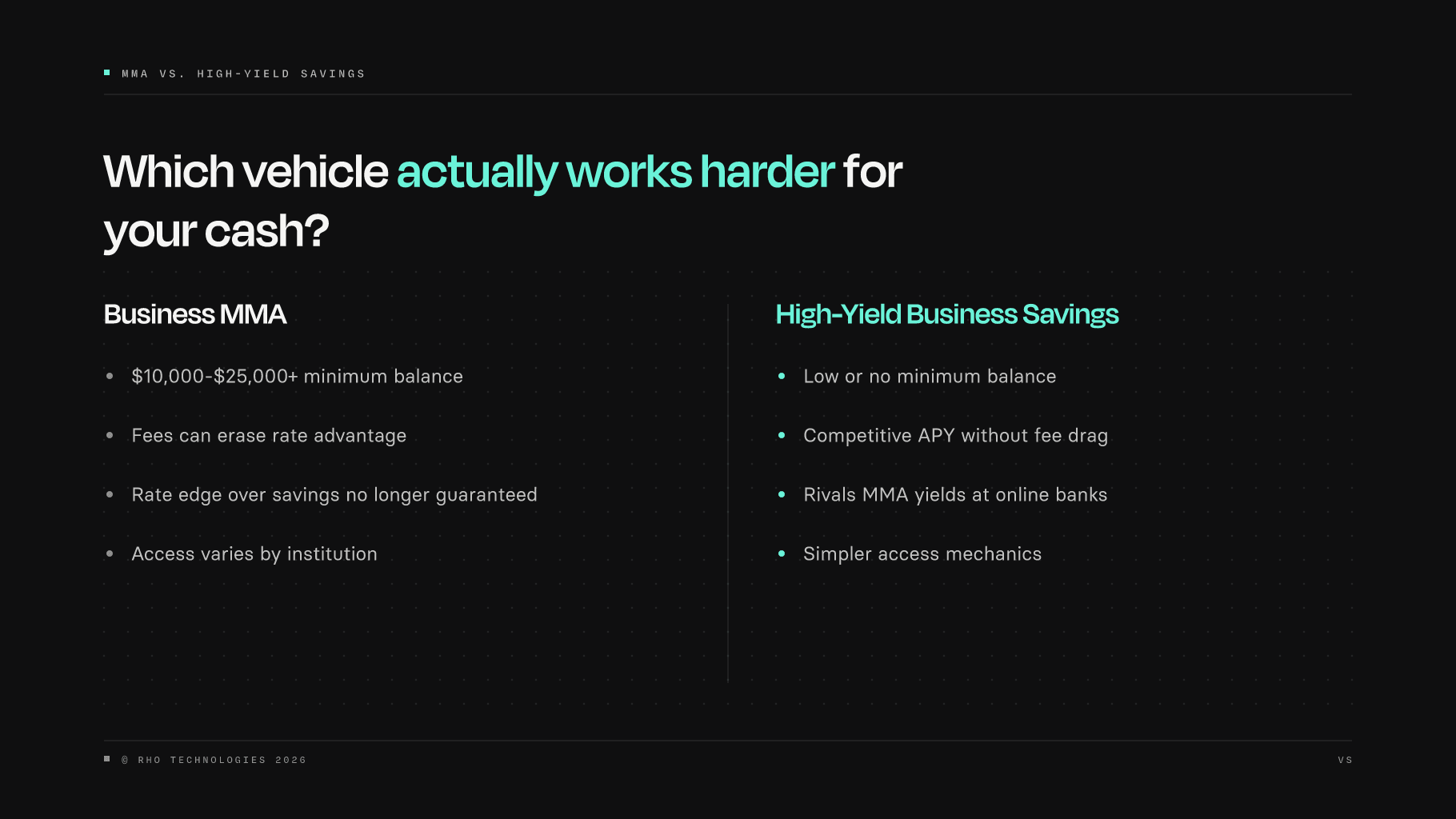
Business MMA vs. High-Yield Business Savings Account
High-yield business savings accounts now rival or exceed standard business money market account rates, making APY alone an insufficient differentiator. Online-first institutions like Live Oak Bank have positioned their business savings products to compete directly with traditional MMAs on yield, which means the old assumption that an MMA automatically out-earns a savings account no longer holds.
The real differentiators are minimum balance requirements and access mechanics. Many traditional business MMAs require $10,000 to $25,000 or more to avoid monthly maintenance fees, while high-yield online savings accounts increasingly require no minimum or a far lower threshold. If your operating cash sits below that floor, the MMA's rate advantage disappears into fees before you collect a dollar of interest.
One pain point we see consistently among business owners: frustration with the near-zero rates offered by large traditional banks on idle operating cash, paired with transfer delays of one to two days that create real stress when payroll or a vendor payment arrives unexpectedly. That combination, poor yield and slow access, is what makes the account structure decision consequential rather than academic.
Business MMA vs. CD, Match the Instrument to Your Cash Timeline
A business money market account offers variable rates and flexible access; a CD locks funds for a fixed term at a fixed rate. That distinction is the decision variable.
Know with certainty that $150,000 will sit untouched for six months? A CD's locked-in rate removes the risk of a rate drop mid-period. Need that same cash to move in 30 days to cover a vendor payment or bridge payroll? A CD becomes a liability.
Match the instrument to the timeline, not to the rate table.
The ability to move money via ACH or wire with no fees, and with predictable, same-day settlement windows, is what makes a flexible account genuinely usable as an operating buffer rather than a yield trap. For teams managing payroll, vendor wires, and capital allocation simultaneously, that settlement certainty matters more than a marginal rate improvement locked behind a CD term.
Business MMA vs. Treasury Bills and Partner-Bank Networks
For larger cash balances, Treasury bills and partner-bank networks offer yield potential that FDIC-insured deposit accounts cannot match. Treasury bills are not FDIC insured, that is the explicit trade-off, not a footnote. A partner-bank network distributes deposits across multiple banks to extend effective FDIC coverage, which is a different risk profile than holding T-bills directly.
The three vehicles sit at meaningfully different points on the yield-vs-safety spectrum:
Vehicle | FDIC Insured? | Yield Potential | Liquidity | Minimum (Rho) |
|---|---|---|---|---|
Business MMA / Savings (network) | Yes, up to $75M via ~400 partner banks | Competitive deposit rates | Flexible; same-day ACH / wire | $0 |
Treasury Bills (via Rho Treasury RIA) | No, investment product, not a deposit | Higher yield potential | T-Bills settle in 2–3 business days | $50,000 minimum investment |
Partner-Bank Network (Rho savings via ADM) | Yes, distributed across partner banks | Deposit rates | Flexible | $0 |
Rho Treasury is a registered investment advisor (RIA) product available directly within the Rho platform, offering Treasury Bills and mutual fund options. Rho Treasury investments are not deposits and are not FDIC insured. T-Bills settle in 2–3 business days and mutual fund redemptions settle the next business day, so idle capital is not stranded if operational needs shift.
Because Rho Treasury sits inside the same platform as banking, bill pay, corporate cards, and accounting integrations, treasury yield and operating cash management remain visible in one place rather than spread across disconnected tools. No separate login, no separate portal, no $250K minimum balance requirement that some competing treasury products impose.
For business owners who have historically felt they were leaving money on the table with traditional bank savings rates, Rho Treasury provides a structured path to put idle cash to work: transparent fees, clear minimums, and explicit disclosure that these are investments, not deposits.
Best Business Money Market Account Rates in 2026 - Top Banks and What They Actually Offer
Rates, minimums, and withdrawal rules vary enough across institutions that the same deposit can earn meaningfully different yields depending solely on where it sits.
Which specific banks offer the best business money market account rates in 2026? The short answer: top accounts range from approximately 2.75% to 4.15% APY (as of 08/13/2026), but the rate alone tells you almost nothing about whether the account will actually work for your company. Here is what the real terms look like across the accounts founders compare most often.
Institution | APY (as of 08/13/2026) | Monthly Fee | Minimum to Earn | Key Tradeoff |
|---|---|---|---|---|
U.S. Bank Platinum Business MMA | Up to 4.15% | $15 (waived with $10K daily balance) | $1,000,000+ for top rate | Tiered structure heavily rewards seven-figure balances |
First Internet Bank Business MMA Savings | 2.94% | None listed | $0 | Solid online-first rate with no minimum friction |
nbkc bank Business Money Market | 2.75% | None | $0 | Zero minimums; accessible for early-stage companies |
Axos Business Premium Savings | 3.60% | $0 | $0 | High yield with no monthly maintenance requirements |
EverBank Business Money Market | 3.50% | None listed | $10,000 | Competitive rate but balance floor applies |
Competitive data collected from U.S. Bank, First Internet Bank, nbkc bank, Axos Bank, and EverBank websites as of 08/13/2026, and may change. Sources: DepositAccounts.com listing data; U.S. Bank product page, July 2026; Investopedia best high-yield business savings accounts.
What the Table Does Not Show
The U.S. Bank Platinum Business Money Market Account illustrates the core problem with rate-first comparisons. The account uses a tiered interest rate structure where the 4.15% special rate applies to balances between $1,000,000 and $2,999,999.99. Balances in the $50,000 to $999,999.99 range earn 3.90%.
Fall below the $10,000 daily minimum and the $15 monthly fee kicks in, regardless of rate. For a seed-stage company holding $300,000 in operating reserves, the headline rate is functionally irrelevant.
Nbkc bank sits at the opposite end of the spectrum. The nbkc Business Money Market Account carries a 2.75% APY with no minimum balance requirement and no service charge.
That is a meaningful combination for an early-stage company that cannot guarantee a stable cash floor every month. The yield is lower, but the account does not penalize you for deploying capital into the business, which is exactly what early-stage companies are supposed to do.
What Rarely Makes the Comparison Chart. A high-APY account that lives in a separate institution quietly creates a reconciliation problem your finance team will absorb every month.
1. Rho - Best All-in-One Business Banking Platform for Startups and Scale-Ups
Rho combines business banking, corporate cards, bill pay, treasury, and accounting automation in a single platform built for venture-backed startups and their finance teams. Unlike standalone money market accounts, Rho lets you earn yield on idle cash while managing every financial workflow in one place, with real human support and no subscription fees.
The tradeoff: it's purpose-built for growth-stage companies, so very early pre-revenue teams may find the full feature set more than they need immediately.
2. U.S. Bank Business Money Market - Best for Established Businesses Wanting Big-Bank Stability
U.S. Bank's business money market account appeals to established SMBs that prioritize FDIC-backed security, branch access, and a recognizable institution behind their idle cash. It pairs tiered interest rates with the convenience of a full-service bank relationship, useful when you also need lending or payroll products under one roof.
The key limitation is that rates are typically lower than fintech or online-bank alternatives, and minimum balance requirements can be a friction point for leaner operations.
3. Wells Fargo Business Market Rate Account - Best for Small Businesses Already in the Wells Fargo Ecosystem
Wells Fargo's Business Market Rate Account is designed for small business owners who want liquidity alongside modest yield, particularly those already using Wells Fargo checking or lending products. The account rewards growing balances with incrementally better rates and integrates cleanly with existing Wells Fargo business tools.
Rates remain below what dedicated online banks or fintech treasury platforms offer, though, making it a convenience play rather than a yield-maximization strategy for cash-rich businesses.
4. Community Bank Business Money Market - Best for Local Relationship-Driven Banking with Flexible Terms
Community banks offer business money market accounts with a relationship-first approach, meaning more flexible minimum balances, personalized service, and local decision-making that larger institutions can't match. For small and mid-sized businesses that value a banker who knows their name and industry, this model delivers real advantages.
The tradeoff is limited digital tooling and rates that vary widely by institution, so businesses with sophisticated treasury needs or remote-first operations may find the experience limiting.
5. Academy Bank Business Money Market - Best for Businesses Weighing Pros and Cons Before Committing
Academy Bank positions its business money market account as an accessible, straightforward option for business owners who want to understand exactly what they're signing up for, with transparent discussion of both benefits and limitations. It suits businesses in the consideration phase that want competitive rates without the complexity of a fintech platform.
The honest tradeoff: as a regional bank, Academy Bank's rate competitiveness and digital feature depth won't match the top online-only or fintech treasury options available in 2026.
Why the Best Business Money Market Rate Still Isn't Enough for Most Startups
Doing the rate comparison right is genuinely good instinct. Shopping APYs, reading the fine print, finding a competitive yield on idle cash, that is exactly what a careful founder or early finance hire should do. The problem is not the research. The problem is what happens the day after the account opens.
Reconciliation and Integration Costs - What APY Comparisons Typically Leave Out
The total cost of chasing the highest MMA rate at a standalone fintech or online bank is structurally understated. It excludes two compounding drags most founders never model: the reconciliation labor tax imposed by every siloed financial account, and the FX and integration fees that emerge the moment the business transacts internationally or needs the account to connect to its accounting stack.
Add those two together and the real number surfaces: enough to erase a full year of yield differential on a modest cash balance.
That new high-yield MMA now lives at a separate institution, with a separate login, transaction history, and reconciliation loop.
Finance teams waste a significant share of their time on manual reconciliation, a December 2024 analysis by Abdul Majid ACCA, APFA found, and the root cause is fragmentation: each additional account operating outside a unified platform adds a discrete time tax. A standalone MMA carries a recurring cost paid in labor.
Key takeaway: Finance teams waste an estimated share of their time on manual reconciliation tasks, and a siloed MMA compounds that drag with every additional account.
What a Siloed MMA Actually Costs a Startup
When financial data lives in disconnected systems, finance teams must manually bridge those silos, multiplying the time cost of every transaction and increasing the risk of errors that surface only at close.
For a two-person finance function at a seed-stage startup, that is the controller spending Friday afternoon exporting CSVs from one institution and reconciling them against bill pay and expense data from another, every month. The yield gain is real, but the drag it introduces is rarely modeled.
Why Liquidity Visibility Matters More Than Liquidity Itself. Liquidity you cannot see in real time is liquidity you cannot act on.
Next steps
If your post-raise cash is sitting in a rate-optimized account at a separate institution, the path forward starts with recognizing that rate is the last decision, not the first. Coverage structure, access speed, and operational integration determine whether a business money market account actually serves your company or quietly works against it.
The FDIC's $250,000 ceiling means a startup holding even a modest seed round at a single bank is almost certainly carrying uninsured cash while assuming it is fully protected. And the reconciliation labor imposed by every siloed financial account can exceed a full year of yield differential on that same balance.
Put those two realities together and the conclusion is straightforward: account structure matters more than the APY column, and consolidating banking, coverage, and cash visibility into a single platform removes both risks at once.
Start with a business bank for startups at Rho, where FDIC-backed checking, network-protected savings up to $75M, corporate cards, and accounting integrations are available at $0 monthly fee with no minimum balance required. From there, your team gets real-time visibility across every account, automatic receipt sync, and same-day ACH and wire settlement so the cash you can see is cash you can actually act on.
FAQs
They can be, but only if your balance stays above the minimum threshold and you have more than $250K covered. Business MMAs genuinely outperform traditional savings accounts on yield and offer flexible access with no fixed lock-in, but the benefits erode quickly through maintenance fees if your balance dips below the required floor, and standard FDIC coverage at a single bank protects only $250,000, leaving any amount above that exposed.
The real benefits are higher yields than standard checking, debit card and check-writing access without a penalty, and FDIC-backed safety. The catches are minimum balance requirements of $10,000 to $25,000 or more that trigger fees if you fall below them, tiered rates that reset downward without notice when your balance drops, and a $250,000 FDIC coverage ceiling that leaves post-raise cash largely unprotected at a single institution.
The spread between the best and worst business MMA rates can exceed 4 percentage points, the best rates currently reach up to 5.00% APY or higher, while many business MMAs still pay well under 1% APY. Rates are tiered, meaning they reset downward automatically if your balance drops a tier mid-month, often without any notification, making yield structurally unreliable for early-stage companies whose cash position shifts with each payroll cycle or delayed customer payment.
Yes, unlike a certificate of deposit, a business MMA allows limited check-writing and debit card access without triggering a penalty, and there is no fixed term locking up your cash. That flexibility is genuinely valuable for startups managing unpredictable cash timing.
Any balance above $250,000 at a single FDIC-insured institution is unprotected, a post-Series A startup with $8 million in one business MMA has $250,000 protected and $7.75 million exposed. Partner-bank network structures solve this by automatically distributing deposits across multiple FDIC-insured partner banks; for example, Rho's savings account uses this approach to extend FDIC coverage up to $75 million through a network of approximately 400 partner banks, all accessible from a single platform at no monthly fee.