
The wrong business bank account doesn't hurt you on day one. It hurts you the moment your business finally gains momentum and you have no time to fix it.
Sole proprietors need a separate business bank account for one reason that cuts across both legal exposure and day-to-day operations: the moment your personal and business money share the same account, every transaction becomes harder to explain, defend, and build on.
That's not a technicality. It's the first architectural decision that either gives you a clean foundation or a mess you'll spend years untangling.
The common assumption is that any reputable business checking account with no monthly fee is essentially the same, the differences are marginal and easy to swap out later if needed. That assumption is wrong, and the cost of acting on it shows up in ways most founders don't anticipate until they're already dealing with the consequences.
See our business bank for startups for how this works in practice.
Sole proprietors report income and expenses on Schedule C, one of the most scrutinized forms the IRS processes. Commingled finances are a direct contributor to that exposure.
As Tydings Law noted, mixing personal and business transactions makes it difficult to substantiate deductions and verify income accuracy, which is exactly what an IRS auditor is looking for when reviewing a Schedule C. Clean, separated records are not a preference. They are your primary audit defense.
Unlike an LLC or corporation, a sole proprietorship creates no separate legal entity. Your personal assets sit exposed to any business liability, and the only practical firewall available to you is behavioral: keep the finances separate, document everything, and make the paper trail unambiguous.
A contractor who runs all income through a personal checking account has no clean record to show a lender, no clear expense history to hand an accountant, and no documentation trail if a client dispute escalates.
First architectural decision: a separate business bank account is the first move a sole proprietor makes; get it wrong and you spend years untangling commingled transactions instead of building on a clean record.
Forced migrations trace to three mismatches: a fee model that punishes growth, cash deposit limits that don't match actual volume, and integrations that require manual CSV exports long after you've outgrown them.
Cheapest is not cheapest: accounts that look free on day one (no monthly fee, fast signup) are often the most expensive in practice once you factor in transaction caps, wire fees, and the cost of switching mid-growth.
Onboarding is fast, but unpredictable: opening a sole proprietor account online typically takes less than 10 minutes; the friction isn't the paperwork, it's not knowing in advance which specific documents a given bank actually requires.
Liability arrives without warning: a sole-proprietor account stops being an asset the moment an investor requests a data room, a contractor needs a formal payment approval, or your accounting sync still requires a manual workaround; none of those moments announce themselves in advance.
Today's account is tomorrow's record: the account you open today becomes the first data point in a financial record that investors, accountants, and the IRS will eventually read closely; it is not a placeholder.
Rho closes the loop: business banking, corporate cards, bill pay, expense management, treasury, and accounting in one platform, no subscription fees, real human support, and infrastructure that scales from a one-person operation to an IPO without forcing a migration.
How to Choose the Right Business Bank Account for Your Sole Proprietorship (Without Picking Yourself Into a Corner)
Most sole proprietors assume that picking a business bank account is a low-stakes, reversible decision. It rarely is.
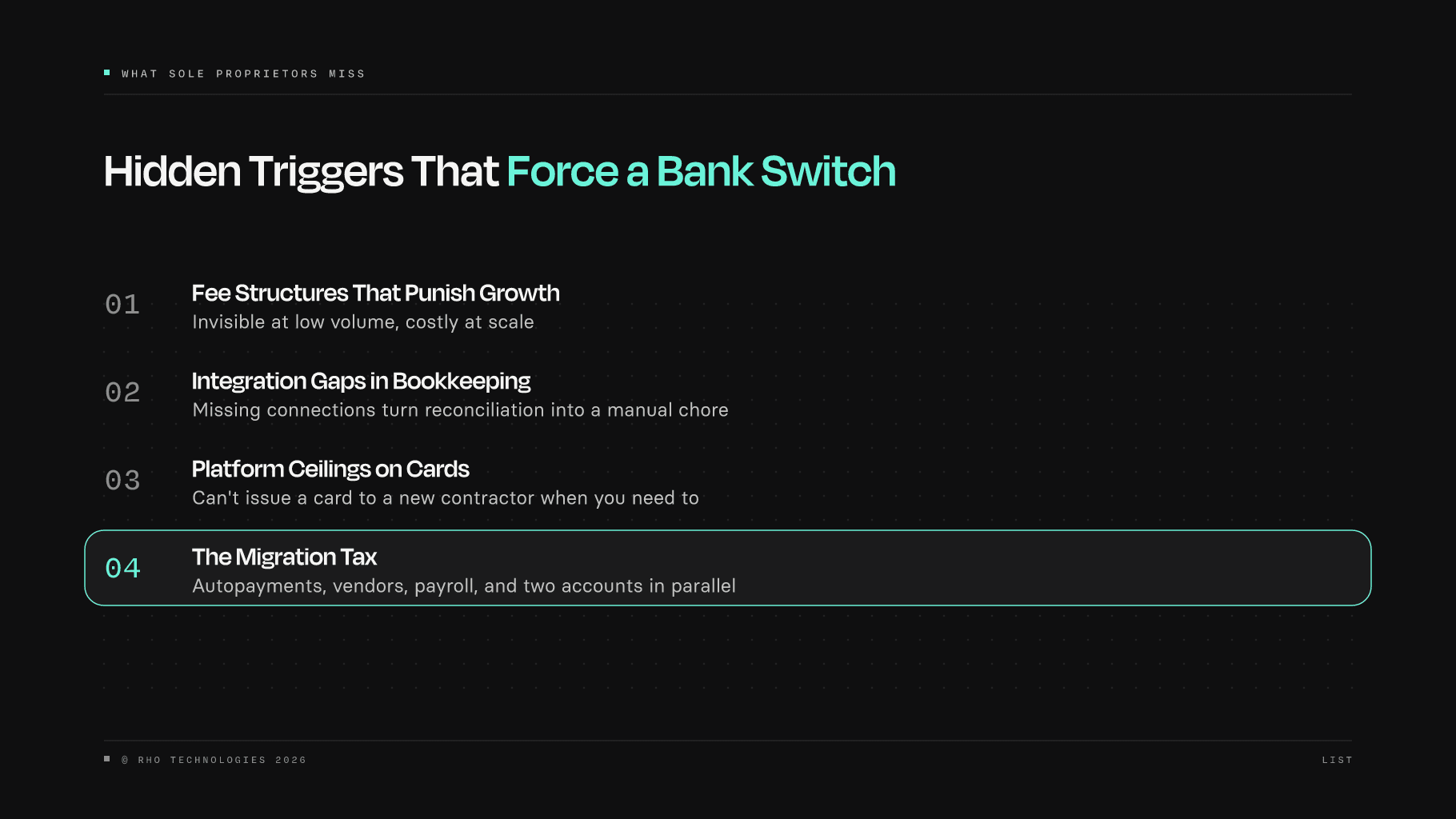
The real cost shows up later, when a fee structure that looked fine at low volume starts punishing growth, when a missing integration turns bookkeeping into a manual weekly task, or when a platform simply can't keep up with the business. Switching means migrating autopayments, notifying vendors, and running two accounts in parallel at exactly the moment you can least afford the distraction.
Hidden Bank-Switching Triggers Sole Proprietors Miss
The common assumption is that any reputable business checking account with no monthly fee is essentially the same, and the differences are marginal enough to swap out later if needed.
Here's where it actually breaks down:
In reality, most forced migrations trace back to one of three structural mismatches: a fee structure that was invisible at low volume but punishing at scale, an integration gap that turned bookkeeping into a weekly manual chore, or a platform ceiling that simply couldn't issue a card to a new contractor.
Switching is not a clean cut. It means migrating autopayments, notifying every vendor, updating payroll and accounting integrations, and running two accounts in parallel during the transition. That is the migration tax, and it lands hardest when the business finally has momentum and the founder has no spare hours.
“Sole proprietors struggle with understanding when it's the right time to open a dedicated business bank account, especially when starting out with modest income.”
The timing is the cruelest part. Forced migrations cluster around the exact moments that demand full attention: right before a first hire, right before a tax deadline, right before incorporation.
One underappreciated source of those forced migrations is a platform that starts to cost money, or limit features, precisely when the business starts to scale.
Sole proprietors building toward their first hire often discover too late that the account they opened at modest income can't keep pace without adding per-user fees, upgrading to a paid tier, or absorbing wire charges that didn't exist at low volume.
Starting on a platform that doesn't impose a ceiling removes that problem.
Rho operates a single unified platform tier: $0 platform fee, $0 subscription fee, and $0 per-user fee regardless of company size or headcount. The only fees charged are on FX transfers and treasury management.
That structure means a sole proprietor who opens an account today can grow, add employees, issue more cards, add AP automation, and connect accounting software without the fee schedule changing beneath them, and without having to migrate again.
$0 Rho platform fee at any company size
Online Bank vs. Traditional Bank: The One Question That Actually Decides It
Online bank or traditional bank? The question that actually decides it is simpler than most comparisons suggest: do you regularly handle physical cash?
If your revenue arrives by ACH, card, or wire, a digital-first account removes nearly every friction point and most of the fees. If you run a market stall, a pop-up retail event, or any operation where weekend cash needs depositing Monday morning, a bank with physical branches is a hard requirement.
Fee Structures Decoded: What the Monthly Fee Doesn't Tell You
The monthly fee is the smallest number on the real cost sheet. Transaction limits, cash deposit fees per hundred dollars, and minimum balance requirements that trigger a fee only after your balance grows past a threshold are all invisible at account opening.
Fee structures that appear low at launch can become significant cost drivers as volume increases, which makes the initial “no monthly fee” framing misleading as a primary selection criterion.
A more accurate framing is: what does the account cost when you are doing $500K in annual revenue, running payroll, and sending a dozen wires a month? On Rho's platform, the answer to that question stays $0 for the platform itself, domestic wires are $0, ACH payments are $0, bill pay and AP automation are included at $0, and corporate cards carry no minimum balance requirement.
Here's what actually costs money:
The only line items that add cost are FX transfers (1% foreign currency conversion fee) and treasury management (15–60 bps annually, a separate RIA product with its own minimums). Everything else is the same flat $0 whether you have one employee or fifty.
Read the fee schedule for the business you expect to run in eighteen months, not the one you have today.
How to Evaluate a Bank's Integration Ecosystem Before You Commit
The integration question is where most early-stage founders underinvest their due diligence, and where the migration tax grows heaviest.
A platform that doesn't sync with your accounting software means someone, usually the founder, is reconciling transactions by hand every week. That overhead doesn't disappear; it just becomes invisible inside the workweek until it isn't.
Here's the practical test:
Does the platform connect natively, not through a third-party export workaround, to the accounting software you actually use? Rho includes native direct integrations with QuickBooks Online, Oracle NetSuite, Sage Intacct, and Xero at $0.
Transactions, receipts, and expense data sync automatically. That means a sole proprietor moving toward their first bookkeeper or accountant hands off a clean, already-synced ledger rather than a folder of downloaded CSVs.
The same logic applies to spend visibility. Sole proprietors often find it hard to keep a real-time picture of cash and expenses without juggling multiple tools: a separate card platform here, an expense app there, a bank portal that doesn't talk to either.
Rho consolidates corporate cards, expense management (including receipt capture and the Gmail Connector, in beta, which scans for receipts without reading email body content), savings, checking, AP automation, and, for qualifying balances, treasury into a single platform.
The goal is visibility into cash and spend without adding operational overhead, not just at the moment of opening but as the business grows.
The downstream cost of switching integrations mid-growth is significant. The cleaner move is to audit the integration ecosystem before committing, not after the first reconciliation crisis.
Best Online and Fee-Free Business Bank Accounts for Sole Proprietors Who Operate 100% Digitally
The best fee-free online business bank accounts for sole proprietors who operate entirely digitally are Rho, Found, Bluevine, and Airwallex, but picking the right one means understanding where each account stops working, not just where it starts.
The accounts that look cheapest on day one are often the most expensive in practice. Bluevine Business Checking's Standard tier, for example, offers up to 1.3% APY, but that rate is behaviorally gated. You only earn it if you spend $500 per month on your Bluevine debit card or deposit $2,500 per month in customer payments.
A freelance copywriter in her first quarter, building her client list, may hit neither threshold. The account is still free, but the yield she was counting on evaporates.
That is the hidden behavioral tax buried inside “no-fee” positioning: the benefits are real, but they are structured for a business that is already running at volume, not one that is just starting.
The same ceiling problem applies across the category. Most of these accounts were designed for a specific kind of sole proprietor at a specific stage. When your business outgrows that stage, the account does not grow with you.
Founders who picked purely on “zero fees” have described the migration pain in terms that are hard to forget: realizing six months before a fundraise that their banking platform has no multi-user controls, no AP automation, and no integration with the accounting software their new bookkeeper uses.
The account that felt like a safe default on day one becomes a liability at exactly the wrong moment.
One struggle that surfaces again and again among sole proprietors is feeling excluded from the better-built business banking products, the ones with real infrastructure, because those platforms only support incorporated entities. That leaves unincorporated small business owners in a gap where their only options are consumer accounts dressed up with a business label.
Understanding that structural limitation up front is the single most useful thing this comparison can give you.
The decision framework is simpler than the marketing makes it look. Match the account to your current revenue profile and your 12-month growth trajectory, not just your current headcount of one.
1. Rho: Best All-in-One Banking Platform for Digitally-Native Sole Proprietors Who Plan to Scale
Most sole proprietors open a fee-free account because it feels low-risk, and it is, until the day they hire a contractor, need to pay a vendor, or try to close the books before a fundraise. At that point, a “simple” account reveals it was never designed for any of those things.
Rho's all-in-one platform starts at $0 and includes corporate cards, bill pay, AP automation, same-day ACH, and native integrations with QuickBooks Online, Oracle NetSuite, Sage Intacct, and Xero, per published product documentation.
There are no monthly fees, no per-user fees, and no platform tier gating. Every feature is available to every customer at every stage and headcount, at $0.
Rho has built a banking foundation for businesses that need infrastructure from day one rather than something they will have to rebuild under pressure later. That foundation, the kind founders often wish they had inherited at the start, is what separates Rho from accounts designed for a solo operator who never grows.
For founders who want their idle cash working harder, Rho Treasury is available directly from the same platform. It is a separate, fee-bearing RIA product with a $50,000 minimum investment. Eligible securities include U.S. Treasury Bills and mutual fund options, and settlement runs 2-3 business days; the management fee runs 15–60 basis points annually based on cost to provide the service.
Rho Treasury investments are not deposits and are not FDIC insured; see the ADV-2A Wrap Fee Brochure and rho.co/treasury for current rates and full disclosures.
The straightforward trade-off: Rho is built for incorporated entities, not unincorporated sole proprietors. If you are operating as a sole proprietor without a formal corporate structure, Rho is not the right fit today.
But it is the right answer for the founder who is already thinking past day one and wants infrastructure that never needs to be rebuilt under pressure.
2. Found: Best Fee-Free Banking for Sole Proprietors Who Need Built-In Bookkeeping and Tax Tools
Found Small Business Banking is designed for self-employed founders who want their bank account to double as a bookkeeping and tax layer, a positioning its own product documentation makes explicit.
The core tier carries no monthly fee and includes real-time expense categorization, automated quarterly tax estimates, and a dedicated tax savings account that sets aside a percentage of each deposit automatically.
For a sole proprietor managing estimated quarterly payments without an accountant, that automation is the difference between a clean April and a panicked one.
The catch is scale: Found's feature set is optimized for solo operators, and its platform ceiling shows quickly once you add contractors or need multi-user spend controls.
3. Bluevine: Best High-Yield Fee-Free Checking for Sole Proprietors Who Carry Meaningful Cash Balances
Bluevine Business Checking earns up to 3.0% APY on eligible Premier tier balances, with no monthly fee on the Standard plan and no minimum balance requirement, according to Bluevine's product page.
Here's the catch:
FDIC coverage extends up to $3,000,000 per depositor through Coastal Community Bank and program banks, which matters for a digital product creator ring-fencing tax reserves in sub-accounts. The critical limitation: the Standard tier's 1.3% APY requires either $500 in monthly debit card spending or $2,500 in monthly deposits.
Low-volume sole proprietors who miss both thresholds earn nothing. Bluevine is the right pick when you carry real balances and can reliably hit the activity threshold.
Update (October 2026): Valley National Bank announced it will acquire Bluevine for $340 million, with the deal expected to close in early 2027. Bluevine will become Valley's small-business banking division; existing accounts aren't expected to change before then.
4. Airwallex: Best Fee-Free Digital Account for Sole Proprietors with International Clients or Multi-Currency Revenue
Airwallex solves a specific problem that every other account on this list handles poorly: getting paid in foreign currencies without losing a meaningful slice to conversion fees. For a sole proprietor billing clients in euros, pounds, or Australian dollars, the FX cost on a standard business account compounds fast.
Airwallex lets you hold, receive, and pay in multiple currencies from a single account, with conversion fees that are structurally lower than traditional bank rates. The catch: Airwallex is not a full-service domestic banking replacement.
If all your clients pay in USD and you never touch a foreign currency, its core advantage disappears and a simpler account serves you better.
All four accounts above assume one thing: that your business never touches physical cash and never needs a teller. If you collect payments in person, deposit checks regularly, or simply want a banker you can call by name, the digital-only model has a hard limit, and the next section covers exactly where traditional banks still win.
Best Traditional Business Bank Accounts for Sole Proprietors Who Handle Cash or Need In-Person Support
The best traditional bank for a sole proprietor isn't the one with the most branches on your commute. It's the one whose fee-waiver threshold you can actually hit, whose cash deposit limits match your volume, and whose built-in tools offset the monthly cost in a way that makes arithmetic sense for your specific business.
For sole proprietors who handle cash daily or need a branch they can walk into, the two accounts that consistently earn a place on the shortlist are Chase Business Complete Banking® and Wells Fargo Initiate Business Checking.
Rho is included below for a different reason: it is the pick for the sole proprietor who plans to incorporate and scale beyond cash, since Rho has no branches and does not accept cash deposits. Here's how each one performs against the use cases that actually matter.
Pros and Cons at a Glance
Pros | Cons |
|---|---|
Broadest traditional-bank footprint among national banks for cash handling | Fee-waiver anchors payment processing, card spend, and cash reserves in one proprietary ecosystem |
More than 5,000 branches and nearly 15,000 ATMs nationwide (as of 08/11/2026) | Migrating any single rail later disrupts the others |
$15 monthly fee waivable via multiple qualifying paths | Caps fee-free cash deposits, creating friction for high-volume cash operators |
Built-in QuickAccept integrated card processing offsets monthly cost | Not ideal if you want flexibility to move payment processing independently |
Migrating any single rail later disrupts the others. The account also caps fee-free cash deposits at a monthly threshold that creates real friction for high-volume cash operators like food vendors or market stall owners.
This is the right pick for a sole proprietor who deposits moderate cash, wants QuickAccept's integrated card processing to offset the monthly cost, and plans to stay inside the Chase ecosystem. If your cash volume regularly clears $5,000 monthly or you want flexibility to move payment processing independently, this account is a poor fit.
1. Rho: Best All-in-One Platform for Sole Proprietors Planning to Incorporate and Scale Beyond Cash
Most sole proprietors who start with a traditional bank because they handle cash today don't stay cash-heavy forever. When the business shifts to digital payments, team spending, and vendor bills, the branch-centric account opened on day one gradually becomes the bottleneck.
Rho is the honest answer to that inflection point: an all-in-one platform with banking, corporate cards, bill pay, expense management, and treasury in one place, no subscription fees, and real human support.
Most beneficial when a company needs a fast, scalable banking setup without legacy bank overhead, it's the account you plan toward rather than scramble to migrate into under pressure.
2. Chase Business Complete Banking: Best Traditional Bank for Sole Proprietors Who Handle Cash
For sole proprietors who deposit cash regularly and want a branch within reach, Chase Business Complete Banking® offers the broadest traditional-bank footprint among national banks for this use case, backed by more than 5,000 branches and nearly 15,000 ATMs nationwide (as of 08/11/2026). That makes it the most operationally accessible option for cash-handling sole proprietors.
Here's how that fee waiver actually works:
The $15 monthly fee is waivable by maintaining a $2,000 minimum daily balance, spending $2,000 on a linked Chase Ink Business Card, or routing $2,000 in deposits through Chase's built-in QuickAccept card processing.
That fee-waiver structure is worth examining closely: choosing Chase means anchoring your payment processing, card spend, and cash reserves inside one proprietary ecosystem.
3. Wells Fargo Initiate Business Checking: Best for Sole Proprietors Seeking Low-Barrier In-Person Banking
Wells Fargo Initiate Business Checking waives its $15 monthly fee (as of 08/11/2026) with a $2,000 minimum daily balance, a $5,000 average combined business deposit balance, or a qualifying Premier checking relationship, making it a straightforward entry point for sole proprietors who want a physical branch relationship.
It doesn't bundle card processing or the deep ecosystem integration Chase offers, but that's the honest trade-off. Sole proprietors evaluating U.S. Bank Business Essentials or Bank of America® Business Advantage will find similar branch-based accessibility, though fee structures and waiver thresholds vary by account.
A sole proprietor contractor who needs to walk in for a cashier's check or deposit a client's paper check will find Wells Fargo a cleaner fit. The limitation is scalability: as transaction volume grows and the need for integrated tools increases, Initiate Business Checking offers fewer built-in capabilities to grow into.
Once you've identified which account fits your cash-handling reality, the next practical question is whether you can actually open the account without a branch visit. The documents you'll need and whether you can submit them online vary more than most guides admit, and that's exactly what the next section maps out.
What Documents Do You Need to Open a Business Bank Account as a Sole Proprietor?
Most founders assume the document bar for opening a sole proprietor business account is high enough to warrant a full afternoon of prep. The reality is that online banks typically complete business account onboarding in less than 10 minutes with no branch visit required.
The friction isn't the paperwork itself. It's not knowing in advance which specific documents a given bank actually needs.
What makes this harder for sole proprietors specifically: many platforms quietly exclude unincorporated businesses entirely, leaving sole proprietors without a clean path to legitimate business banking. That exclusion gap is real, and it compounds the SSN exposure problem.
Using a personal Social Security Number for business operations keeps finances muddier than they need to be. The goal of getting your documents right before you apply is removing the last obstacle between you and a clean financial separation that lets you get back to building.
SSN Is Usually Enough: Here's Exactly When You Need an EIN Instead
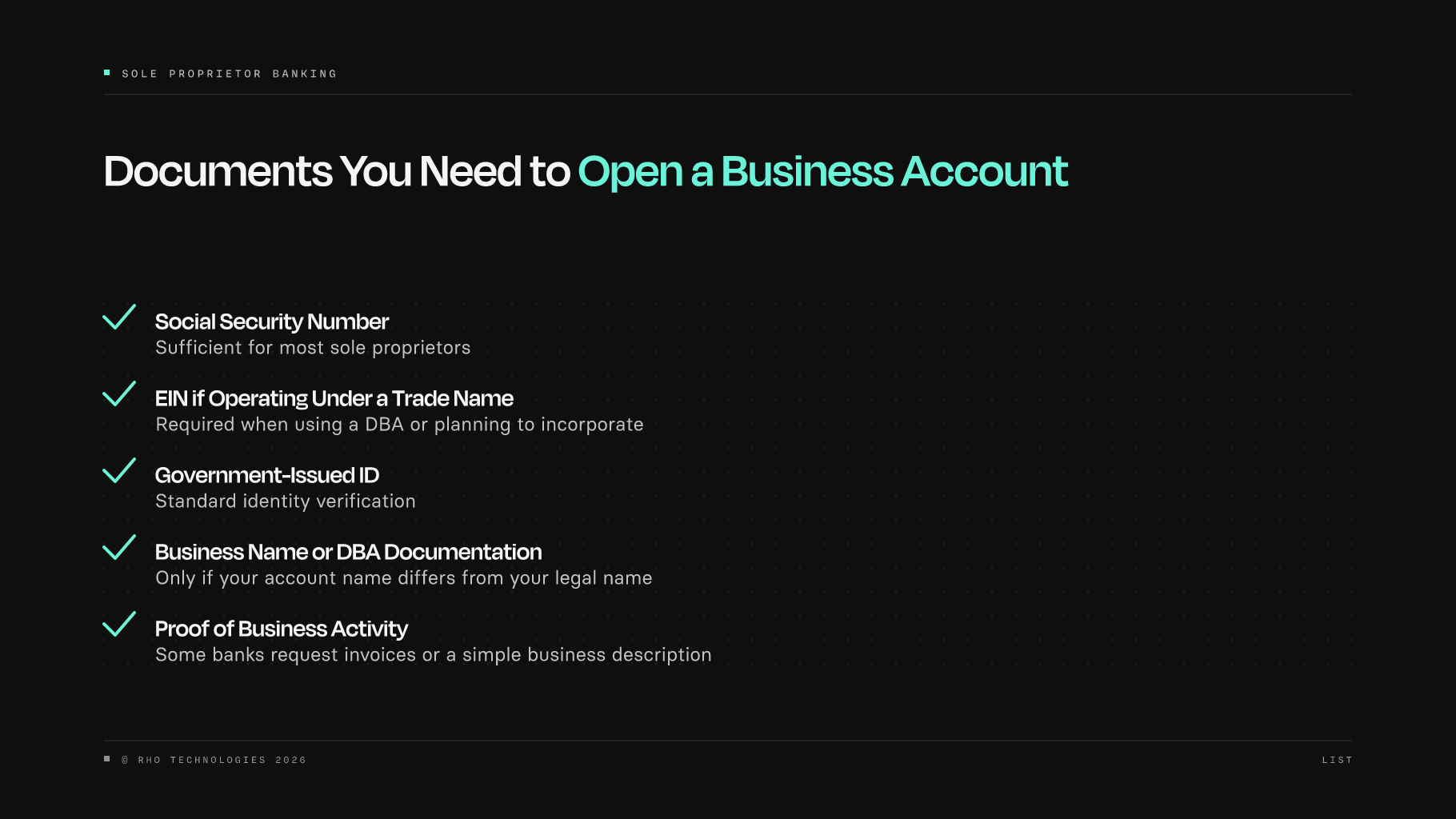
For most sole proprietors, a Social Security Number is all you need to open a business account. An EIN is not required unless you operate under a trade name, hire employees, or plan to incorporate.
That said, treating your SSN as a permanent foundation carries a hidden cost: the moment you incorporate or bring on a hire, an SSN-linked account becomes structurally incompatible with your new entity's legal identity.
That forced migration lands at exactly the moment your operational complexity is highest. Opening with an EIN now, even if optional, removes that constraint before it becomes urgent.
Key takeaway: Opening with an EIN now, even when optional, removes a forced account migration from arriving at the exact moment your operational complexity is highest.
Rho supports pre-EIN onboarding, so founders can open an account before their EIN arrives, a practical on-ramp for sole proprietors who are mid-formation and don't want to stall. There is no monthly fee, no per-user fee, and no minimum balance required to open a checking account, so there's no financial penalty for starting early.
Here's what changes once you're set up:
The checking account is provided by Webster Bank, a division of Santander Bank, N.A., member FDIC. Once you're set up, corporate cards are issued immediately with no minimum balance required, so you can separate business spend from personal spend from day one.
That clean financial boundary is precisely what sole proprietors using their SSN for business operations most need to establish.
The DBA Certificate: Why Your Trade Name Changes the Document Checklist
Operating under a trade name triggers an additional requirement. Banks typically require a DBA (Doing Business As) certificate or fictitious business name filing before opening an account under a trade name.
Filing location varies by jurisdiction: some states handle it at the state level, others at the county level. Check your specific county or state business registry before assuming one process applies everywhere.
The Core Document Stack Every Sole Proprietor Should Gather Before Applying
The standard document stack covers three items. Having these in hand before you start an application is the single fastest way to compress onboarding time.
Here's the short list:
Government-issued photo ID
SSN or EIN
DBA certificate (only if you operate under a trade name)
For founders who want a fast, scalable banking setup without legacy bank overhead, Rho is built for exactly that moment.
The platform runs on a single unified tier. Every feature, including $0 bill pay, AP automation, expense management, unlimited reimbursements, and native accounting integrations with QuickBooks Online, Oracle NetSuite, Sage Intacct, and Xero, is included at $0 for all customers, with no platform or subscription fee.
Once your documents are ready and your account is open, you can integrate your financial data cleanly with your existing accounting software immediately, without waiting on a pricing tier unlock. The Rho platform is built to scale alongside companies from early-stage through growth, starting with the same document-ready onboarding moment you're preparing for now.
When Your Sole Proprietor Account Becomes a Liability: and What You Grow Into
There is a specific moment when a sole-proprietor account stops being an asset and becomes a liability. It doesn't announce itself with a failed transaction. It shows up quietly, in the form of an investor's data request, a contractor who needs a formal payment approval, or a QuickBooks sync that still requires a manual CSV export eighteen months in.
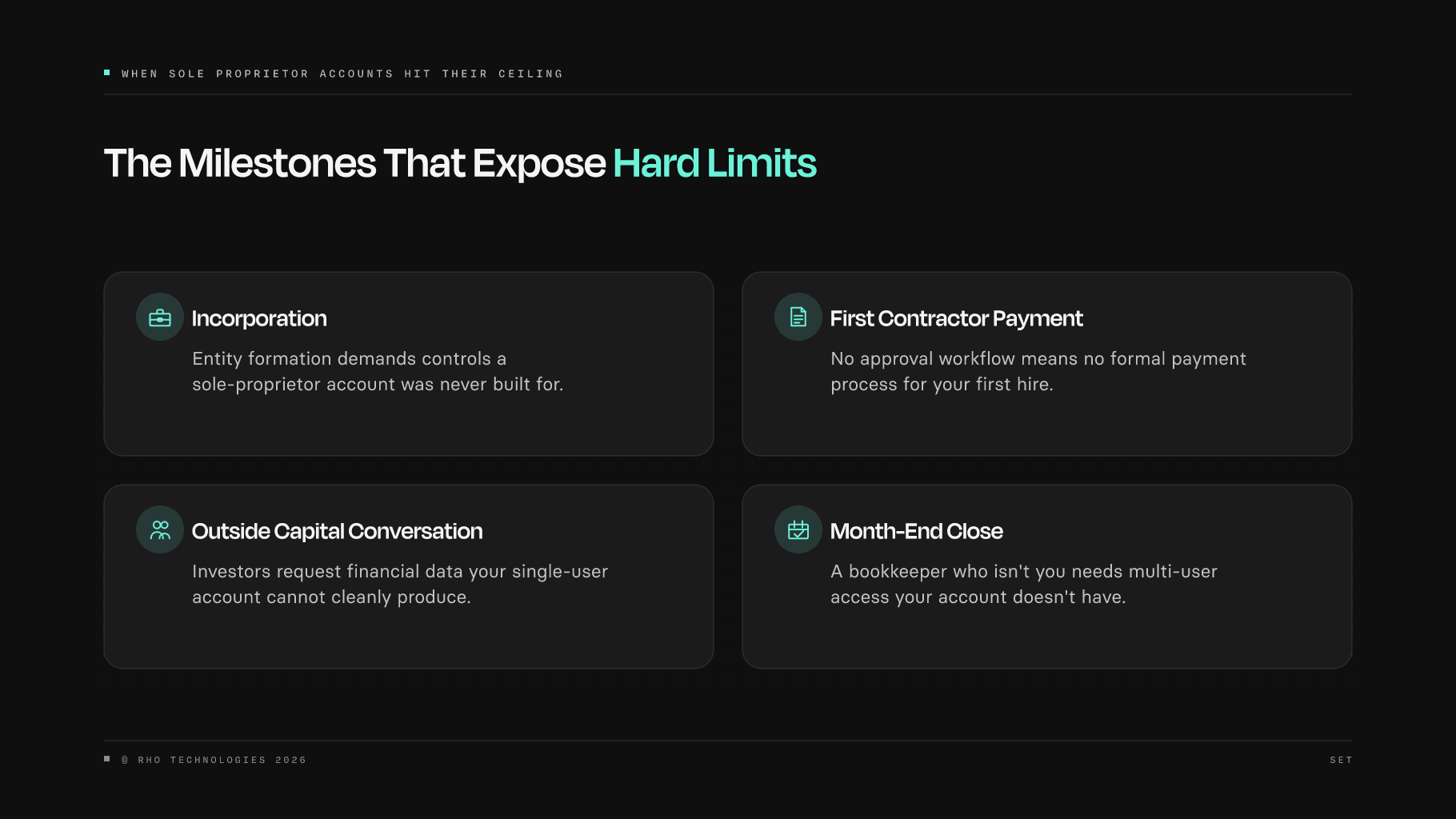
The Four Milestones That Expose Hard Limits
The four growth events that expose a sole-proprietor account's ceiling are incorporation, the first contractor payment, the first outside capital conversation, and the first month-end close with a bookkeeper who isn't you.
In practice, that looks like this:
Bookkeeping complexity scales structurally at each of these milestones. Single-user, transaction-only accounts create friction at exactly these moments, all at once.
The Capability Gap Most Listicles Skip
Standard sole-proprietor-optimized accounts lack three things that become operationally necessary almost immediately after growth: multi-user financial controls, AP automation, and real spend visibility.
A founder who adds a part-time contractor discovers there is no approval workflow. A co-founder who needs card access discovers there is no corporate card. These aren't edge cases. They are the first three requests any real team makes.
The absence of these features is a structural ceiling baked into the account at opening.
The Hidden Audit Risk Sole Proprietors Face, and How the Right Account Reduces It
Here's where the real risk hides:
Sole proprietors face a structurally compounded audit risk in which three separate facts converge into a single, underappreciated liability.
Schedule C audit rates run materially higher than S-Corp rates, the primary audit trigger is commingled finances, and the accounts most commonly marketed to sole proprietors, optimized for simplicity and low fees, are precisely the accounts that lack the sub-account or envelope structures needed to maintain clean financial separation.
The cheapest, simplest accounts available to sole proprietors are simultaneously the ones that create the highest audit exposure, at the income levels where audits are most likely.
When to Incorporate: The Sign Your Sole-Proprietor Account Has Hit Its Limit
Incorporation changes the legal entity, the tax treatment, and the banking requirements simultaneously. The problem is that most founders treat it as an administrative event rather than a financial infrastructure decision.
Next Steps
If your banking setup forces a migration right before incorporation, right before a first hire, or right before a tax deadline, the path forward starts with matching your account to the business you are building toward, not just the one you have today. Start with our business bank for startups.
The compounded audit risk insight from this guide makes the stakes concrete: Schedule C filers face materially higher audit rates than S-Corps, commingled finances are the primary trigger, and the simplest sole-proprietor accounts are precisely the ones that lack the sub-account structures needed to maintain clean separation.
At the same time, the integration debt insight makes the cost of switching visible: every contractor payment, recurring invoice, and accounting workflow layered onto the wrong platform compounds the migration tax. The scale-readiness threshold is not a future event you prepare for. It's a countdown that started the day you opened the account.
Together, they point to one action: open a platform built for where the business is going, not just where it is.
Start with Rho to see the full platform. The same account that works for a sole proprietor on day one includes AP automation, corporate cards, native accounting integrations, and $0 platform fees at every headcount, so the infrastructure you build today does not need to be rebuilt under pressure later.
FAQs
When personal and business money share the same account, every transaction becomes harder to explain, defend, and build on, and commingled finances are a direct contributor to IRS audit exposure. Schedule C filers face materially higher audit rates than S-Corporations, and clean, separated records are your primary audit defense. A contractor who runs all income through a personal checking account also has no clean record to show a lender, no clear expense history to hand an accountant, and no documentation trail if a client dispute escalates.
Unlike an LLC or corporation, a sole proprietorship creates no separate legal entity, so your personal assets sit exposed to any business liability, and the only practical firewall available to you is behavioral. Mixing personal and business transactions also makes it difficult to substantiate deductions and verify income accuracy, which is exactly what an IRS auditor looks for when reviewing a Schedule C. The paper trail you build, or fail to build, is your only protection on both fronts.
Not necessarily, the monthly fee is the smallest number on the real cost sheet. Transaction limits, cash deposit fees, and minimum balance requirements that only trigger at higher balances are all invisible at account opening, and fee structures that appear low at launch can become significant cost drivers as volume increases. The more honest framing is to read the fee schedule for the business you expect to run in eighteen months, not the one you have today.
Switching is not a clean cut, it means migrating autopayments, notifying every vendor, updating payroll and accounting integrations, and running two accounts in parallel during the transition. Forced migrations tend to cluster around the exact moments that demand full attention: right before a first hire, right before a tax deadline, right before incorporation. The structural fix is starting on a platform that doesn't impose a ceiling, so you never have to migrate under pressure.
The practical test is whether the platform connects natively, not through a third-party export workaround, to the accounting software you actually use, because a platform that doesn't sync means someone, usually the founder, is reconciling transactions by hand every week. The downstream cost of switching integrations mid-growth is significant, so auditing the integration ecosystem before committing, not after the first reconciliation crisis, is the cleaner move. Rho, for example, includes native direct integrations with QuickBooks Online, Oracle NetSuite, Sage Intacct, and Xero at $0.