
The wrong business savings account costs a funded startup a month of payroll every year. Here is how to pick the one that actually builds runway.
The common assumption among most YC and accelerator founders is that any FDIC-insured savings account at a reputable bank is good enough for now, that the yield difference is marginal and they can optimize later when the company is bigger.
It isn't.
For a funded startup holding $500K or more in idle cash, the account you pick on day one quietly shapes how much runway you actually have on day 365.
According to FDIC data, the national average yield on business savings accounts sits well below what high-yield accounts at online banks and credit unions routinely pay, rates many multiples above that average. At 4% APY, $500K generates over $20,000 annually. The difference is not a rounding error. It is a month of payroll.
Most founders close a round and immediately redirect attention to hiring, product, and growth. The cash sits in whatever checking account the company opened at incorporation. That default is understandable. It is also expensive.
Here's what that looks like in practice:
A common pattern: a startup deposits $750K in a standard business checking account and leaves it there for four months while the team focuses on sprint planning. By the time a finance hire arrives, tens of thousands in potential interest income have already evaporated.
It is not negligence. It is prioritization without full information.
Stretch the window to twenty-four months and the difference exceeds $40,000 on a $500K starting balance. For a seed-stage company, that is one additional engineering hire, two months of extended runway, or the cushion that prevents a bridge round.
So why does the default persist?
The default is structural. Business checking accounts are bundled with incorporation services, banking referrals, and accelerator partnerships. That logic held when rates were near zero. It does not hold now.
Rho is a fintech company, not a bank or an FDIC-insured depository institution. Checking account and card services provided by Webster Bank, a division of Santander Bank, N.A. Member FDIC, and by Lead Bank, Member FDIC. Savings account services provided by American Deposit Management Co. and its partner banks.
The national average business savings APY sits at 0.38%. On a $500K balance, the gap between that and a high-yield account compounds into real runway loss before the end of year one.
Yield is the number founders check first; liquidity, transfer speed, and accounting integration are the numbers that determine whether the account actually works when the company is moving fast.
FDIC coverage is not binary, it scales per depositor, per institution, per account category, which means staying at one traditional bank often produces more uninsured exposure than founders assume, not less.
High minimums and withdrawal restrictions are not fine print, they are structural constraints that quietly limit how your team can move operating cash mid-quarter.
The hidden overhead of a savings account that lives in a separate portal and syncs to nothing in your accounting stack is real, even when the APY looks competitive.
Rho Savings closes the loop by pairing FDIC insurance (via partner banks) with liquidity within two business days, giving teams a straightforward insured cash bucket that sits alongside Treasury allocations for yield-seeking, without locking the cash down.
How to Choose a Business Savings Account That Actually Serves a Growing Company
Yield is the number everyone checks first. It is almost never the number that determines whether an account actually works for a growing company.
The common assumption among most YC and accelerator founders is that any FDIC-insured savings account at a reputable bank is good enough for now, the yield difference is marginal and they can optimize later when the company is bigger.
Here's the problem with that logic:
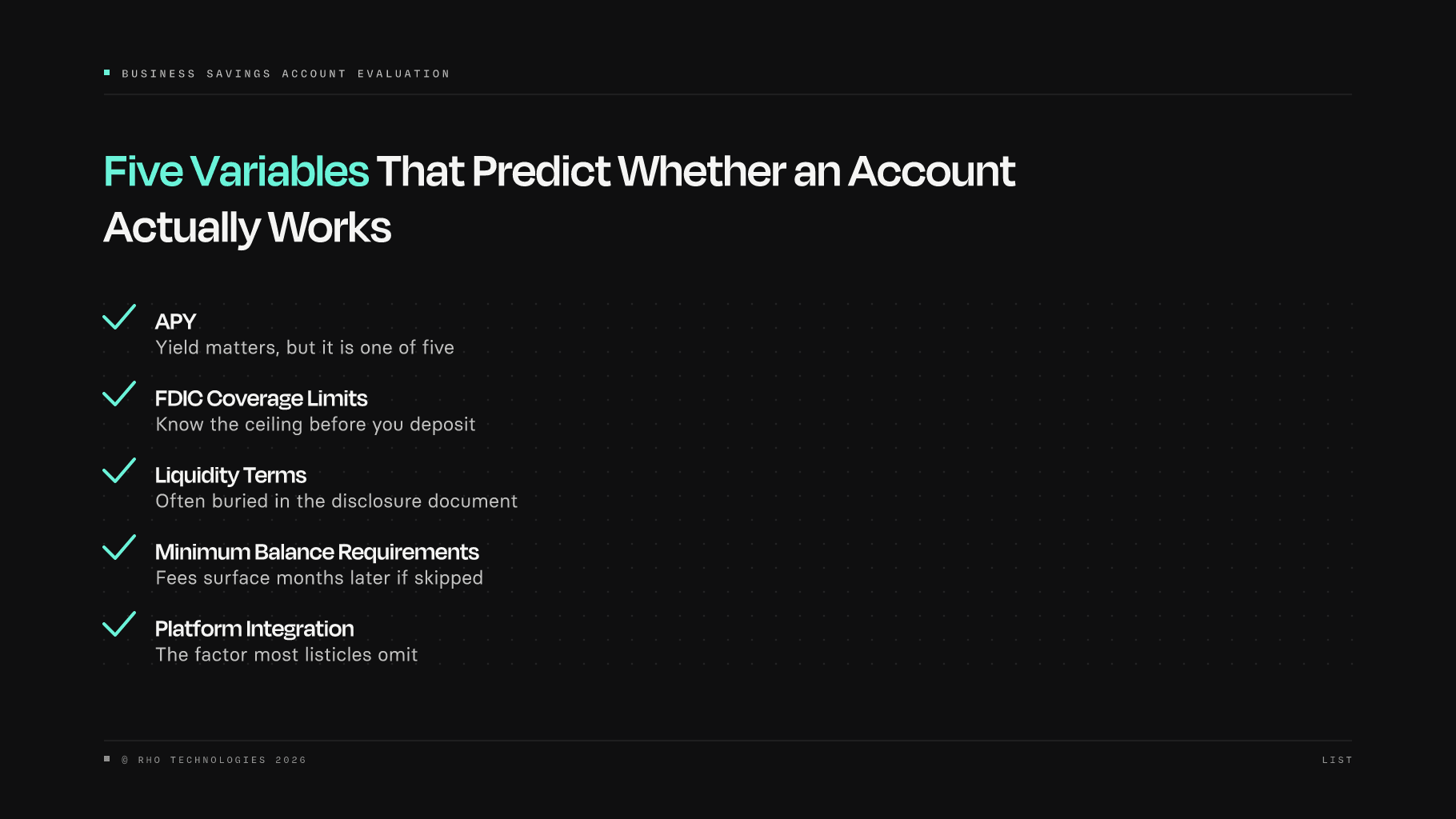
A rigorous account evaluation is actually a five-variable problem: APY, FDIC coverage limits, liquidity terms, minimum balance requirements, and platform integration.
Founders who skip four of those five often discover the gap months later, when a fee notice arrives or a wire gets delayed because the account's liquidity terms were buried in paragraph nine of the disclosure document.
The Five Variables That Actually Predict Whether an Account Serves a Growing Business
Most comparison tables rank accounts by APY and stop there. That works for a consumer with a stable balance and no payroll obligations.
It does not work for a company where cash moves fast, balances fluctuate, and the finance team needs every account to connect cleanly to the rest of the stack.
Here's the math that gets skipped:
A 4.00% APY account that charges a $12 monthly fee, locks withdrawals for 30 days, and requires a manual CSV export for reconciliation can deliver lower net value than a 3.60% account with no fee, same-day liquidity, and a native accounting integration.
That pattern, fee structures quietly eroding advertised yield, shows up across the market. The problem is that comparison tables rarely lay it out.
The goal most founders articulate, grow the business without adding operational or financial overhead, runs directly into how traditional banking products are structured. Legacy banks monetize friction: maintenance fees, minimum balance requirements, and manual reconciliation workflows that quietly absorb the hours of whoever is running finance.
The accounts that look cheapest in a rate table are frequently the ones that generate the most back-office drag as a company scales. Financial infrastructure that stays invisible while you're growing and shipping is the baseline condition for keeping a lean team lean.
Rho is built most directly for companies that need a fast, scalable banking setup without legacy bank overhead.
The core platform, checking, savings, corporate cards, expense management, AP automation, bill pay, and unlimited invoicing, carries a $0 monthly fee, $0 per-user fee, and no minimum balance requirement on the banking side. There is no platform tier to graduate into.
Every customer, at every stage and headcount, operates on the same single unified platform. The savings account is provided by American Deposit Management Co. and its partner banks, with FDIC coverage up to $75M through a network of approximately 400 partner banks.
How Monthly Fees and Minimum Balance Traps Quietly Offset Your APY Gains
Monthly maintenance fees on business savings accounts at traditional banks typically run $5 to $15 per month, and they are almost always waivable if you maintain a minimum balance between $500 and $10,000, depending on the institution, based on broader industry trends.
For an early-stage company that sweeps cash into payroll, vendor payments, and software subscriptions every two weeks, the balance dips below the threshold regularly. The fee triggers. The yield advantage shrinks.
A money market account offering 3.80% APY with a $10,000 minimum loses its yield advantage over a no-minimum 3.60% account the moment the balance drops below the threshold even once.
The fee that triggers at that dip effectively cancels weeks of accrued interest, a pattern that repeats every time payroll or a large vendor payment temporarily drains the account below the required floor.
Investopedia's analysis of high-yield business savings accounts backs this up: advertised rates are only as valuable as the conditions under which a real operating company can actually maintain them.
Rho's banking platform charges $0 in monthly or subscription fees and requires no minimum balance on the core banking side, which means payroll cycles, large vendor payments, and software renewals do not create fee exposure.
For companies that want to put idle cash to work beyond the savings account, Rho Treasury is available from the same platform.
It is a separate, fee-bearing RIA product: access requires a $50,000 minimum investment, a management fee of 15–60bps annually applies (see the ADV-2A Wrap Fee Brochure), and Rho Treasury investments are not deposits and are not FDIC insured.
Treasury Bills and mutual fund options are available; T-Bills settle in 2–3 business days and mutual fund redemptions settle the next business day.
The structure matters: unlike Mercury Treasury, which requires $250,000 across all accounts, Rho Treasury's minimum investment is $50,000.
The integration variable, the one most rate tables omit, is where systems either hold together or quietly break as a company scales.
Rho includes native direct integrations with QuickBooks Online, NetSuite, Sage Intacct, Xero, Campfire, and Puzzle at $0. Transactions, receipts, and expense data sync automatically.
AP automation, same-day ACH (free, if initiated before 2pm ET for amounts under $1M), $0 domestic wires, and unlimited reimbursements are included at no additional cost.
The result is financial infrastructure that can stay invisible, not because it is simple, but because it is built to not require manual intervention at every growth inflection point.
11 Best Business Savings Accounts of 2026 – Ranked for Yield, Liquidity, and Scale
Scan a rate table, find the highest number, open the account. That heuristic works fine until you realize the account you just opened lives in a separate portal, syncs to nothing in your accounting stack, and requires a manual transfer every time you need to move operating cash.
The yield is real. The hidden overhead is also real.
Rate comparisons consistently obscure one thing: the "best APY wins" heuristic collapses entirely once you model it against startup-scale balances.
Here's why:
The spread between the FDIC national average and a top high-yield business account is not a marginal optimization. It is a structural gap that, at realistic post-raise cash positions, produces a dollar figure large enough to constitute measurable runway rather than yield enhancement.
That spread is not a rounding error. The percentage-point gap produces $24,150 to $27,150 in additional annual interest.
That is not a yield optimization. That is measurable runway, and every week it sits in a zero-yield checking account is a quantifiable decision to burn operating capital rather than preserve it, not a neutral default made inevitable by a busy roadmap.
The table below captures the key data points for each account so you can compare at a glance before reading the full editorial breakdown beneath it.
Quick Comparison – Best Business Savings Accounts of 2026
Account | APY | Monthly Fee | Min. Balance | FDIC Coverage | Key Feature |
|---|---|---|---|---|---|
Rho Savings | 1.00% APY (as of 08/05/2026) | $0 | $0 | Up to $75M (ADM network, ~400 banks) | Embedded in unified banking platform |
Axos Business Premium Savings | 3.60% | $0 | $0 | Up to $250K (expandable via IntraFi) | QuickBooks integration, free incoming wires |
Live Oak Bank Business Savings | 2.85% | $0 | $0 | Up to $10M (multi-bank network) | SBA-lender credibility, extended FDIC |
Mercury Business Savings | Varies | $0 | $0 | Standard FDIC | Clean digital experience for early-stage |
Bluevine Business Checking with Savings Yield | Up to 3.70% | $0 to $95 | $0 | Standard FDIC | Yield on operating funds, no separate account |
Relay Business Savings | Varies | $0 | $0 | Standard FDIC | Multi-account organization, team controls |
Brex Business Account | Varies | $0 | $0 | Extended via partner network | Treasury yield at scale |
TowneBank Business Savings | Varies | Varies | Varies | Standard FDIC | Community bank relationships, Mid-Atlantic |
American Express Business Savings | Varies | $0 | $0 | Standard FDIC | Amex ecosystem integration |
Grasshopper Innovator Money Market | Up to 3.55% | $0 | $100 | Standard FDIC | Unlimited transactions, API-first infrastructure |
U.S. Bank Platinum Business Money Market | Up to 3.98% | $15 (waivable) | $50,000 to earn top rate | Standard FDIC | Nationwide branch access, qualifying-activity rate |
The accounts that look identical on a rate table diverge sharply once you factor in minimum balance requirements, fee structures, and whether the account connects to the rest of your financial stack. Here is what each one actually delivers.
Beyond the Rate Table – What to Look For in the Best Business Savings Account
The accounts above span a wide range of yield, coverage, and operational fit. The ones that look best on a rate table are not always the ones that cost the least in practice.
The real cost shows up somewhere else entirely:
Finance teams at growing companies consistently report that the real overhead of a siloed savings account is not the fee line.
It is the time spent on manual fund transfers, the reconciliation gap when a transfer does not sync to the ledger, and the cash visibility problem that emerges when operating funds and reserves live in separate systems with separate logins.
That friction is not hypothetical. It compounds every month close, every payroll cycle, and every board reporting cycle where someone has to reconcile what the savings account shows against what the accounting system recorded.
For a finance lead or an operations team already stretched across multiple tools, adding one more login is not a neutral decision. It is a weekly tax on the team's time.
The accounts that eliminate that tax do so by embedding savings directly into the platform where the rest of the financial work happens.
Yield and liquidity are only two legs of the stool. The third is knowing your deposits are actually protected when your cash position outgrows the standard $250,000 FDIC limit.
The next section breaks down exactly how multi-bank networks, pass-through insurance, and multi-bank deposit programs work at the infrastructure level, so you can evaluate extended coverage claims with the same rigor you would apply to an APY comparison.
1. Rho – Best All-in-One Business Banking Platform for Startups and Scale-Ups
Most founders open a high-yield savings account expecting to earn more on idle cash, and they do, right up until the account lives in a separate portal, syncs to nothing, and adds a reconciliation step every time funds move.
Rho's Savings eliminates that drag by embedding FDIC-insured cash storage (up to $75M via its ADM network of roughly 400 partner banks) directly inside the same platform where bills get paid, cards get issued, and the books get closed.
That structural design removes the separate-portal reconciliation step, the kind of manual overhead that, according to industry data on finance team time allocation, accounts for roughly 30% of finance staff hours and compounds on every monthly close cycle.
No minimum balance, no monthly fee, and no extra tool in the stack.
The fit is clearest for a company that wants one fast, scalable banking setup instead of a siloed savings account bolted onto a separate checking relationship.
2. Axos Bank Business Premium Savings – Best High-Yield Option for Cash-Rich SMBs
The Business Premium Savings account offers 3.50% APY, per Axos Bank's product page, with no monthly maintenance fee, no minimum opening deposit, and no average daily balance requirement.
Free incoming domestic and international wires add operational value, and QuickBooks integration means reconciliation does not require a separate export step. FDIC coverage is standard at $250K but expandable through the IntraFi network.
The tradeoff: it is a standalone savings product, so teams without an Axos checking account will still manage two separate logins and a manual transfer process.
Cash-rich SMBs already inside the Axos ecosystem, or founders fine running a two-institution setup, get the most out of this one.
3. Live Oak Bank Business Savings – Best for SBA-Focused Small Business Owners
Live Oak Bank Business Savings pays 2.85% APY with no monthly fee and no minimum opening deposit, according to published rate data.
The standout feature is extended FDIC coverage up to $10 million through its multi-bank network, which matters for businesses holding post-raise capital or large operating reserves that exceed the standard $250,000 limit.
Live Oak's identity as a leading SBA lender also means the relationship can extend beyond savings into lending when growth capital is needed.
Yield-chasers should look elsewhere: several competitors on this list beat Live Oak's rate outright. This one makes sense for an owner who values FDIC scale and a lender relationship more than squeezing the last basis point out of idle cash.
4. Mercury Business Savings – Best for Early-Stage Startups Wanting a Clean Digital Experience
Mercury offers a clean, founder-friendly digital banking experience with no monthly fees and a straightforward onboarding flow that appeals to pre-revenue and early-stage teams.
The savings product integrates with Mercury's checking account, which reduces some of the reconciliation friction common to two-institution setups. FDIC coverage is standard, so companies holding more than $250,000 will need to evaluate whether the platform's extended coverage options are sufficient.
The interface is polished, and Mercury has built meaningful brand recognition in the startup community, reflected in its frequent appearance on recommended-tools lists published by YC-affiliated communities and fintech review platforms such as G2 and Product Hunt.
The limitation worth naming: teams that need deep accounting integrations (NetSuite, Sage Intacct) or embedded bill pay will find the platform lighter than purpose-built finance stacks designed for post-seed operational complexity.
5. Bluevine Business Checking with Savings Yield – Best for Small Businesses Wanting Yield on Operating Funds
Bluevine's approach is structurally different from the others on this list. It layers a competitive yield (up to 3.70% APY) onto a business checking account, which eliminates the manual transfer entirely. Monthly fees range from $0 to $95 depending on the tier, with a $0 minimum balance.
For small businesses that want yield without the cognitive overhead of managing two accounts, this is a genuinely practical setup.
The tradeoff is that yield on a checking account typically comes with conditions (spending thresholds, direct deposit requirements) that not every business will consistently meet. Confirm the qualifying criteria before assuming the top rate applies to your balance.
Update (October 2026): Valley National Bank announced it will acquire Bluevine for $340 million, with the deal expected to close in early 2027. Bluevine will become Valley's small-business banking division; existing accounts aren't expected to change before then.
6. Relay Business Savings – Best for Multi-Account Cash Organization and Team Spending Control
Relay's strength is not the APY. It is the organizational structure: the platform lets teams create multiple savings accounts and assign them to specific purposes (tax reserves, payroll buffers, project funds) within a single dashboard.
That structure supports the cash-envelope approach operators use when they need visibility and control over categorized capital, not just yield.
Fee structure is lean and the team spending controls are a genuine differentiator for businesses managing multiple contributors to a shared budget. For founders whose primary concern is maximizing yield on a large cash position, Relay will not top the rate comparison.
For operators who need organized, labeled buckets with team-level permissions, that structure is the entire pitch.
7. Brex Business Account – Best for High-Growth Startups Needing Treasury Yield at Scale
Brex targets high-growth startups that need yield at scale, and its business account reflects that positioning: extended FDIC coverage through partner-bank arrangements, plus treasury yield options accessible at larger balance tiers, features consistent with Brex's published product positioning for post-seed and Series A+ companies.
The platform is built for companies that have moved past the seed stage and are managing more complex finance operations. No monthly fee and a polished interface make onboarding straightforward.
The honest limitation: Brex's full feature set is most valuable at higher headcounts and balance levels. Early-stage teams may find they are paying, in time and setup complexity, for capabilities they will not use for another 12 to 18 months.
Evaluate fit against your current operational stage, not where you plan to be.
8. TowneBank Business Savings – Best for Mid-Atlantic Businesses Wanting FDIC-Backed Community Bank Relationships
TowneBank is a community bank with a strong Mid-Atlantic footprint, and its business savings product is designed for owners who value a local relationship, branch access, and a named banker over the highest advertised APY. FDIC insurance is standard.
Rates are not published as prominently as the digital-first options on this list, which means prospective customers should confirm current APY directly with a branch or relationship manager.
The fit is narrow but real: a Mid-Atlantic business owner who wants a community banking relationship with personal accountability, not someone optimizing for yield or platform integrations.
Everyone else will get more, on both yield and operational efficiency, from the digital options above.
9. American Express Business Savings – Best for Existing Amex Cardholders Maximizing Idle Cash
American Express Business Savings offers a straightforward high-yield option with no monthly fee, making it an easy add-on for businesses already running corporate cards through the Amex ecosystem.
The brand credibility and FDIC insurance are table stakes. The account earns competitive yield on idle cash, and the setup process is simple for existing Amex customers.
The limitation is integration depth: the account does not embed into accounting workflows the way platform-native options do, and businesses that need their savings balance to sync automatically with QuickBooks or NetSuite will find this a standalone product requiring manual reconciliation.
This one earns its spot for Amex cardholders who just want a simple, trusted place to park cash, not a new banking relationship to manage.
10. Grasshopper Bank Business Savings – Best for Startups and Fintechs Wanting API-First Banking Infrastructure
Grasshopper Bank's Innovator Money Market Savings account offers up to 3.55% APY on balances over $25,000, with balances under $25,000 earning 1.80% APY, per data published by U.S. News and Investopedia.
The $0 monthly fee and $100 minimum opening deposit keep the entry bar low.
The defining feature here is unlimited transactions, with no restrictions on transfers in or out, which removes the withdrawal-limit friction that plagues standard savings accounts.
Grasshopper is built for startups and fintechs that want API-first infrastructure and a developer-friendly banking layer. The tiered rate structure means the top APY is only available once the balance clears $25,000, so early-stage teams with smaller reserves will earn meaningfully less than the headline rate suggests.
11. U.S. Bank Business Savings – Best for Established Mid-Market Companies Needing Nationwide Branch Access and FDIC Scale
U.S. Bank's Platinum Business Money Market account offers up to 3.98% APY with qualifying activities.
The catch is structural: the top rate requires a $50,000 minimum balance to earn the stated APY, a $15 monthly fee (waived with a $10,000 minimum balance), and a $100 minimum opening deposit.
Those thresholds make this account a poor fit for early-stage companies but a reasonable one for established mid-market businesses that maintain large, stable cash reserves and want nationwide branch access alongside competitive yield.
The qualifying-activity requirement means rate-sensitive teams should confirm exactly which activities trigger the top tier before treating 3.98% as the baseline expectation. For businesses that clear those hurdles consistently, the combination of rate, FDIC backing, and branch network is hard to match at the traditional-bank tier.
FDIC Insurance for Business Savings – How to Protect Deposits Beyond $250,000
For most founders, FDIC insurance reads as a yes-or-no question when it is actually a math problem, and the default answer leaves significant balances unprotected.
Coverage limits apply per depositor, per bank, and per ownership category, which means the name on the institution is irrelevant once deposits exceed $250,000 at a single bank.
How your provider structures coverage, and across how many partner banks, determines whether you are actually protected, or simply assuming you are.
The $250,000 Ceiling Is a Default, Not a Limit
Staying at a traditional bank because it "feels safer" is an unexamined choice that typically produces more uninsured exposure while forfeiting yield.
Founders who treat FDIC insurance as a binary "safe/unsafe" signal are misreading the actual mechanism: coverage is per depositor, per insured bank, per ownership category, and any balance above $250,000 at a single institution is entirely uninsured regardless of that institution's reputation.
A well-known bank name on the door does not change that math, the FDIC's own coverage rules make no exception for reputation.
A founder parking $2M at a single reputable institution holds $250,000 in insured deposits and $1.75M in uninsured exposure, a distinction Silicon Valley Bank's 2023 collapse made viscerally real.
Neobanks and fintech apps falsely claim FDIC insurance, leaving users with deposits that are not actually protected, directly exposing business and personal savings beyond any insured threshold.
One pattern that compounds this risk: some neobanks and fintech platforms advertise FDIC insurance in ways that obscure where coverage actually begins and ends.
Founders who take those claims at face value can end up with deposits that are not protected beyond the standard $250,000 threshold, sometimes without realizing it until a problem surfaces.
Understanding the mechanics of how your provider achieves coverage, and through how many partner banks, is the entire question.
How ICS and ADM Deposit Networks Actually Work
Multi-bank deposit network programs resolve this problem by distributing deposits across multiple partner banks, each providing its own share of coverage, all through a single banking relationship.
ICS (IntraFi Cash Service) and ADM (American Deposit Management Co.) programs split a large deposit into sub-$250,000 tranches and place each tranche at a separate FDIC-member institution.
Each sub-deposit is individually insured, IntraFi's own explanation of the mechanism, so aggregate coverage scales directly with the number of participating banks.
The depositor never opens a second account. The distribution happens automatically, in the background.
The critical variable most founders never ask about: how many partner banks does your provider actually use?
Coverage at Scale
A multi-bank network with 3 partner banks delivers $750,000 in aggregate FDIC coverage. A network with 400 partner banks delivers something categorically different.
Rho's savings account, provided through American Deposit Management Co. and its partner bank network, distributes deposits across approximately 400 partner banks, enabling up to $75M in aggregate FDIC-insured coverage.
That ceiling is sufficient to fully cover the cash position of most seed- through Series B-stage companies, without requiring a single additional banking relationship.
For companies with more active treasury management needs, Rho also offers Rho Treasury, a separate, fee-bearing RIA product accessible from the same Rho platform. It includes Treasury Bills and mutual fund options, with a $50,000 minimum investment; T-Bills settle in 2–3 business days and mutual fund redemptions settle the next business day.
A management fee of 15–60 basis points annually applies, based on the cost to provide the service (see the ADV-2A Wrap Fee Brochure for full details).
Importantly, Rho Treasury investments are not deposits and are not FDIC insured, a distinction that matters and that Rho discloses clearly.
For finance teams managing spend and financial oversight across multiple business entities from one platform, having both the FDIC-insured savings account and Treasury access under one roof, with no separate login, no separate onboarding, and no platform fee, removes meaningful operational friction.
Month-end close, AP automation, corporate cards, and treasury management all live in the same workflow, which is precisely where the time savings compound.
Benefits of a Business Savings Account and the Integration Advantage Most Listicles Miss
A business savings account does more than park cash between funding rounds.
The decision of where to hold that cash, and how that account connects to the rest of your financial infrastructure, quietly shapes how much time your team spends on month-end close, how clearly your CFO dashboard reflects reality, and whether your board reads your cash management as disciplined or haphazard.
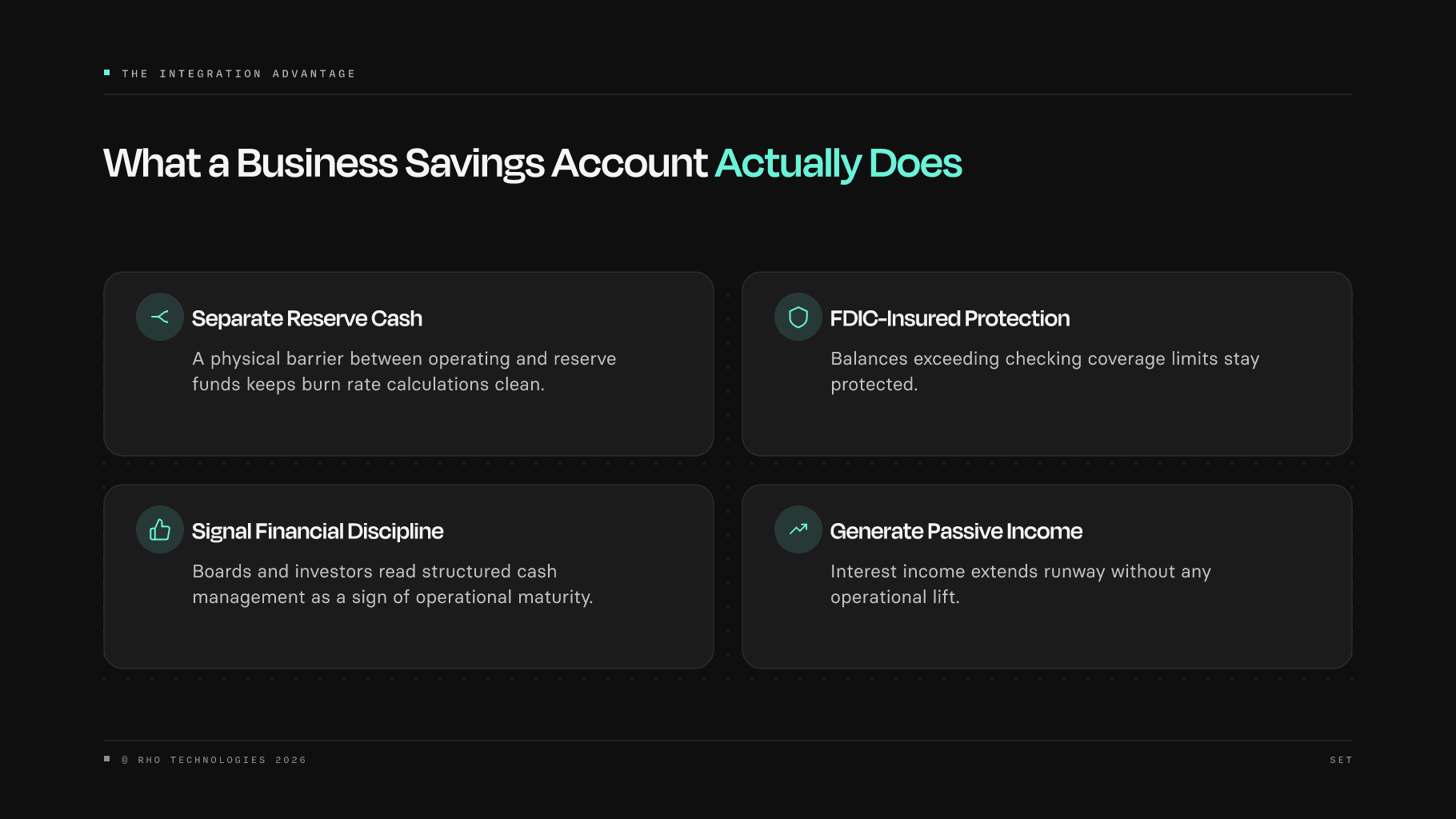
The Four Core Jobs a Business Savings Account Actually Does
Beyond yield, a well-chosen savings account does four jobs at once.
First, it creates a physical barrier between operating cash and reserve cash. FDIC-insured protection for balances above checking coverage limits comes second.
Third is the discipline signal it sends to investors and boards. And the account quietly earns passive interest that extends runway, with zero operational lift.
Most APY-focused listicles price only that last function. The other three are often worth more.
Separating Reserve Cash from Operating Cash
The discipline of keeping reserve cash in a separate bucket matters independent of the rate it earns.
When operating cash and reserve cash share the same account, spend decisions get murky, burn rate calculations drift, and the psychological anchor of "how much do we actually have to operate" disappears.
A dedicated savings account enforces that separation structurally, not just on a spreadsheet.
Finance Stack Drag, the Hidden Reconciliation Cost
Industry research puts a number on this: finance teams spend roughly 30% of their time on manual reconciliation work that could be automated.
A standalone high-yield savings account at a separate institution adds a second login, a manual transfer workflow, a reconciliation gap in QuickBooks or NetSuite, and a cash-visibility lag that widens every month.
The yield is real. So is the operational tax.
Platform integration determines whether a high APY actually nets out positive.
A 4.00% APY account that lives in isolation may deliver lower total ROI than a 3.50% APY account embedded inside a unified platform, once you price the founder and finance bandwidth it quietly consumes.
That calculus lines up with the industry finding that manual reconciliation alone consumes roughly that same share of finance team time, a cost that dwarfs the 50-basis-point yield premium on any sub-$1M balance.
It is the same Finance Stack Drag the account was supposed to eliminate.
Business Savings Account FAQs – What Founders Actually Ask Before Opening One
The questions that trip founders up before opening a business savings account are rarely the ones on the standard FAQ page.
They are structural: does my entity type qualify, will I hit a liquidity wall mid-quarter, and what happens to my yield when the Fed moves?
Getting those answers wrong costs real money, but the more consequential mistake is treating the decision to open an account as something that can wait.
The "optimize later" deferral is the active accumulation of institutional debt with a calculable interest rate. And the procrastination cost is largest precisely when it hurts most, since post-raise cash balances sit at their lifetime peak in the earliest months after funding.
Can an LLC Open a High-Yield Business Savings Account?
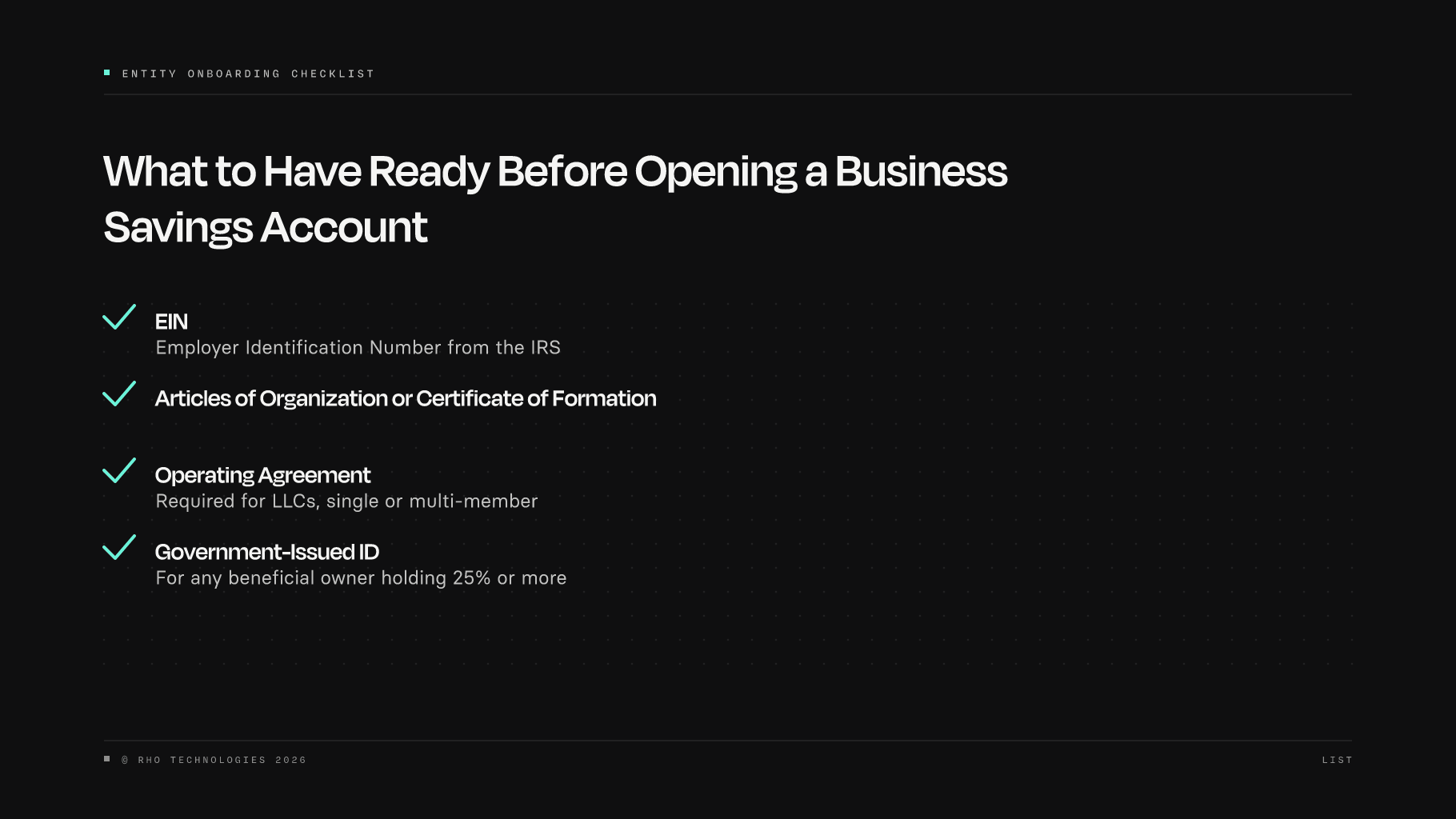
Yes, LLCs can open high-yield business savings accounts. Most banks and fintech platforms accept single-member and multi-member LLCs, S-corps, and C-corps alike. The standard documentation checklist includes your EIN, articles of organization or certificate of formation, an operating agreement, and government-issued ID for any beneficial owner holding 25% or more.
The friction founders actually hit is coordinating documents for an entity incorporated three weeks ago that may not yet have a complete operating agreement on file. Platforms that support pre-EIN onboarding remove the single biggest bottleneck for founders coming straight out of an accelerator batch.
Business Savings Account vs. Money Market Account
Which structure fits an operating company? The structural difference matters more than most founders realize.
Money market accounts typically offer tiered interest rates, may allow limited check-writing privileges, and can require higher minimum balances (per the Federal Reserve Board, April 2020), whereas standard savings accounts generally offer a flat rate with no check-writing.
For an operating company that needs predictable, frictionless access to reserves, a flat-rate high-yield savings account with no minimum is usually the cleaner fit.
How Liquid Is High-Yield? Withdrawal Limits and Access Timelines
Liquidity terms vary significantly across high-yield business savings products and are often buried in account disclosures rather than featured on comparison tables.
Standard high-yield savings accounts typically offer next-business-day access to funds, meaning a transfer initiated today settles tomorrow, workable for planned payroll or vendor payments, but a friction point if an unexpected expense hits.
Some money market accounts offer same-day or even real-time access; others impose withdrawal frequency limits that were codified under Regulation D before the Fed removed the six-per-month cap in April 2020, though individual institutions may still enforce their own limits as a matter of policy.
For a Rho Treasury account, T-Bills settle in 2–3 business days and mutual fund redemptions settle the next business day. For Rho's savings account, outbound transfers settle within 2 business days.
Before treating any headline APY as final, confirm whether the account imposes a notice period, a per-withdrawal fee, or a minimum holding requirement. Any of those can transform an attractive rate into a liquidity trap during a cash-tight quarter.
Next Steps
If your post-raise cash is sitting idle while the roadmap demands every hour of attention, the path forward starts with recognizing that deferral is not a neutral default.
The spread between the 0.38% national average APY and a top high-yield account on a $750,000 balance produces $24,000 or more in additional annual interest.
That is not yield optimization. That is runway, and it compounds whether or not you have time to think about it.
The platform integration insight changes the calculus further.
A 4.00% APY account that lives in a separate portal, adds a reconciliation loop, and quietly consumes 30% of your finance team's time may deliver lower total ROI than a lower-rate account embedded in a unified stack.
The FDIC coverage insight reframes the "reputable bank" assumption entirely: any balance above $250,000 at a single institution is uninsured, regardless of brand name, while a multi-bank network across roughly 400 partner banks extends that ceiling to $75 million through a single relationship.
Together, they point to an account that combines competitive yield, extended coverage, and zero reconciliation overhead inside one platform.
Start by exploring business bank for startups through Rho, where the savings account carries no monthly fee, no minimum balance, and FDIC coverage up to $75 million through its ADM network of partner banks.
From there, checking, corporate cards, AP automation, and treasury access are all available in the same workflow, with no per-user fees and no separate onboarding required.
FAQs
The difference is significant enough to constitute real runway. At the FDIC national average of 0.38% APY, $500K earns roughly $1,900 over twelve months; at 4% APY, that same balance generates over $20,000, a gap the post describes as equivalent to a month of payroll. Stretched to 24 months on a $500K starting balance, the difference exceeds $40,000.
Yes, and it happens faster than most founders expect. A money market account offering 3.80% APY with a $10,000 minimum loses its yield advantage over a no-minimum 3.60% account the moment the balance dips below the threshold even once, because the triggered fee effectively cancels weeks of accrued interest. For early-stage companies that move cash into payroll and vendor payments regularly, this pattern can repeat every pay cycle.
Standard FDIC insurance covers up to $250,000 per depositor per institution, but several accounts on the market use multi-bank networks of partner banks to extend that coverage significantly further. For example, Rho's savings account provides FDIC coverage up to $75M through its ADM network of approximately 400 partner banks, and Live Oak Bank extends coverage up to $10 million through its own multi-bank network, both designed specifically for businesses holding post-raise capital or large operating reserves.
It's the number everyone checks first, but the post argues it's almost never the number that determines whether an account actually works for a growing company. A rigorous evaluation covers five variables: APY, FDIC coverage limits, liquidity terms, minimum balance requirements, and platform integration, and the last one, platform integration, is the factor most comparison lists omit and most finance teams later wish they had weighted more heavily.
Business checking accounts typically pay little to no yield, and the post points out that founders who leave post-raise cash in a default checking account are quietly burning operating capital rather than preserving it. The spread between the FDIC national average savings APY of 0.38% and a top high-yield business account at 3.60%-4.00% APY produces $24,150 to $27,150 in additional annual interest on a $750,000 balance, a structural gap large enough to constitute measurable runway.