
Fee waivers are the smallest cost on the list. The account your team picks will either quietly drain staff hours every close cycle, or it won't.
The common assumption among nonprofit finance leads is that manual reconciliation, end-of-month close sprints, and chasing receipts are simply the unavoidable cost of doing nonprofit work properly.
That homework on fee schedules matters, but it only captures the costs a bank is willing to show you. The costs a bank never shows you are the ones that hurt most.
A nonprofit bank account is a business checking or savings account held in the organization's legal name, tied to its Employer Identification Number, and governed by the board-approved authorization structure the organization's bylaws require.
It is not a personal account. It is not a founder's account with a different label.
The legal separation is the point: co-mingling organizational funds with personal or founder finances creates audit exposure and can jeopardize 501(c)(3) status entirely.
The fee-comparison instinct is correct as far as it goes, but fee schedules show only part of what an account costs. Every published line item reflects what the bank charges, not what your team spends.
Best-in-class finance teams close the books in one to three days, while many organizations spend five to ten. That gap is almost never explained by complexity.
It's explained by tool fragmentation, and the banking layer is where fragmentation most reliably begins.
Rho is a fintech company, not a bank or an FDIC-insured depository institution. Checking account and card services provided by Webster Bank, a division of Santander Bank, N.A., member FDIC, and by Lead Bank, Member FDIC. Savings account services provided by American Deposit Management Co. and its partner banks.
Fee schedules are the wrong scorecard. The real cost of a nonprofit bank account shows up in staff hours lost to manual reconciliation, receipt chasing, and end-of-month close sprints that stretch past business hours.
Most nonprofit finance teams treat fragmented tools as an unavoidable condition of the work. They're not. It's a banking problem, not an operations one.
Every bank on this list requires the same core documents to open an account. What separates them is how fast and cleanly they process those documents and what your workflow looks like on the other side.
Fund separation, FDIC coverage limits, and IRS compliance questions are the last objections that stall a final banking decision. Each has a concrete answer that belongs in the comparison, not the fine print.
A nonprofit bank account that waives monthly fees but forces a three-tool reconciliation stack every close cycle is not cheap. It's just hiding the invoice.
Rho's Business Banking consolidates accounts, cards, and money movement into one platform, earns yield on idle cash, and opens quickly, so your finance team closes the books faster instead of stitching systems together at 7 p.m.
Key Features of Nonprofit Bank Accounts That Actually Move the Needle
The fee schedule is the first thing most nonprofit finance leads check, and the last thing that actually determines how much the account costs.
The common assumption is that manual reconciliation, end-of-month close sprints, and chasing receipts across departments are simply the unavoidable realities of running a tight finance operation, the cost of doing nonprofit work properly.
The real price is paid in hours: the treasurer rebuilding fund balances in a spreadsheet at month-end, the board member waiting two weeks to get added as an authorized signer, the program director who cannot tell at a glance whether a deposit is restricted or unrestricted without opening a separate file.
None of those costs appear on any bank's pricing page.
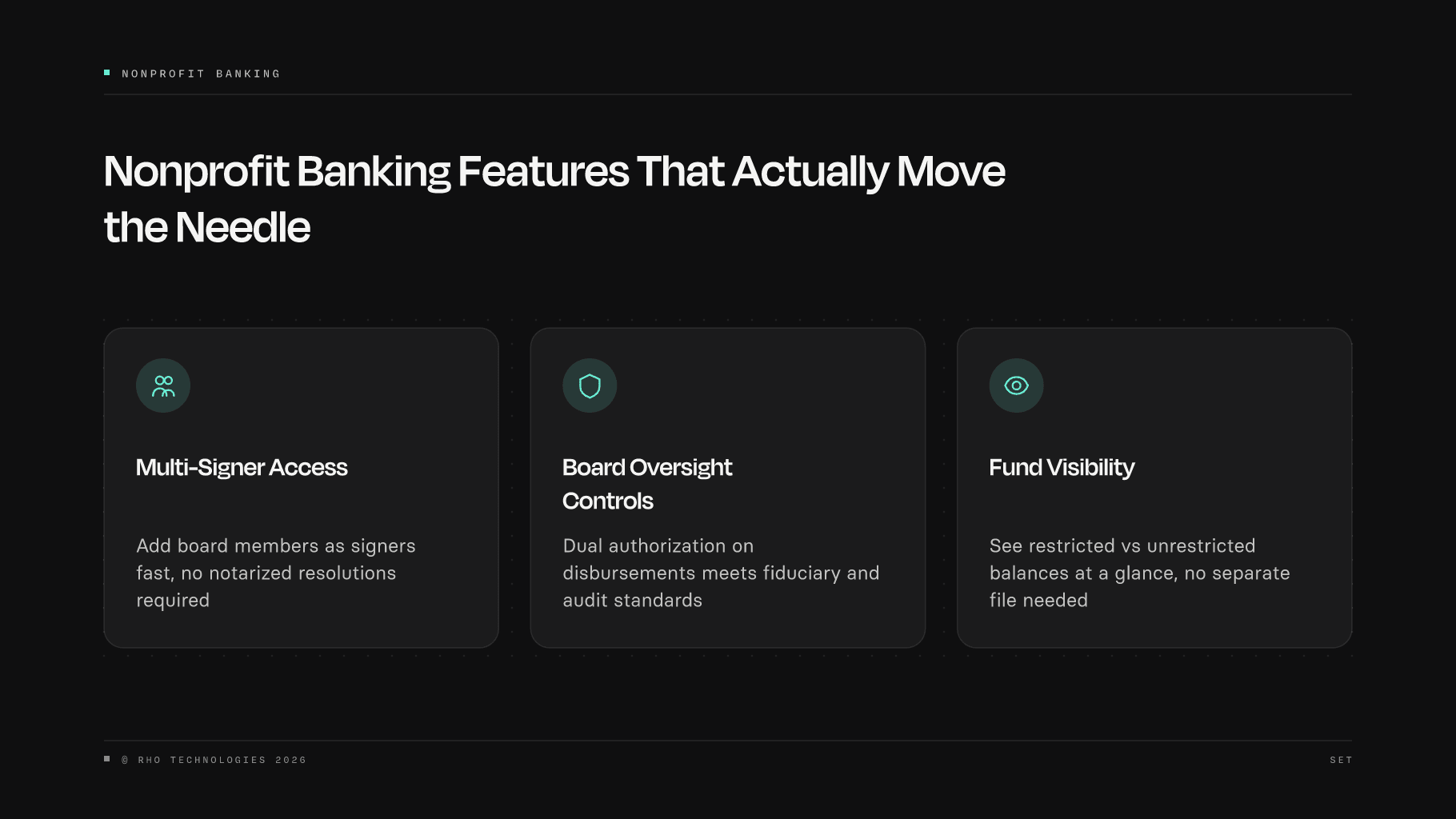
Multi-Signer Access and Board Oversight Controls Are Non-Negotiable for Compliance
Multi-signer flexibility and board oversight are nonprofit-specific banking requirements. Nonprofits operate under fiduciary standards that typically require dual authorization on disbursements above a set threshold, and auditors routinely flag inadequate segregation of duties as a material weakness.
A common frustration among nonprofit finance leads is the procedural bottleneck of adding a new board member as a signer: many traditional banks require a notarized board resolution mailed to a branch, a process that can take weeks. For a board that turns over annually, that delay is a compliance gap.
Fund-Tagged Sub-Accounts for Grant Segregation
Banks that offer sub-account structures for grant fund segregation directly address a problem that affects a significant share of nonprofits managing multiple active grants.
Reconciliation overhead for nonprofits is driven by the need to separately track restricted versus unrestricted funds across grants, so sub-accounts that segregate those balances help with audit readiness.
Without it, a nonprofit with three active grants is forced to maintain a parallel spreadsheet to track restricted balances, a workaround that compounds every reporting cycle.
A fee-free checking account with no sub-account structure leaves all funds in one undifferentiated balance, so separation falls to your finance team.
The Reconciliation Tax and Native Accounting Integrations
Native accounting integrations reduce that same reconciliation burden by syncing transactions, receipts, and expense data directly to the general ledger, no manual exports required.
Best Nonprofit Bank Accounts Ranked: 10 Options for 2026
According to Ledge's Month-End Close Benchmarks for 2025, best-in-class finance teams close their books in under three business days, while roughly half of finance teams still need six or more.
The culprit is almost never the complexity of the work itself.
It is fragmentation: transactions sitting in one system, receipts in another, grant coding in a spreadsheet, and a bank account that exports a CSV and calls it an integration.
Most nonprofit finance leads evaluate bank accounts by scanning the fee schedule first. That instinct is understandable. A $15 monthly fee waiver feels like a concrete win. But the Ledge benchmarks also point to tool fragmentation, not unavoidable operational complexity, as the real driver of close delays.
An account that saves $15 per month but forces your team to manually match transactions, chase down receipts before a grant report is due, and export data into a spreadsheet because there is no accounting sync is not a cost-saving choice. It is a hidden labor purchase.
The standard nonprofit bank account comparison frame is wrong at its root. Fee schedules and 501(c)(3) waivers get evaluated as cost decisions.
But the features that actually determine total cost, real-time transaction feeds, role-based signer permissions, native integrations with accounting tools, are the exact variables that decide how many staff-hours get consumed every close cycle.
A cheap account without these capabilities isn't actually cheap. It just moves the cost onto your finance team's calendar, one extra close-cycle day at a time.
The real cost differential between nonprofit bank accounts shows up in staff hours, not on the pricing page. A finance team spending four extra hours at month-end close on manual reconciliation, at even a modest blended staff rate, erases months of fee savings in a single close cycle.
Here's how the ten below stack up: what they cost on paper, and what they actually cost in practice.
What Traditional Banks Offer Nonprofits
The traditional bank options for nonprofits most commonly lead with fee waivers and branch access, a pattern consistent across the fee schedules and product pages reviewed for this guide.
For organizations handling cash donations, in-person deposits, or payroll funded through local relationships, physical infrastructure still matters.
Here's the catch.
Most traditional bank accounts stop there. Fee waivers are table stakes in 2026, and the operational features that actually reduce close time, real-time transaction feeds, role-based permissions, native accounting integrations, are largely absent from the traditional bank lineup.
Chase Business Complete Banking and PNC Non-Profit Checking follow this same pattern: fee waivers up front, limited accounting automation behind them.
What Fintech Platforms Offer Nonprofits
Digital-first platforms tend to close the operational gap that traditional banks leave open.
Sub-accounts for fund separation, multi-user access with spend controls, and direct accounting integrations are standard features on fintech platforms rather than premium add-ons. Mercury, for example, offers multi-user access and accounting integrations as baseline features rather than premium tiers.
What you give up is physical branch access, which matters for nonprofits with heavy cash donation volume. For organizations operating mostly online or through digital payment rails, that gap barely registers.
1. Rho: Best All-in-One Banking and Spend Management Platform for Incorporated Nonprofits That Run Like Modern Businesses
Rho earns the top position not on fee schedule but on operational ROI.
The platform collapses checking, corporate cards, bill pay, and accounting sync into one place at a $0 platform fee, with no per-user charges.
Rho's native sync to QuickBooks Online, NetSuite, Sage Intacct, and Xero directly targets the fragmentation layer that the Ledge benchmarks identify as the primary driver of close delays.
For incorporated nonprofits that run staff corporate cards, vendor payments, and expense management like a modern business, Rho's integrated business bank for startups significantly reduces the manual reconciliation layer.
Transactions, receipts, and expense data sync natively to QuickBooks Online, NetSuite, Sage Intacct, and Xero, so the close sprint that consumes most finance teams can shrink from days to hours.
Rho does not replace dedicated fund-accounting software for grant or restricted-fund tracking. It feeds that system clean, automatically reconciled transaction data.
FDIC coverage is substantially extended through American Deposit Management Co.'s network of partner banks.
Where it doesn't fit: Rho is a fintech platform, not a chartered bank, so nonprofits that need in-person cash deposit processing will want a supplementary account.
2. U.S. Bank Nonprofit Checking: Best Traditional Bank Option with No Monthly Maintenance Fees
U.S. Bank Nonprofit Checking offers a $0 monthly maintenance fee, no minimum balance requirement, a generous allotment of free transactions annually, and 300 free cash deposit units per year.
For nonprofits running high-volume cash donation programs, or relying on branch staff for complex deposit needs, this is the strongest traditional bank option on the list.
U.S. Bank does not offer native integrations with nonprofit accounting software, so reconciliation still requires manual data exports at close. Best suited to organizations with dedicated bookkeeping support that prioritize branch access over automation.
3. Truist Community Checking: Best Nonprofit Account from a Regional Bank with Mission-Aligned Branding
Truist Community Checking carries a $0 monthly fee and a set number of free monthly transactions, with unlimited cash deposit processing at no charge.
For nonprofits in the Southeast and Mid-Atlantic with existing Truist relationships, the regional branch network and mission-aligned nonprofit positioning add real value.
The ceiling looks familiar: no native accounting sync, limited spend visibility tools, manual reconciliation at close, the same limits that show up across most traditional banks on this list.
Does your team value local banking relationships and unlimited cash deposits more than integrated financial workflows? Then Truist earns a look.
4. Axos Bank Nonprofit Banking: Best Online-Only Bank for Nonprofits Prioritizing Digital Transactions
Axos Bank brings a fully digital model with competitive fee structures and strong ACH processing capabilities, a practical fit for nonprofits that receive most donations through online payment processors and rarely handle physical cash. The absence of branch infrastructure is irrelevant to these organizations.
Where it comes up short for operationally complex nonprofits is accounting depth. Axos handles the banking layer well, but it won't close the reconciliation gap driving your month-end delays.
5. First Bank Nonprofit Checking: Best Community Bank Pick for Nonprofits Focused on Local Relationships
First Bank's nonprofit checking is built for organizations where the banking relationship itself carries operational weight: local lenders who understand the grant cycle, branch staff who know your executive director by name, community reinvestment commitments that align with mission-driven work.
Scale is where it strains. First Bank's digital tools and accounting integrations lag behind both fintech platforms and larger national banks, so finance teams at growing nonprofits will absorb more manual reconciliation overhead as transaction volume climbs.
A good fit if your organization is small, stable, and not looking to outgrow its bank anytime soon.
6. Great Lakes Credit Union Nonprofit Checking: Best Credit Union Option for Member-Owned Nonprofit Banking
Credit unions bring a structural advantage for nonprofits: member-owned governance, lower fee structures, and a community orientation that mirrors the nonprofit model itself.
Great Lakes Credit Union's nonprofit checking delivers on those fundamentals: no monthly fees and competitive rates on savings products. Like most local credit unions, it trails national banks and fintech platforms on digital tooling, accounting integrations, and spend management features.
This one works well for nonprofits in the Great Lakes region that care more about the cooperative banking model than about automation, and whose financial operations stay straightforward and low-volume.
7. Heritage Federal Credit Union Nonprofit Checking: Best for Fee-Free Banking with High-APY Savings Potential
Heritage Federal Credit Union offers a fee-free nonprofit checking account paired with savings rates that outperform most traditional banks, a strong pairing for nonprofits that maintain operating reserves or hold funds between grant disbursements.
The APY advantage is the differentiator here, though the rest looks familiar: limited accounting integrations, no native spend management tooling, the same ceiling as other credit union options on this list.
Is minimizing fee drag and earning a bit of yield on reserves your main goal, more than shortening the close cycle? That's exactly what Heritage is built for.
8. Bank of America Nonprofit Banking: Best for Large Nonprofits Needing Enterprise-Grade Banking Infrastructure
Bank of America's nonprofit banking serves organizations that need the full weight of a major financial institution: extensive wire processing capacity, strong fraud protection, treasury management services, and a national branch footprint.
For large nonprofits managing multi-million-dollar budgets, complex payroll funding, and relationships with institutional funders, that infrastructure is exactly what the workflow requires.
Cost and complexity come with it. Fee waivers require minimum balance maintenance, and the operational tooling is built for large-enterprise workflows, not for a lean nonprofit finance team trying to shave days off its close.
9. Wells Fargo Nonprofit Checking: Best for Nonprofits That Need Integrated Payroll and Merchant Services
Wells Fargo's nonprofit checking account fits organizations that want to consolidate banking, merchant services, and payroll funding under one institutional roof.
The branch network is extensive, and the built-in integration with Wells Fargo's merchant and payroll services cuts down on the number of vendor relationships a finance team has to manage, useful for larger nonprofits looking to simplify.
Finance leads should review the fee schedule carefully relative to their average balance. Teams with complex grant-reporting requirements will also want to confirm whether the accounting sync actually matches their reconciliation workflow before committing.
This account rewards nonprofits that would rather consolidate payroll and merchant services under one roof than chase deeper accounting automation.
10. Relay Financial: Best Fintech Nonprofit Account for Teams That Need Multi-User Access and Spending Controls
Relay is a fintech platform built around spend visibility: multiple checking accounts, team-level card issuing, and role-based spending controls.
For nonprofits managing program budgets across multiple staff members or departments, Relay's multi-account structure provides a practical fund-separation layer without requiring a full accounting workaround.
Holdings and similar fintech platforms occupy a comparable niche, prioritizing spend visibility and multi-user access over deep accounting integrations.
Relay's more advanced bill-payment automation sits behind a paid plan tier, and its accounting integrations stop short of what more comprehensive platforms provide, so reconciliation can still require manual export steps at close.
Choose Relay when spend visibility is the pain point you're solving for, not close-cycle automation.
Most nonprofit finance teams accept that banking and expense management will always live in separate systems, and then absorb the reconciliation cost every single month-end close.
Transactions, receipts, and expense records scattered across disconnected tools are the primary structural driver of close delays, not the complexity of the work itself.
The accounts above differ most meaningfully not in their fee schedules, but in how much of that fragmentation they actually eliminate.
A low fee with none of that plumbing isn't a discount. It's a bill that arrives later, itemized in staff hours instead of dollars.
Knowing which account fits your organization is only half the equation.
The other half is getting it open without losing two weeks to document requests and compliance back-and-forth.
Here's exactly what you'll need to bring to the table, and which platforms turn the onboarding process into a preview of how they'll treat you as a customer.
How to Open a Nonprofit Bank Account: Required Documents and What to Expect
Getting the document list right is the easy part. The harder question is what the list reveals about the institution asking for it.
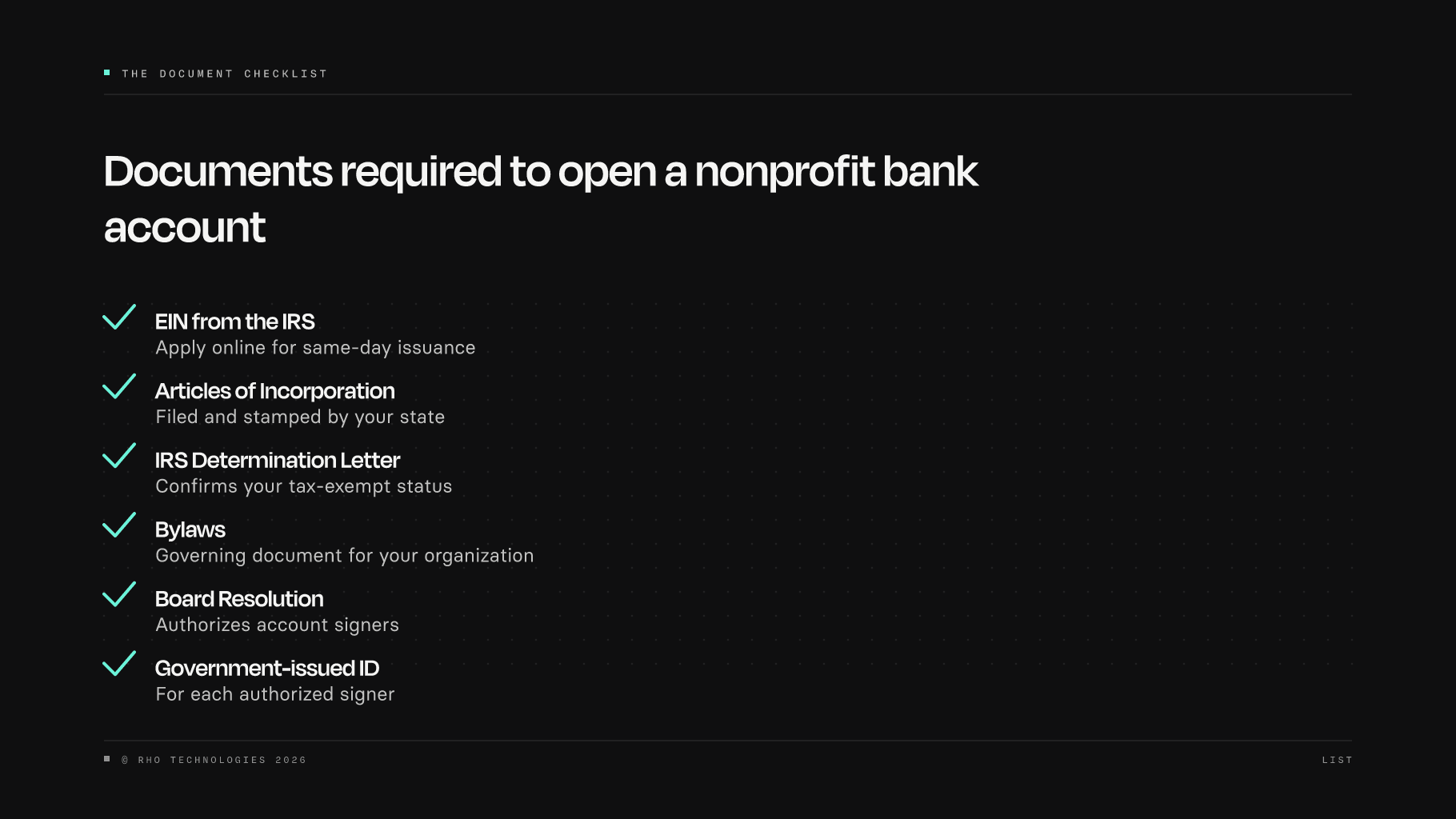
Every bank, whether a national branch or a fully digital platform, requires the same core documents to open a nonprofit account. What varies is how each institution handles those documents once you submit them, and that difference shapes how your finance team operates every month after.
Your EIN Must Exist Before Anything Else
An EIN is the single non-negotiable prerequisite for opening any nonprofit bank account. The IRS issues EINs instantly when you apply online at irs.gov, in under five minutes. Mail applications, by contrast, can take four to six weeks.
That sequencing gap matters. A nonprofit that mails its EIN application and then tries to open a bank account is looking at a month-plus delay before the process can even begin. Apply online, and you can move to the bank the same day.
One important note for organizations in formation: some digital-first platforms support pre-EIN onboarding, where you can start the account application before your EIN arrives and complete verification once it does. That capability is worth asking about directly, because it compresses the timeline significantly.
The Full Document Checklist
To open a nonprofit bank account, you need to provide: your EIN, Articles of Incorporation, your 501(c)(3) determination letter (if applicable), Bylaws plus a Board Resolution authorizing the account, and government-issued photo ID for all authorized signers.
This list applies broadly across account types, per U.S. Bank's published nonprofit checking requirements.
The determination letter is the document most likely to cause a stall. Banks scrutinize it carefully because it establishes your tax-exempt status and governs how they classify the account.
If your organization is still awaiting IRS determination, confirm with the bank whether it will open a provisional account or hold the application until the letter arrives.
The Board Resolution is the second common friction point. Small organizations with three or fewer board members sometimes struggle to produce a resolution that meets the bank's dual-signatory requirements. Draft it before you start the application, not after.
Treat the Application Process as a Friction Audit
The document checklist is identical whether you apply at a traditional branch bank or a digital-first platform. What differs is everything that happens next.
As digital-first platforms have demonstrated, a document review process that accepts uploads electronically, confirms receipt the same day, and moves to underwriting without branch appointments is itself a signal of how the institution will handle your team's requests after the account is live.
Nonprofit Bank Account Document Checklist
Use this checklist before you start any bank application to avoid mid-process stalls:
# | Document | Notes / Watch-outs |
|---|---|---|
1 | Employer Identification Number (EIN) | Must be confirmed before application. Apply at irs.gov for same-day issuance. |
2 | Articles of Incorporation | Filed with and stamped by your state agency. |
3 | 501(c)(3) IRS Determination Letter | If pending, confirm whether the bank will open a provisional account. |
4 | Organizational Bylaws | Must reflect current board structure. |
5 | Board Resolution authorizing the account | Draft before starting. Include dual-signatory language if your bylaws require it. |
6 | Government-issued photo ID for all authorized signers | Required for every signer named in the Board Resolution. |
7 | Voided check or initial deposit (if required) | Confirm minimum opening deposit with the specific institution. |
Quick decision rule: if your determination letter is still pending and you need the account open immediately, prioritize fintech platforms that support pre-EIN or pre-determination onboarding over traditional banks that hard-stop the application until all documents are in hand.
Nonprofit Banking Questions: What Finance Leads Actually Ask Before Signing
By the time a nonprofit finance lead is ready to sign, the big-picture comparison is done.
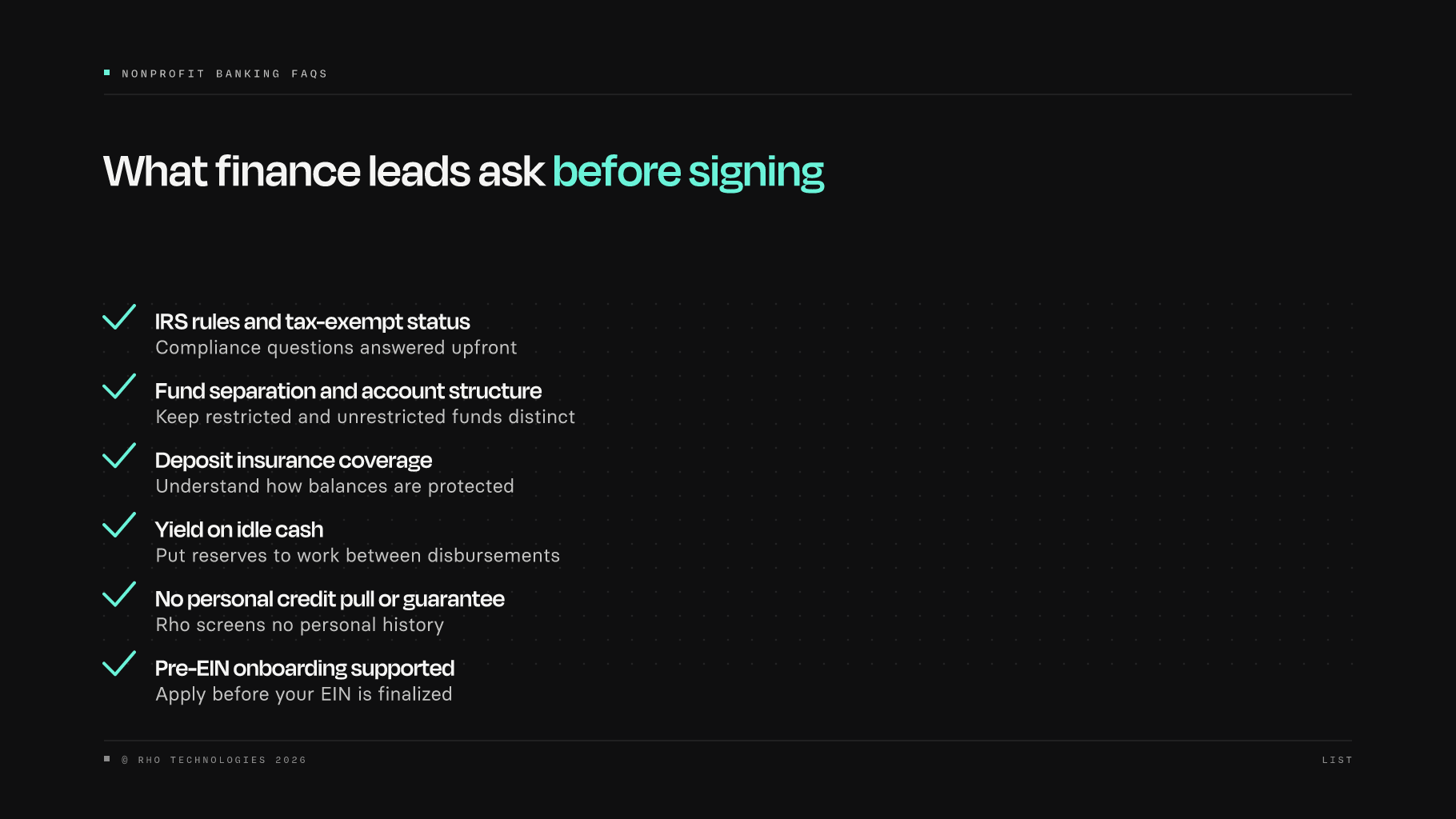
What stalls the final decision is a cluster of sharper, more specific questions: IRS rules, fund separation, deposit insurance, yield, documentation. These aren't edge cases. They are the last objections standing between a finance lead and a banking setup that actually works.
Here's a struggle that surfaces more often than most finance leads expect: account applications get denied before any of those questions can even be answered.
Many nonprofits, and the founders behind them, don't realize that banks routinely screen applicants through ChexSystems or Early Warning Systems (EWS) reports, which compile prior banking history across institutions.
A single flag, a prior account closure, an overdraft pattern, even an unrelated founder's personal history, can halt onboarding entirely.
Rho supports pre-EIN onboarding, requires no personal guarantee, and runs no personal credit pull, removing several of the friction points that cause traditional bank applications to stall before they start.
The most consequential question a nonprofit finance lead never thinks to ask is whether the account eliminates the need for a separate close sprint entirely.
Best-in-class organizations close in one to three days, and that performance gap is only accessible to organizations whose bank account natively feeds transaction data into their accounting system in real time.
Rho's native direct integrations with QuickBooks Online, Oracle NetSuite, Sage Intacct, and Xero, included at $0 with no per-user fee, automatically sync transactions, receipts, and expense data to the ledger.
A finance lead who evaluates accounts solely on fee schedules is, in effect, choosing their close-cycle length without knowing it.
Does the IRS 33 Percent Public Support Test Have Anything to Do With Your Bank Account?
The 33% public support test is a tax-classification requirement, not a banking rule.
According to the IRS, public charities must demonstrate that at least one-third of their total support comes from public sources over a rolling five-year period, reported annually on Form 990 Schedule A. Foundation Group notes that failure to meet the threshold risks reclassification as a private foundation.
That's a compliance risk driven entirely by your funding mix, not by which bank account you choose or how deposits are held.
What your bank account does affect is the cleanliness of the financial records your finance team or CFO must prepare for that Form 990.
Organizations that rely on manual export-and-import workflows between their bank and accounting system introduce reconciliation errors that compound across a fiscal year.
Rho's accounting integrations eliminate that manual layer, giving finance teams a defensible, automatically reconciled transaction record, the kind that makes Schedule A reporting significantly less painful.
Why Keeping Founder and Nonprofit Funds Separate Isn't Optional. It's a 501(c)(3) Survival Requirement
Co-mingling personal or founder funds with nonprofit funds is one of the fastest ways to jeopardize tax-exempt status. The IRS treats a nonprofit's assets as belonging to its public mission, not its founders.
A dedicated nonprofit bank account, opened under the organization's EIN, creates the paper trail that auditors and board members require. There is no workaround.
For organizations that incorporate through Stripe Atlas or Clerky, both of which Rho integrates with directly, the path from incorporation to a properly separated bank account is compressed into a single workflow.
Founders can open a Rho account and begin establishing that clean separation before the EIN even arrives, because Rho supports pre-EIN onboarding.
The checking account is provided by Webster Bank, a division of Santander Bank, N.A., member FDIC, giving the organization a documented, auditable banking relationship from day one.
No personal guarantee is required, and no personal credit pull is run, which matters for founders building nonprofit infrastructure separately from their own financial history.
FDIC Coverage at Traditional Banks vs. Fintech Multi-Bank Networks: The $250K Ceiling Most Finance Leads Don't Know They're Hitting
Standard FDIC insurance covers $250,000 per depositor per insured institution.
For nonprofits holding large operating reserves, multi-year grant funds, or endowment assets in a single account, that ceiling is easier to breach than most finance leads realize.
Rho's savings account, included at $0, provided by American Deposit Management Co. and its partner banks, distributes deposits across a large network of FDIC-member partner banks, extending effective FDIC coverage substantially beyond the standard single-institution limit.
That makes multi-bank network access a material consideration for any nonprofit with significant cash on hand, and it's built into the same platform the finance team already uses for bill pay, expense management, and accounting integrations.
For nonprofits whose reserves cross $50,000, Rho Treasury is also available from the same platform. Treasury Bills and mutual fund options are available, and both settle in 2-3 business days.
A $50,000 minimum investment applies for Rho Treasury. Management fees run 15 to 60 basis points annually based on cost to provide the service (see the ADV-2A Wrap Fee Brochure).
Finance teams evaluating yield options should weigh those terms carefully against the organization's liquidity needs and board-approved investment policy.
Current rates are available at rho.co/treasury.
Next Steps
If your finance team is still absorbing five to ten business days of close overhead every month, the path forward starts with recognizing that the cost is structural, not unavoidable.
Disconnected tools are the source. A banking layer that natively connects checking, cards, bill pay, and accounting sync removes the fragmentation that drives those delays in the first place.
Start with our business bank for startups.
A low-fee account without real-time transaction feeds, role-based permissions, and native accounting integrations doesn't save money. It just moves the cost onto your finance team's calendar, one close cycle at a time.
And grant and restricted fund tracking isn't a spreadsheet problem to begin with.
It's a bank account architecture problem. When the account lacks sub-accounts or fund-tagged transaction labels, every audit and funder report requires a manual reconstruction of a paper trail that should have been built automatically at the moment of transaction.
Together, these realities point to one practical next step: evaluate banking infrastructure on operational ROI, not fee schedules.
From there, you can see how Rho connects corporate cards, bill pay, and accounting integrations into a single platform at $0, compressing the close sprint that most nonprofit finance teams have accepted as a permanent cost of doing the work properly.
FAQs
Yes, the IRS requires every nonprofit to obtain an Employer Identification Number before opening a business bank account, full stop. Starting the banking process before your EIN is confirmed creates avoidable delays at exactly the moment cash flow is most urgent, so secure the EIN first through the IRS website.
Yes, and multi-signer access is a compliance requirement, not a convenience. Nonprofits typically need dual authorization on disbursements above a set threshold, and auditors flag inadequate segregation of duties as a material weakness. The frustration with many traditional banks is that adding a new signer can require a notarized board resolution mailed to a branch, a process that can take weeks. Platforms that offer role-based signer permissions digitally eliminate that bottleneck entirely.
Banks that offer sub-account structures let you segregate grant funds directly inside the banking platform, which is the cleanest solution. Without that feature, your finance team is forced to maintain a parallel spreadsheet to track restricted balances, a workaround that compounds every reporting cycle and drives up reconciliation overhead at month-end close.
Not on its own. Fee schedules capture only what the bank charges, not what your team spends. A finance team spending four extra hours at month-end close on manual reconciliation, even at a modest blended staff rate, can erase months of fee savings in a single close cycle. The features that actually determine total cost are real-time transaction feeds, role-based signer permissions, and native integrations with nonprofit accounting tools like QuickBooks Online, NetSuite, Sage Intacct, and Xero.
Yes, and the difference can be material for nonprofits holding large reserves or multi-year grant funds. Standard FDIC insurance covers up to $250,000 per depositor at traditional banks, while fintech platforms that distribute deposits across a network of partner banks, like Rho's American Deposit Management Co. network, can extend that coverage substantially.