
Most California founders pick a bank by logo and fee, then spend six months untangling the mess. Here is the framework that matches your actual business to the right account before it costs you.
Rho is a fintech company, not a bank or an FDIC-insured depository institution. Checking account and card services provided by Webster Bank, a division of Santander Bank, N.A. Member FDIC, and by Lead Bank, Member FDIC. Savings account services provided by American Deposit Management Co. and its partner banks.
Most founders searching for the best bank for small business in California do exactly what the search results suggest: open a tab, scan a fee table, recognize a logo, and pick.
Here's the trap in that shortcut.
YC and accelerator founders default to whichever California bank has the best-known brand or the lowest monthly fee, then layer tools on top and hope the integration problem stays small. The process feels like due diligence. It rarely is.
See our business bank for startups for how this works in practice.
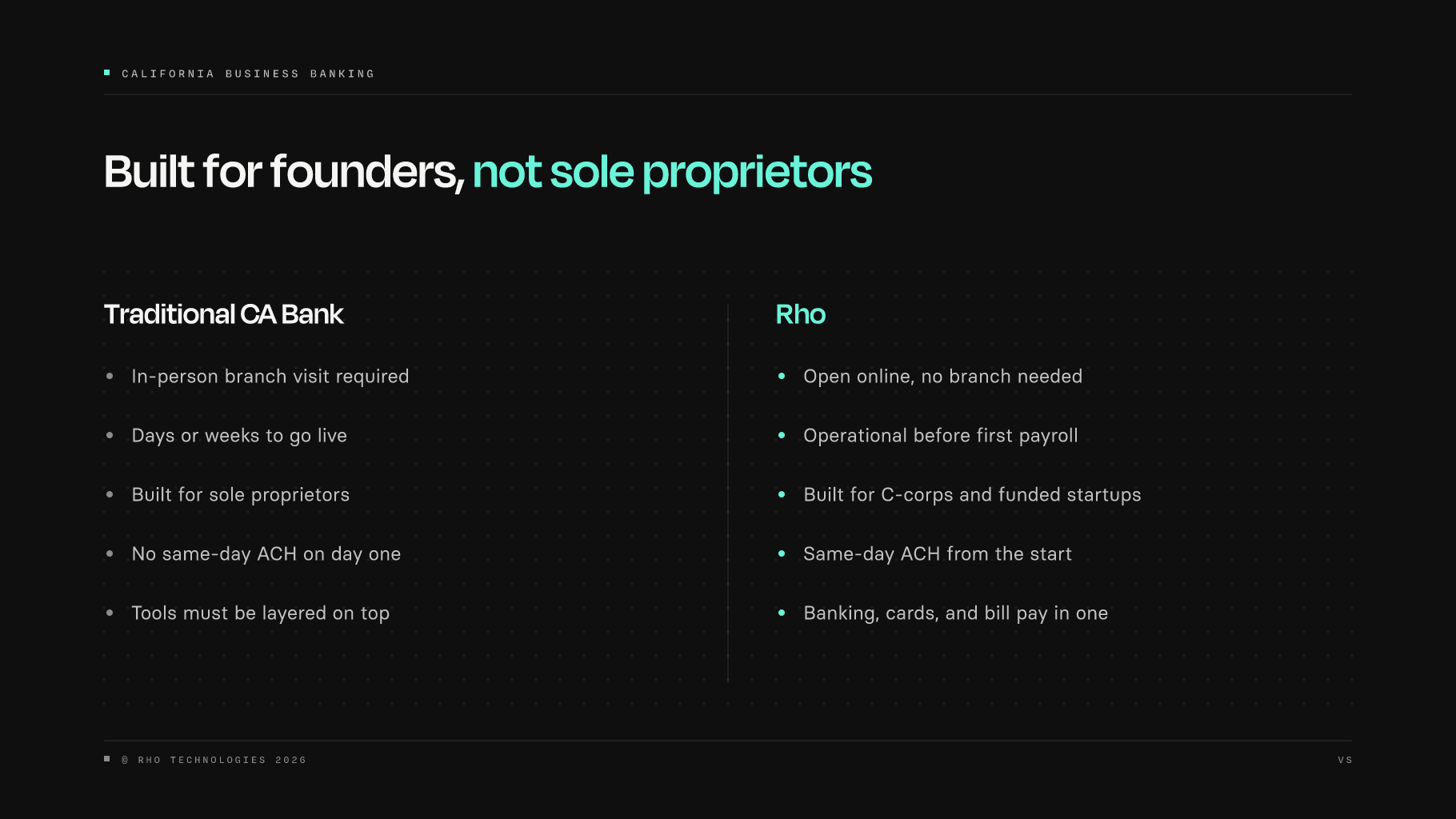
The comparison content dominating that search was built for a sole proprietor. Not for a C-corp that closed a pre-seed round last Tuesday and needs same-day ACH, multi-user corporate cards, bill pay, and a QuickBooks integration working before the first payroll hits.
A boutique. A food truck. That mismatch is invisible until it costs you something real.
US business bank accounts at major institutions typically require in-person branch visits and verification processes that can stretch days or weeks before an account is fully operational.
For a founder who incorporated on Monday and needs to pay a contractor by Friday, that timeline is a hard stop.
California has roughly 4.2 million small businesses, and the overwhelming majority are sole proprietors or brick-and-mortar operators. Content optimized for that majority naturally centers on branch access, ATM networks, and minimum-balance fee waivers.
Incorporated startups are a fast-growing, structurally different segment that comparison content hasn't caught up to.
The state's density of venture-backed companies makes the gap sharper: a YC-backed founder in San Francisco has nothing in common operationally with a Sacramento retailer, yet both surface the same listicle.
4.2 million Small businesses in California
The familiar pattern: open a checking account at a recognizable bank, discover the card takes two weeks and a mortgage application's worth of paperwork, add a separate expense tool, add an AP solution, then realize none of them talk to each other cleanly at month-end.
Most California founders pick a bank based on brand recognition or monthly fee, then spend the next six months duct-taping integrations together, and switch banks anyway after their first growth milestone.
Cash-heavy retail businesses need physical branch locations; venture-backed startups need API-grade infrastructure. Conflating the two is the single most common reason founders rebuild their financial stack at Series A.
Switching costs are not low, transaction limits, broken accounting integrations, and missing spend controls tend to surface around month six, exactly when a finance hire is onboarding and has zero patience for workarounds.
A cash-heavy retailer in Fresno and a funded SaaS company in San Francisco need different banks; copying the other's choice is a mistake. What matters is whether your business looks materially different in twelve months, and whether your bank was built for that version.
Fee tables are the least important comparison point; what actually drags is the operational friction when a bank's infrastructure stops scaling before the business does.
Rho closes that gap by combining banking, corporate cards, bill pay, expense management, treasury, and accounting in one platform, no subscription fees, real human support, and infrastructure designed to hold from day zero through IPO without a rebuild.
How to Choose the Right Business Bank in California - The Framework Founders Actually Need
Picking a California business bank by brand recognition or the lowest monthly fee, then bolting tools on top later, treats the decision like it's low-stakes. It isn't.
Here's why that framing fails:
The bank you open in your first week of incorporation is not just a vendor relationship. It is a structural bet on how your business moves money for the next two years, and most California founders make that bet using the wrong variables entirely.
Cash-Handling vs. Digital-First Operations
Before reading a single bank profile, answer one question: does your business regularly deposit physical cash? A restaurant LLC needs night-deposit access, coin exchange, and a teller relationship. A SaaS startup needs same-day ACH and accounting software sync.
These are different infrastructures. Small businesses still deposit physical cash regularly, while the majority operate entirely on digital transactions.
Which side of that line you sit on determines whether a branch network is an asset or a distraction.
The Five Dimensions That Actually Predict Fit at 18 Months
Evaluate every bank on these five dimensions before committing:
Fee structure: a $0 monthly account can still cost more than a $15 one once you count ATM fees and wire charges.
Setup speed: some accounts open online in minutes; others require a branch visit and a week of verification.
Integration depth: whether the bank talks to QuickBooks Online, Xero, or NetSuite natively, or needs a separate expense tool bolted on.
Scale-readiness: whether the bank still fits once you have a finance hire, multiple entities, or a Series A close.
Support quality: whether a wire problem gets a same-day human or a 72-hour ticket queue.
The hidden cost of optimizing for fee alone never shows up on the fee table. It shows up in your calendar.
Why Brand Recognition Alone Won't Tell You If a Bank Fits Your Business
Brand recognition signals stability, not fit. According to Coalition Greenwich's research, a significant share of small and mid-size businesses in the U.S. are actively considering switching banks, and the drivers go well beyond fees: service quality, digital capabilities, and integration with business tools are the primary complaints.
Founders who chose on brand name are the most likely to end up in that switching pool. Recognizing a logo is not a framework.
The 15 Best Banks for Small Business in California - Ranked for Every Business Type
The five-dimension framework exposes that mismatch before it costs you. Most California founders hit it around the six-month mark, the bank they picked on day one was never designed for the company they were building.
“As a small business owner in California, I experience delayed ACH/wire transfers that disrupt cash flow, a key concern when evaluating the best banks for small business in California.”
The fee looked fine. The brand was familiar. The branch was nearby. And then the business started to grow.
Transaction limits appeared. The accounting integration broke during a month-end close. A wire went out on a Friday afternoon and the support queue said 72 hours.
Then a finance hire joined and immediately asked why the expense reports lived in a spreadsheet, the corporate cards were from a different provider, and bill pay ran through a third tool nobody had documented.
The bank was not wrong, exactly. It was just built for a different business than the one that now existed.
This list is built to prevent that outcome. Every entry is evaluated on two axes: whether the bank fits a cash-heavy or digital-first operation, and whether it can survive the moment the business changes shape.
Fee minimums are noted but treated as table stakes. What matters more for each entry is whether it still holds up as the right answer in eighteen months.
Fee and Waiver Comparison for Major California Business Banks
The table below surfaces the sourced fee data for the major banks covered in this list. Use it as a starting filter, not a final decision.
Bank | Monthly Fee | Waiver | Transactions |
|---|---|---|---|
Bank Business Essentials | $0/month | No waiver needed | 25/month, then $0.50 each |
BlueVine Standard | $0/month | No waiver needed | Unlimited |
Relay Starter | $0/month | No waiver needed | Unlimited |
Axos Basic Business Checking | $0/month | No waiver needed | Unlimited |
Novo | $0/month | No waiver needed | Unlimited (up to $5,000 ACH/day) |
Banc of California | $9/month | Relationship-based; contact branch | Not publicly disclosed |
Rho | $0/month | No waiver needed | Unlimited |
Sources: CreditDonkey 2024, Wise 2024, BlueVine 2024, FitSmallBusiness 2024.
1. Rho - Best All-in-One Banking Platform for Startups and Scale-Ups
Rho earns the top slot not because its checking account is the cheapest, though the $0 monthly fee and unlimited free ACH and domestic wires help. It earns the spot because it's the only entry on this list where the platform you open on day one is the same platform your CFO runs the day you file a Series A.
Banking, cards, bill pay, expense management, and accounting integrations are all native to a single dashboard, which eliminates the multi-tool stack that competitors require.
Corporate cards, bill pay, expense management, and native accounting integrations with QuickBooks Online, NetSuite, Sage Intacct, Xero, Campfire, and Puzzle are all included at no additional cost.
Qualifying C-Corps that deposit $20,000 within 60 to 90 days of opening receive a sign-on bonus (terms apply; see rho.co for current offer details).
Rho is purpose-built for incorporated businesses, particularly C-Corps, so a sole proprietor running a cash-heavy retail shop will find the platform over-engineered for their needs.
It works best when a company has multiple employees incurring business expenses and needs centralized spend oversight from a single dashboard rather than three disconnected tools.
2. Chase Business Complete Banking - Best for California Small Businesses Needing Branch Access
Chase operates the largest branch and ATM network in California, with over 800 branches statewide according to Chase's own branch locator (as of 08/11/2026), making it the strongest option for businesses that handle regular cash deposits or need in-person relationship management.
The $15 monthly fee is waived with a $2,000 minimum daily balance, and the account includes 100 free transactions per month plus $5,000 in free cash deposits.
For growing startups, the friction is structural: Chase's onboarding is branch-anchored, its fee disclosure is opaque online, and it offers no native expense management or AP automation.
Founders who default to Chase for brand recognition are pre-selecting into a high-switching-friction environment. By month twelve, the same physical-first infrastructure that felt safe on day one becomes the exact mechanism that makes migration expensive.
3. BlueVine Business Checking - Best for High-Yield Online Checking
BlueVine's Standard plan carries a $0 monthly fee and pays 1.30% APY on balances up to $250,000 in months when the business spends $500 on its Bluevine card or receives $2,500 in customer payments, otherwise 0.00% APY that month (as of 08/11/2026).
The Premier tier reaches 3.00% APY on all balances for $95 per month (industry data, as of 08/11/2026).
Cash withdrawals are available at 37,000-plus no-fee ATMs in the MoneyPass network. BlueVine integrates directly with QuickBooks and Xero, which removes a meaningful reconciliation headache for small teams.
BlueVine is a strong checking and yield product, but not a full stack. Businesses that also need corporate cards, bill pay automation, and expense management will still bolt on additional tools, which reintroduces the integration tax the platform was supposed to eliminate.
Update (October 2026): Valley National Bank announced it will acquire Bluevine for $340 million, with the deal expected to close in early 2027. Bluevine will become Valley's small-business banking division; existing accounts aren't expected to change before then.
4. Bank of America Business Advantage - Best for Established California SMBs Wanting Relationship Banking
Bank of America's Business Advantage account waives its $16 monthly fee for the first 12 statement cycles, then requires either a $5,000 combined balance or $500 per month in debit card purchases (industry data, as of 08/11/2026).
The account includes 200 free transactions per month and connects to Bank of America's Cash Flow Monitor and Connected Apps, which integrates with QuickBooks and Xero for basic cash flow tracking (industry data, as of 08/11/2026).
This account makes the most sense for an established California SMB that already carries a stable balance and wants in-person relationship management. A startup optimizing for setup speed and no minimum balance will find the fee structure and branch-dependent onboarding create friction that compounds fast.
5. Wells Fargo Initiate Business Checking - Best for Low-Cost Entry-Level Business Accounts
Wells Fargo's Initiate tier is the most accessible entry point among the major California national banks, with a $15 monthly fee (as of 08/11/2026) waivable with a $2,000 minimum daily balance, a $5,000 average combined business deposit balance, or a qualifying Premier or Private Bank checking relationship.
The account includes 100 free transactions and $5,000 in free cash deposits per month. Wells Fargo's most important differentiator for growth-stage businesses is its SBA lending volume.
It is consistently ranked among the most active SBA 7(a) lenders in the United States, which matters for businesses that anticipate needing a credit line or term loan within the next two years.
The Initiate account itself is a thin product, but it creates a banking relationship that can unlock SBA access faster than starting from scratch at a fintech.
6. Mercury - Best for Tech Startups Wanting a Developer-Friendly Fintech Bank
Mercury carries no required monthly maintenance fee and supports unlimited transactions, making it a clean, low-friction option for early-stage tech startups (industry data, as of 08/11/2026).
Mercury has publicly cited a large base of YC-batch companies as customers across its cohort partnerships, making it a common default for founders who want a digital-first experience without branch overhead. The product is strong on simplicity and developer tooling.
Mercury, at its core, is a banking product. Teams that grow past a handful of employees and need integrated bill pay automation, corporate card controls, and native accounting sync will find themselves stitching together additional tools.
That integration work is manageable at five people; it becomes a real time cost at twenty-five.
7. Silicon Valley Bank (SVB) / First Citizens - Best for VC-Backed Startups Needing Venture Debt
SVB banked roughly half of U.S. venture-backed tech and life sciences companies according to its own pre-acquisition reporting. Its core differentiation is the relationship: SVB's lending team understands cap tables, runway, and venture debt in a way that generalist commercial banks do not.
For a VC-backed startup that anticipates needing a venture debt facility or a credit line tied to ARR, maintaining an SVB banking relationship is a strategic asset.
Where SVB doesn't compete is the operational banking experience: digital onboarding speed, expense integration, and AP automation. Most founders who bank at SVB still bolt on a separate expense and AP tool.
8. Relay Financial - Best for Small Business Owners Who Want Multi-Account Cash Flow Control
Relay's Starter plan is free, supports unlimited transactions, and allows businesses to open up to 20 individual checking accounts within a single dashboard (industry data, as of 08/11/2026).
That multi-account structure is what actually sets Relay apart: it lets small business owners separate operating cash, tax reserves, payroll funding, and project budgets into distinct buckets without opening accounts at multiple banks.
Cash deposits are available at Green Dot retail locations for $4.95 per deposit, and no-fee ATM withdrawals run through the Allpoint+ network (industry data, as of 08/11/2026).
Relay is a well-designed product for the owner-operator who wants cash flow discipline without a finance team. It is not built for companies that need AP automation, corporate card controls, or native accounting integrations at scale.
9. Novo Business Banking - Best for Freelancers and Micro-Businesses Wanting Zero-Fee Banking
Novo charges no monthly fee and supports up to $5,000 in ACH transfers per day (industry data, as of 08/11/2026). The product is designed for freelancers, sole proprietors, and micro-businesses that need a clean, no-cost checking account with basic invoicing and a Stripe integration for payment acceptance.
Novo Reserves, a built-in feature, lets owners set aside money for taxes and recurring expenses automatically, a practical tool for self-employed operators who do not have a bookkeeper.
The ceiling is low: Novo's business credit card is invitation-only for existing checking customers, and the platform lacks AP automation and deep accounting integrations.
It is the right product for a one-person operation, and the wrong product the moment a second employee joins.
10. U.S. Bank Business Essentials Checking - Best for California Businesses Wanting a Mid-Tier National Bank
U.S. Bank Business Essentials Checking carries a $0 monthly fee with 25 free transactions per month, then $0.50 each (industry data, as of 08/11/2026). It also includes 25 free cash deposit units per cycle.
U.S. Bank is a reasonable middle-ground option between the large national banks and the fintech platforms.
The transaction limit is the main watch point: businesses running more than 25 teller or paper transactions per cycle pay $0.50 each, while electronic and digital transactions are unlimited (as of 08/11/2026), making the account more expensive in practice than the $0 headline suggests.
11. Axos Bank Business Interest Checking - Best for Online-First Businesses Wanting Interest on Deposits
Axos Bank's Basic Business Checking carries a $0 monthly fee and unlimited free transactions (industry data, as of 08/11/2026). Cash deposits are available at Green Dot locations for $4.95 per deposit, which is the primary limitation for any business that handles physical cash regularly.
Axos competes on the combination of no fees, unlimited transactions, and interest-bearing options on business deposits, making it a solid choice for online-first businesses, e-commerce operators, and service businesses that operate entirely digitally.
The product is not built for companies that need integrated expense management or corporate card controls. It is a capable online checking product.
12. California Bank & Trust - Best for California-Headquartered Businesses Wanting Local Relationship Banking
California Bank & Trust is a state-chartered institution with deep roots in the California business community, offering SBA lending, commercial real estate loans, and treasury management tailored to in-state businesses.
Its relationship managers understand the California regulatory and economic landscape in ways national banks often don't. The tradeoff is limited geographic reach outside California and a less polished digital banking experience compared to fintech-forward competitors.
13. Comerica Bank - Best for Mid-Market California Businesses Needing Treasury Management
Comerica has a long-standing presence in California's commercial banking market and is best positioned for mid-market businesses with more complex treasury needs, including controlled disbursement, lockbox services, and commercial credit facilities.
It is not the right fit for a startup or a micro-business. The product is designed for companies with a finance team or controller who can manage a more sophisticated banking relationship.
Comerica does not compete on digital-first UX or $0 fee structures. It competes on the depth of its treasury management services and its commercial lending relationships, which matter to a California business generating $5 million or more in annual revenue with active working capital needs.
14. Airwallex - Best for California Businesses with International Payments and Multi-Currency Needs
Airwallex offers a $0 monthly base account with multi-currency support across 13 currencies (USD, EUR, GBP, CAD, HKD, JPY, and others), payments in 98-plus currencies, and FX pricing from 0.22% above mid-market (industry data, as of 08/11/2026).
Outbound SWIFT transfers run $5 on a shared-cost basis or $15 on a full-cost basis. The account also pays up to 3.70% annually on invested balances through its treasury product, and includes 1.5% unlimited cashback on card spend.
For a California business with significant international supplier payments, cross-border payroll, or multi-currency revenue, Airwallex is the most purpose-built option on this list.
It is not designed to replace a full domestic banking stack. It is designed to sit alongside one, or to serve as the primary account for businesses where international payments are the dominant workflow.
15. Local California Credit Unions (e.g., CU SoCal, E-Central CU): Best for Community-Rooted Businesses Needing Affordable Lending
California credit unions offer a genuinely different value proposition from banks: member-owned structure, lower loan rates, and community lending programs that national banks do not replicate.
Patelco Credit Union operates 35 California branches and provides access to more than 30,000 fee-free ATMs through the CO-OP network (industry data, as of 08/11/2026). Golden 1 Credit Union offers a $0 monthly fee business account, 200 free transactions, and access to 30,000-plus surcharge-free ATMs (industry data, as of 08/11/2026).
For a California business that is cash-flow constrained, community-rooted, and prioritizing affordable lending over digital-first workflows, a local credit union is often the most practical option. The limitation is that credit union business banking products typically lag fintech platforms on digital integrations, corporate card functionality, and AP automation.
Online/Fintech Banks vs. Traditional Banks in California - Which Type Fits Your Business?
Cash-based operations and digital-first businesses face structurally different banking constraints, and conflating the two is one of the most common reasons California founders end up switching banks within eighteen months.
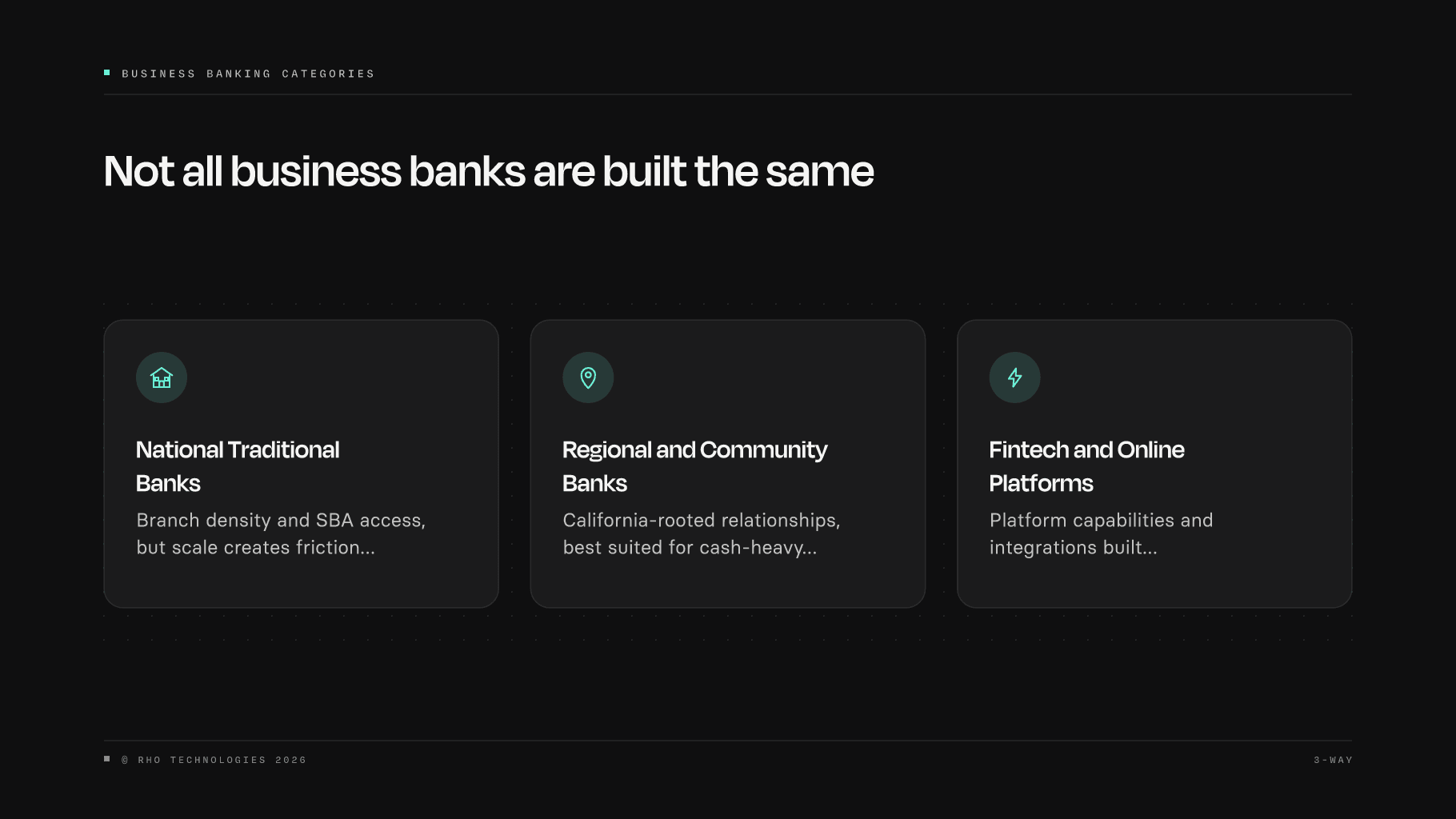
Three types of business banks serve California founders, and they are not interchangeable. Picking the wrong category is an architectural constraint that shapes what your financial stack can and cannot do as your business grows.
The Three-Category Filter
The fastest way to choose a business bank is to rule out entire categories before you read a single fee schedule. The three categories are national traditional banks, California regional and community banks, and fintech or online business banking platforms.
Each one carries structural properties that either fit your business model or create friction that compounds over time. A Series A SaaS company with a CFO hire needs platform capabilities, not branch access. A California food truck chain with daily cash sales needs exactly the opposite.
National Traditional Banks in California
Branch density, SBA access, and the hidden cost of scale are the defining structural properties of national banks. National banks offer two genuine structural advantages:
Physical branch density across California for businesses that deposit cash regularly
Established SBA lending relationships
According to the Federal Reserve Small Business Credit Survey, 49% of small businesses applied for financing at a large bank, reflecting how deeply brand familiarity shapes where founders seek capital.
Here's what that familiarity costs: monthly fees at traditional banks average $15 to $16 before waivers, and onboarding typically requires a branch visit and several business days. For a digital-first startup, that premium buys infrastructure you will never use.
California Regional Banks
Regional and community banks earn their premium through local underwriting judgment and relationship depth that national banks rarely extend to early-stage companies. The Federal Reserve Small Business Credit Survey found small-bank borrower satisfaction at 79%, compared to 67% at large national banks.
A loan officer who knows your business makes faster, more flexible credit decisions; that gap is real. What regional banks rarely offer is the API integrations, instant card issuance, or accounting sync that a venture-backed startup needs on day one.
Fintech and Online Business Banking Platforms
The fintech versus traditional bank debate gets misframed as a question of features. It's really about Scale-Readiness Threshold: the point at which your banking infrastructure must support credit access, not just transactions.
Founders who optimize purely for day-one simplicity at a digital-only bank may be trading away the depository relationship depth that determines credit access at precisely the moment growth demands it.
A real and underappreciated friction point: founders we work with consistently flag customer service responsiveness as a make-or-break issue with fintech banks, especially when fraud strikes. When a fraud event hits, a slow ticket queue is an existential problem.
That concern is legitimate, which is why the model matters as much as the feature list. Rho includes a dedicated point of contact for every customer, reachable via chat, SMS, or phone, with typical response times under a minute, 24/7, at no additional cost.
When a wire recall is necessary, Rho charges a $30 wire recall fee. That is the kind of structural decision that only becomes visible at the moment you need it most.
A second pattern is equally predictable: founders discover that most banking products were designed for consumers or for Fortune 500 treasury teams, with nothing built for the $1M, $50M revenue company trying to close the books faster and add entities without adding headcount.
Rho is built for that gap. The platform runs on a single unified tier: banking, corporate cards, bill pay, AP automation, expense management, unlimited reimbursements, invoicing, and accounting integrations with QuickBooks Online, NetSuite, Sage Intacct, Xero, Campfire, and Puzzle.
All of it is included at $0 platform fee, $0 per-user fee, and $0 subscription fee, regardless of company size.
That structure is intentional: it lets the finance function scale headcount and entity count without a proportional increase in overhead, and it lets operators speed up month-end close, including AI-suggested first-pass transaction coding through Rho Close, so reconciliation takes one pass rather than consuming cycles on its own.
A third risk that does not get enough attention is arbitrary account closure. Founders running online businesses have learned the hard way that some fintech platforms will freeze or close accounts with little explanation and no clear escalation path, creating an operational disruption at exactly the wrong moment.
Rho is backed by Webster Bank, a division of Santander Bank, N.A., Member FDIC, a national bank founded in 1935, and Lead Bank, Member FDIC.
FDIC pass-through insurance through the partner bank network now extends coverage well beyond the standard $250,000 threshold.
Rho's checking accounts carry standard FDIC coverage up to $250K through Webster Bank, a division of Santander Bank, N.A., while the savings product, provided by American Deposit Management Co. and its network of 400+ partner banks, extends coverage up to $75M.
For companies holding meaningful operating cash, that is a structural advantage that belongs on the comparison checklist.
Deposit security and institutional backing consistently rank among the top criteria small business owners apply when evaluating banking relationships.
For founders who want their operating cash working harder, Rho Treasury is available from the same platform. Current annual management fees and rates are available at rho.co/treasury (see the ADV-2A Wrap Fee Brochure).
Treasury access requires a $50,000 minimum investment. The point is architectural: banking, spend management, and treasury yield are accessible from a single platform without switching tools or maintaining separate vendor relationships.
The fintech category is not monolithic. What matters is whether the platform you choose was built with the visibility, control, and institutional backing to support a growing business, not just to open an account quickly.
Next steps
If your banking stack is quietly taxing your calendar instead of your fee statement, the path forward starts with treating the integration architecture as a day-one decision, not a later fix. Start with our business bank for startups.
The standard comparison framework, sort by monthly fee, count branches, check for a QuickBooks logo, selects for the wrong variables at every step, as the fee table above shows.
A bank that forces you to bolt on three separate tools is not cheaper than one that includes them natively. It is just hiding its cost in reconciliation hours.
And once payroll anchors, AP workflows, and card programs are wired into a fragmented stack, the switching cost is not low.
Founders who discover that mismatch at month twelve are not choosing freely between options. They are absorbed into the structural trap that a better day-one decision would have avoided entirely.
Start with Rho to see the all-in-one platform. Banking, corporate cards, bill pay, expense management, and accounting integrations are all native to a single dashboard, with no monthly fee and no per-user cost, so the stack you open on day one is the same one your finance team runs at Series A.
FAQs
Rho is built specifically for this scenario, it offers $0 monthly fees, unlimited free ACH and domestic wires, and a single dashboard that includes corporate cards, bill pay, expense management, and native accounting integrations with QuickBooks, NetSuite, Sage Intacct, Xero, Campfire, and Puzzle from day one. It's the only option on this list where the platform you open at incorporation is the same one your CFO runs after a Series A, without bolting on additional tools.
Wells Fargo is consistently ranked among the most active SBA 7(a) lenders in the United States, and the post notes that maintaining a banking relationship there can unlock SBA access faster than starting from scratch at a fintech. The Initiate account is a thin product on its own, but it's framed as a strategic entry point for businesses that anticipate needing a credit line or term loan within the next two years.
BlueVine is the only entry on this list with a highlighted yield offering, its Standard plan pays 1.30% APY on balances up to $250,000 when monthly activity requirements are met ($500 card spend or $2,500 in customer payments; otherwise 0.00% that month, as of 08/11/2026), and the Premier tier reaches 3.00% APY on all balances for $95 per month. The post notes, however, that BlueVine is a strong checking and yield product rather than a full financial operating platform, so businesses that also need corporate cards, bill pay, and expense management will still need to add separate tools.
Integration depth varies significantly. Rho offers native integrations with QuickBooks, NetSuite, Sage Intacct, Xero, Campfire, and Puzzle at no additional cost, all within a single dashboard. BlueVine integrates directly with QuickBooks and Xero, and Bank of America connects to QuickBooks and Xero through its Cash Flow Monitor and Connected Apps feature. The post warns that banks without native integrations force founders into manual exports and month-end reconciliation work that shows up in your calendar, not your fee table.