
Brand recognition is not a banking strategy. Here is how to find the Texas business bank that fits how your company actually operates, before the wrong choice costs you 250 hours a year.
Rho is a fintech company, not a bank or an FDIC-insured depository institution. Checking account and card services provided by Webster Bank, a division of Santander Bank, N.A., Member FDIC, and by Lead Bank, Member FDIC. Savings account services provided by American Deposit Management Co. and its partner banks.
Picking the best bank for small business in Texas sounds straightforward. The common assumption is that picking the most recognizable bank name (Chase, Frost, Wells Fargo) is the safe, fast path; brand trust means fewer surprises, and any gaps can be patched with separate tools later. The reality is messier, and the cost of getting it wrong rarely shows up on a fee schedule.
The damage appears later. A founder opens an account, closes a seed round, and then spends the next three months duct-taping together separate tools for cards, bill pay, and expense tracking. Month-end close becomes detective work.
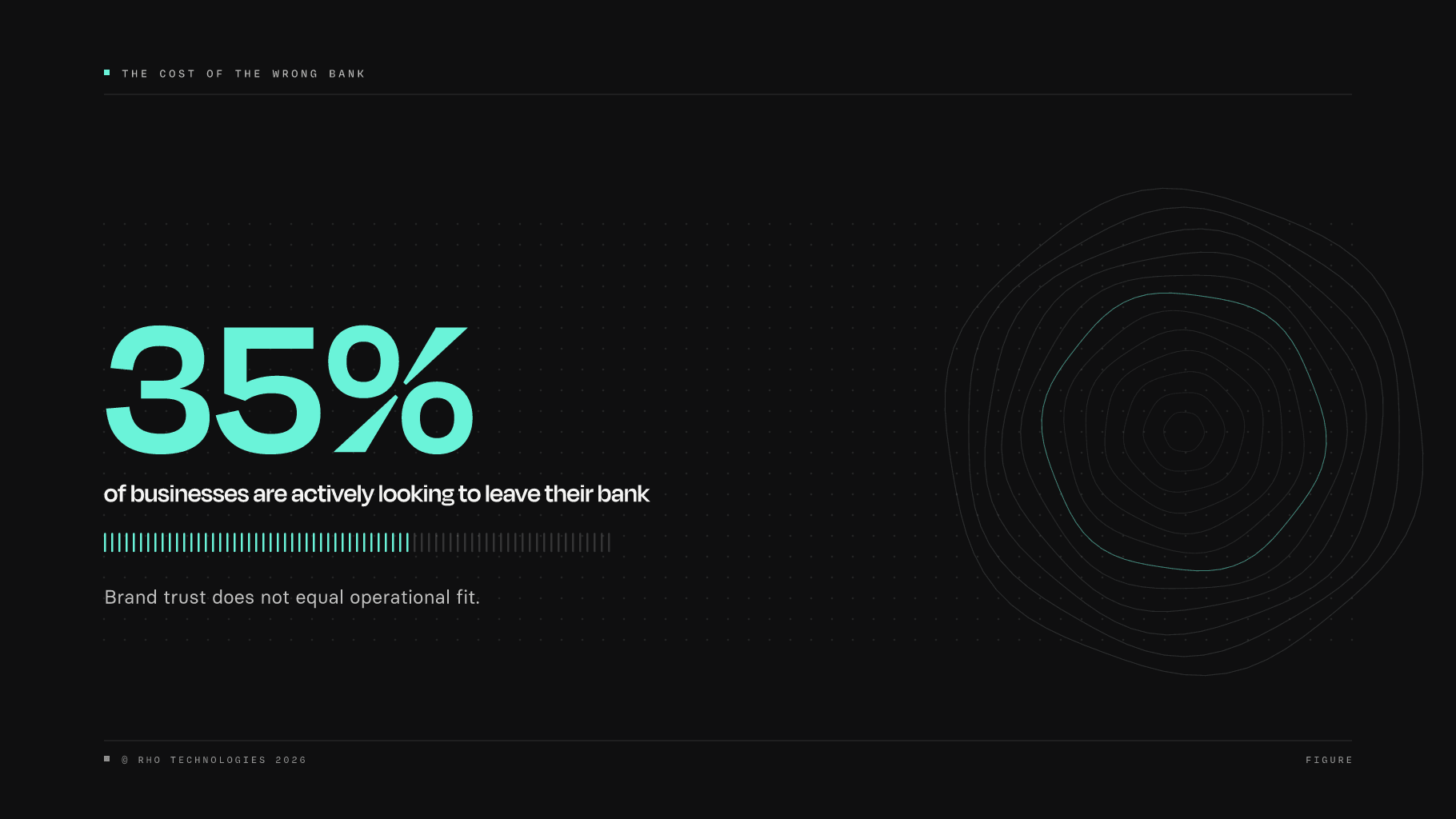
35% of businesses are actively seeking a new bank.
Reconciliation eats a full day. The bank was just wrong for how the business actually operates. That distinction matters more than most listicles acknowledge.
See our business bank for startups for how this works in practice.
Texas hosts more FDIC-insured banks and credit unions than any other state, with well over 400 institutions operating as of 2025. That volume creates an illusion of easy comparison. In practice, it means dozens of institutions competing on surface-level metrics like ATM counts and promotional rates while burying the operational differences that actually determine fit. Most ranked guides default to brand recognition. Roughly one in three businesses chose a bank, almost certainly a familiar name, and are now looking to leave it. Brand trust does not equal operational fit.
Small business owners spend an average of roughly 5 hours per week on manual bookkeeping and reconciliation tasks. Across a year, that is more than 250 hours. No fee comparison captures that number. Platforms that combine banking, cards, bill pay, and accounting sync in one place, like Rho, address this directly.
250 hours are lost yearly to manual bookkeeping tasks.
Brand-name banks feel like the safe default, but the real cost of a bad fit shows up in operational drag, misfired wires, month-end closes that eat three days, and tools that were never designed to talk to each other.
Fee schedules capture maybe 40% of what a business bank account actually costs; the rest lives in calendar time, software subscriptions, and the two business days lost every time something needs tracing.
Texas regional banks earn their reputation, dedicated local bankers and SBA lending relationships are genuine advantages, but those advantages only matter if your business model actually needs them.
Switching data shows the driver behind most mid-growth bank changes is operational fit, not fee levels; founders who treat the account as a formality at launch are the ones absorbing the most friction six months later.
Cash-heavy retail businesses, professional services firms, and venture-backed startups each need a different financial foundation; a single 'best bank' answer doesn't survive contact with those differences.
Rho closes the gap for startups and scale-ups by putting banking, corporate cards, bill pay, expenses, treasury, and accounting on one platform, no subscription fees, real human support, and infrastructure that holds up from day zero through an IPO.
How to Choose the Right Business Bank in Texas - The Criteria That Actually Matter
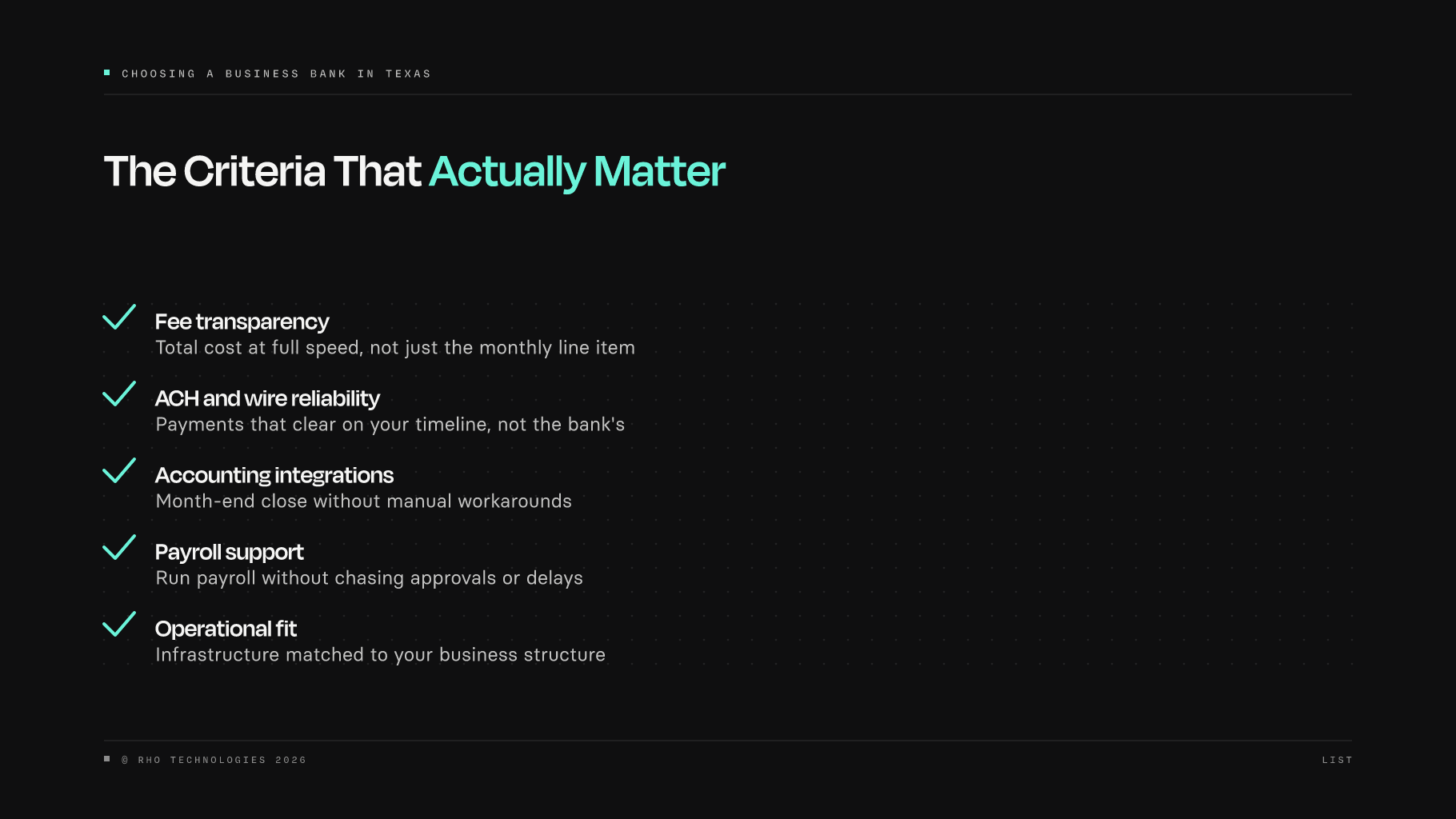
Choosing the right business bank in Texas comes down to matching your operational structure to the right financial infrastructure. The criteria that actually matter go well beyond what most founders check first.
Fee tables are the wrong map for this decision. The monthly charge on a bank's pricing page tells you almost nothing about what that account will actually cost you once your business is running at full speed.
Most Texas founders think picking the most recognizable bank name (Chase, Frost, Wells Fargo) is the safe, fast path. Brand trust means fewer surprises, and any gaps can be patched with separate tools later.
That assumption breaks fast. The real cost of the wrong bank shows up in hours lost to manual reconciliation, ACH delays that stall vendor payments, and accounting integrations that fail at month-end close.
Here's the math that actually matters: a $0-fee account that forces three manual workarounds per week is more expensive than a paid platform that eliminates them entirely.
Founders we work with describe the core problem the same way every time: they need to fund payroll, wire vendors, and manage capital without relying on banks that don't understand their business or timeline. Most traditional bank accounts simply aren't built to answer that need.
Rho is built around banking, cards, and automation that just work, with the visibility and control to stay ahead of risk. Every customer also gets an on-the-frontlines support team that actually understands the day-to-day realities of running a business, responding in under a minute, 24/7 via chat, email, or phone, at no added cost.
So what actually separates a smart banking decision from one that creates friction as your business scales? The sections below break it down criterion by criterion, the kind of detail that can save Texas founders real time, money, and operational headaches down the road.
Cash-Heavy vs. Digital-Only Operations
A restaurant owner who picks a digital-only neobank and can't deposit daily cash without a three-day hold has made the wrong call, regardless of the fee schedule. Cash-heavy Texas businesses in food service, retail, and trades need branch density, ATM networks, and vault services.
If your business touches physical cash regularly, your bank list shortens fast: you're choosing among institutions with a real Texas footprint before any other criteria even applies.
For businesses that are not cash-heavy and do have multiple employees incurring expenses across vendors, travel, and operations, the calculus flips. Centralized spend oversight becomes the deciding variable.
This is where Rho earns its place. Rho Corporate Cards are included at $0, with no minimum balance required, no personal guarantee, and no personal credit pull, built for exactly the moment a company has multiple employees incurring business expenses and needs centralized visibility in one place.
Cards earn up to 2% Cashback with Rho Platinum (terms apply), on up to $1M in eligible annual card spend; 1.25% standard, credited directly to the account. Same-day ACH (for amounts under $1M initiated before 2pm ET) and $0 domestic wires mean vendor payments don't stall while you wait for a bank that doesn't understand your timeline.
SBA Lending Access in Texas
Not every bank that offers SBA loans is an SBA Preferred Lender, and that distinction matters. Preferred Lenders have delegated authority to approve loans without waiting for SBA review, which cuts weeks off the timeline.
Community banks in Texas have historically driven a disproportionate share of SBA 7(a) volume for smaller loan amounts, while national banks concentrate approvals at higher dollar thresholds. If an SBA loan is in your 12-month plan, verify the specific branch's lending credentials before you open the account, not after.
LLC and Entity-Level Banking in Texas
IRS Publication 334 and Bank of America's guidance on separating business and personal finances both underscore that commingling funds is one of the most common and costly mistakes early-stage businesses make. It creates tax exposure, pierces liability protections for LLCs, and turns year-end reconciliation into chaos.
Opening a dedicated business account before your first dollar of revenue moves is the baseline.
For Texas founders moving fast through incorporation, Rho supports pre-EIN onboarding: you can open an account before your EIN arrives.
If you're incorporating through Stripe Atlas or Clerky, Rho integrates directly with both. Founders can open accounts and start using Rho before their EIN arrives via Stripe Atlas, and Clerky offers one-click pre-fill of the Rho application. There is no personal guarantee requirement and no personal credit pull on the platform.
The savings account is provided by American Deposit Management Co. and its partner banks, with FDIC coverage up to $75M through ADM's network of approximately 400 partner banks. Treasury Bills and mutual fund options are also available.
Rho Treasury is not FDIC insured, and a management fee of 15-60bps annually applies based on cost to provide the service.
All other platform features, including bill pay, AP automation, basic invoicing, expense management, accounting integrations with QuickBooks Online, Oracle NetSuite, Sage Intacct, and Xero, are included at $0, with no per-user fees and no subscription fees, for every customer regardless of company size.
Best Texas Regional and Community Banks for Small Business
Texas-headquartered banks earn their reputation honestly. A dedicated local banker who knows your industry, branch staff who can handle cash deposits at scale, and SBA lending relationships built over years are advantages no fee table captures.
Those strengths are real. The question is whether they match what your business actually needs right now.
For cash-heavy retailers, brick-and-mortar operators, and small businesses actively pursuing SBA financing, a Texas regional or community bank is often the right fit.
For startups and fast-scaling businesses, though, the same relationship model can become a bottleneck: loan approvals move slowly, digital tools lag, and the back-office automation that saves hours every week simply isn't there. Recognizing which profile fits your business is the real decision.
1. Rho - Best All-in-One Banking Platform for Texas Startups and Scale-Ups
Founders who've just closed a round and need to move fast consistently hit the same wall with traditional banks: slow onboarding, manual reconciliation, and a support ticket that arrives three days later.
The underlying problem isn't any single bank. Growing a business without adding operational or financial overhead is only possible if banking, spend, and accounting live in one place, rather than scattered across disconnected tools.
Rho is built around that premise. It combines banking, corporate cards, bill pay, expense management, and native accounting integrations, QuickBooks Online, Oracle NetSuite, Sage Intacct, and Xero, in a single unified platform at $0 monthly fee, $0 per-user fee, and $0 domestic wires.
Same-day ACH is included at no cost (for transfers initiated before 2 PM ET under $1M), and every customer gets a dedicated point of contact reachable via chat, email, or phone with a response time under a minute, 24/7.
Proof it works in practice: the finance team at Anti Agency Group cut month-end close time in half after switching to Rho, according to the company's published case study, a direct result of centralizing banking and spend data in one place, without needing to hire a larger finance team.
Corporate cards are issued immediately with no minimum balance required and earn up to 2% Cashback with Rho Platinum (terms apply), on up to $1M in eligible annual card spend; 1.25% standard, credited directly to the account. That matters most once multiple employees are incurring business expenses and the business needs centralized spend oversight in real time.
Expense management, including the Gmail Connector (in beta) that scans receipts automatically, is included at $0. The savings account, provided by American Deposit Management Co. and its partner banks, carries FDIC coverage up to $75M through ADM's network of partner banks, meaningful protection for companies holding significant operating reserves.
For founders who need to move even before their EIN arrives, Rho supports pre-EIN onboarding and is available directly through Stripe Atlas, so teams can open banking and issue cards in minutes without becoming a finance operator.
Qualifying C-Corps that maintain a $20,000 minimum balance for their first 60 days also receive a $1,600 sign-on bonus. Treasury Bills and mutual fund options are available, with Treasury access requiring a $50,000 minimum investment.
Management fees run 15-60 basis points annually based on cost to provide the service (see the ADV-2A Wrap Fee Brochure for full terms). Rho Treasury investments are not deposits and are not FDIC insured. Settlement timing varies by product and is typically within 2-3 business days.
Worth saying plainly: Rho is built for digitally-operated businesses. Cash-heavy operations that depend on branch deposits won't find the physical infrastructure here.
2. Frost Bank - Best Texas-Only Community Bank for Relationship-Driven Small Business Banking
Frost Bank holds SBA Preferred Lender status, meaning the SBA has delegated final credit decision authority directly to Frost, allowing faster loan approvals than standard lenders can offer. That regulatory designation matters more than brand scale when an SBA 7(a) approval is on the line.
With 100+ branches across Texas and a brand identity built around “the Texas bank you know,” Frost Bank is a strong fit for relationship-driven small businesses, SBA borrowers, and operators who want direct banker access. Where it comes up short is digital automation: once a business has outgrown the branch model, the tools don't keep pace.
3. Texas Capital Bank - Best for Small Businesses Seeking SBA Loans and Growth Financing
Texas Capital Bank targets growing mid-size small businesses that need more than a basic checking account. The Star Plus Checking account carries zero monthly maintenance fees, a practical option for professional services firms and owner-operated businesses that want a local relationship without paying for it monthly.
Texas Capital also maintains SBA lending credentials, positioning it well for businesses pursuing growth financing. Where it doesn't keep up: digital tools and back-office automation aren't built for the pace a venture-backed startup needs post-raise, where speed of onboarding and integration depth matter most.
4. Texas First Bank - Best Local Community Bank for Personalized Small Business Support
Texas First Bank operates as a community-focused institution, built for small business owners who want a banker who knows their name and their industry. For a San Antonio restaurant group or a Gulf Coast contractor managing seasonal cash flow, the ability to call a local decision-maker rather than route through a national ticket queue has real operational value.
Prosperity Bank and Randolph-Brooks Federal Credit Union (RBFCU) serve similar relationship-banking niches across Texas, and businesses in those networks often cite the same advantage.
The catch: Texas First Bank's digital banking tools and accounting integrations are limited compared to fintech-forward options, so businesses that run lean and depend on automated reconciliation will find the model friction-heavy.
5. Texas Regional Bank - Best for Small Businesses Needing Flexible Business Loans and Credit Lines
Texas Regional Bank serves the Rio Grande Valley and surrounding markets, with a focus on flexible credit products for small businesses that may not fit the underwriting templates of larger institutions.
For business owners who need a lender willing to understand the context behind their financials, not just run a score, that flexibility is a meaningful advantage. But its branch footprint is tightly clustered in South Texas, which limits its use for businesses operating across multiple Texas cities or needing statewide branch access.
Local presence and relationship banking are real advantages, but only for specific business profiles. Cash-heavy retailers, SBA borrowers, and brick-and-mortar operators benefit most from a dedicated local banker and branch network.
For startups and fast-scaling businesses, though, that same relationship model becomes a bottleneck. If your business operates across multiple Texas cities, moves money frequently, and needs every dollar of overhead justified, the platform that lets you grow without adding operational or financial complexity is almost always the better starting point.
Best National Banks With a Strong Texas Presence for Small Business
Chase's name on a storefront is one of the most recognizable signals in American banking, and for Texas small business owners, that familiarity carries real weight. The bank has an existing physical presence spanning Houston, Dallas, Austin, San Antonio, and dozens of secondary Texas markets.
For businesses that need in-person cash deposits, multilingual ATM access, or a branch within driving distance, that density is a real asset. But Chase's branch network is optimized for retail volume, which leaves the sub-$1M Texas LLC without a relationship manager who has local override authority when something goes wrong.
Wells Fargo is one of the highest-volume SBA 7(a) lenders operating in Texas. A Houston construction firm pursuing SBA 7(a) financing, or a multi-location DFW retailer that needs certified lender status and established credit history on file, will find Wells Fargo's infrastructure built for exactly that use case.
Bank of America rounds out the national tier with competitive small business credit products and a strong Texas footprint, a reasonable fit for established businesses that already carry consistent revenue and can absorb minimum balance requirements without friction.
National banks hand you an account, not a banker. Onboarding can take days or weeks, and once the account is open, routine support routes through ticket queues rather than a dedicated contact.
Chase Business Complete Banking waives its monthly fee only when you maintain a $2,000 minimum daily balance, a threshold that punishes early-stage businesses before revenue stabilizes. For a fast-moving Texas startup that just closed a round and needs cards issued, bill pay configured, and books connected to QuickBooks by end of week, that friction lands at exactly the wrong moment.
That is the gap Rho is built to close. The hidden cost was never the monthly fee, it's the back-office drag that compounds quietly until month-end close becomes a multi-day project.
Rho combines business banking, corporate cards, bill pay, and expense management in a single platform, at $0 monthly, subscription, and per-user fees, with native direct integrations into QuickBooks Online, Oracle NetSuite, Sage Intacct, and Xero, so the reconciliation work that national banks leave on your plate gets handled at the source.
That outcome isn't an accident. Rho is designed to automate month-end close so finance teams reclaim time for core business operations, letting businesses scale headcount and entity count without a proportional increase in finance overhead.
Multi-entity support is included on the platform, so founders managing more than one Texas LLC can oversee spend and financial oversight across all entities from a single dashboard, with no duplicate logins and no separate fee tiers.
Every Rho customer, at every stage, also gets a dedicated point of contact reachable via chat, email, or phone, with a response time under a minute, 24/7, at no added cost. Cashback is credited directly to the account. Bill pay, AP automation, same-day ACH, and unlimited reimbursements are all included at $0.
1. Rho - Best All-in-One Banking Platform for Texas Startups and Scale-Ups
Rho is built for venture-backed startups and growth-stage companies that need more than a basic checking account. It combines banking, corporate cards, bill pay, expense management, treasury, and accounting integrations in one platform, with no subscription fees and real human support.
Texas founders who've just raised and need infrastructure that scales will find Rho fits that moment well. Where it's not the right call: cash-heavy or brick-and-mortar businesses that need in-person branch access.
2. Chase Business Complete Banking - Best National Bank for Established Texas Small Businesses
Chase Business Complete Banking is the right call for Texas businesses that need the widest ATM footprint in the state, in-branch cash deposit access across major and secondary markets, or a single institution that can grow into SBA lending and premium credit products over time.
For early-stage operators, it's a harder sell: the $2,000 minimum daily balance fee waiver requirement adds balance-management overhead right when cash is most constrained, and the account structure was never designed to automate the back-office work that fast-growing startups need handled before month-end close arrives.
3. Texas Capital Bank - Best Texas-Headquartered Bank for SBA Loans and Commercial Growth
Texas Capital Bank is a Dallas-headquartered institution built for Texas businesses that are scaling and need serious commercial lending firepower, including SBA 7(a) and 504 loans. Unlike national banks, it brings local market expertise and relationship-driven banking to mid-sized and growth-stage businesses across the state.
Where it struggles: accessibility. Micro-businesses and early-stage startups without established financials are less likely to fit, and its digital-first experience lags behind fintech competitors.
Best Digital-First and Fintech Banks for Texas Small Business - Including the One Built for Startups Scaling Fast
Speed is only half the problem. A significant share of small business owners who switch banking platforms do so within the first year, and switching data from Coalition Greenwich (August 2024) shows the driver is operational fit, not fee levels.
It is the moment they realize their bank, their corporate card platform, and their bill pay tool have never spoken to each other, and someone on their team has been quietly absorbing the cost every Friday afternoon.
Small business owners and startup founders face frequent minor banking and admin interruptions that distract from core business operations, a gap that digital-first banks like Mercury alternatives are trying to solve.
For Texas startups post-raise, the true cost differential between a legacy bank and a fintech platform like Rho isn't visible in any fee table. It lives in the compounding labor overhead of manual reconciliation, which can push total financial administration costs to multiples of a bank's published monthly fee.
Choosing a banking platform is a workflow decision, and the wrong workflow compounds silently until a month-end close forces the reckoning.
The digital-first and fintech banking category has expanded fast. Industry data suggests more than 50 distinct neobank and fintech business banking platforms now compete for U.S. small business accounts.
Which means the real challenge isn't finding a platform, it's finding the one that fits your operational complexity at the stage you are actually in, not the stage you were at when you signed up.
The best digital-first banks for Texas small businesses are the ones that match your workflow depth, not just your fee tolerance.
For freelancers and solo operators, that might mean built-in tax tools or invoicing. For a funded startup with a finance team and a growing vendor list, it means AP automation, accounting sync, and cards that don't require a separate reconciliation step.
The fee line matters. The operational drag underneath it matters more. Texas businesses that need SBA lending or higher deposit limits alongside digital tools often pair these platforms with an FDIC-insured institution like Bluevine or Live Oak Bank, which offer small business lending depth that pure fintech platforms do not.
1. Rho - Best All-in-One Banking Platform for Texas Startups Scaling Fast
Amir Eldar, co-founder of Anti Agency Group, put it plainly after switching to Rho: “It's cut our workloads in half and allowed us to minimize the time and resources we spend managing our finances. Rho isn't just our banking platform or our corporate card provider. They're our whole financial solution.”
The company's published case study cites month-end close running twice as fast since centralizing on Rho. That is the core of what Rho delivers for scaling startups: banking, corporate cards, bill pay, AP automation, and native QuickBooks Online and NetSuite integrations in one platform, with $0 domestic wires, same-day ACH, and up to 2% Cashback with Rho Platinum (terms apply), on up to $1M in eligible annual card spend; 1.25% standard.
Worth being upfront about: Rho is built for companies that have financial complexity to automate. A solo founder with three vendors and no accounting integration won't feel the difference on day one.
The platform earns its value once the team grows, the vendor list lengthens, and month-end close starts pulling hours from the calendar.
2. Relay - Best for Texas Small Businesses That Need Multi-Account Cash Flow Control
Relay lets owners open up to 20 individual checking accounts and 50 virtual cards from a single dashboard, a strong fit for operators who run the “profit first” cash allocation method or manage multiple revenue streams that need clean separation. There is no monthly fee on the standard plan, and the Xero and QuickBooks integrations are solid for basic reconciliation.
Depth is where it thins out: Relay gates bill pay by plan, batch vendor payments require its Grow plan, and bill-payment automation sits on its top Scale plan. That falls short of the AP depth a growing team needs, so founders who move beyond basic cash-bucketing will eventually need additional tools.
3. Novo - Best for Texas Freelancers and Micro-Businesses Wanting Accounting-First Banking
Novo is built around the idea that a small business owner should be able to see their Stripe, Square, and QuickBooks data inside their banking dashboard without a separate integration layer. For Texas freelancers billing clients and tracking project income, that framing is useful. The account carries no monthly fee and no minimum balance.
Where it hits a ceiling: Novo's business credit card is invitation-only, without corporate-card expense management controls, and its AP capabilities are limited. It stops fitting cleanly once a business adds employees or a meaningful vendor payment workflow.
4. Airwallex - Best for Texas Businesses with International Clients or Cross-Border Payments
Airwallex is the right call when a material share of your revenue comes in foreign currency or your vendor payments go overseas. It supports multi-currency accounts, local collection in over 60 countries, and competitive FX conversion rates that beat most traditional bank wire fees by a wide margin.
For a Texas export business or a software company billing European clients in euros, that infrastructure is valuable. Domestic-only operators get less out of it: Airwallex's U.S. business banking features are thinner than dedicated domestic platforms, and the product is clearly optimized for cross-border complexity first.
5. Wise Business - Best for Texas Importers and Exporters Needing Transparent FX Pricing
Wise Business prices its FX conversions at the mid-market rate plus a disclosed percentage fee, one of the most transparent international payment options available to small businesses. Texas importers paying overseas suppliers and exporters collecting from international customers benefit most here, the cost of each transfer is predictable before you initiate it.
It's worth knowing what it isn't: a full banking platform. There is no AP automation, no corporate card expense management, and no accounting sync depth. It's a payments tool that does one thing very well.
6. Slash - Best for Texas Startups Needing Granular Spend Controls and Virtual Cards at Scale
Slash is designed for operators who want to issue a unique virtual card for every vendor, subscription, or department budget, then lock or kill each card independently. For Texas startups managing SaaS subscription sprawl or running multiple paid acquisition channels, that level of control reduces unauthorized charges, and reconciliation moves faster because every card maps to a single cost center.
But Slash is a spend control layer, not a full financial stack. Banking depth, accounting integrations, and AP automation all require additional tools alongside it.
7. Mercury - Best for Texas Tech Startups Wanting a Clean, Developer-Friendly Banking Interface
Mercury has become a default choice for Texas VC-backed tech startups that want a polished digital banking experience, API access, and a startup-native product culture. It offers FDIC-insured checking and savings, treasury vaults, and team permissions.
Compared to Rho, the gap shows up in expense management and bill pay: Mercury's are less deeply integrated, often requiring third-party tools to complete the finance stack.
8. Bluevine - Best for Texas Small Businesses That Want a High-Yield Checking Account
Bluevine is a strong option for Texas small business owners who want their operating account to earn meaningful interest without locking funds in a separate savings product. Its business checking account offers a competitive APY on balances, no monthly fees, and access to a business line of credit through the same platform.
Where it comes up light: expense management and card controls, both fairly basic compared to more startup-focused fintech platforms.
Update (October 2026): Valley National Bank announced it will acquire Bluevine for $340 million, with the deal expected to close in early 2027. Bluevine will become Valley's small-business banking division; existing accounts aren't expected to change before then.
9. Brex - Best for Texas Startups with Institutional Backing That Need a Premium Corporate Card Stack
Brex is the right fit for well-funded Texas startups that need a premium corporate card program with high limits, travel rewards, and global spend management at scale. It integrates with NetSuite, Sage Intacct, and major ERPs, a natural fit for companies approaching Series B and beyond.
The catch: Brex has moved upmarket. Smaller or bootstrapped Texas businesses may find its pricing and minimum requirements prohibitive.
10. Found - Best for Texas Self-Employed Owners and Solopreneurs Who Need Built-In Tax Tools
Found is built for Texas freelancers, independent contractors, and self-employed business owners who want banking and tax prep in one place. It automatically sets aside estimated taxes, categorizes expenses, and generates Schedule C-ready reports, removing the need for a separate accounting tool at the solo stage.
It doesn't grow with you, though: Found isn't built to scale to multi-employee businesses, payroll, or complex entity structures.
Related Reading
Fees and Account Structure Breakdown - Comparing Top Texas Business Bank Options
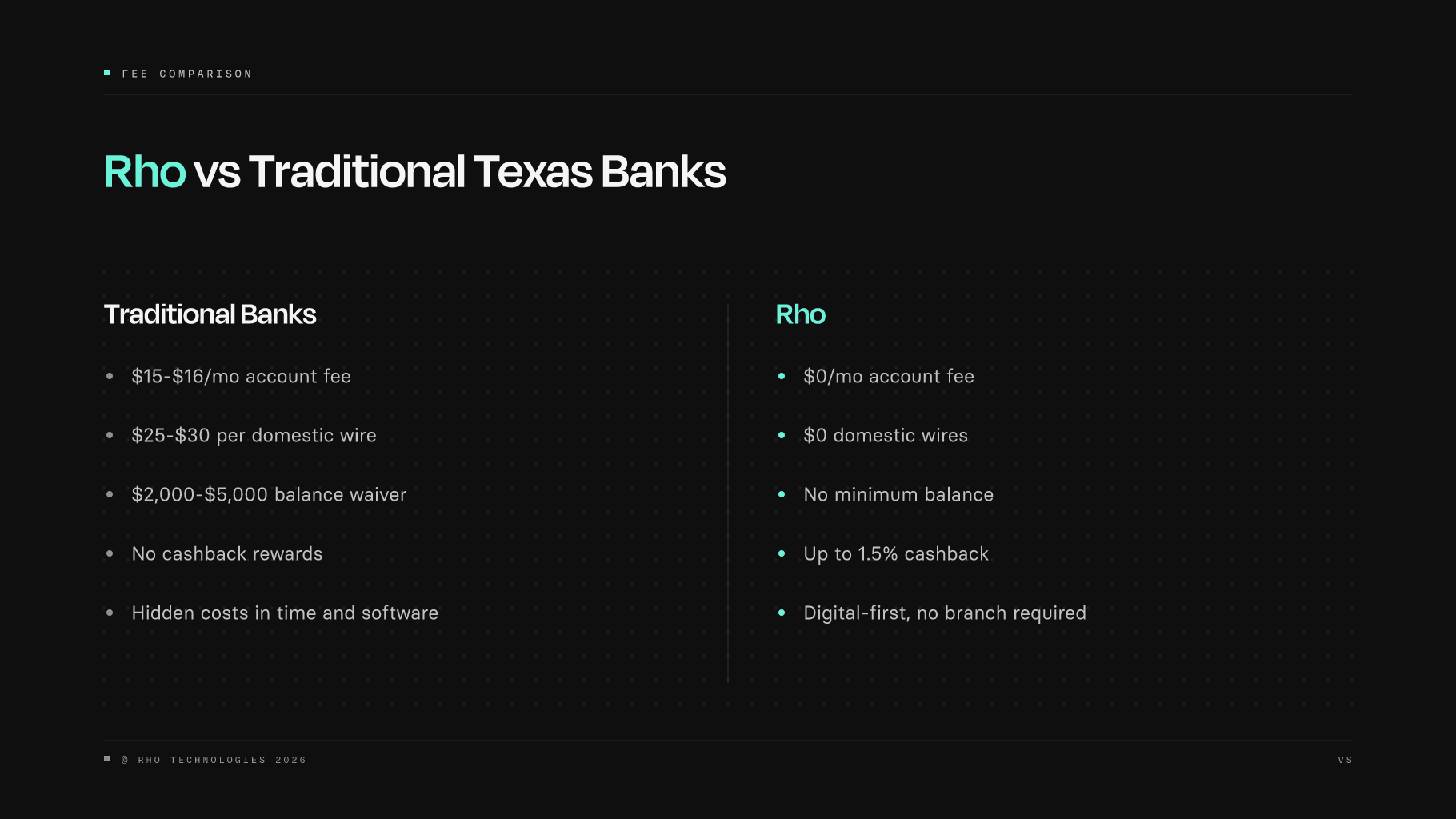
Every business bank account in Texas comes with a published fee schedule. The problem is that fee schedule captures, at best, 40% of what you will actually spend. The other 60% shows up in your calendar, your software subscriptions, and the two business days you lose every time a wire needs tracing.
Side-by-Side Fee Comparison - Monthly Fees, ACH, Wires, Minimums, and Cashback Across Top Texas Business Banks
Bank | Monthly Fee | Fee Waiver | Domestic Wire | Cash Deposits | Cashback |
Frost Bank | $0 (Free tier) | No minimum | Not published | Branch-based | None |
Wells Fargo | $15 | $2,000 daily balance | $25-$30 typical | 100 free tx/mo | None |
Bank of America | $16 | $5,000 balance or $500 debit spend | $25-$30 typical | $7,500/mo free | None |
Chase | $15 | $2,000 daily balance | $25-$30 typical | $5,000/mo free | None |
Prosperity Bank | $10 | Not published | Not published | Unlimited (some accounts) | None |
Bluevine | $0 (Standard) | N/A | Not included standard | Limited | None |
Texas Capital Bank | $12-$15 | Balance-based | Not published | Standard | 0.25% APY option |
Rho | $0 | No minimum | $0 | Digital-first | Up to 2%* |
*Up to 2% Cashback with Rho Platinum (terms apply), on up to $1M in eligible annual card spend; 1.25% standard.
Wire fees at traditional banks typically run $25 to $30 per outbound domestic wire, based on published schedules from Wells Fargo, Bank of America, and Chase. Send ten wires a month and you have added $250 to $300 in costs that never appear in a headline fee comparison.
What the Fee Table Does Not Show: Hidden Operational Costs That Dwarf Monthly Fees. According to Slaton Financial Services' analysis, in-house bookkeeping for a Texas small business costs $62,000 or more per year when you account for Bureau of Labor Statistics 2024 wage data.
Related Reading
How to Choose the Best Bank for Your Texas Small Business - A Decision Framework
Most Texas founders who end up switching banks mid-growth did not choose poorly after careful deliberation. They chose quickly, treated the account as a formality, and moved on, then spent the next several months absorbing friction they never anticipated until it became too costly to ignore.
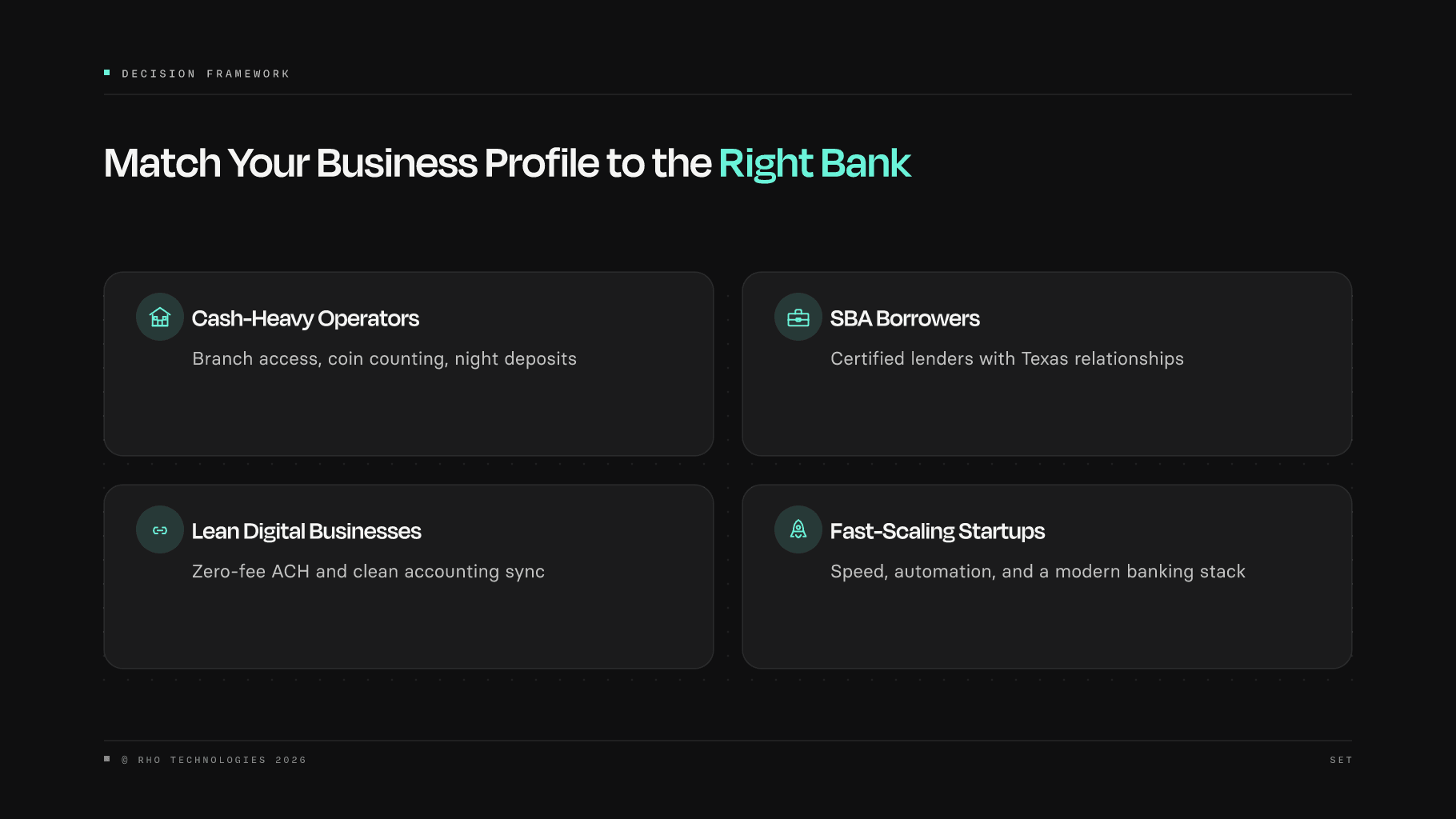
Match Your Business Profile First - The Four-Quadrant Decision Map
Cash-heavy businesses benefit most from traditional banks with branch density and cash deposit infrastructure, while fast-scaling startups post-raise are better served by platforms offering multi-user access, spend controls, and treasury yield. That single distinction eliminates half the field before you compare a single fee.
The four profiles that matter: cash-heavy operators (need branch access, coin counting, night deposits), SBA borrowers (need certified lenders with established Texas relationships), lean digital businesses (need zero-fee ACH and clean accounting sync), and fast-scaling startups (need speed, automation, and a banking stack that doesn't require a part-time finance operator to maintain).
When Traditional Banks Win, and When Their Onboarding Timeline Becomes the Problem
Traditional banks earn their place for businesses that need SBA financing. Lender type materially affects approval odds, not just rates, and community banks with SBA Preferred Lender status move faster through the approval process than national institutions routing applications through centralized underwriting.
If an SBA 7(a) loan is on your roadmap within 12 months, building that relationship early matters.
The friction shows up post-raise. Traditional bank account opening timelines run several business days to multiple weeks when in-branch verification, signature cards, and business documentation reviews are required. For a founder who just wired in seed capital and needs payroll funded and vendor payments scheduled immediately, that timeline is a real operational cost.
Next steps
If your banking setup is forcing weekly reconciliation sessions that your fee schedule never warned you about, the path forward starts with treating this as a workflow decision, not a fee decision. Start with our business bank for startups.
The true cost differential between a legacy bank and a fintech platform lives in compounding labor overhead, not monthly charges. A $0-fee account built around manual workarounds is more expensive than a paid platform that eliminates them.
And as the switching data shows, one in three businesses that defaulted to a recognizable name are now bearing both the operational drag of the wrong bank and the friction cost of trying to leave it. Those two facts point to the same action: choose the platform that closes the reconciliation gap before it compounds, not after.
Start with Rho for business bank for startups. Banking, cards, bill pay, and accounting integrations ship as one platform at $0 monthly fee, so the duct-tape stack never forms in the first place.
FAQs
Rho is built for this. There is no personal guarantee requirement and no personal credit pull on the platform. It also supports pre-EIN onboarding, so you can open an account before your EIN arrives, which matters for Texas founders moving fast through incorporation.
Rho is purpose-built for this scenario, combining banking, corporate cards, bill pay, expense management, and accounting integrations in one platform at $0 monthly fee, with same-day ACH and domestic wires included at no cost. Founders who need to move immediately after a raise can open an account through Stripe Atlas before their EIN arrives, and qualifying C-Corps that maintain a $20,000 minimum balance for their first 60 days receive a $1,600 sign-on bonus.
Yes, it matters significantly. Not every bank that offers SBA loans is an SBA Preferred Lender, and Preferred Lenders have delegated authority to approve loans without waiting for SBA review, which can cut weeks off the timeline. Verify a specific branch's SBA lending credentials before you open the account, not after.
Rho's savings account, provided by American Deposit Management Co. and its partner banks, carries FDIC coverage up to $75M through ADM's network of approximately 400 partner banks, meaningful protection for companies holding significant operating reserves. For businesses that want to put idle cash to work beyond that, Rho Treasury is available on the same platform, offering eligible securities including U.S. Treasury Bills and mutual fund options, though it is a separate fee-bearing RIA product and is not FDIC insured.
Rho Corporate Cards are issued with no personal guarantee and no personal credit pull, and they're included at $0 with no minimum balance required. Cards earn up to 2% Cashback with Rho Platinum (terms apply), on up to $1M in eligible annual card spend; 1.25% standard, credited directly to the account, and they're most useful when multiple employees are incurring business expenses and the business needs centralized spend visibility in real time.