
Rho is a fintech company, not a bank. Checking and card services provided by Webster Bank, a division of Santander Bank, N.A., member FDIC, and by Lead Bank, Member FDIC; savings account services provided by American Deposit Management Co. and its partner banks.
The monthly fee is a rounding error. The real cost is the reconciliation burden, integration gaps, and liability exposure hiding inside the wrong account choice.
Most NC founders assume the best bank is whichever well-known institution has the most branches nearby and the lowest monthly fee. Most guides ranking the best banks for small business in NC were written with a sole proprietor in mind, someone comparing monthly fees the way a retail customer would.
That framing made sense for a local bakery in 2010. It does not make sense for an incorporated startup that just closed a seed round and needs automated AP running by Monday.
See our business bank for startups for how this works in practice.
The selection criteria that dominate those listicles, branch count, ATM network, SBA lending desks, are nearly irrelevant once your business has a payroll run, a vendor roster, and a finance stack that needs to talk to QuickBooks.
The result is a mismatch: a $12/month account generating far higher operational costs through redundant data entry, manual reconciliation, and systems that were never designed to share data.
According to Slaton Financial Services, DIY in-house bookkeeping costs small businesses more than $62,000 per year, compared to $6,000 to $10,800 annually for outsourced professional bookkeeping.
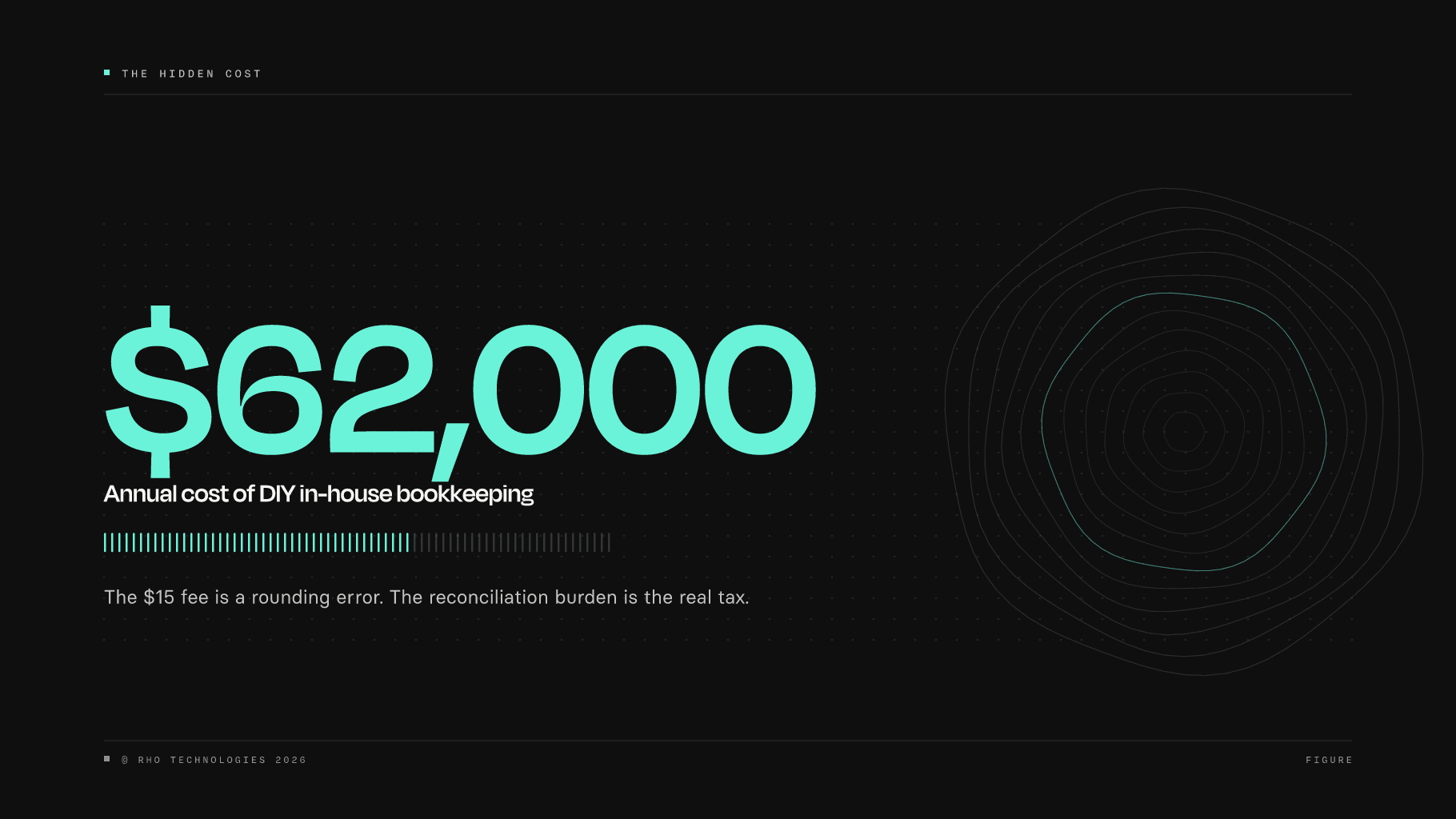
$62,000 Annual cost of DIY in-house bookkeeping
The $15 fee is a rounding error. The reconciliation burden is the real tax.
Most NC business banking guides were written for a sole proprietor opening a first checking account, not for an incorporated startup that needs spend controls, instant cards, and accounting integrations on day one.
The lowest monthly fee is rarely the highest cost: the real expense is the hours your finance team burns stitching together four separate tools to cover what one platform should handle natively.
Mixing personal and business finances in North Carolina isn't just messy bookkeeping, it pierces the liability shield your LLC or C-Corp was formed to provide.
The account type you open at incorporation is a stage-of-growth decision, not a permanent one; the wrong structure quietly creates tax exposure and operational drag most founders never trace back to the bank.
Legacy banks with the most Charlotte branches were built for Main Street cash flow, their card issuance timelines, credit pull requirements, and branch-dependent workflows are product decisions, not industry rules.
Rho closes the gap: it's an all-in-one business banking platform built for incorporated companies, banking, corporate cards, bill pay, expenses, treasury, and accounting in one place, with no subscription fees and human support that scales from pre-revenue to IPO. Up to 2% Cashback with Rho Platinum (terms apply), on up to $1M in eligible annual card spend; 1.25% standard.
Top 15 NC Business Banks Compared at a Glance
When the fee comparison tables line up those fifteen contenders, they default to the same three columns: monthly fee, minimum balance, and maybe a note about free transactions.
What they never show is the cost of stitching together four separate tools to cover what one platform should handle natively. That invisible cost is where the real decision lives.
Growing companies can't afford to add operational or financial overhead every time headcount climbs. The goal is to fund payroll, wire vendors, and manage capital without relying on banks that don't understand your business or timeline, and to improve cash visibility by centralizing banking and spend data in one place. That's the lens applied here.
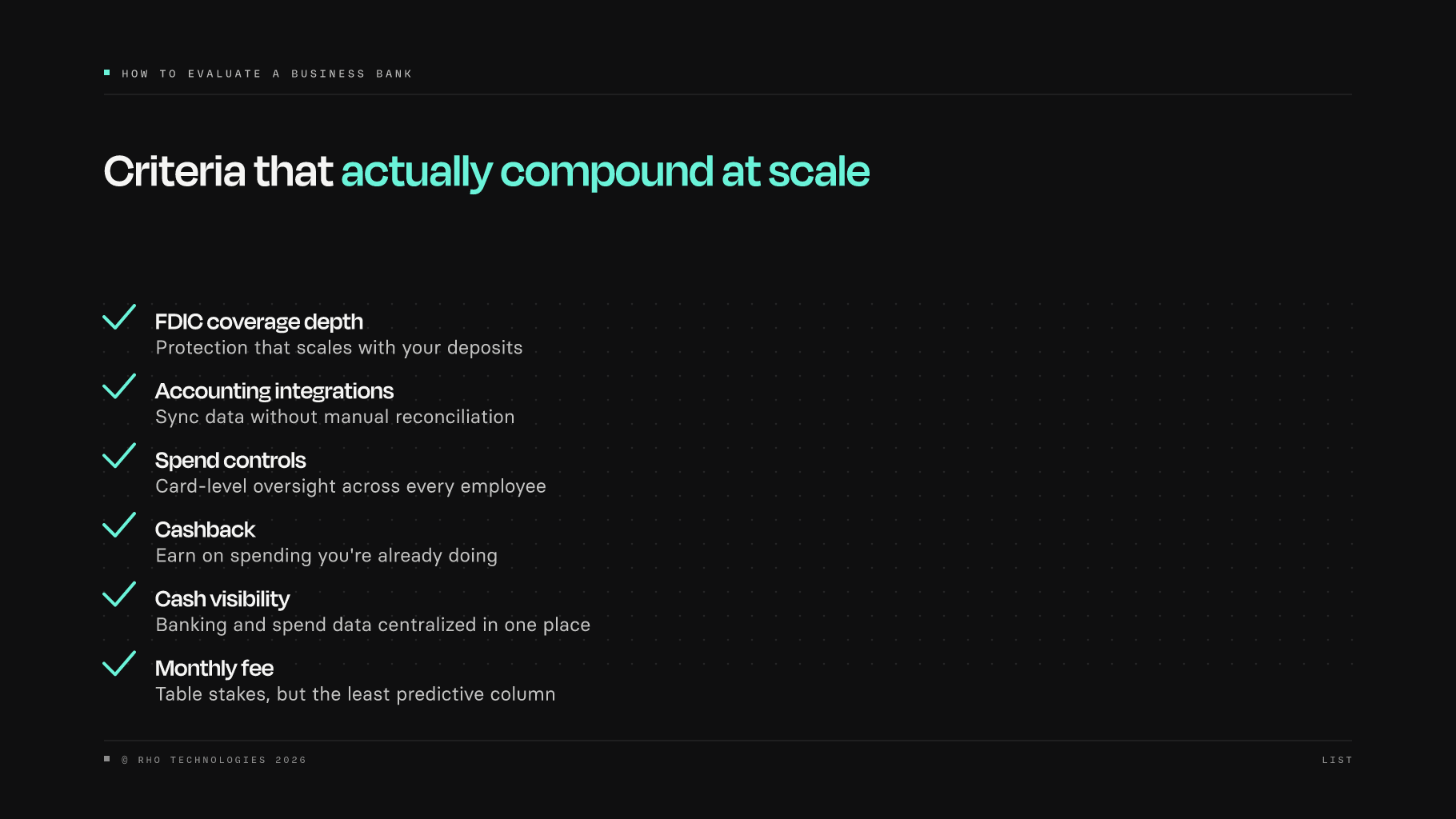
The 15 institutions below are scored on the criteria that actually compound at scale: FDIC coverage depth, accounting integrations, spend controls, and cashback, alongside the standard fee data.
Monthly fee is included because readers expect it. Treat it as the least predictive column in the table.
Spend controls, for instance, matter most once multiple employees are incurring business expenses simultaneously. That's precisely when centralized card-level oversight pays for itself, and why corporate card architecture is weighted heavily in the scoring.
Fintech platforms are increasingly closing the gap between banking infrastructure and the operational tools businesses actually need day-to-day.
The Comparison Table
$75M Rho's max FDIC coverage via sweep network
The 15 Best Banks for Small Business in NC in 2026 - Reviewed
There is a question that almost never appears in NC banking listicles, but it is the one that will cost you the most if you ignore it: not “what does this account cost to open?” but “what does this bank cost me when my business actually starts working?”
The answer depends entirely on your business structure, transaction volume, and how much of your finance team's time you are willing to spend on reconciliation.
For NC LLCs and S-corps, there is also a legal dimension most fee comparisons skip entirely. Commingling funds by defaulting to a personal account or a poorly structured business account is one of the primary grounds courts use to pierce the corporate veil.
That means a founder who “sorts out banking later” after incorporation is not just operationally exposed. They're personally liable for business debts until they fix it.
That is not a banking problem. That is a liability problem wearing a banking problem's clothes.
The 15 options below are evaluated through one lens: scale-readiness. Not just “can you open it today?” but “will it still work when your headcount triples and your AP volume quadruples?”
1. Rho - Best All-in-One Banking Platform for NC Startups & Scale-Ups
Most NC founders patch together a legacy checking account, a separate card program, and a spreadsheet for expenses because they assume that is just how business banking works.
The hidden cost shows up later.
10-plus hours a week lost to manual reconciliation, receipts that vanish before month-end, and books that only close after a fight between the finance team and the accounting software.
Rho eliminates that patchwork entirely, combining banking, corporate cards, bill pay, expense management, treasury, and accounting integrations (QuickBooks Online, NetSuite, and Sage Intacct) in one place at a $0 platform fee, with no personal credit pull and cards issued immediately.
A Durham-based C-Corp that closes a seed round can open an account via Stripe Atlas before the EIN arrives. Once deposits reach the $50,000 Treasury minimum, they begin earning yield, building a clean financial foundation to hand to their first finance hire without rebuilding the stack.
The one honest trade-off: Rho is purpose-built for incorporated businesses, not sole proprietors who need a simple personal-adjacent account and a local branch to deposit cash.
2. First Bank NC - Best Community Bank for Established NC Small Businesses
Founded in Troy, NC, First Bank has grown to more than 80 statewide locations, making it one of the most accessible community banks for established NC small businesses that value in-person relationships alongside digital tools.
It is the right pick for an owner-operated business with steady, predictable revenue that wants a banker who knows the local market and can structure a loan accordingly.
The trade-off is clear: First Bank's product depth and integration ecosystem do not match what a scaling startup needs, and businesses processing high AP volume will outgrow its reconciliation tools faster than they expect.
3. Relay - Best for Small Business Owners Who Want Multi-Account Cash Flow Control
Relay's core design choice is letting owners open up to 20 individual checking accounts and 50 virtual cards from one dashboard, figures sourced from Relay's published product specifications. That makes it genuinely useful for businesses that run the envelope-budgeting method at scale: one account for payroll funding, one for taxes, one for operating expenses.
For a small business owner who has been burned by overdrafts or surprise tax bills because everything lived in one account, that structure is a real operational fix.
The limitation worth naming: Relay does not offer treasury yield, AP automation at depth, or the accounting integrations that a finance team running 200-plus invoices a month will need.
4. Bluevine - Best for NC Small Businesses Needing a High-Yield Checking Account
For NC small businesses whose primary frustration is watching idle cash earn nothing in a traditional checking account, Bluevine offers a high-yield business checking account with no monthly fee and a competitive APY on qualifying balances (current rates available at bluevine.com, as rates adjust with the Fed).
It is a strong fit for service businesses, freelancers, and small retailers who want their operating cash working harder without moving to a full treasury product.
The practical ceiling: Bluevine's expense management and bill pay capabilities are lighter than what a company with a dedicated finance team or complex AP workflows will need. It tends to be a first-account solution rather than a scaling one.
Update (October 2026): Valley National Bank announced it will acquire Bluevine for $340 million, with the deal expected to close in early 2027. Bluevine will become Valley's small-business banking division; existing accounts aren't expected to change before then.
5. Bank of America - Best for NC Small Businesses Wanting National Scale with Local Presence
Bank of America is a major SBA lender with a significant Charlotte presence, and its Business Advantage suite gives established small businesses access to a wide product set: merchant services, business credit lines, payroll integrations, and a branch network that covers most of NC's population centers.
BofA delivers if your business moves cash frequently, needs in-branch deposits, and wants a single institution relationship for both banking and lending.
The friction points that surface at growth stage are real: wire delays, fee structures that stack up at higher transaction volumes, and a support model built for volume rather than dedicated attention.
6. Wells Fargo - Best for NC Small Businesses Needing Strong SBA Loan Access
Wells Fargo is among the most active SBA lenders in the Charlotte market and across NC, which makes it a legitimate option for a small business owner whose primary near-term need is SBA 7(a) or 504 financing rather than a modern banking platform.
The branch network and lending relationships are genuine assets for businesses in growth corridors like Charlotte, Raleigh, and Greensboro.
The honest limitation: Wells Fargo's fee structure and support model are designed for high transaction volume at scale, and smaller or earlier-stage businesses may find the day-to-day banking experience less tailored to their needs than a dedicated small-business platform.
It earns its place on this list for SBA access. It does not earn it for day-to-day operational banking at scale.
7. Live Oak Bank - Best for NC Businesses in Specialized Industries Seeking SBA Loans
Live Oak Bank, headquartered in Wilmington, NC, was named the most active SBA 7(a) lender by dollar amount in the U.S. for the SBA's 2025 fiscal year, according to the U.S. Small Business Administration (October 2025).
It also holds SBA Preferred Lender status, meaning it can approve SBA loans in-house without waiting for SBA review. That's a process the SBA indicates can compress a standard multi-week approval timeline down to approximately one week for qualified borrowers.
Live Oak specializes in industry-specific lending (veterinary practices, dental offices, funeral homes, breweries, and others), so it is the right call when SBA financing is the primary objective and the business fits one of its target verticals. It is not a full-service operational banking platform, and businesses that need automated AP or corporate card programs will need to supplement it.
8. Truist - Best for NC Small Businesses Wanting a Regional Bank with Broad Product Depth
Truist operates the largest physical branch network in North Carolina, which makes it the default answer for businesses that handle significant cash volume, need in-person support frequently, or operate in markets where digital-only banking creates friction with vendors or landlords.
Its product breadth spans business checking, merchant services, lines of credit, and treasury management.
The scale-readiness caveat: Truist's operational banking tools and integrations are built for the middle market and up. Small businesses in the $500K-to-$2M revenue range often find the fee structures and manual processes more burdensome than the branch access is worth.
9. Carter Bank & Trust - Best for NC Small Businesses in Rural or Underserved Markets
Carter Bank & Trust serves communities across Virginia and North Carolina with a focus on relationship-based lending, including commercial construction loans and business lines of credit.
It's an excellent choice for NC small businesses in smaller markets, particularly contractors and real estate developers, who want a community lender that understands local economic conditions.
The catch: a smaller branch footprint compared to regional giants, and more limited digital banking capabilities.
10. Atlantic Union Bank - Best for Minority- and Women-Owned NC Businesses
Atlantic Union Bank has expanded its NC footprint with a stated commitment to serving minority- and women-owned businesses, including access to SBA lending programs and community development resources that larger institutions often route through slower internal channels.
For an MWBE-certified business that wants a banking relationship where that certification actually opens doors rather than just checking a box, Atlantic Union is worth evaluating.
Its digital tools are functional but not best-in-class, and businesses with complex AP workflows will find the platform limiting at higher transaction volumes.
11. Carolina Small Business Development Fund - Best for NC Startups Needing CDFI Financing
The Carolina Small Business Development Fund is a Community Development Financial Institution (CDFI), not a bank, which means it operates outside the standard fee-and-branch comparison entirely.
Its purpose is capital access for businesses that traditional lenders decline: early-stage startups, businesses in low-income markets, and founders without conventional credit profiles.
If a business has been turned down for an SBA loan or a traditional line of credit, and the underlying business is sound, the CSBD Fund is the right next call.
It is not a checking account provider. It is a financing resource that pairs well with a separate operational banking platform.
12. Chase Business Banking - Best for NC Small Businesses Wanting Premium Card Rewards
For NC small businesses whose owners spend heavily on travel, advertising, or vendor categories that map cleanly to Chase's Ink card reward structure, Chase Business Banking offers a card rewards program that is genuinely competitive.
The branch network in NC's major metros is solid, and the Ink cards integrate with Chase's broader ecosystem.
The operational banking side is worth evaluating carefully: Chase's business checking fees and wire costs are structured differently from its consumer products, and founders whose primary need is operational efficiency rather than card rewards may find a dedicated business platform a better fit at growth stage.
13. PNC Bank - Best for NC Small Businesses Needing Cash Flow Forecasting Tools
PNC's Cash Flow Insight tool is a real differentiator for small business owners who want forward-looking visibility into their cash position without building a spreadsheet model from scratch.
The sweet spot is an owner-operated business in the $1M-to-$5M revenue range: not yet ready for a full CFO, but past needing just a basic checking account dashboard. PNC's forecasting layer adds genuine value there.
The limitation at scale: PNC's AP automation and accounting integrations are not built for a finance team running high invoice volume, and the fee structure becomes harder to justify as transaction complexity grows.
14. Grasshopper Bank - Best for NC Tech Startups Wanting a Digital-Native Business Bank
Grasshopper Bank is a digital-first institution built specifically for startups and small businesses, with no monthly fees, API access for tech-forward teams, and a product philosophy closer to fintech than traditional banking, per the bank's published product documentation.
An NC tech startup that wants a straightforward online bank account with decent interest rates and no branch overhead will find Grasshopper a credible option.
The honest gap: it does not offer the integrated corporate card program, AP automation, or expense management depth that a startup post-seed will need. It tends to work best as a primary checking account paired with other point solutions rather than as a single financial platform.
15. Uwharrie Corp / Uwharrie Bank - Best for NC Piedmont Region Small Businesses
Uwharrie Bank is a community bank with deep roots in the NC Piedmont region, serving Albemarle, Asheboro, and surrounding markets with a relationship-banking model that prioritizes local decision-making and personal banker access.
An established small business in the Piedmont that values a banker who attends the same chamber events, and who can approve a line of credit without routing it through a distant regional office, gets something from Uwharrie the national banks cannot replicate.
Realistically, that comes with limited geographic reach, modest digital infrastructure, and a product set that suits a stable, locally-rooted business rather than one scaling toward multi-state operations.
Each of these 15 institutions fits a different business profile. Not all business bank accounts are created equal, and the wrong account type can limit your access to credit, complicate your taxes, and quietly cap your growth.
Business Bank Account Types Explained: and Which NC Businesses Actually Need Each
The account type you open at incorporation is not a permanent decision. It is a stage-of-growth decision, and treating it as anything else is one of the quietest ways a North Carolina business bleeds time, tax exposure, and liability protection it never knew it had.
“Small business owners with LLCs are unsure which types of business bank accounts they actually need (checking, savings, credit card), suggesting a lack of clear guidance on account types and their purposes.”
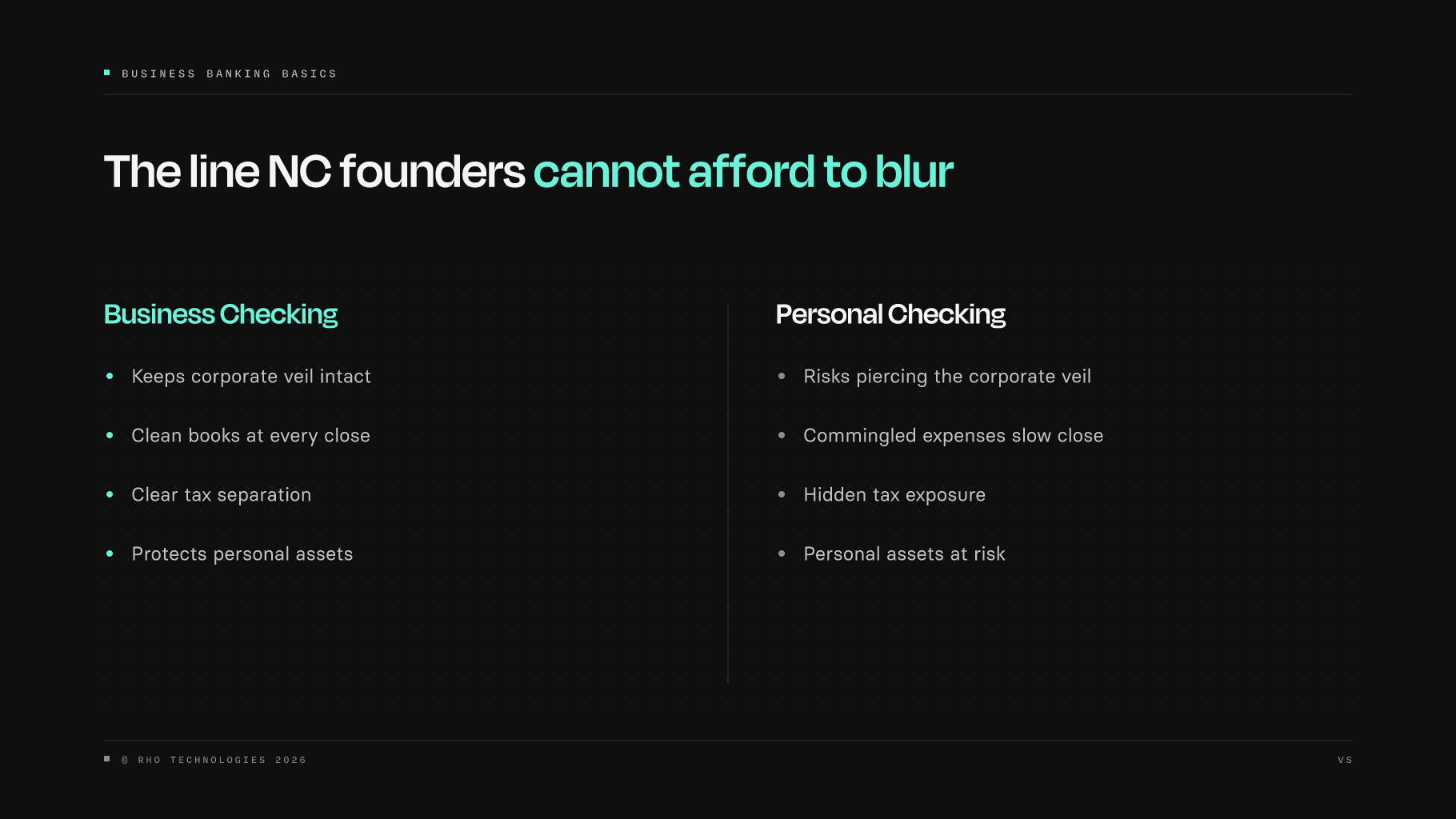
Business Checking vs. Personal Checking
The legal and operational line NC founders cannot afford to blur is one of the most common points of confusion among new business owners, whether opening a gym, launching a service LLC, or spinning up a first SaaS.
That confusion is understandable, but it carries real cost when it leads founders to delay separation or default to a personal account “just to get started.”
The operational case for separation is straightforward: as Jasmin Group LLC noted in December 2024, commingled accounts force accountants to untangle overlapping personal and business expenses before any real analysis can begin, adding cost and delay at every close cycle.
The legal case is sharper. Mixing funds can pierce the corporate veil for an LLC or corporation, exposing personal assets to business creditors regardless of how carefully the entity was structured.
The tax exposure is just as real. Commingled accounts raise IRS audit flags because they make it genuinely difficult to distinguish legitimate business deductions from personal spending. A dedicated business checking account NC founders open at formation is not a formality. It is the first line of legal and financial defense.
Critically, the banking infrastructure a founder chooses compounds these risks in a direction most founders never anticipate. A bank without API-native accounting integrations degrades the real-time reliability of burn-rate and runway calculations at the exact moments they matter most.
When transactions don't sync automatically to QuickBooks, NetSuite, Sage Intacct, or Xero, founders are operating on financial data that is days or weeks stale. That makes those calculations unreliable at the moments, fundraising, hiring, first commercial lease, when accurate financial visibility is most consequential.
For accounting teams and controllers who need a fast, scalable banking setup without legacy bank overhead, platform choice becomes a structural advantage rather than a vendor preference.
Rho's native direct integrations with QuickBooks Online, Oracle NetSuite, and Sage Intacct, plus Xero via bank feed, sync transactions, receipts, and expense data automatically. The close cycle starts from clean data rather than a reconciliation backlog.
The entire platform, including those integrations, AP automation, bill pay, and expense management, carries a $0 platform fee with no per-user charges. A two-person founding team and a fifty-person finance org access the same infrastructure at the same cost.
The Four Core Business Account Types, Plain-Language Definitions
Small business owners with LLCs frequently ask whether they need a checking account, a savings account, a credit card, or some combination, and the answer depends on the stage and shape of the business, not a one-size rule. Here is how each layer works in practice.
Business checking handles daily operations: payroll funding, vendor payments, card transactions.
On Rho, the checking account is provided by Webster Bank, a division of Santander Bank, N.A. (member FDIC), carries no minimum balance requirement, and includes same-day ACH for payments initiated before 2 p.m. ET on amounts under $1M, and domestic wires at $0, settled the same business day if initiated before 4:45 p.m.
Business savings earns modest interest on reserves you do not need immediately. On Rho, the savings account is provided by American Deposit Management Co. and its partner banks, with FDIC coverage up to $75M through a sweep network of approximately 400 partner banks, a meaningful difference from the standard $250K ceiling on a single checking account.
Money market accounts sit between the two, offering modest yield on reserves while preserving faster access than a traditional savings product, useful for businesses that want a light buffer between their operating checking account and a longer-duration treasury position.
For businesses that have grown past that buffer and want to put idle cash to work more deliberately, Rho Treasury is a separate, fee-bearing RIA product accessible from the same Rho platform. Treasury Bills and mutual fund options require a $50,000 minimum investment.
Rho Treasury carries a management fee of 15–60 basis points annually based on cost to provide the service (see the ADV-2A Wrap Fee Brochure), T-Bills settle in 2–3 business days, and it is not FDIC insured, investments are not deposits.
The key structural point for NC founders comparing options: Rho Treasury has no $250K minimum balance requirement, unlike some competing treasury products that set that threshold as a floor for access.
How to Choose a Business Bank Account in NC - The Framework Fast-Scaling Founders Actually Use
Most founders discover their spend controls are inadequate at the worst possible moment: a duplicate charge clears, a contractor overspends a budget line, or a card issued to a new hire takes two weeks to arrive.
Step 4 of the decision filter asks you to pressure-test both dimensions before you commit to an institution: how granular are the controls, and how fast can cards actually reach the people who need them.
The ability to issue a corporate card in minutes matters most right after a funding close or a new hire's first week. Online and all-in-one platforms can typically approve and open a business account within 24 to 48 hours, while traditional banks can take several days. That gap compounds quickly for founders who are trying to get back to building rather than chasing card-activation timelines.
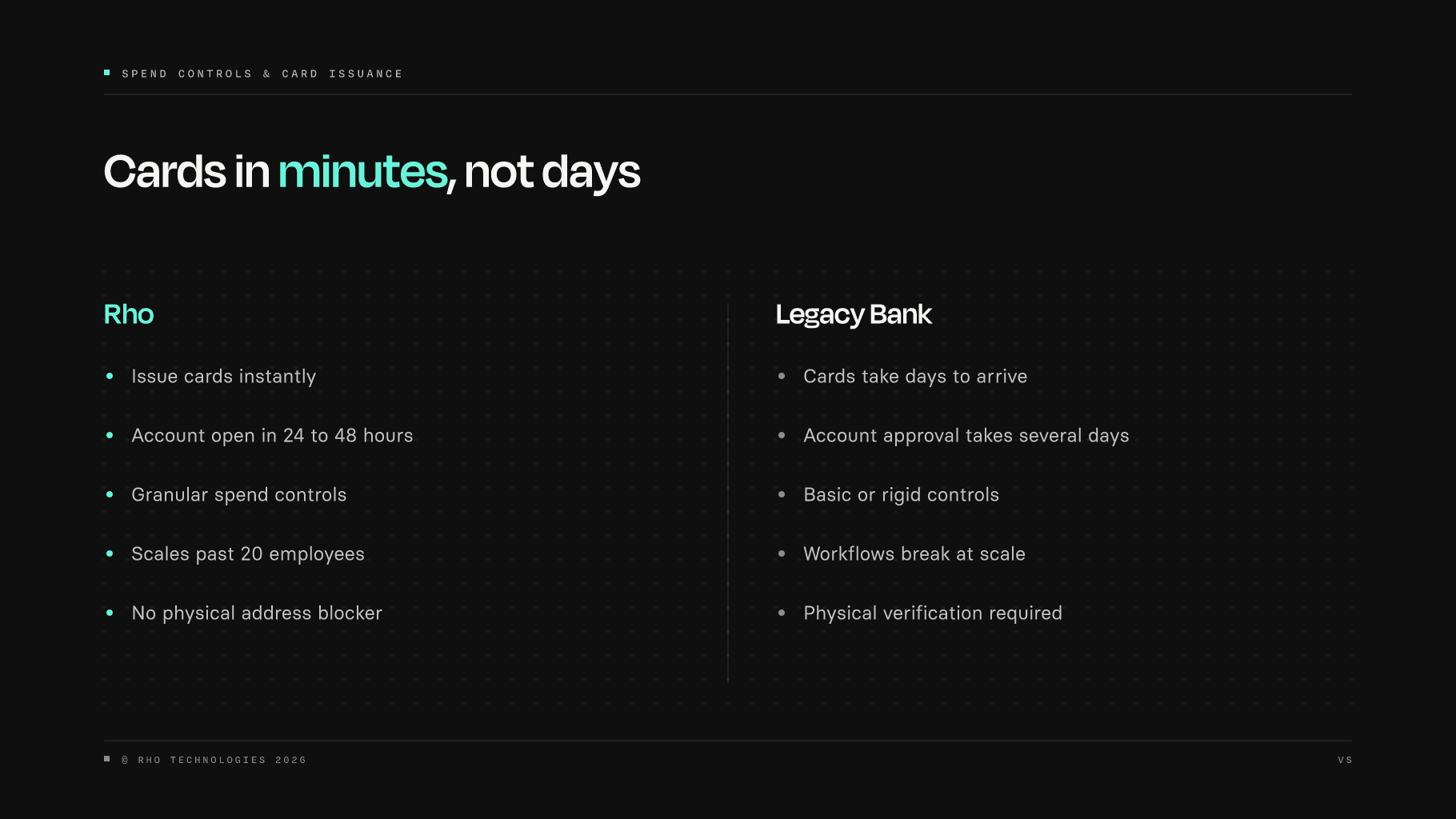
A related friction point: founders operating remotely or across multiple states often run into physical address verification requirements at legacy institutions. That's a hard blocker that has nothing to do with creditworthiness and everything to do with how those banks were architected.
Founders who scale past roughly 20 employees and multiple vendors find that the workflows those same institutions offer simply stop keeping up. Fees accumulate and basic processes break down.
These are predictable failure modes of legacy banking infrastructure applied to fast-moving companies.
This is precisely where a platform like Rho is most beneficial: when a company needs a fast, scalable banking setup without legacy bank overhead. Every customer, regardless of company size or headcount, gets the same unified platform at $0 platform, subscription, and per-user fee.
That means card-level spend controls, real-time visibility, and unlimited expense reimbursements are available from day one. Treasury Bills and mutual fund options are available; T-Bills settle in 2–3 business days. Treasury access requires a $50,000 minimum investment.
A management fee of 15–60bps annually applies (see the ADV-2A Wrap Fee Brochure). Rho Treasury investments are not deposits and are not FDIC insured.
Notably, Rho Treasury carries no $250K minimum balance requirement. Mercury Treasury, by contrast, requires $250,000 across all accounts for access. Competitive data collected from Mercury's website as of 08/30/2026, and may change.
Checking accounts are provided by Webster Bank, a division of Santander Bank, N.A., member FDIC, with up to $250K in standard FDIC coverage. Savings accounts, provided by American Deposit Management Co. and its partner banks through a sweep network of approximately 400 partner banks, extend FDIC coverage up to $75M.
Rho also supports pre-EIN onboarding, so founders can open an account and begin using Rho before their EIN arrives, a meaningful advantage when time between incorporation and first vendor payment is measured in days, not weeks.
The synthesis for this step of the decision filter: spend controls and card issuance speed are table stakes. The variable that actually separates a good early choice from one you outgrow is the institution's ability to scale with your operational complexity, without adding fees, tiers, or manual workarounds.
Founders who get fast banking setup, real yield on idle funds, and clear visibility into spending from day one are better positioned at every subsequent stage of growth.
Treat Institution Type as a Lending Variable, Not Just a Brand Preference
The clearest illustration of this principle sits in Wilmington: Live Oak Bank holds SBA Preferred Lender status and ranked #1 nationally in SBA 7(a) dollar volume for the SBA's 2025 fiscal year. That gives it delegated authority to approve SBA loans entirely in-house, compressing a decision that typically takes weeks through standard SBA channels down to roughly one week.
A branch-count leader without that delegated authority routes the identical application through the SBA's external queue, adding weeks to a timeline that may already feel urgent.
Live Oak operates with no local branches, a fact that would disqualify it under a naive branch-count filter. Yet it outperforms nearly every branch-heavy competitor on the dimension that matters most to a capital-seeking founder.
The synthesis here is not simply that Live Oak is a strong SBA lender. It's that optimizing for the wrong variable at account-opening can foreclose faster capital access later, exactly when the cost of that mistake is highest. Live Oak's delegated SBA authority illustrates it concretely: standard multi-week timelines compressed to roughly one week for qualified borrowers.
Before you open a business account, ask explicitly whether the institution holds SBA Preferred Lender status, what its average SBA 7(a) approval timeline looks like, and whether it has a dedicated small business lending team in your market.
Those three questions will surface more decision-relevant information than comparing monthly maintenance fees across five institutions.
Institution type is a lending infrastructure choice disguised as a banking preference, and NC founders who recognize that distinction early are better positioned when a growth opportunity or cash-flow gap demands a fast answer.
NC Business Bank Decision Filter, Quick Checklist
Before committing to any institution, run these five checks:
Any institution that fails checks 2, 3, or 4 will create reconciliation drag at scale regardless of its monthly fee.
Next steps
If your banking setup is quietly taxing your Fridays with manual reconciliation, the path forward starts with treating platform architecture as the selection criterion, not monthly fee.
A $0-to-$15 monthly fee is a rounding error next to that $62,000-plus bookkeeping drag, the one that shows up when transactions never sync and receipts pile up waiting for a human to file them. Start with our business bank for startups.
Choosing a bank without API-native accounting integrations means your burn-rate calculations are running on data that is days or weeks stale. Every runway conversation at a fundraise or lease negotiation gets less reliable than it should be.
The specific growth triggers most NC founders underestimate, first hire, first payroll run, first commercial lease, are exactly the moments when a mismatched banking stack hits its limit. Switching banks mid-stride means re-doing ACH authorizations, payroll routing, and accounting connections simultaneously.
Together, those two realities point to one action: choose a platform that handles the full finance stack before you hit those triggers, not after.
Start with a business bank for startups at Rho. The account opens without a personal credit pull, corporate cards are issued immediately, and native integrations with QuickBooks Online, NetSuite, Sage Intacct, and Xero sync automatically, so your first close cycle starts from clean data rather than a reconciliation backlog.
FAQs
Rho is purpose-built for incorporated businesses, LLCs, S-corps, and C-corps, and lets a Durham-based C-corp open an account via Stripe Atlas before the EIN even arrives. It combines banking, corporate cards, bill pay, expense management, and accounting integrations (QuickBooks Online, NetSuite, and Sage Intacct) at a $0 platform fee, with no personal credit pull and cards issued immediately, making it the strongest fit for an NC founder who needs a clean financial foundation from day one.
Yes, Rho charges $0 with no platform, subscription, or per-user fee, and requires no minimum balance for corporate cards. The post's core argument is that the monthly fee is the least predictive number in any comparison: the real cost is the reconciliation burden that comes from stitching together separate tools, which Rho eliminates by handling banking, spend, and accounting integrations natively in one place.
Rho allows an incorporated business to open an account online, including via Stripe Atlas before an EIN arrives, with no minimum balance required to access corporate cards. Treasury yield access through Rho Treasury does require a $50,000 minimum investment, but the core checking and card product carries no deposit requirement to open.
The post highlights three strong SBA options depending on your situation: Live Oak Bank (headquartered in Wilmington, NC) was named the most active SBA 7(a) lender by dollar amount in the U.S. for the SBA's 2025 fiscal year and holds Preferred Lender status, which can compress approval timelines to approximately one week for qualified borrowers; Wells Fargo is among the most active SBA lenders in the Charlotte market; and Bank of America is a major SBA lender with a significant Charlotte presence. The post notes that SBA lending access and day-to-day operational banking are different needs, businesses that also need automated AP, corporate cards, and accounting integrations will want a separate operational platform alongside any SBA lender.
Because the real cost of a mismatched bank isn't the fee, it's the operational drag from manual reconciliation, redundant data entry, and stitching together separate tools. The post cites Slaton Financial Services data showing DIY in-house bookkeeping costs small businesses more than $62,000 per year, compared to $6,000–$10,800 for outsourced professional bookkeeping, and attributes that gap to cumulative inefficiencies, not the monthly bank fee.