
Most free business checking accounts pass the monthly fee test and fail the four that matter. Here is how to find the ones that charge nothing on wires, ACH, and balances either.
The headline number is doing a lot of work. The common assumption among most YC and accelerator founders is: "If the monthly fee is $0, the account is free, the rest is fine print that probably won't affect me." A founder searching for a free business checking account scans the monthly fee, sees $0, and moves on, confident the cost question is settled.
It rarely is. The monthly fee is often the smallest line in the entire fee schedule. Wire charges, cash-deposit surcharges, transaction caps, and minimum-balance triggers sit further down the page, disclosed but easy to miss, and collectively they can cost a founder hundreds of dollars a year on an account they genuinely believe is free.
A $0 monthly fee does not make a business checking account free. Wire fees, ACH charges, and minimum balance requirements are where the real cost accumulates.
Most 'free' accounts gate their most useful features (same-day ACH, unlimited transactions, integrations) behind paid tiers that kick in exactly when a startup starts scaling.
Five fee dimensions determine what you actually pay: monthly fee, wire fees, ACH costs, minimum balance requirements, and feature access. Most accounts only look clean on the first one.
The account you open on day one becomes load-bearing infrastructure. Payroll, bill pay, corporate cards, and accounting software all route through it, making a mid-growth migration expensive in ways that never show up on a fee schedule.
Matching your account to your primary constraint (high wire volume, daily reconciliation, pre-revenue cash management) matters more than chasing the longest list of $0 line items.
Pre-EIN founders are not locked out of quality banking; some accounts support onboarding before an EIN is issued, which eliminates the common delay between incorporation and operational banking.
Rho's Checking account closes the loop: $0 ACH and domestic wires, pre-EIN onboarding, Virtual Account Numbers for receiving payments without exposing primary account details, and native connections to Cards, Treasury, Bill Pay, and Accounting, so the account you open on day one is the one that still fits after you raise.
Platforms built for modern startups, like Rho's banking for founders, are designed around this exact gap. See our business bank for startups for how this works in practice.
Rho is a fintech company, not a bank or an FDIC-insured depository institution. Checking account and card services provided by Webster Bank, a division of Santander Bank, N.A., Member FDIC, and by Lead Bank, Member FDIC; savings account services provided by American Deposit Management Co. and its partner banks.
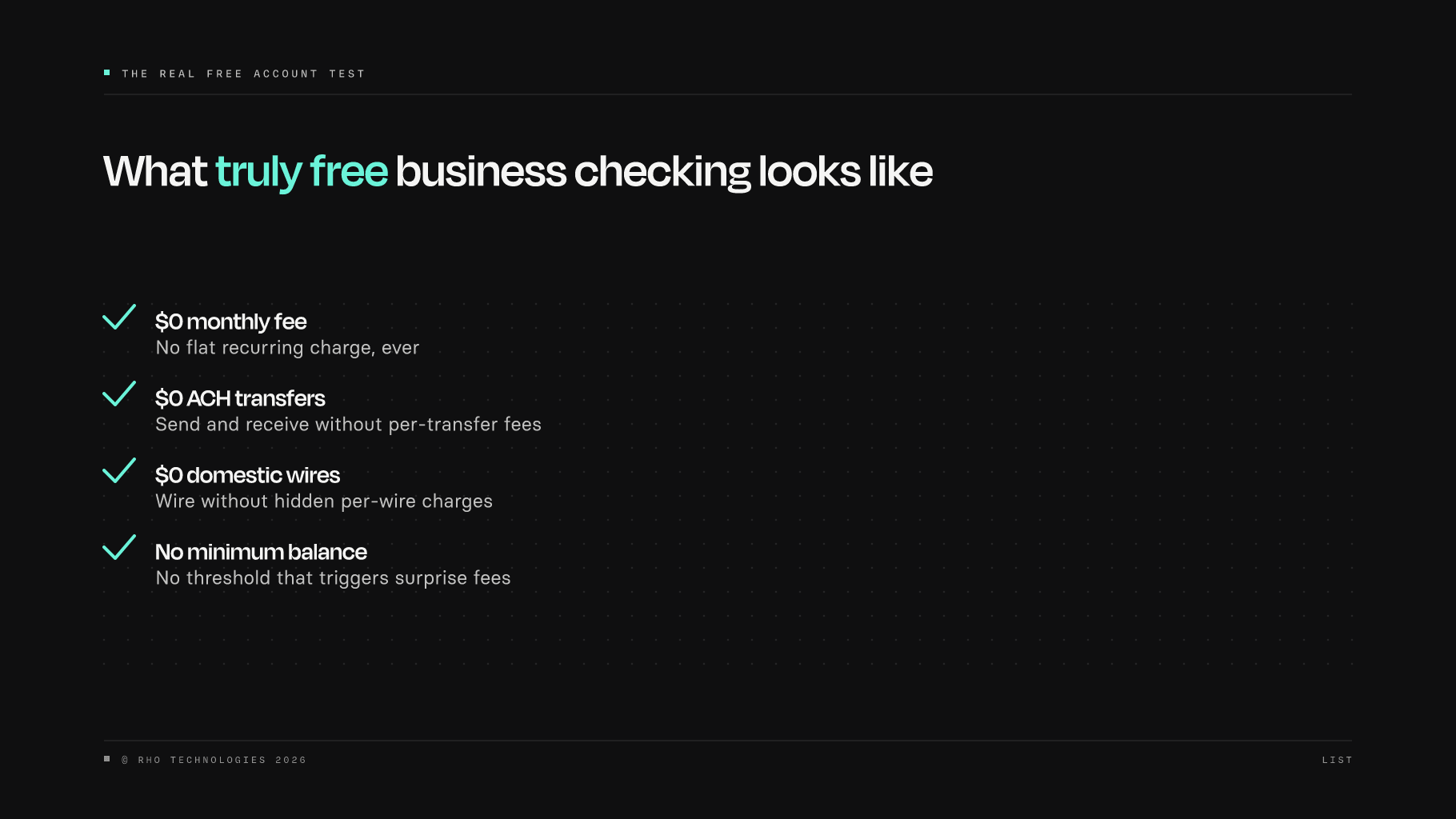
A $0 monthly fee tells you one thing: you will not be billed a flat recurring charge. It says nothing about what happens when you send a wire, deposit cash, or dip below a balance threshold.
Here's the gap that opens up next: many accounts marketed as free still charge fees elsewhere, including wire transfers, cash deposits, and exceeding transaction limits. The headline number rarely reflects the true cost of the account.
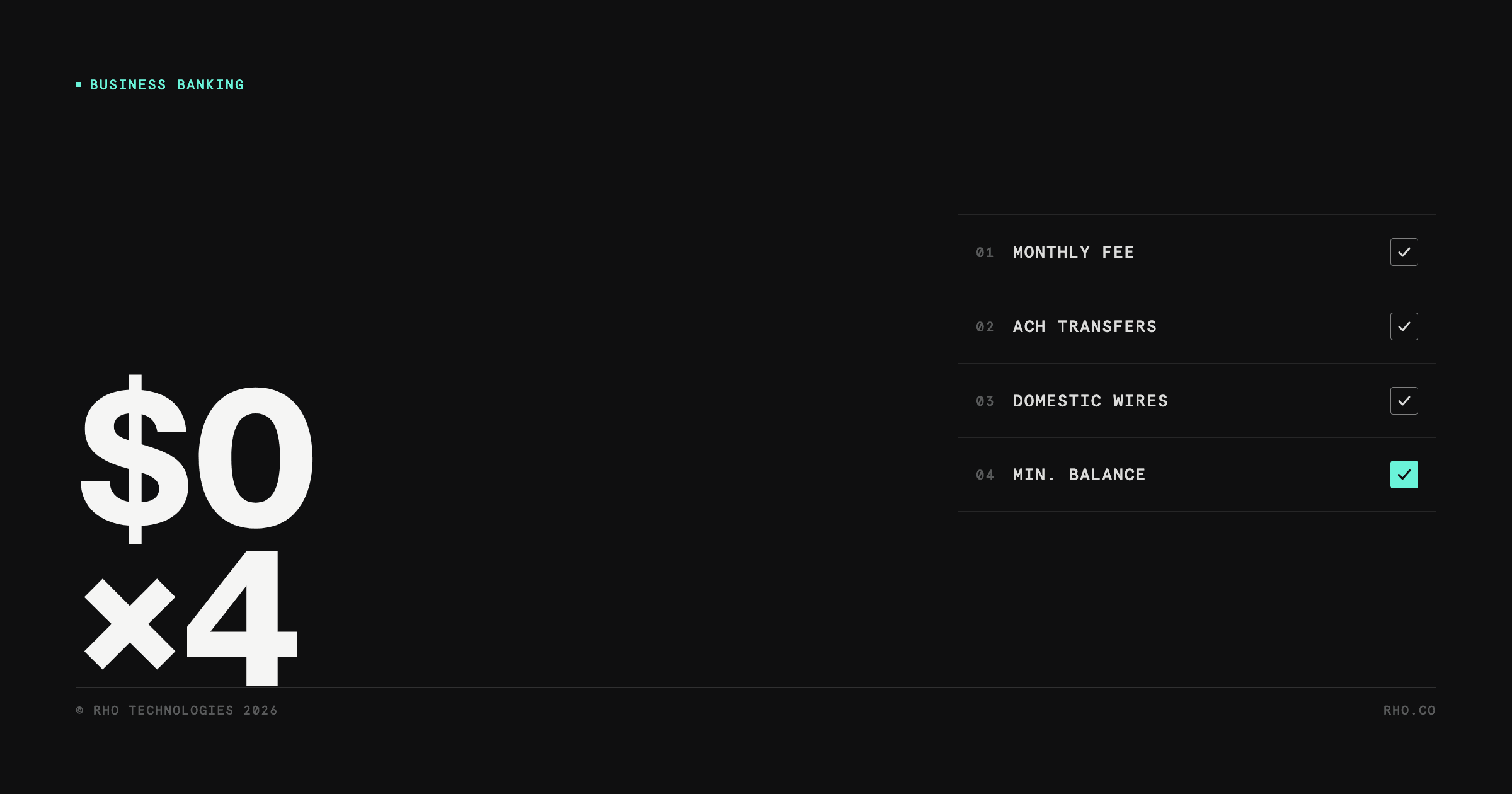
Truly free means passing four tests simultaneously: $0 monthly fee, $0 ACH transfers, $0 domestic wires, and no minimum balance requirement. Most accounts pass one or two. Very few pass all four.
Minimum balances are where traditional banks quietly claw back their margin. Wells Fargo and similar institutions advertise a $0 monthly fee, but only if you hold a qualifying average balance. Miss it once, during a slow month, and the fee applies retroactively.
For an early-stage company watching runway closely, that is a conditional account wearing an unconditional label.
The Hidden Fees Inside 'Free' Business Checking - What to Watch Before You Sign Up
The common assumption among early-stage founders is that if the monthly fee is $0, the account is free, and that the rest is fine print that probably won't affect them. The problem is that the monthly fee is almost never where the money actually leaves.
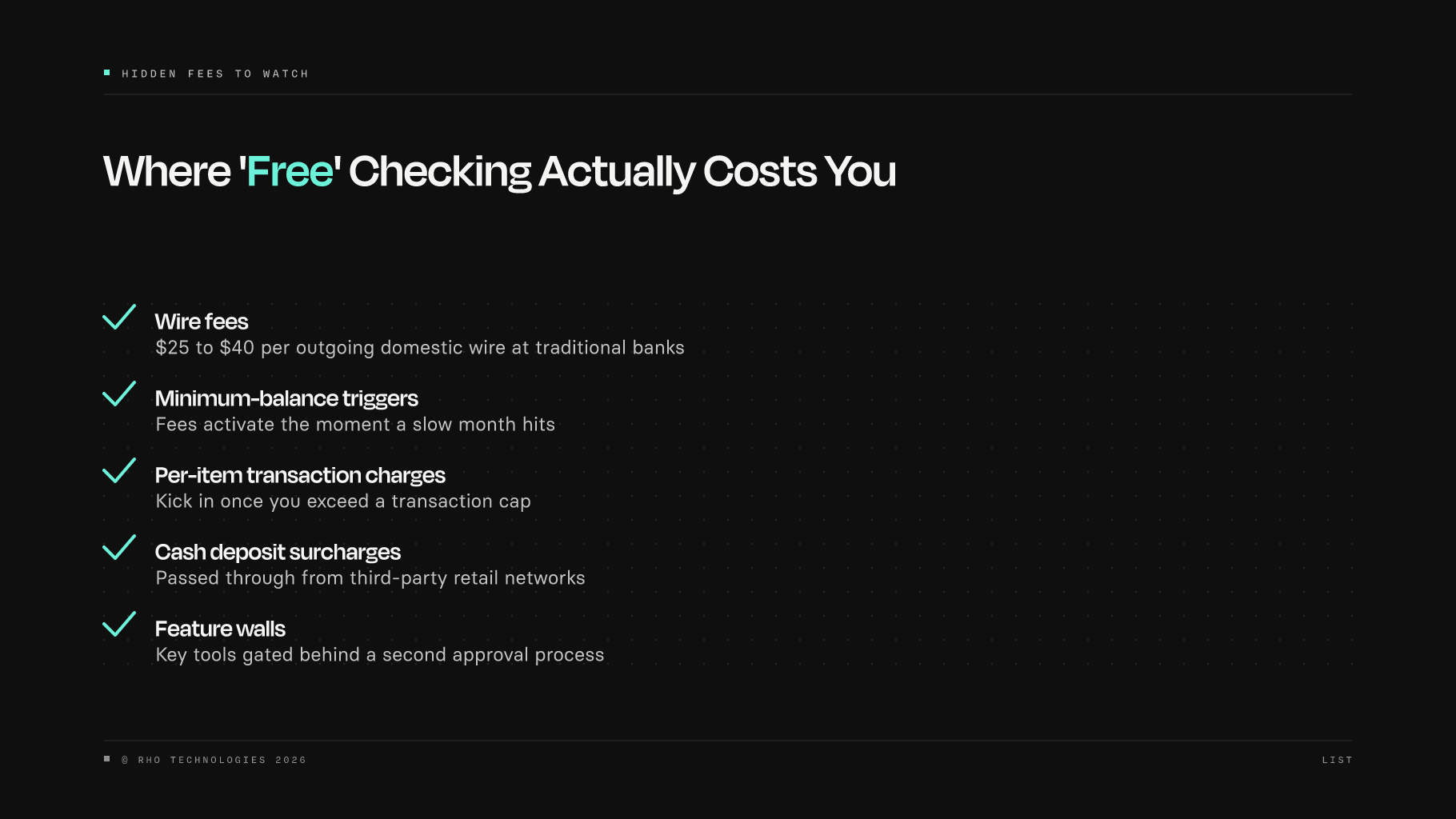
The real cost lives in the transaction-level fine print. Wire fees compound every time you pay a contractor. Minimum-balance triggers activate the moment a slow month hits. Per-item charges kick in once you exceed a transaction cap, and cash deposit surcharges get passed through from third-party retail networks.
Here's the part nobody mentions at sign-up:
Some accounts also gate the tools you actually need behind a second approval process you only discover after you've opened the account. Together, these charges can cost far more than a transparent monthly fee ever would, and they hit hardest exactly when a startup is moving fastest.
Wire Fees - The $15 to $30 Line Item That Compounds
Outgoing domestic wire fees catch nearly every founder off guard after they open a "free" account. Traditional banks typically charge $25 to $40 per outgoing domestic wire; online banks run $5 to $10.
Pay four contractors in a month, close a vendor agreement, and fund an escrow account, and the wire fees alone can outpace what most paid accounts charge in monthly maintenance. Twelve wires in a quarter adds up to $300 in friction that never showed up in the account's marketing.
Minimum-Balance Triggers - How One Slow Month Costs You
Many accounts advertise a $0 monthly fee but bury a condition: the fee is waived only when you hold a minimum average daily balance. That condition punishes exactly the companies least equipped to absorb it, since early-stage revenue rarely arrives on a predictable schedule.
A single delayed payment or large disbursement can push the balance below the threshold for a few days. The fee posts automatically, and founders often don't notice the charge until they're reconciling statements weeks later.
Transaction caps add another layer of surcharges: brick-and-mortar banks like U.S. Bank and Citizens often cap free transactions per month before per-item fees kick in.
Best Free Business Checking Accounts for 2026 - Compared Across All the Fees That Matter
What actually separates a genuinely free business checking account from one that only looks free on the homepage comes down to five things: the monthly fee everyone checks first, plus wire fees, ACH costs, minimum balance requirements, and feature access, the four that quietly determine what you pay once you're operating at scale.
The table below maps every major account across all five dimensions. Scan the monthly fee column and every account looks identical. Scan the wire fee column and the picture changes fast.
Fee Comparison - Top Free Business Checking Accounts for 2026
Account | Monthly Fee | Domestic Wire Fee | ACH Fee | Minimum Balance | Cash Back / APY |
|---|---|---|---|---|---|
Rho | $0 | $0 | $0 (same-day) | $0 | Up to 2% cashback with Rho Platinum (terms apply), on up to $1M in eligible annual card spend; 1.25% standard |
Bluevine Standard | $0 | $15 outgoing | Unlimited free | $0 (APY requires activity) | 1.3% APY (spend/deposit trigger) |
Grasshopper | $0 | Incoming free | Free ACH | $0 (cash back requires $10K avg) | 1% cash back |
U.S. Bank Business Essentials | $0 | Varies ($30–$50) | Included | $0 | None |
Bank of America Business Advantage Fundamentals | $0 (waivable) | Varies | Included | $5,000 to waive fee | Rewards ecosystem access |
Novo | $0 | Varies | Unlimited free | $0 | ATM fee refunds |
QuickBooks Checking | $0 | Varies | Included | $0 | Envelopes feature (5.00% APY on set-aside balances only) |
Two rows deserve a closer look before you choose. Bluevine Standard earns 1.3% APY only when you spend $500 a month on the debit card or receive $2,500 a month in deposits. Miss the trigger in any given month, and the yield disappears entirely.
The wire fee tells the rest of the story.
Bluevine's outgoing domestic wires carry a fee of up to $15 each, so its ACH-only "free" framing doesn't extend to wires. Grasshopper's 1% cash back works the same way: qualifying purchases only pay out consistently once you hold a $10,000 average balance.
Both accounts advertise $0 monthly fees. Both attach a condition to that number.
The Bank of America Business Advantage Fundamentals account charges a $16 monthly fee that is waived only when you maintain a $5,000 average monthly balance or spend $500 per month on a linked business card. A startup burning through runway in its first quarter, or one that keeps lean operating balances, will pay the fee.
The Seven Accounts, Ranked for This Audience
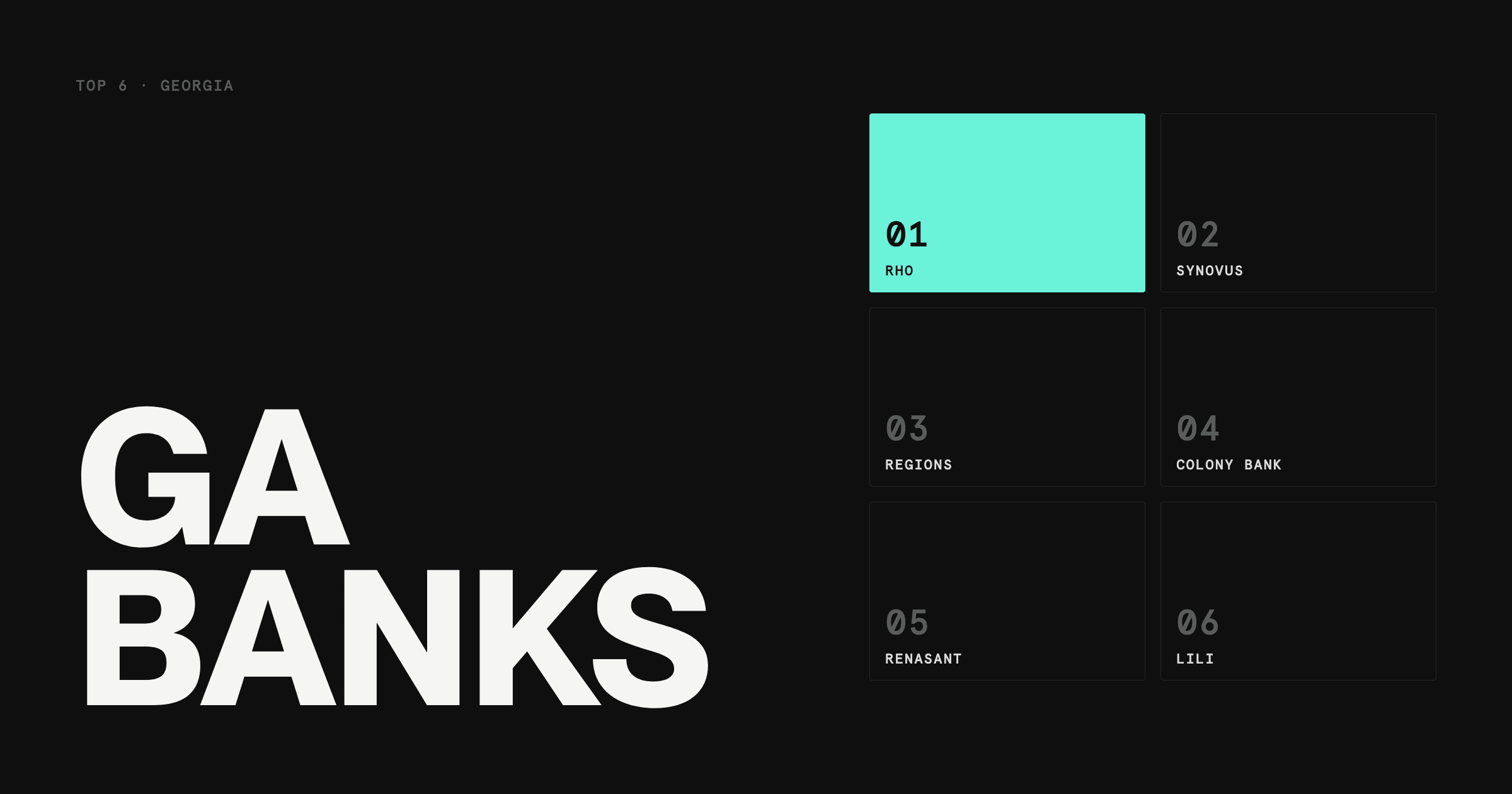
Rho earns the top position for funded founders who need more than a place to park cash. The account charges $0 monthly, $0 for domestic wires, and $0 for ACH, with same-day settlement and pre-EIN onboarding. Corporate cards, bill pay, expense management, and native accounting integrations are included at no additional cost.
1. Rho - Best All-in-One Free Business Checking for Startups and Scale-Ups
Rho is built for the moment after you raise: free business checking alongside corporate cards, bill pay, expense management, treasury, and accounting integrations, all in one platform. No subscription fees, no nickel-and-diming, and real human support set it apart from pure fintechs. It is optimized for venture-backed startups and growth-stage companies, though, so a solo freelancer or micro-business may find the feature depth more than they actually need.
2. Mercury - Best Free Checking for Early-Stage Tech Startups Wanting Simplicity
Mercury has become a go-to for early-stage founders who want a clean, API-friendly checking account with no monthly fees and free domestic wires. Its minimalist dashboard and tight integrations with tools like Stripe and QuickBooks make it a strong fit for lean teams, at least until the team stops being lean.
Mercury lacks the full-stack spend management and bill pay depth that fast-scaling companies eventually outgrow, which makes it a better starting point than a long-term home.
3. QuickBooks Checking - Best Free Account for Businesses Already Inside the Intuit Ecosystem
QuickBooks Checking earns its place for small businesses already running QuickBooks. Cash flow insights, instant deposit access, and an Envelopes feature paying 5.00% APY on set-aside balances (the everyday checking balance itself earns nothing) are genuinely compelling for zero monthly fees, and the native sync erases manual reconciliation headaches.
Step outside the QuickBooks ecosystem, though, and the incremental value drops fast: the account has no treasury or corporate card depth for companies that are growing past a single tool.
4. U.S. Bank Business Essentials Checking - Best Free Traditional Bank Account for Established Small Businesses
Who is U.S. Bank's entry-level Business Essentials Checking built for? Established Main Street businesses that want FDIC-backed stability and a real physical branch network. It carries no monthly maintenance fee, and pairing digital banking with in-person service is a genuine advantage for businesses that handle cash. Transaction limits kick in quickly, though, and outgoing domestic wire fees run $30 to $50 depending on channel, with no fee-free tier at any level.
5. Wells Fargo Initiate Business Checking - Best Free Entry Account for High-Cash-Volume Retail Businesses
Wire fees run expensive at Wells Fargo's standard tier, and the digital experience lags behind fintech competitors built for remote teams that need real-time spend visibility. Where the Initiate account wins is cash handling: it waives its monthly fee at a low minimum daily balance, offers generous cash deposit allowances, and pairs nationwide branch density with established merchant services integrations, genuinely useful for retail and restaurant operators moving physical cash every day.
6. Bank of America Business Advantage Fundamentals - Best Free Checking for Businesses Wanting Rewards Ecosystem Access
Bank of America's Business Advantage Fundamentals account plugs businesses into the Preferred Rewards for Business program, which can meaningfully cut fees and boost interest rates across BofA products as balances grow, provided you can clear the $5,000 minimum balance the fee waiver requires. Below that threshold, the account adds little value. Above it, particularly for businesses that already bank personally with BofA or carry significant deposits, it's a strong pick.
7. Brex Business Account - Best Free Checking for High-Growth Companies Prioritizing Global Payments
Brex's business account pairs free checking with zero-fee domestic and international wires, a standout for companies with frequent cross-border payment needs, and its tight integration with Brex corporate cards and spend management software creates a unified financial stack for fast-moving teams.
Where it falls short: Brex has shifted focus toward larger, venture-backed companies and has offboarded smaller businesses before, making it a less reliable long-term home for pre-revenue or bootstrapped startups.
Which Free Business Checking Account Is Right for Your Situation?
Not all free business checking accounts are built for the same founder. The account that saves a cash-heavy startup thousands in wire fees will actively frustrate a Shopify seller who reconciles daily, and vice versa.
Matching your primary constraint to the right account is the sharpest move you can make on day one, but only if you know what each account is actually optimized for.
Bluevine - Best for Earning Interest on Idle Cash
Bluevine Business Checking is the most-cited pick for founders who want their operating cash to earn yield without a monthly fee. Standard-plan customers earn 1.3% APY (as of 08/11/2026) by spending $500 per month on the Bluevine debit card or receiving $2,500 per month in customer payments; a month that misses both earns 0.00% APY.
The interest rate is a performance-gated feature: you earn it only when you clear specific spend or deposit thresholds each month. A founder who opens the account for the yield, then misses a slow month's spend requirement, earns nothing on that idle cash that month.
Bluevine's yield is a conditional benefit dressed as a standard one. It pays off only when your business consistently clears the qualifying thresholds every month, not just at launch.
Mercury - The Only Truly $0 International Wire Option
For a best account for LLC or C-Corp sending regular international payments, the wire fee structure is the only number that matters. Many popular free accounts charge $15 to $25 per outgoing international wire. At 10 contractor payments a month, that is $250 in fees on an account marketed as free.
Mercury charges $0 on domestic wires and $0 on international USD wire transfers, against the per-transfer fees most other accounts in this comparison charge. Founders paying overseas vendors or contractors in USD carry no wire costs at all.
The math on even moderate international wire volume makes Mercury the clear winner here, especially for YC-backed SaaS founders or distributed teams paying contractors across borders every month.
Novo - Best Native Integrations for E-Commerce and Freelance Work
Novo is purpose-built for the e-commerce business checking use case. Its native integrations with Stripe and Shopify surface real-time balance visibility directly inside the banking dashboard, so a Shopify seller reconciling daily doesn't need to toggle between three tools just to understand cash position.
Novo also offers reserve envelopes, letting founders set aside funds for taxes or inventory without opening a separate account.
That workflow specificity is exactly why Novo wins for this cohort. And it is exactly why it loses for everyone else. It offers no meaningful yield on deposits, no free international wires, and no branch access.
U.S. Bank Business Essentials - Best for Physical Branches and Cash Deposits
Online-only accounts route cash deposits through third-party retail networks, passing that fee straight to the customer. U.S. Bank Business Essentials skips it entirely, offering in-branch cash deposits across a large physical footprint, the pragmatic pick for founders in retail, food service, or any cash-adjacent business.
It solves exactly one problem, and solves it well. Don't expect meaningful yield, free international wires, or a feature set that scales with a venture-backed company, because none of those are on offer here.
A less-obvious version of this problem: local credit unions sometimes surface as a no-fee alternative, but their technology stack frequently cannot support the workflows a growing startup depends on, things like clean accounting integrations, after-hours card controls, or automated AP routing. The branch access is real; the operational functionality is often not.
The One Constraint None of These Accounts Solve
Each account above is a specialist. The moment a startup needs interest on idle cash AND free international wires AND native e-commerce integrations AND branch access, none of these accounts deliver. Founders who have outgrown their original account describe the migration as genuinely painful: re-issuing cards, re-linking payroll and vendor payments, and re-training the team.
Platform security and institutional backing are table stakes, not marketing copy. Rho's checking account is provided by Webster Bank, a division of Santander Bank, N.A., a well-capitalized, FDIC-member institution.
Most founders start with the right specialist account for their day-one constraint, then face a forced migration the moment the business adds a second financial need. The better question is which platform handles the second and third constraint without switching accounts.
Rho is built around that question. It's a single unified platform, $0 monthly fee, $0 per-user fee, connecting corporate cards, expense management, bill pay with AP automation, and invoicing under one login, integrated natively with QuickBooks Online, NetSuite, Sage Intacct, Xero, Campfire, and Puzzle.
That matters most for founders who've been burned before.
For anyone who has dealt with a brokerage-based business account that doesn't connect cleanly to Plaid or a payroll provider, Rho's native accounting integrations sync transactions, receipts, and expense data automatically to the ledger. No CSV exports. No broken connections. No manual reconciliation at month-end.
The invoicing piece closes a gap that specialist accounts leave open. Rho includes basic invoicing at $0, giving founders accounts-receivable visibility alongside their banking.
For a founder paying vendors and collecting from customers at the same time, having both AP and AR in one platform, already wired into the accounting integration, removes coordination overhead that would otherwise require a separate tool.
Founders who need yield on idle cash can access Rho Treasury directly from the same platform. Rho Treasury is a separate RIA product; it is not FDIC insured, and a management fee of 15–60 basis points annually applies.
Eligible securities include U.S. Treasury Bills and mutual fund options; redemptions typically settle within 2-3 business days, and access requires a $50,000 minimum investment. The yield question and the banking question don't require two different logins or two different relationships.
Getting started is fast by design. Accounts open in minutes, cards are issued immediately with no minimum balance required, and Rho supports pre-EIN onboarding, so founders coming out of Stripe Atlas or Clerky can open an account while incorporation paperwork is still in transit.
Transacting goes live the moment the EIN lands. That matters most when the priority is getting back to building, not managing banking logistics.
Why Scaling Startups Eventually Outgrow Most Free Checking Accounts, and How to Pick One You Won't
The account you open on day one becomes the account your payroll processor, your bill pay workflow, your corporate cards, and your accounting software all route through.
By the time a startup hires its second employee or closes a seed round, that account has stopped being a passive container for cash. It's load-bearing infrastructure, and the cost of replacing it mid-growth is rarely measured in dollars per statement.
Why Most Free Business Checking Accounts Are Built for Solo Operators, Not Startups
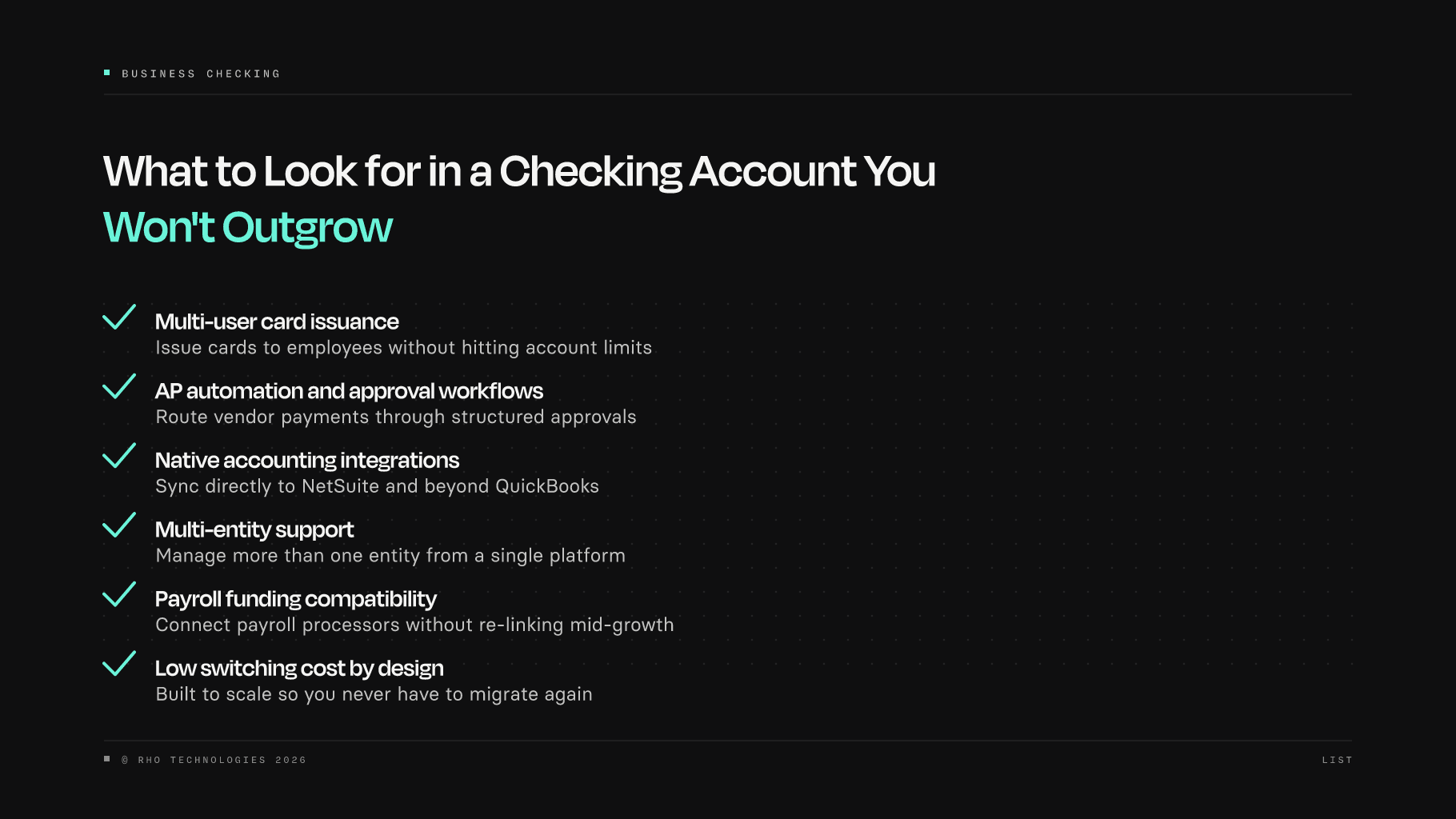
Most free business checking accounts were designed for a solo operator sending a handful of ACH payments each month. That becomes a problem the moment a startup needs to issue cards to five employees, route vendor payments through an approval workflow, or sync transactions directly to NetSuite.
Free accounts built for freelancers or sole proprietors hit scaling walls quickly: no multi-entity support, no native accounting integrations beyond QuickBooks, no AP automation. The account that felt frictionless at month one starts generating friction at month seven.
The Real Cost of Switching Business Checking Accounts Mid-Growth
Switching business banking mid-growth is not a one-afternoon task. It means re-issuing every corporate card, re-linking payroll funding, updating vendor payment details, and re-connecting every accounting integration, all while the finance team is already stretched.
The cost is weeks of operational drag paid in founder hours and team attention.
Five Signs a Free Business Checking Account Is Built to Scale With You
The breaking point for most popular free accounts is an integration ceiling, not a monthly fee appearing on a statement. Across the market, the scale-readiness signals worth checking are same-day ACH, $0 domestic wires, multi-entity support, native ERP integrations, and pre-EIN onboarding.
An account that clears all five is built for where the company is going. One that clears two or three will eventually force a migration, usually at the worst possible moment.
When Free Business Checking Accounts Hit an Integration Ceiling
The critical difference between accounts that scale and accounts that stall is the integration ceiling, not the fee schedule. Accounts like Bluevine and Novo hit their wall not when fees appear, but when a scaling startup needs multi-entity support, native AP automation, or ERP-level accounting integration.
At that point, the finance team is stuck choosing between a patchwork of third-party connectors or a full migration.
When a Free Business Checking Account Supports Pre-EIN Onboarding
The window between incorporation and EIN issuance can stretch days or weeks. A startup that can't open a bank account during that window loses the ability to accept its first wire, fund payroll, or receive investor capital on schedule.
Accounts that require a validated EIN before onboarding force founders into a holding pattern at exactly the moment momentum matters most.
The real scale-readiness signal is whether the account lets the company start operating on day one, before the federal paperwork clears, so the first dollar in and the first dollar out both flow through infrastructure the team will still be using at Series A.
How to Open a Free Business Checking Account - Documents, Steps, and What to Expect
Most founders clear the application without friction. The delay hits later, after the confirmation email arrives, when they try to actually move money and discover the account is open in name only.
"New business owners (e.g., after forming a corporation) are unsure which bank or account type to choose when opening a business checking account for the first time."
The Document Checklist Every Founder Needs Before Hitting Apply
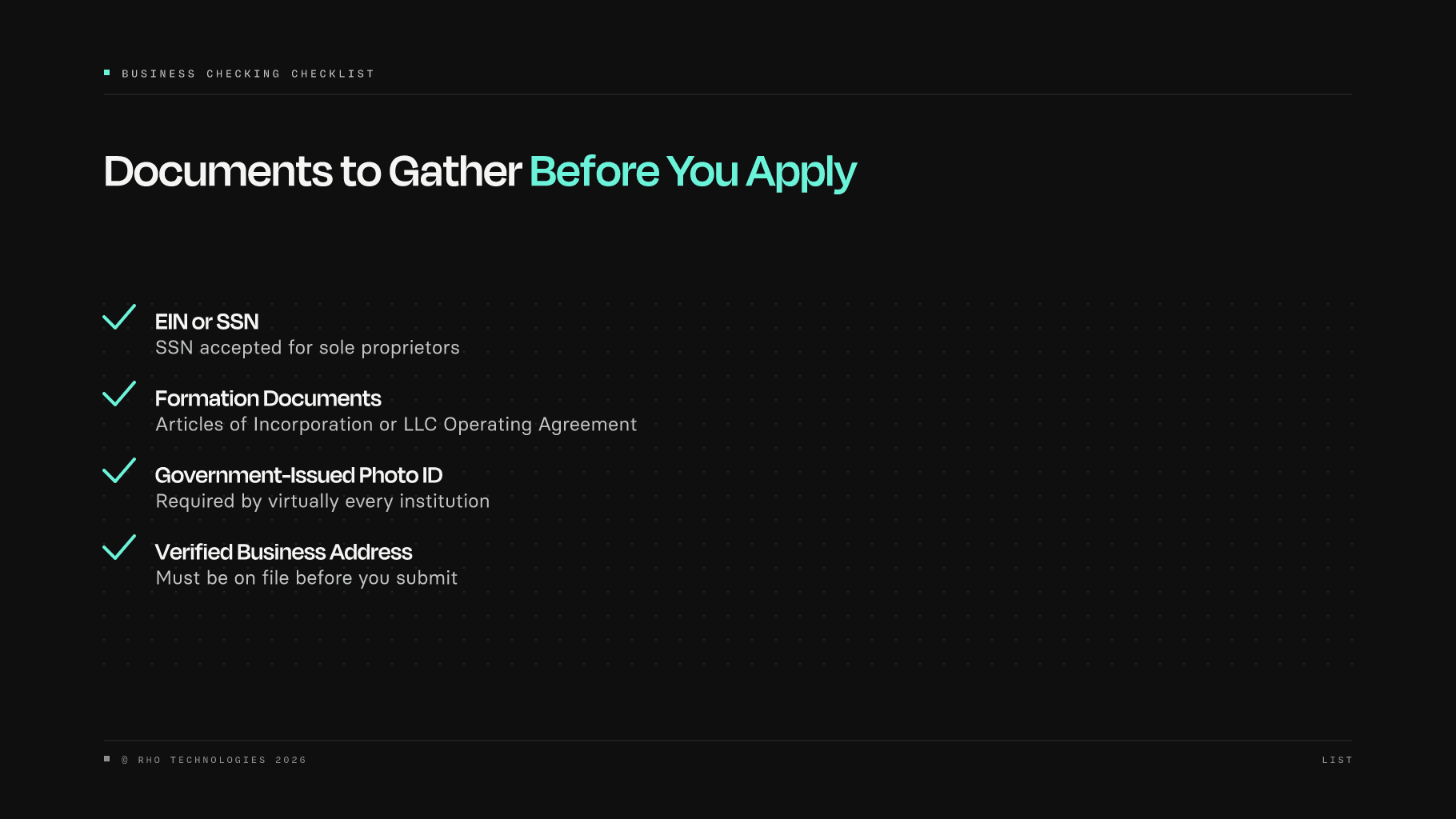
Gather these before you start: your EIN (or SSN if you're a sole proprietor), formation documents such as Articles of Incorporation or an LLC Operating Agreement, a government-issued photo ID, and a verified business address.
These are the standard requirements across virtually every institution. Missing even one document mid-application forces a restart at most banks, so have the full set ready before you click apply.
Pre-EIN Onboarding - Why Waiting for Incorporation Paperwork Costs You Time
IRS processing times for EIN applications can run several weeks when filed by mail, and even online applications occasionally hit delays. According to Stripe, mail submissions typically take about four weeks to process.
Waiting for that number before opening an account means your first vendor invoice goes unpaid and your payroll setup stalls. Some platforms support pre-EIN onboarding instead, letting founders open an account while incorporation paperwork is still in transit and transact once the EIN is issued and attached.
The Secondary-Approval Trap - When Open Does Not Mean Operational
A common pattern among new founders is discovering that the account is technically open but cards are pending activation, ACH transfers require a separate verification step, and wire access sits behind an additional review queue. That queue does not care that payroll runs tomorrow.
The account that was approved in 45 minutes can still leave you unable to move a dollar for 72 hours. Business banks for startups close this gap by making ACH, wires, and card issuance available immediately upon approval, staged behind no secondary queues.
Speed is a trade-off here, not a free win. Founders who prioritize application speed are making a consequential choice, one they rarely recognize as a choice at all.
Next steps
If your operating account looks free on the homepage but charges $25 per outgoing wire and gates its best yield behind monthly spend triggers you miss half the time, the path forward starts with treating the monthly fee as table stakes rather than the finish line. Start with our business bank for startups.
Many accounts' $0 wire fee is a domestic-only guarantee, so one international payment breaks the promise. Bluevine's APY is a conditional feature disguised as a standard one: a founder who opened the account specifically for the yield may never actually earn it.
And across Bluevine, Novo, and Mercury alike, the account you open at incorporation hits a hard ceiling, not when a monthly fee appears, but when your team needs multi-entity support, native AP automation, or ERP-level accounting integrations. That forces a disruptive migration at precisely the moment the company is least able to absorb it.
Those three constraints together point to opening an account that passes all four tests simultaneously, $0 monthly, $0 ACH, $0 domestic wires, no minimum-balance trigger, and that carries the integration depth to stay non-disruptive through Series B.
Start with business bank for startups to see how Rho handles checking, corporate cards, bill pay, and accounting integrations under one login at $0 monthly.
From there, accounts open in minutes with pre-EIN onboarding available, cards issue immediately, and same-day ACH activates on transfers initiated before 2 p.m. The infrastructure you set up at incorporation is the same infrastructure your controller inherits at scale.
FAQs
The real costs live in wire fees ($25–$40 per outgoing domestic wire at traditional banks), minimum-balance triggers that activate a monthly fee the moment a slow month hits, per-item charges once you exceed a transaction cap, and cash deposit surcharges passed through from third-party retail networks. A founder sending just 12 domestic wires in a quarter can spend $300 in fees on an account they believe is free.
According to the post, a truly free account must pass four tests at the same time: $0 monthly fee, $0 ACH transfers, $0 domestic wires, and no minimum balance requirement. Most accounts pass one or two of these, very few pass all four.
Some free accounts do offer yield, but it is typically performance-gated rather than automatic. For example, Bluevine's APY is only earned when you clear specific monthly card spend or deposit thresholds, miss a slow month and you earn nothing on that idle cash. Rho also gives founders access to Rho Treasury from the same platform for earning yield on idle cash above the $50,000 minimum investment, though that product is a separate RIA, is not FDIC insured, and carries a management fee.
Yes, several accounts in the post, including Rho, carry a $0 minimum balance requirement with no conditions attached. By contrast, Bank of America Business Advantage Fundamentals charges a $16 monthly fee unless you maintain a $5,000 average monthly balance or spend $500 per month on a linked business card, making it a conditional rather than truly free account.
Rho is built for exactly this use case, it charges $0 monthly, $0 for domestic wires, and $0 for ACH, with same-day ACH on transfers initiated before 2 p.m., and it includes corporate cards, bill pay with AP automation, expense management, basic invoicing, and native integrations with QuickBooks, NetSuite, Sage Intacct, Xero, Campfire, and Puzzle, all under one login with no subscription fee.