
Rho is the best business bank account for LLC owners in 2026: no monthly fee, no per-user fee, no minimum balance, and support for pre-EIN onboarding so you are not stuck waiting on your EIN to open an account. The wrong business bank account won't just cost you fees. It can quietly erase the liability protection your LLC was built to provide.
The common assumption among early-stage founders is that choosing a business bank account is a simple, reversible admin decision: just pick the one with $0 fees and a decent app, then upgrade later if needed. An LLC gives you something genuinely valuable: a legal wall between your personal assets and your business obligations. Most founders understand that in theory. What they underestimate is how easily that wall comes down, and how quietly the damage happens before anyone notices. See our business bank for startups for how this works in practice.
A separate business bank account is the primary evidence a court uses to confirm that your LLC operates as a real, independent entity. Commingling personal and business funds is one of the most common grounds courts examine when deciding whether to pierce the corporate veil and hold LLC members personally liable for business debts. The Pennsylvania Supreme Court went further, adopting an "enterprise" theory that lets courts look across an entire group of commonly owned entities, not just a single account, when formalities are not maintained.
Rho is a fintech company, not a bank or an FDIC-insured depository institution. Checking and card services provided by Webster Bank, a division of Santander Bank, N.A., member FDIC, and by Lead Bank, Member FDIC; savings account services provided by American Deposit Management Co. and its partner banks.
That ruling matters for any founder with more than one business interest. One sloppy transaction does not automatically destroy your protection, but a pattern of them builds a case that opposing counsel will use. The moment a personal expense runs through a business account, or a business payment runs through a personal one, the separation the LLC was built on starts to erode.
Courts have ruled against founders for patterns as routine as a single utility bill paid from the wrong account. The liability that follows is concrete: personal savings, a personal vehicle, or a personal home can become fair targets for a business creditor.
Investors conducting due diligence treat a dedicated business account as table stakes, not a nice-to-have.
Separating your LLC's finances isn't just tidy bookkeeping; it's the mechanism that keeps your personal assets behind the legal wall your LLC was designed to create.
Most business bank account rankings are written for the median founder, which means they're useful for no one in particular; the same account can't be the right answer for a solo operator and a seed-stage startup with payroll.
The four documents every bank requires to open an LLC account are your EIN, Articles of Organization, Operating Agreement, and a government-issued ID for any owner holding 25% or more.
The account that takes twenty minutes to open often takes six months to outgrow; limited sub-accounts, slow card issuance, and CSV-only exports are the first signs you've already hit the ceiling.
A single checking account quietly becomes a six-tool patchwork the moment a second employee joins; most founders don't notice until the duct tape is already load-bearing.
Rho consolidates banking, corporate cards, bill pay, expenses, treasury, and accounting into one platform with no subscription fees and human support, built to hold up from day one through the point where switching would actually cost you something.
What to Look for in an LLC Business Bank Account - Before You Touch a Single Ranking List
Most LLC owners start with a ranking list and work backward. That's how you end up with an account built for someone else's business.
Here's a better order of operations.
This section walks through how to structure your evaluation before you compare a single feature, starting with the one structural question that eliminates half the field before fees or perks even enter the conversation.
Evaluate Accounts Before Reading Any Ranking
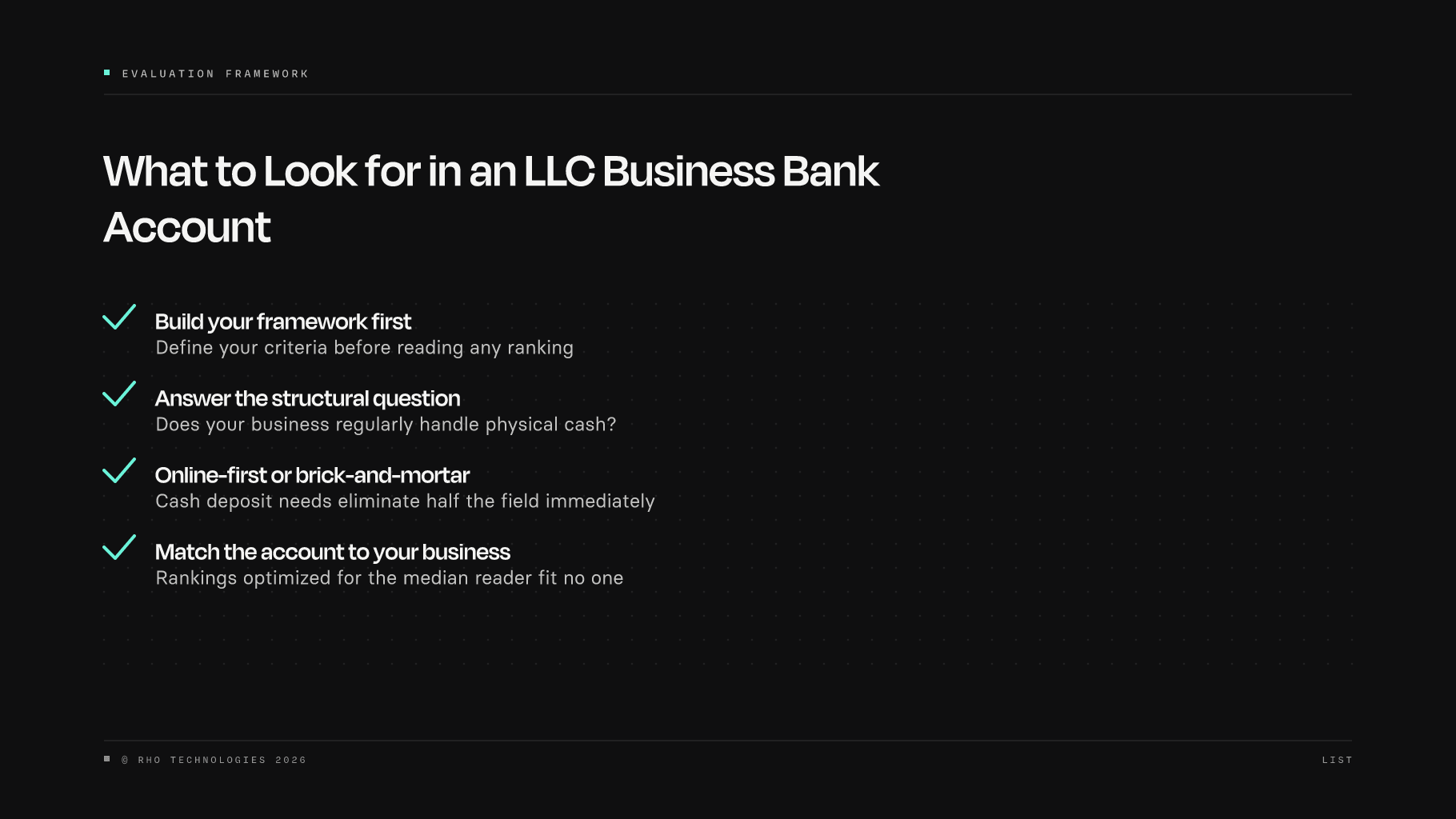
Most rankings are optimized for the median reader, which means they are optimized for no one in particular. A list that crowns the same account for a solo e-commerce operator and a seed-stage startup with three hires and a NetSuite instance is a traffic document. The evaluation framework you build before you touch a ranking determines how useful any ranking can be.
Online-First vs. Brick-and-Mortar
The common assumption is that choosing a business bank account is a simple, reversible admin decision: pick the one with $0 fees and a decent app, then upgrade later if needed.
Before comparing fees or features, answer one structural question: does your business regularly handle physical cash?
If yes, you need a brick-and-mortar institution or an online bank with a verified cash deposit network. If no, an online-first account will almost always give you faster card issuance, cleaner integrations, and lower fees. If your business handles cash or needs a branch, see our guide to the best banks for small business, by business type.
This single axis eliminates half the field before you read a single feature comparison.
Monthly Fees Across Top LLC Accounts
Most online banks charge $0 in monthly fees for LLC business checking. Chase Business Complete Banking is the exception.
According to Chase's own published account terms, the fee is $15 a month, waivable only by maintaining a minimum daily balance of $2,000, making qualifying deposits through Chase QuickAccept, or linking a Chase Private Client Checking account.
For an early-stage LLC with variable cash flow, that $2,000 minimum is a quiet liquidity trap.
Cash Deposit Support Is the Silent Dealbreaker
Most online-first banks do not support cash deposits at all. Bluevine supports cash deposits through the Green Dot retail network, though per-deposit fees apply and location availability varies. If your LLC collects cash at any point in operations, confirm deposit support before you apply, not after.
The 8 Best Business Bank Accounts for LLCs in 2026 - Ranked by What Founders Actually Need
Six months is usually how long it takes for a convenient early choice to become an operational liability.
The account that cleared signup in minutes, carried no monthly fee, and deposited a welcome bonus cannot issue a card to a new hire without a five-day wait.
It cannot hold tax reserves in a sub-account separate from operating cash, either, and it exports to your accounting software only as a CSV that someone has to scrub by hand before the numbers are usable.
None of that was visible at signup. It rarely is.
That is a financial migration event, arriving at exactly the moment you can least afford to stop and rebuild.
The deeper problem starts even earlier, before the migration event, in the moment you chose the account.
Here's the trap.
The "free" business bank account is a liquidity trap disguised as a cost advantage. Accounts that advertise $0 fees either impose hidden minimum balance requirements that lock up working capital, like Chase's $2,000 daily balance to waive its $15/month fee.
Or they condition their advertised yields on behavioral thresholds founders rarely track, like Bluevine's APY requirement tied to monthly spend or deposit minimums.
The true cost of a "free" account is measured not in fees paid but in capital immobilized or yield forfeited, a drag that compounds invisibly as the LLC scales.
Choosing a banking setup without accounting for those hidden constraints is a slow tax on growth that never appears as a line item.
$2,000: Daily balance needed to waive Chase's fee
The eight accounts below are ranked against five criteria that predict whether a banking setup will still work at 10x your current scale:
Monthly fee structure
Card issuance speed
Sub-account flexibility
Accounting integrations
Yield or treasury access
Each entry includes the one real tradeoff that matters to a growing LLC, because an honest shortlist is more useful than a polished one.
1. Rho - Best All-in-One Banking Platform for Startups and Scale-Ups
Most founders get the appeal of starting with a free, simple checking account and bolting on tools later.
The cost shows up later: hours spent reconciling four disconnected platforms, chasing receipts across three card programs, and rebuilding the financial stack the moment headcount or transaction volume crosses a threshold.
Rho is built to skip that rebuild entirely.
Banking, corporate cards, bill pay, expense management, treasury, and accounting integrations live in a single platform at $0 monthly and per-user fees, with real human support that responds in under a minute, 24/7.
The infrastructure that works on day one still works at Series B, without a migration event in between. Most beneficial when a company needs a fast, scalable banking setup without the overhead of stitching together separate tools as headcount grows.
2. Mercury - Best Digital-First Bank for Early-Stage Tech LLCs
Mercury earns documented loyalty among early-stage tech founders. It consistently ranks among the top-chosen accounts in founder community surveys, for its clean interface, multi-user role management, and no monthly fees.
Mercury also extends FDIC coverage significantly above the standard limit through its partner bank sweep network, which matters once you are holding raised capital.
The real limitation surfaces the moment you need more than banking.
AP automation, expense management, and treasury access all require separate tools bolted on afterward, so the reconciliation burden grows right alongside your team.
Mercury suits founders who want a well-designed digital bank first and don't mind stitching a finance stack around it.
3. Relay - Best Business Checking for Cash-Flow-Conscious LLC Owners
Relay allows up to 20 individual checking sub-accounts and 50 virtual cards per account on its Starter and Grow plans, making it the most practical option for founders running a Profit First cash allocation system.
It works just as well for anyone who needs to separate operating funds, tax reserves, and payroll into distinct buckets without a spreadsheet. There is no monthly fee on the standard plan.
Where it narrows is scope: Relay is a cash management tool, not a finance platform.
Card rewards run through the invitation-only Relay Visa Credit Card, bill-payment automation requires the $90/month Scale plan (as of 08/11/2026), and accounting integrations do not go much deeper than a bank feed.
Ideal for multi-member LLCs that prioritize cash-flow discipline over consolidated workflows.
4. Grasshopper Bank - Best FDIC-Insured Bank Built Specifically for Startups
Grasshopper is a federally chartered bank built for startups and small businesses, which means it carries the regulatory credibility of a traditional institution while operating entirely online.
It offers cashback on debit purchases and no monthly maintenance fees, a rare combination at the bank level rather than the fintech level.
What's missing is depth, not credibility.
Grasshopper does not offer the AP automation, expense management depth, or treasury access that a scaling startup eventually needs.
It works best for founders drawn to a regulated bank charter and a clean digital experience, provided they're willing to add spend management tools on their own.
5. Airwallex - Best Business Account for LLCs with Global Operations
Airwallex is purpose-built for businesses that move money across borders regularly. It supports multi-currency accounts, local collection accounts in major markets, and competitive foreign exchange rates without the markup that traditional banks layer on.
For an LLC that pays international contractors, collects revenue in multiple currencies, or operates across markets, Airwallex removes friction that standard business checking accounts were never designed to handle.
So where does it fall short domestically?
If your operations are primarily US-based, Airwallex's domestic banking features are thinner than dedicated US-first platforms, and you will likely need a separate account for day-to-day operating cash.
6. Chase Business Complete Banking - Best Traditional Bank Option for LLCs Needing Branch Access
Chase Business Complete Banking® carries the largest branch and ATM network in the country, built-in credit card processing, and the brand credibility that some vendor and landlord relationships still require.
The fee structure is straightforward: $15 a month, waivable by maintaining a $2,000 minimum daily balance or meeting qualifying activity thresholds, according to Chase's published account terms.
That balance requirement is the real constraint for early-stage LLCs, since the same figure sitting in idle cash is working capital that earns nothing.
For founders who need in-person banking, cash deposit capability, or a recognizable institution name on their account, Chase is the honest answer. For founders optimizing for yield, card issuance speed, or accounting automation, it is not.
7. Bluevine - Best High-Yield Checking Account for Revenue-Generating LLCs
Bluevine Business Checking's Standard plan earns 1.3% APY on balances up to $250,000 with no monthly fee, but the yield is conditional.
According to Bluevine's published account terms, you must either spend $500 per month on the Bluevine Business Debit Mastercard or receive $2,500 per month in qualifying deposits to unlock it. Passive account holders earn nothing.
There's a higher tier, too.
The Premier plan earns 3.0% APY on all balances; its $95 monthly fee is waived by maintaining a combined $100,000 balance across checking and sub-accounts, or by spending $5,000 per month on the Bluevine Business Debit Mastercard.
3.0% APY: Bluevine Premier yield on all balances
This structure illustrates the core problem with "free" account marketing: yield is behavioral, not automatic. Founders who do not actively track those thresholds forfeit the return that made the account attractive in the first place.
In other words, the advertised APY is a reward for a specific pattern of use, one most founders never explicitly commit to maintaining.
Revenue-generating LLCs that will reliably hit those activity minimums, and want the highest available yield in a checking account, get the most out of Bluevine.
Update (October 2026): Valley National Bank announced it will acquire Bluevine for $340 million, with the deal expected to close in early 2027. Bluevine will become Valley's small-business banking division; existing accounts aren't expected to change before then.
8. North One - No Longer Accepting New Customers (Site Now Redirects to Relay)
North One is no longer an option for new accounts: as of 08/10/2026, its website (including its help center) redirects to Relay, and it is not accepting new customers.
North One was known for a clean digital banking experience built around its Envelopes budgeting feature, which let owners allocate funds across categories inside a single account.
Service-based businesses, freelancers, and main street LLCs that wanted simple cash segmentation will find the closest current equivalent in Relay's sub-account structure (see #3 above).
Once you have identified the account that fits your LLC's stage and scale trajectory, the next question is practical: what does the bank actually need from you before it will open the door? The answer depends on your entity status, your EIN timeline, and one often-overlooked shortcut that can cut your setup time from weeks to days, covered in the next section.
What Documents Do You Need to Open a Business Bank Account for an LLC?
Getting the document list right before you apply saves you from stalled applications and repeated back-and-forth with compliance teams.
Every bank will ask for the same four core documents, but understanding why each one exists, and where the requirements actually come from, helps you anticipate what happens if something is missing or your ownership structure triggers additional scrutiny.
One group should pay extra attention here.
Non-US resident LLC owners in particular face a layer of KYC friction that goes beyond the standard checklist, and knowing that upfront changes how you choose where to apply.
The Four Documents Every Bank Will Ask For and Why Each One Exists
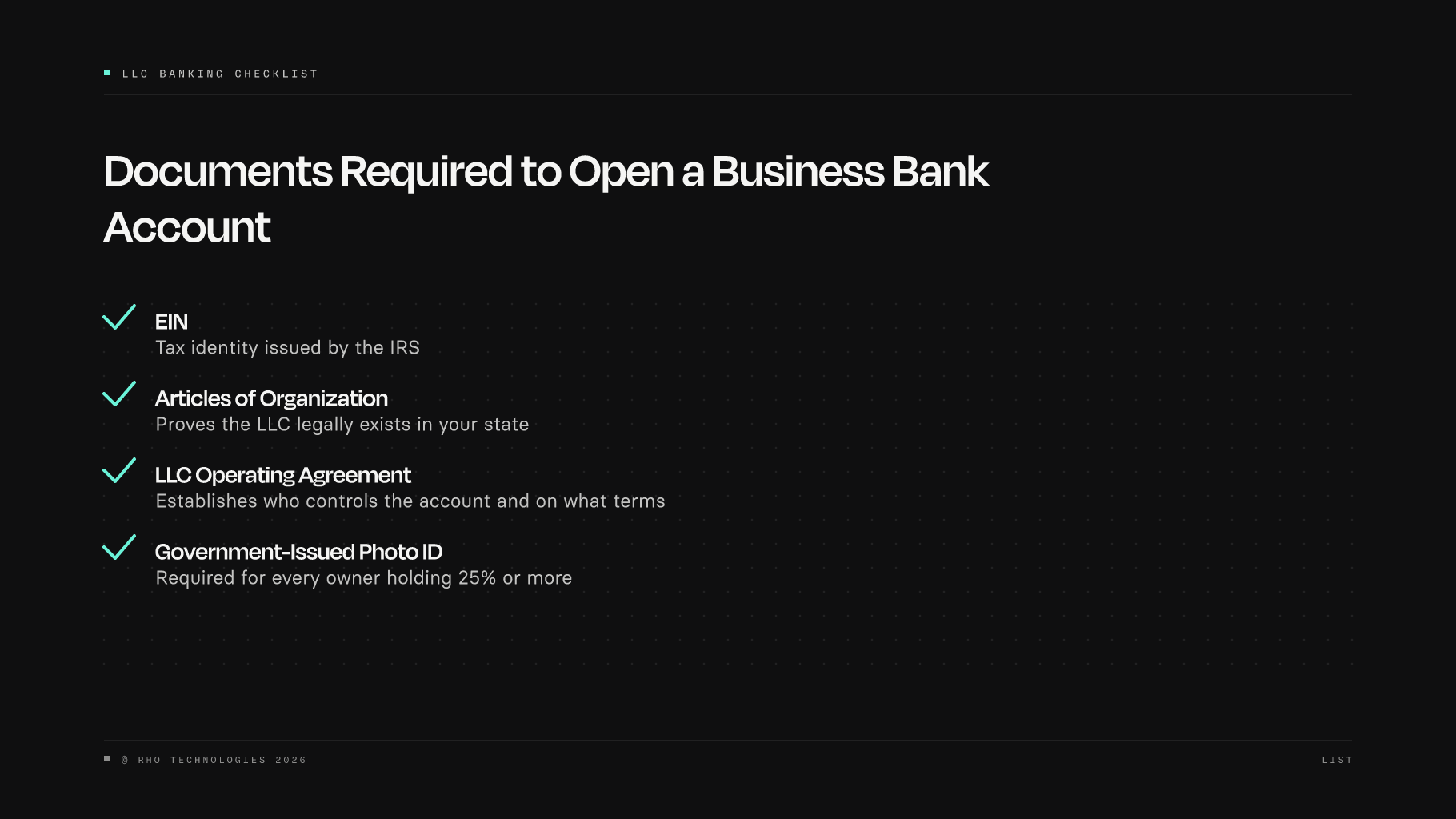
To open a business bank account for an LLC, you need four documents: your EIN (Employer Identification Number), your Articles of Organization, your LLC Operating Agreement, and a government-issued photo ID for every owner holding 25% or more of the company.
Your Articles of Organization prove the LLC legally exists in your state. The EIN, issued by the IRS, is your business's tax identity, required for the bank to report interest income and verify the entity.
The Operating Agreement establishes who controls the account and on what terms. The ID requirement flows directly from the FinCEN Customer Due Diligence Rule, which requires banks to collect and verify identity information for any individual who owns 25% or more of a legal entity.
Miss any one of these four, and the application stalls.
One friction point that catches non-US resident LLC owners off guard: many banks layer additional KYC requirements on top of the four core documents, such as a physical US address, repeated rounds of document requests, or passport re-submissions that have already been provided.
The pattern is a familiar one.
Founders we work with who are non-US residents describe submitting the same document multiple times before an application either advances or quietly dies. Most traditional bank KYC workflows were not designed for foreign-owned US entities.
Choosing a platform built to handle fast, scalable banking setup without legacy bank overhead reduces that friction at the moment it matters most, before you have revenue or operations to lose time to.
SBA lenders, invoice factoring companies, and payment processors evaluate average daily balance history, transaction velocity, and wire infrastructure from the primary business account.
An LLC that spends its first 12–24 months in a $0-fee neobank with no wire rails or lending products arrives at its first capital event with an underwriting profile that reflects the limitations of its platform rather than the strength of its business.
That's a gap that cannot be retroactively filled.
Rho is built for founders who need to open banking and issue cards in minutes without becoming a finance operator.
Rho offers a checking account (member FDIC) and a savings account (provided by American Deposit Management Co. and its partner banks, with expanded FDIC coverage through its network of partner banks).
Corporate cards are issued immediately with no minimum balance required, domestic wires are $0, same-day ACH is $0, and support is available 24/7, responding in under a minute.
Cards are issued immediately after account opening, with no waiting period and no minimum balance gate.
Rho also offers Treasury Bills and mutual fund options through Rho Treasury, with T-Bills settling in 2–3 business days, a $50,000 minimum investment, and a management fee disclosed in the ADV-2A Wrap Fee Brochure; Rho Treasury investments are not deposits and are not FDIC insured.
What You Can and Cannot Do Without an EIN
You cannot open a traditional business bank account without an EIN. Banks use it to satisfy IRS reporting obligations, and no workaround exists at institutions that require it upfront.
That said, the EIN itself is not the slow part. According to the IRS, the online EIN application is free and issues the same day, often within minutes. The real delay is waiting on your state to process your Articles of Organization.
Rho supports pre-EIN onboarding, so founders can open an account and start the setup process before their EIN arrives. The moment the number is issued, the account is ready to fund rather than stuck at step one.
Two shortcuts make this faster still: for companies incorporating through Stripe Atlas, Rho accounts are available directly through the Atlas flow, so founders can open accounts and start using Rho before the EIN arrives, and Clerky users get a one-click pre-fill of the Rho application.
The goal in both cases is the same: get back to building, not paperwork.
How to Open a Business Bank Account for Your LLC - Without Losing a Week to Paperwork
Submitting your application is the easy part. The real clock starts after you hit send, and for most founders, that gap between "submitted" and "first usable card" lands somewhere between two days and two weeks depending entirely on which platform they chose.
EIN acquisition is a major bottleneck for LLC owners, taking 4–8 weeks by fax for non-US residents, making it the single biggest delay before a bank account can even be opened.
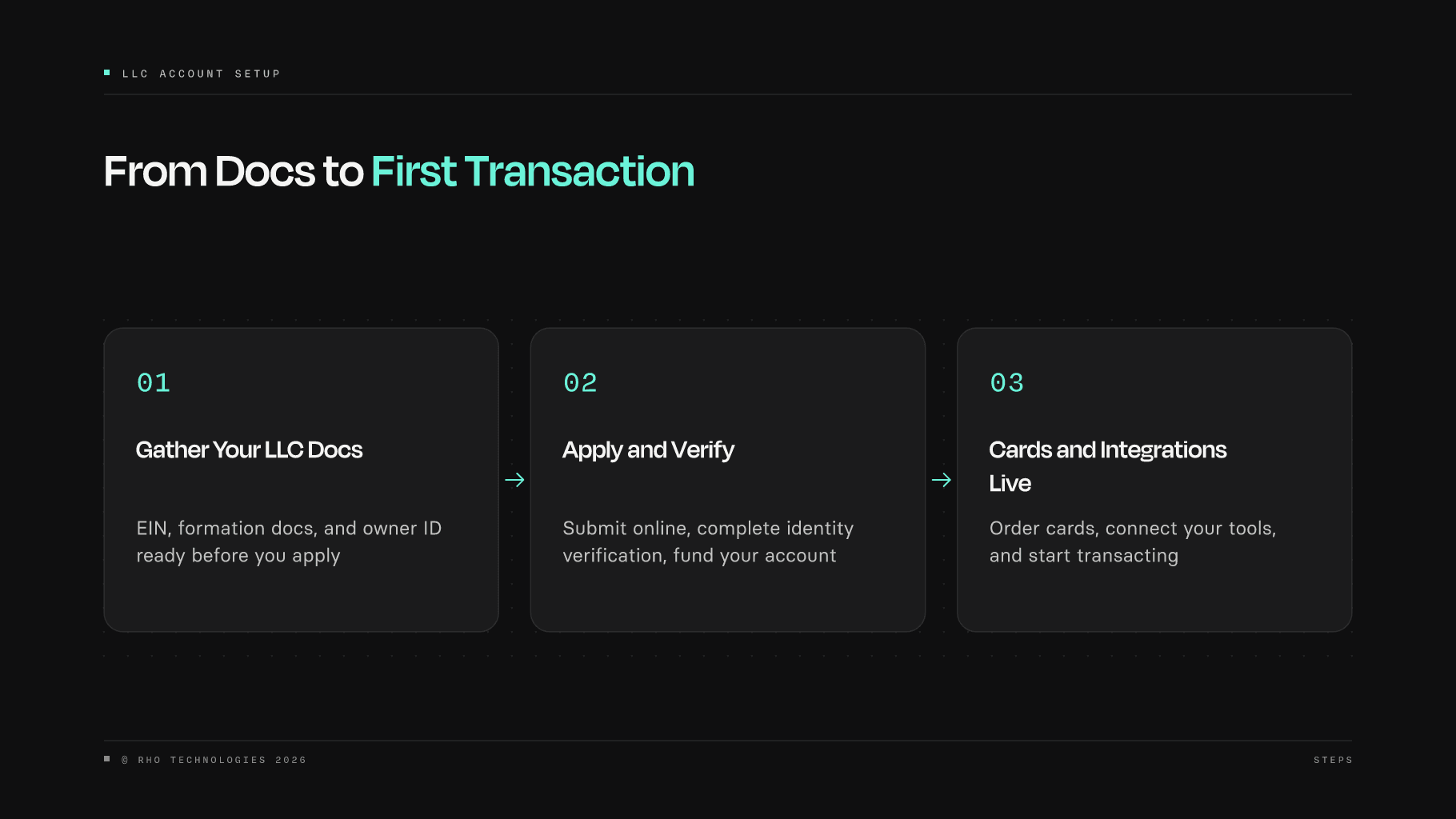
The End-to-End Opening Sequence, Five Steps from LLC Docs to First Transaction
The process follows a fixed path: choose your account type, gather documents, apply online, fund the account, then order cards and connect your tools. Each stage carries its own potential delay.
Here's the part that's on the bank, not the government.
Because the IRS issues an EIN online in minutes at no cost for US residents, every day-long delay a founder experiences after that point is attributable to the bank itself. Platform selection is now the primary determinant of how fast a new business reaches operational readiness.
For non-US resident LLC owners, the EIN bottleneck is real and significant. Fax-based applications can take four to eight weeks, making it the single biggest delay before a bank account can even be opened. That delay is a structural constraint no platform can eliminate, but what happens the moment the EIN arrives is entirely within the platform's control.
Where the Clock Actually Stops - Identity Verification, Deposit Holds, and Card Issuance Delays
Identity verification queues are the single most common stall point. KYC reviews at traditional institutions can sit in a queue for days before a human reviews them.
Add a minimum opening deposit hold, traditional business checking accounts commonly require anywhere from $25 to several hundred dollars to activate, and you have two separate delays stacking before a single transaction clears.
Founders who expected one afternoon of admin often find themselves a week in, with no card and no way to pay for the tools their business needs.
The access problem has also intensified for non-resident founders specifically. Major platforms have tightened onboarding requirements, demanding proof of US operations and a verifiable physical address in ways that effectively close the door on legitimate international business owners before they even reach the KYC queue.
Rho's checking account, provided by Webster Bank, a division of Santander Bank, N.A., member FDIC, is built around removing exactly these stall points. There is no minimum balance required to open or maintain the account, no monthly fee, and no per-user fee.
Corporate cards are issued immediately on approval with no minimum balance requirement, so the gap between "approved" and "first usable card" collapses to the approval decision itself rather than a separate card-issuance queue.
For founders who need to fund payroll, wire vendors, and manage capital without relying on institutions that don't understand their timeline, that compression matters.
Rho also supports pre-EIN onboarding. Founders can open an account before their EIN arrives, which directly addresses the waiting-period problem that strands so many new businesses in limbo. Same-day ACH (for transfers created before 2 p.m. ET under $1M) and $0 domestic wires mean that once the account is live, cash moves on the founder's schedule, not the bank's processing queue.
Online-First vs. Traditional Branch - How the Timeline Gap Became a Competitive Advantage
The gap is structural, not cosmetic. That difference compounds fast when you factor in vendor onboarding, software subscriptions, and payroll. Every day without an active card and a funded operating account is a day the business cannot look or operate like a real company.
Rho's single unified platform tier, $0 subscription fee, $0 per-user fee, no minimum balance for the core platform, means the operational tools scale with headcount and entity count without a proportional increase in finance overhead.
Bill pay, AP automation, basic invoicing, expense management, unlimited reimbursements, and native integrations with QuickBooks Online, Oracle NetSuite, Sage Intacct, and Xero are all included at $0.
A growing base of customers and significant assets under management reflect a platform that has already proven this model at scale.
For founders who need to reach operational readiness fast and stay there as the business grows, platform selection is the decision that determines the timeline.
The Financial Stack Problem - Why the Account You Open Today Might Break Tomorrow
The moment a second employee joins your LLC, the bank account you opened in twenty minutes stops being infrastructure and starts being a liability. Not because the account itself fails, but because everything bolted onto it does.
How a Single Checking Account Quietly Becomes a Six-Tool Patchwork
Picture a solo operator with three vendors and one revenue stream. A basic business checking account and a debit card cover everything, and there's no reason to think about it twice.
Then the business grows.
Each new operational need, a team member who needs a card, a vendor who requires ACH, a bookkeeper who wants clean exports, pulls in a new tool.
Industry data shows that SMBs that start with a basic checking account typically bolt on separate tools for corporate cards, accounts payable automation, and treasury management as transaction volume grows. The result is a multi-platform stack that requires manual reconciliation across every seam.
The Scale-Readiness Threshold
The break doesn't announce itself. It arrives as a question from an investor asking for clean financials, or a payroll run that exposes a cash-flow gap nobody caught because the AP tool and the checking account don't talk to each other in real time.
Growing LLCs face a forced financial infrastructure rebuild the moment they cross scale thresholds around headcount, transaction volume, or capital raised, and that rebuild consumes significant founder time beyond the direct cost of the tools themselves.
What Founders End Up Bolting On, And What It Costs
The pattern is consistent: a basic checking account, then a separate corporate card product, then a bill pay or AP automation tool, then an expense management layer. Each addition solves one problem and creates two new ones: another login, another export format, another reconciliation workflow. The business financial infrastructure that felt lightweight at month one becomes a five-tool coordination problem by month twelve.
Next Steps
If your LLC is still running on a "free" account you picked at incorporation, the path forward starts with recognizing that switching later is not an upgrade; it is a full financial migration that arrives at the worst possible moment. Start with our business bank for startups.
The free account's hidden cost is not a monthly fee. It is capital immobilized by minimum balance requirements, or yield forfeited because you never hit the behavioral thresholds buried in the terms. That drag compounds invisibly as you scale.
There's a second cost stacking on top of it.
The platform you choose in month one quietly sets a ceiling on your future capital access, because SBA lenders and payment processors evaluate your average daily balance history and wire infrastructure, not just your revenue. An underwriting profile shaped by a minimal neobank cannot be retroactively corrected.
Those two dynamics make the same case: the account decision you are making right now is a capital decision, not an admin one, and the cost of getting it wrong is measured in founder-hours and foregone financing, not monthly statements.
Start with Rho. After reviewing the platform, you can open an account, get cards issued immediately with no minimum balance required, and connect your accounting stack the same day, without a migration event waiting for you six months from now.
FAQs
It is a legal necessity, not just good practice. A separate business bank account is the primary evidence a court uses to confirm that your LLC operates as a real, independent entity, and commingling personal and business funds is one of the most common grounds courts examine when deciding whether to pierce the corporate veil and hold LLC members personally liable for business debts. Courts have ruled against founders for patterns as routine as a single utility bill paid from the wrong account, which can expose personal savings, vehicles, or a home to business creditors.
You need four documents: your EIN (Employer Identification Number), your Articles of Organization, your LLC Operating Agreement, and a government-issued photo ID for every owner holding 25% or more of the company. The ID requirement flows directly from the FinCEN Customer Due Diligence Rule, and missing any one of these four will stall your application.
Most online-first banks advertise $0 monthly fees, but the real costs are often hidden in other requirements. Chase Business Complete Banking, for example, charges a $15 monthly fee that is only waivable by maintaining a $2,000 minimum daily balance, locking up working capital that earns nothing. Yield-bearing accounts like Bluevine condition their advertised APY on hitting spending or deposit minimums each month, meaning passive account holders earn nothing. The true cost of a 'free' account is measured in capital immobilized or yield forfeited, not fees paid.
The deciding factor is whether your business regularly handles physical cash. If it does, you need a brick-and-mortar institution or an online bank with a verified cash deposit network, since most online-first banks do not support cash deposits at all. If your LLC does not handle cash, an online-first account will almost always give you faster card issuance, cleaner accounting integrations, and lower or zero fees, and this single axis eliminates half the field before you compare any other features.
The post identifies five scale-readiness criteria that predict whether a banking setup will still work at 10x your current size: monthly fee structure, card issuance speed, sub-account flexibility, accounting integrations, and yield or treasury access. The risk of ignoring these early is a forced financial migration event, switching platforms mid-growth, which arrives at exactly the moment you can least afford to stop and rebuild. An all-in-one platform that covers banking, corporate cards, bill pay, expense management, treasury, and accounting integrations from day one eliminates that rebuild entirely.